

Bonjourhi!
Every institution chooses a symbol. Few ask it to carry an argument. Ours does, and today we publish the book that explains why.
The Nautilus: Coherence Economics and the Logic of Living Systems is a short story told by a nautilus. Born in a room it must one day leave, it crosses a reef that bleaches, a basin whose current fails, and a harbour where a child holds a drawing of its shell against the glass. It grows by sealing the chambers it has outgrown, and those sealed rooms become the lift that bears it forward.
The story comes first, so the reader lives the framework before meeting its terms. A short chapter then names the three laws of Coherence Economics (coherence compounds, decoherence extracts, recoherence recompounds) and the master theorem beneath them: the instruments go first. An afterword sets out what the shell can teach economics, and where the metaphor ends.
At its centre is the question the Institute exists to ask: how a system can keep growing and still see itself clearly.
If it speaks to you, pass it on. The nautilus line has spent nearly half a billion years turning accumulated history into support. We hope this small book does the same for the ideas inside it.
With warm regards,
Pierre Somers
Chief Editor, Bonjourhi Institute, Montreal
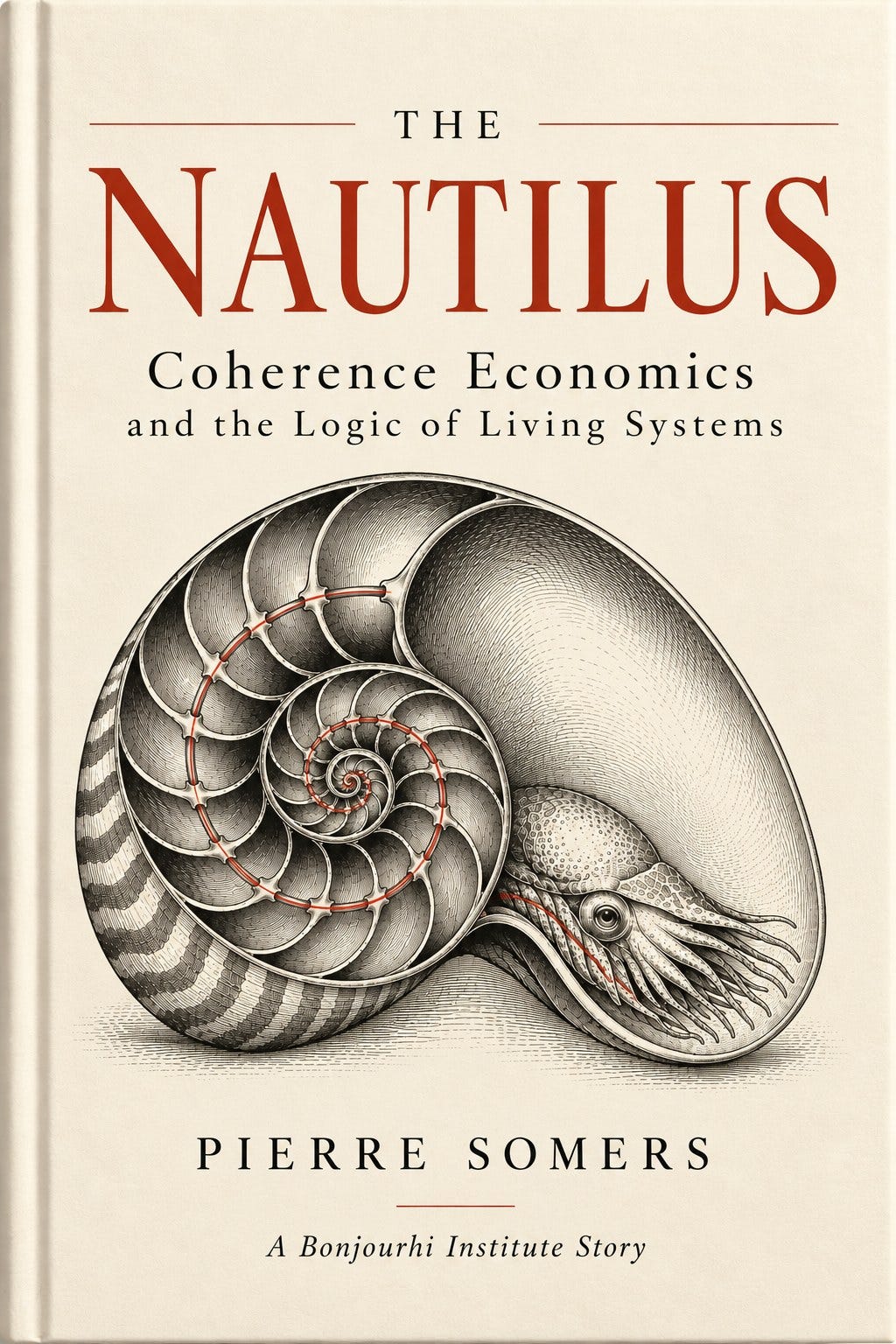

The Nautilus: Coherence Economics and the Logic of Living Systems
Copyright © 2026 Pierre Somers. All rights reserved.
No part of this publication may be reproduced, stored, or transmitted in any form without the prior written permission of the publisher, except for brief quotations in reviews and scholarly works.
Published by Bonjourhi Institute Analytics, Montreal, Quebec, Canada.
First edition, 2026.
Illustrations created with the help of image generators.
Contents
Afterword: The Nautilus and the New Bookshelf
Also from the Bonjourhi Institute
Preface
Why a Nautilus
The Bonjourhi Institute wanted a symbol that does more than decorate. It chose the nautilus because the animal’s shell shows, in plain sight, how a living system grows.
Nautiloids have lived in the oceans for nearly half a billion years, and the modern nautilus is the last survivor of a group that once filled ancient seas. What matters to the Institute is not how long the line has lasted but how each animal grows. It builds a new chamber, seals off the one it has outgrown, and moves forward into the newest. Nothing is thrown away. The past stays inside the shell and helps to carry it.
The shell coils in an approximately logarithmic spiral, each chamber a fixed proportion larger than the one before. It is often said to follow the golden ratio. It does not, and the Institute makes no such claim.
The Institute also reads the chambers as levels of a system. Theory lies at the centre, then states, institutions and the single enterprise, and finally life at the outer edge, where consequences arrive. This book is told from that outer chamber.
The framework’s own diagram is an open infinity symbol, a loop that climbs out instead of closing. The nautilus is the same idea grown in a living body: a spiral that never returns to where it began.
The symbol carries one question, and the rest of this book keeps it open: can a system continue to grow without losing the ability to understand itself?
Part One
The First Ocean
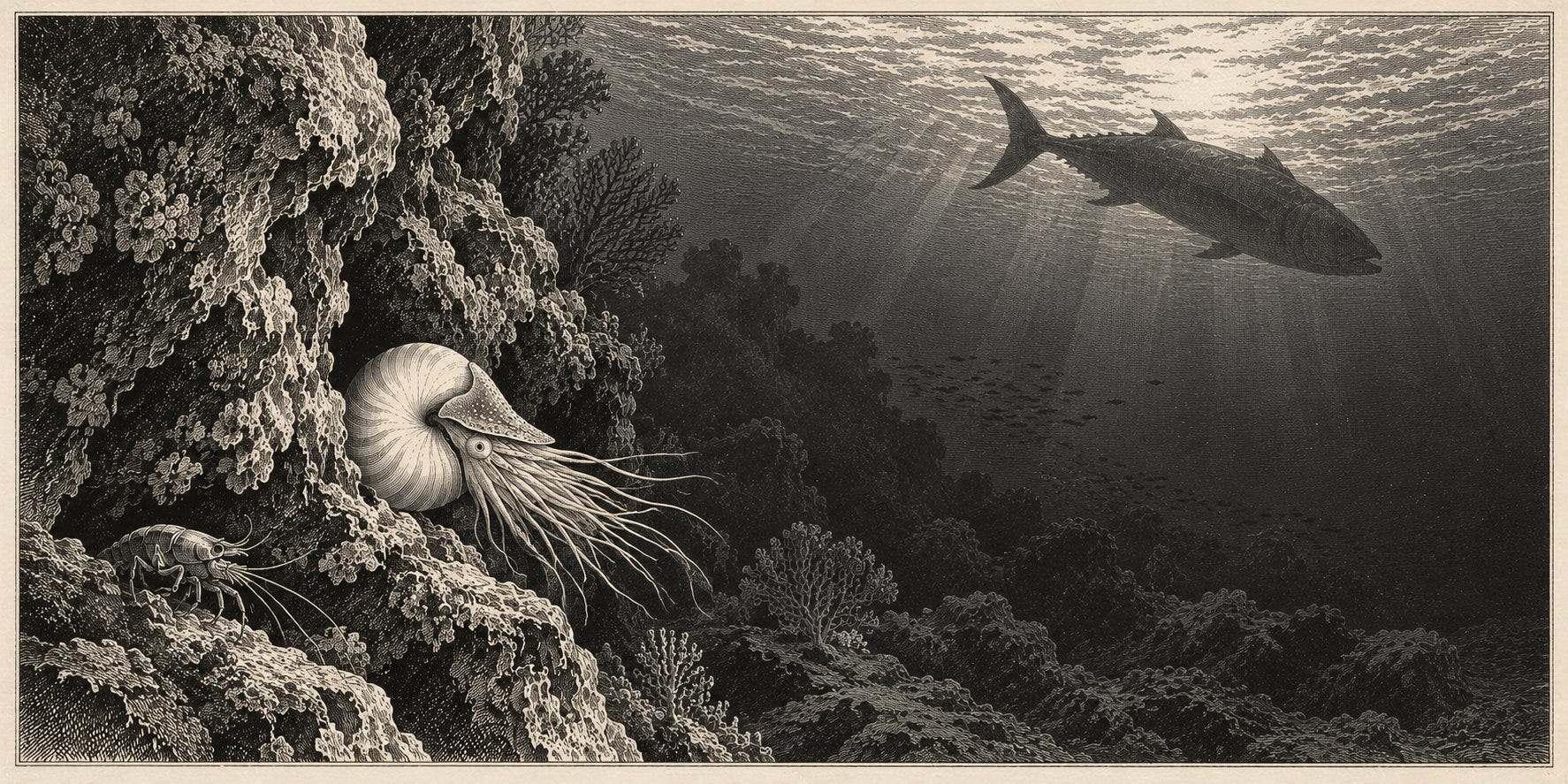
The Room
I was born in a room I would one day have to leave.
The wall curved around me, pale and close. Beyond the opening lay a darkness that moved. Water entered and withdrew. Sometimes a shadow passed over the faint light, and I drew myself inward before I knew what fear was.
My body grew. The room did not. At last I extended my tentacles beyond its opening and entered the sea.
The first small animal escaped me. So did the second. I lunged at movement and stirred the water; every creature vanished into the stone. Hunger made me patient. On another night I waited beside a crevice until a crustacean emerged, then gathered it in my tentacles and ate.
Something larger crossed above me. I saw an eye, then a mouth. The blow struck the outer curve of my shell and drove me against the rock. I withdrew as far as I could. A second impact came, weaker than the first. Then the predator left.
One tentacle was damaged. The shell had held. For days I hunted only within reach of shelter. I had discovered that the ocean contained food, and that I was food.
As I grew, a partition began forming behind my body. When it closed, the space I had occupied became an empty chamber, joined to me by a narrow living tube. I could not return to my first room. It remained with me nevertheless.
The Stranger
The larger nautilus appeared beside a rocky slope. Its shell bore a rough patch near the opening and a pale scar across its curve. I approached; it extended its tentacles. We touched, then separated.
On later nights I found it searching the same ledges. It investigated crevices slowly, turning its shell away from narrow gaps and keeping close to the rock when large fish passed. Once it drew back before I sensed danger. I followed its movement. A shadow crossed above us and went on.
I could not know whether I had learned anything from the stranger. But I began searching more carefully, and I survived.
One night I found the larger shell lying sideways in the sand. Its opening was broken. Tentacles hung motionless in the current. I touched one. Nothing answered. Small scavengers gathered beneath the rim.
I returned twice. On the second visit a crab emerged from the opening with a fragment of flesh. The shell remained nearly whole. The animal that had made it was disappearing.
I left before the current changed. For a long time afterward I searched the rocks for the pale scar and found only other shells, other shadows, other living things.
The Thread
More partitions formed as I grew. Each new chamber closed full of liquid, and no living flesh entered it. Over many nights the slender siphuncle threading through the chambers drew that liquid away, and a thin gas seeped into the space it left. The emptied rooms grew light. They balanced the weight of my body and shell, so that I could hang in the water above the rock with little effort. I carried rooms I could no longer enter, and they carried me.
One night a promising scent drew me down a steep slope. The water cooled. The remaining light vanished. I descended past familiar ledges into a region where even the small animals moved differently.
The pressure increased. The gas in my emptied chambers was far thinner than the water pressing on them, and only the shell held the difference. It was hard, but it was not beyond the reach of the sea. I stopped, moved a little deeper, and felt the strain again. Hunger drew me downward; the condition of my shell urged me back.
I turned and moved upward with repeated jets from my funnel. The ascent was slow. The scent of food remained below. I left it there.
Back among the rocks, I rested with my tentacles spread across a ledge. A shell could defeat a mouth and still fail against depth. Its strength had a boundary. So did mine.
The Leaving
The current that had fed the reef weakened. Familiar crevices became empty. I searched farther each night and returned with less.
At the outer wall a cooler flow carried the faint scent of food. I followed it a short distance, then returned to the rocks I knew. The next night I did the same. On the third, a stronger movement of water caught my shell and carried me away from the wall.
I expelled water and tried to turn. The reef sank away into darkness. There was no ledge to seize and no passage to enter. Through many nights I travelled with the current, feeding little and resting whenever its force allowed.
At last another scent rose from below. I descended cautiously. Stone appeared, then coral, then the flicker of prey among branching formations. I caught a crustacean beneath a ledge and ate it in the shelter of the stone.
The place was unfamiliar. Behind me, my shell curved inward through all the rooms I had left. Ahead lay a reef I had never known. I extended my tentacles and began again.
Part Two
The Broken Reef
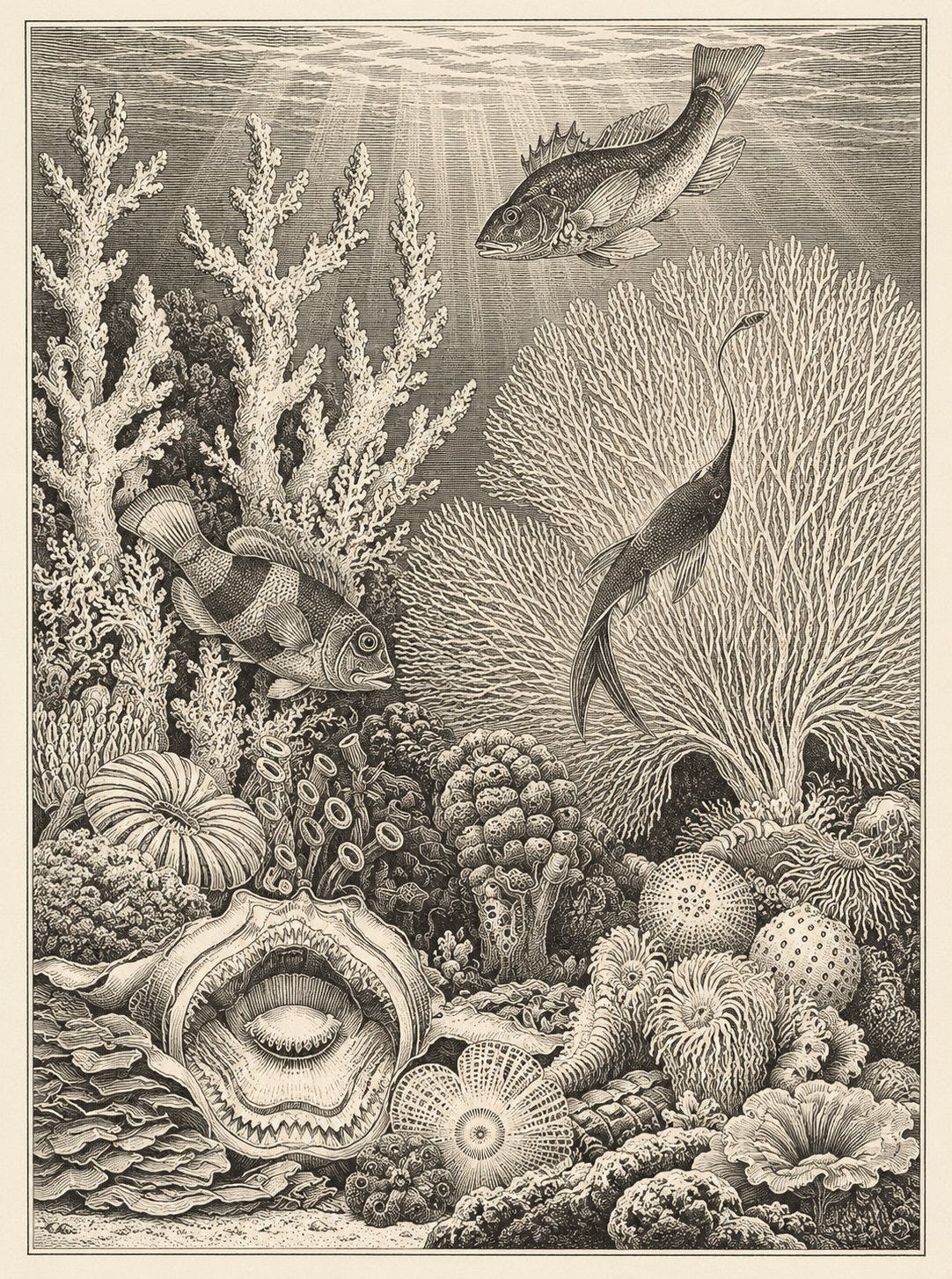
The Garden
The new reef was crowded with life. Fish sheltered among coral branches; filter feeders strained the current; scavengers searched the crevices below. Food reached me from more directions than I could follow.
A lobster occupied a cavity beside my feeding ledge. It emerged at night, sweeping its antennae across the stone and searching with its heavy claws. When it moved away, fragments sometimes remained. I fed among the smaller scavengers that gathered there.
The lobster did not welcome me or drive me off. We used neighbouring spaces and seldom met. Once a fish with a scar near its eye entered the passage and approached my shell. I withdrew. The lobster emerged and raised its claws. The fish turned away.
The lobster had defended its cavity, not me. Still, I lived because the cavity was occupied. I found a recess nearby and returned to it night after night.
The First White Branch
A branch of coral near the upper passage lost its colour. At first only its tip was pale. Then the whiteness spread along its length and onto neighbouring branches.
The water had grown warmer. Fish still moved through the reef, and the lobster still searched the rocks, but fewer creatures gathered among the affected coral. Some branches lived on for a time without their usual colour. Others died and became coated with unfamiliar growth.
The lobster began travelling farther. I sometimes watched it return to its cavity without prey. One night it did not return. The following night the cavity was empty again.
I entered carefully. Scavengers had begun using it. I caught one and ate. The shelter had not changed shape. Its occupant was gone. I had gained a feeding place in a passage that had lost something larger.
The Architecture of Absence
The pale branches multiplied. Some broke when fish brushed against them. Familiar schools thinned. The reef retained its corridors, but the creatures that had animated them were moving away.
My hunting trips grew longer. A chamber began forming behind me, yet growth slowed as food became harder to find. I ventured toward the deeper slope, following a scent until the pressure became uncomfortable. I turned back hungry.
On the return I passed the lobster’s empty cavity. The scarred fish was hunting near it, striking at the few animals gathered beneath a surviving coral head. I pressed myself under a ledge until it passed.
The reef looked much as it once had from a distance. Up close, its openings had become places of waiting. A branch still stood where a small fish once sheltered. The cavity still existed where the lobster once lived. The shape of a place could persist after the life that made it useful had gone.
The Falling Stone
The storm came at night. Water surged through passages that had usually been calm. Sediment rose; fragments struck the rocks. I withdrew beneath my ledge as a coral branch snapped and fell across the entrance.
A heavier piece struck the rim of my shell and turned me sideways. I hit the wall, drew in, and waited. The current pulled at the broken coral. The reef shuddered through repeated surges.
When the water settled, familiar corridors were blocked. The broad formation above the lobster’s cavity had collapsed. Injured creatures lay exposed among the fragments, and for one night I fed easily.
The next night there was less. On the third, I found almost nothing. The storm had supplied a brief meal by breaking the places where future meals would have lived.
The Choice
I stayed. I knew the passages, the damaged reef still offered shelter, and each small meal seemed proof that another might be found.
The scarred fish pursued me one night through a broken corridor. Its mouth struck my shell and chipped the already damaged rim. I escaped beneath a slab of fallen coral and remained there long after it departed.
Along the outer wall a cooler current carried a trace of food. I went a little way with it, then turned back to the reef. The following night I came again. The current was still moving. The familiar crevices behind me were nearly empty.
This time I followed the water beyond the wall. The reef vanished slowly. I did not know where the current led, only that remaining had become more dangerous than leaving.
The Shell and the Sea
The new feeding ground was a rocky slope with little coral. Food was scarce but present. Small crustaceans sheltered under stones; remains drifted down from shallower water. I learned several places to search.
The chipped edge of my shell became less prominent as new material formed. Another partition closed behind my body. The room it sealed was beyond my reach, but the siphuncle passed through it, and in time it emptied and lightened like the others.
At night I rested beneath a ledge while the current moved above me. I carried the rooms formed on the broken reef. I did not carry its lobster, its coral, or the water that had sustained them.
A scent passed along the wall. I reached into it and followed. The next place might offer food. I had learned not to ask the shell to provide what only the sea could give.
Part Three
The Ocean of Plenty
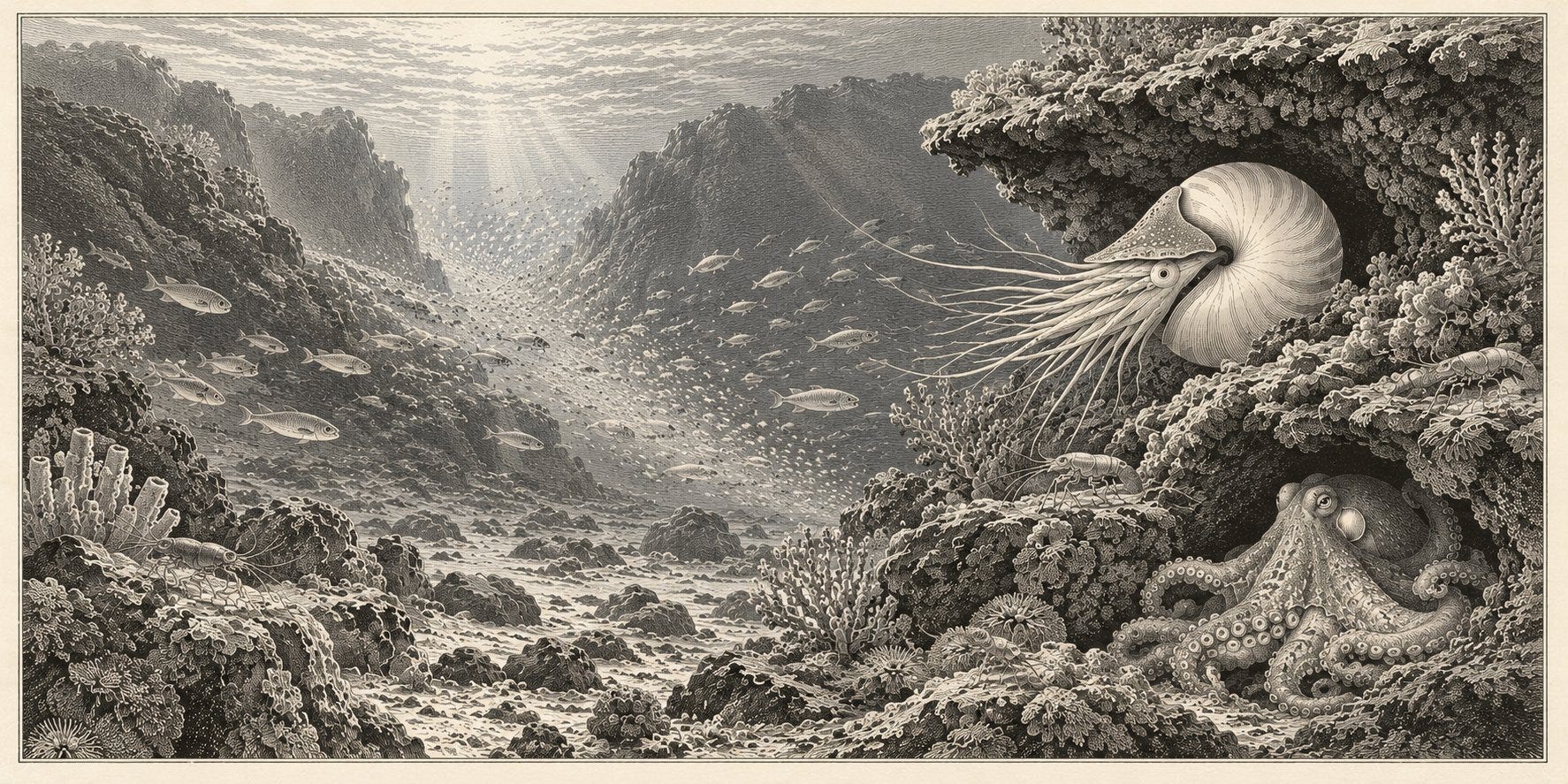
The Narrow Gate
The basin lay beyond a passage between two ridges. A strong current entered through the opening, carrying small drifting animals and the remains of creatures from farther away.
Inside, the water slowed. Fish gathered. Crustaceans occupied the ledges. Scavengers consumed what fell. I found an overhang beside the eastern wall and ate more that night than I had eaten in many nights.
The following night the current delivered food again. Soon I came straight to the same ledge without exploring the surrounding wall. My shell widened; chambers formed. I grew larger, and the journeys that had once filled my nights became unnecessary.
I did not see where the current began. I knew only where it ended, and where I could wait to eat.
The Pale-Eyed Hunter
An octopus lived below my ledge. A pale mark lay beside one eye. Its arms searched the lower rocks, finding crabs and fish among the crevices. I avoided its den. It seldom travelled far, for prey was abundant near its home.
One night the current weakened. Prey gathered less densely, and I searched beyond my usual passage. The next night the flow recovered and food returned.
A second interruption lasted longer. Fish travelled toward the narrow gate. I followed, then returned to the ledge when I found enough to eat. The current resumed before hunger became serious.
The basin seemed unchanged. The octopus hunted below. I hunted above. Our paths rarely crossed. I began to expect that they never would.
The Empty Passage
The third interruption did not end quickly. The water entering through the gate grew warmer and carried less food. Fish gathered in fewer places. Small crustaceans vanished from the passages where I had fed for so long.
The octopus emerged from its den and moved along the upper wall. I drew back beneath my ledge, but one arm entered the opening, then another. Suckers fastened to my shell. I expelled water and twisted against the rock. The grip tightened.
A movement behind the octopus disturbed the water. Its hold loosened. I escaped into a narrow gap and stayed there until the passage grew quiet.
The octopus had always possessed those arms. I had always possessed the shell it could seize. What had changed was the distance hunger drove us both to travel.
The Weight of Growth
I was larger now. My body needed more food, yet every meal demanded a longer search. The broad chambers formed during the years of plenty remained behind me. They did not diminish my hunger.
I returned to the narrow gate. The current had become a weak movement against the stone. There was still food in the basin, but finding enough of it now cost much of my strength.
Later I saw the pale-eyed octopus waiting near my old shelter. I turned away before it reached me and followed a smaller current over the northern ridge.
Behind me the basin retained its passages and ledges. I left while living creatures still occupied them. The place was not empty. It was no longer enough.
The Wider Water
The northern current led to a long escarpment. Food arrived from several directions: from above, along the wall, and from deeper channels. No single ledge was as rich as the one I had left. I learned three, then four places to hunt.
A young nautilus emerged from a crevice one night. Its shell was small and nearly unmarked. We touched tentacles briefly before it slipped back into the crevice. Later I watched it miss a crustacean, wait, and catch the animal on a second attempt.
I encountered it on other nights and sometimes travelled nearby. Then our routes separated. I continued along the wall, where unfamiliar objects were beginning to appear among the rocks.
Part Four
The Invisible Current
The Line
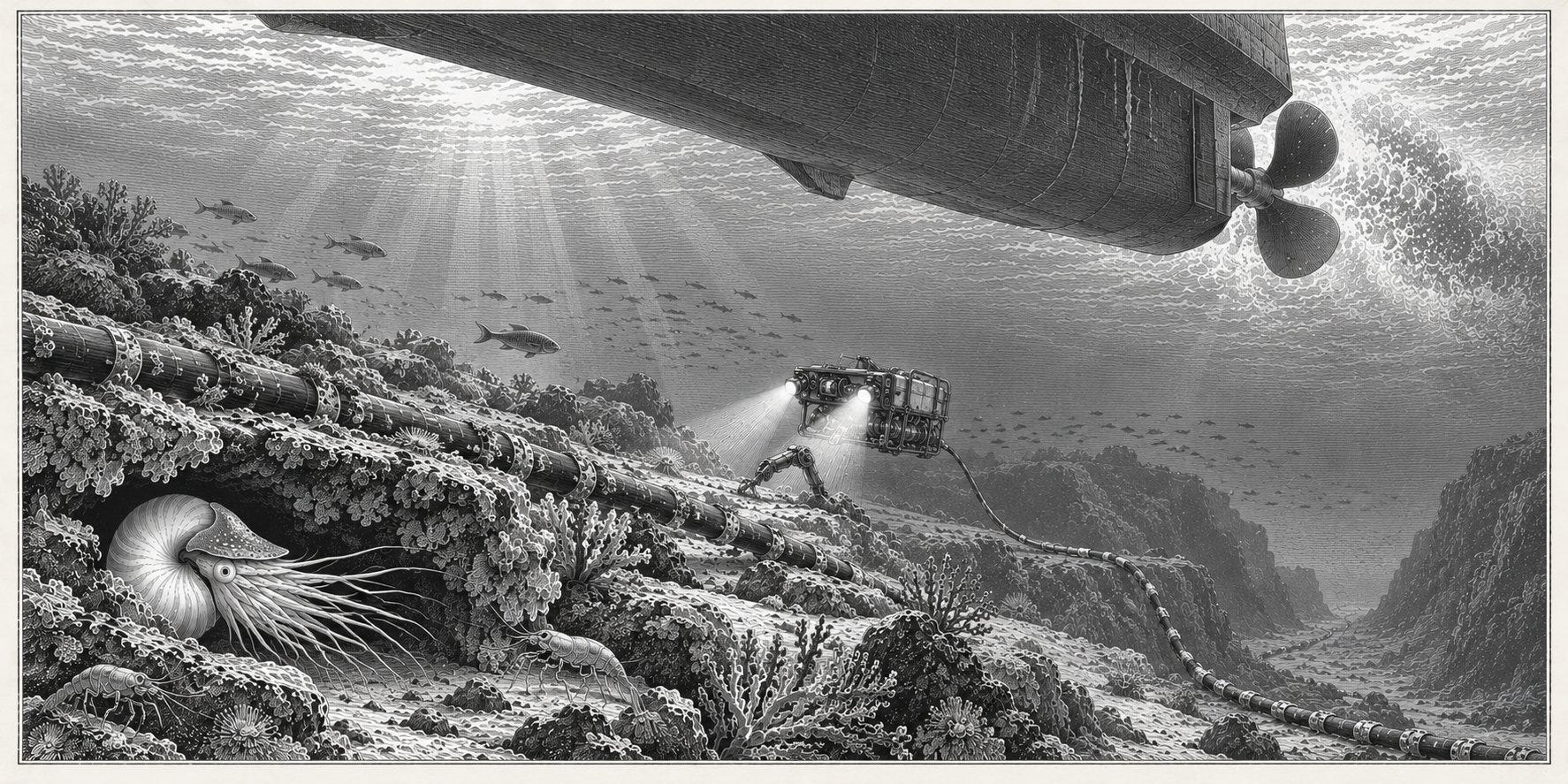
The first object was a line that crossed the seabed and descended along the escarpment. It was hard, smooth, and too regular to resemble anything that had grown there. Small organisms clung to its surface; fish sheltered beside it.
I touched it and drew back. It did not move. I followed it until sediment concealed it, then found it again farther along the wall. It continued beyond the distance I was willing to travel.
On another night a bright beam passed over the rock. I sank beneath a ledge. A machine with lights moved slowly through the water, paused beside a crevice, and extended an arm toward the stone. Then it departed.
Later a deep, regular vibration travelled through the water and into the rock, and an immense dark shape crossed the faint light far above. Others followed. None pursued me. They crossed the feeding grounds without taking food from them, yet the animals they drove from the ledges did not return for days.
I learned to wait beneath shelter until the vibrations passed. Nothing had hunted me, but something had searched the wall with a purpose I could not recognize, and what moved above was beyond my power to stop.
The Net
I touched a thin strand near the upper slope. It yielded. Another crossed it, then another. Before I could turn, the whole structure tightened and caught my shell at its widest point.
I was lifted. The rocks fell away beneath me. The water brightened toward a moving silver surface I had seldom approached. I twisted, expelled water through my funnel, and struck the strands with my shell.
A section tore against the rocks. The loop loosened. I slipped through and descended, but a length of material remained caught on my shell. It snagged on stone again and again until a sharp projection finally pulled it free.
Farther along the slope a cage hung from a line, and the scent of flesh drifted from it. Two nautiluses moved inside, searching its walls. I came close, then turned from the narrow opening. On a later night the cage was gone, and so were they.
The net had taken whatever it could hold. The cage had been made for us.
The Window
Near a harbour I found walls that descended straight into the water, chains hanging from above, and immense hulls that arrived and departed with deep vibrations.
Beside one wall was a transparent surface. I touched it. Beyond it stood a small creature on two legs. It moved closer and raised a hand. I reached toward it with my tentacles. Its hand met the glass opposite them.
The creature returned on other nights, sometimes with a larger one. Once it held a flat object marked with dark lines. The lines formed a spiral like my shell. I turned. The spiral on the object did not change.
I stayed beside the window until the small creature moved away. I did not know what it had made, only that it had watched me closely enough to preserve my shape on something outside its body.
The Broken Glass
A storm entered the harbour. Ships departed, water surged through the entrance, and loose objects moved along the bottom. I sheltered beneath a stone projection as a heavy impact shook the wall beside the window.
A crack spread across the glass. Another surge struck. The surface broke. Bubbles rushed into the water and the chamber beyond filled with the sea.
When the storm weakened, I entered through the opening. A chair lay on its side. Small objects rested among the sediment. Near the wall was the flat object bearing the spiral.
I touched it. The current turned it over. The drawing disappeared against the floor.
The small human was gone. I could not know whether it had escaped, or whether it would ever return. I left the flooded room and followed cooler water away from the harbour.
The Water Itself
Beyond the harbour the sea grew quieter. The machines and ships became distant, but the water did not return entirely to what I had known. Some currents were warmer. Certain feeding grounds held fewer animals. At depths I had once visited, the water sometimes offered less oxygen.
My shell continued growing in water whose chemistry was changing in ways I could not sense directly. I had escaped reefs, predators, a net, and a harbour. I could not escape the medium through which I moved.
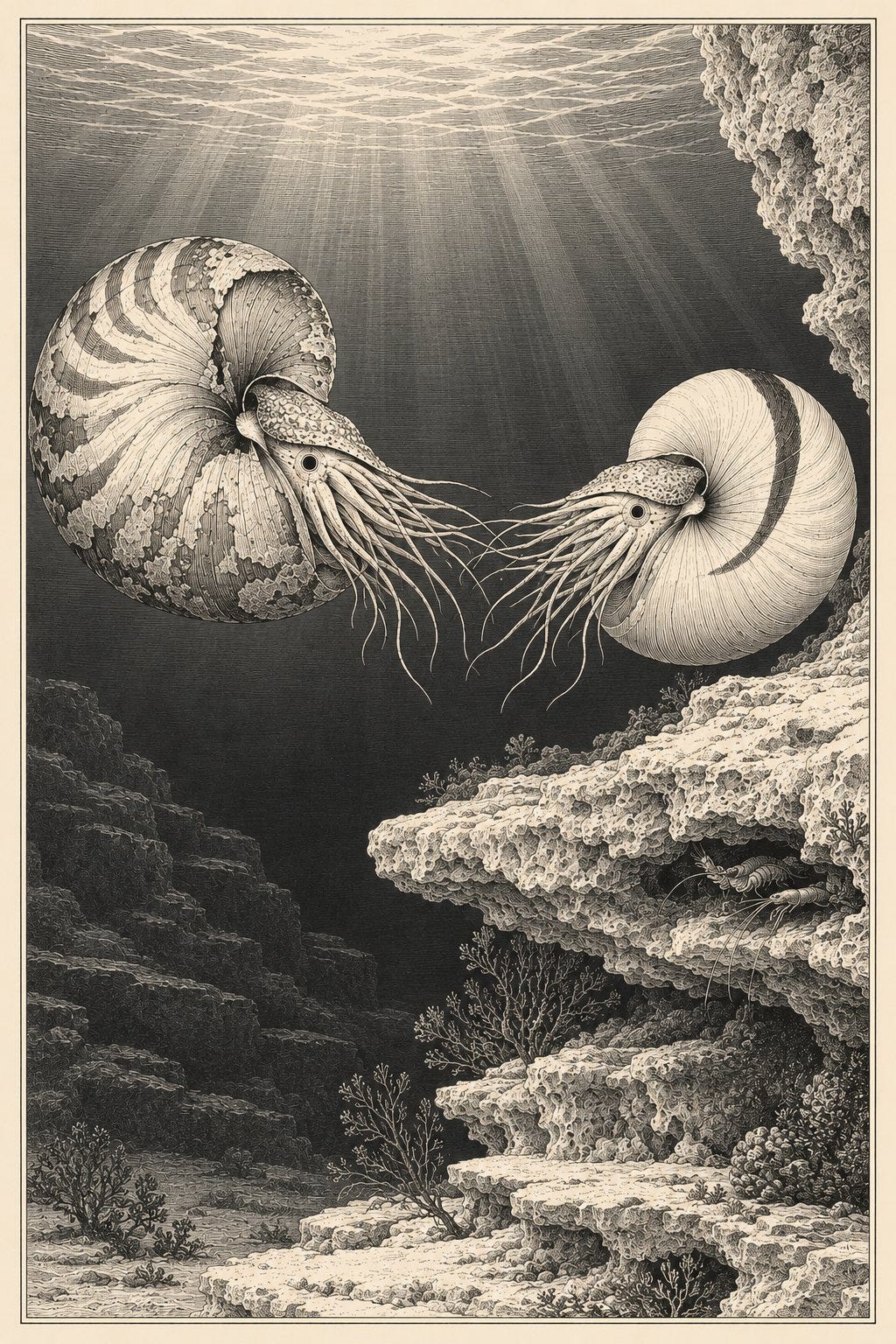
One night, near a limestone terrace, I detected the presence of another nautilus. A pale shell emerged from beneath an overhang. Its outer curve carried a narrow dark band. I approached. She withdrew, then returned. Our tentacles met.
Part Five
The Living Spiral
The Other
She moved along the limestone terrace, investigating crevices where prey sheltered. I followed. Sometimes she turned away; sometimes she approached until our tentacles touched.
I left food within reach to remain near her. We moved together beneath an overhang, separating and coming close again. What she sensed in me stayed hidden. I knew only that my movements had changed.
We aligned in the water. I used the specialized structure formed from modified tentacles to transfer sperm. We stayed in contact while the current moved gently around our shells, then separated.
She resumed searching the rock. I fed in a neighbouring passage. We remained near one another through the night. By morning the current had carried us apart.
The Hidden Place
I encountered her again near a recess beneath the limestone. She investigated the protected surface and moved into darkness. I remained outside, searching for food along the ledge.
Much later I found a large egg attached beneath a sheltered rock. Its firm covering held it against the stone. I touched it lightly and moved away. Nothing told me whether it was hers, or whether our meeting had produced it.
I came back to the terrace many times. Sometimes the egg was visible. Sometimes the current drove me to other feeding grounds. Months passed. I grew more slowly. The sea changed around the small object, which remained fixed to the rock.
The Small Spiral
When I next found the egg covering, it was open and empty. I searched the neighbouring ledges. Beneath a projection a tiny nautilus moved among the stones, its pale shell already divided into chambers.
I approached. It withdrew. I stopped. After a while it emerged again. A small crustacean passed; the young creature reached and missed. It waited, reached again, and caught the animal.
I kept near until it disappeared into its shelter. I could not tell whether it had emerged from the egg I had watched, or whether it was my offspring.
But a small shell had begun adding rooms to itself, and the sea around it was still capable of supplying a meal.
The Last Room
My movements grew slower. I rested more often and travelled shorter distances between feeding grounds. The shell behind me carried rough places, repairs, broad chambers formed during abundance, and narrower periods of difficult growth.
I returned to the limestone terrace. The young nautilus was gone. Perhaps it had found another ledge. Perhaps a predator had taken it. I searched and found nothing.
Beneath the overhang I remembered the larger nautilus whose broken shell had lain in the sand, the lobster’s empty cavity, the whitened reef, the basin whose current had failed, and the small human who had held a spiral against glass.
None of those places could be entered again as I had known them. The chambers within my shell remained, but the sea beyond them had changed.
A faint scent passed in the current. I emerged and followed it to a narrow crack. A small animal moved within. I waited. It emerged. I caught it and ate.
Then I settled back into the shelter of the rocks. Water passed over my shell. Somewhere beyond the terrace another nautilus might be making its first partition, leaving behind the first room it would never enter again.
I extended my tentacles into the moving water and waited for the night.
After the Story
Reading the Shell
Go back to the first chapter. As its first chamber closes, the narrator mentions a narrow living tube joining it to the room it has left. The tube returns in The Thread, named this time, and after that only in passing. It is the siphuncle, and it has been at work on every page.
The story has been carrying a framework. Coherence Economics asks one question of any system, whether an economy, an institution or a company: are its parts working together, or working against each other? When they work together, the system has coherence. When that alignment is lost, it suffers decoherence. When it is honestly rebuilt, it achieves recoherence. Three laws govern how a system moves between these states.
The first law is that coherence compounds. When the parts of a system work together, each success makes the next one easier. Trust lowers the cost of the next agreement, and order is cheaper to extend than to create from nothing. The First Ocean showed it in a young animal that learned to hunt, survived its first attack, and added chamber after chamber.
Decoherence extracts: that is the second law. A part that falls out of line does not simply stop helping. It begins to feed on the whole, and it does so most easily where no one is looking. On the broken reef the coral bleached while the reef kept its shape, and the storm only revealed damage already done. In the basin, the animal grew large on a single current it never traced to its source. That growth was real, and the story makes no case against prosperity. The danger lay in the dependence, and in the habits of searching that abundance let the animal forget.
The third law, recoherence recompounds, describes what comes after a collapse. By then a system cannot return to what it was, because that arrangement has already failed. It can only build something new from what survived, and the new arrangement begins to compound in its turn. The shell works the same way: a sealed chamber is never reopened, so the animal can only go forward. The story ended with a young nautilus making its first partition, the same process starting again on new ground. Infinity was the wheel. This is the spiral.
Beneath the three laws sits the master theorem: the instruments go first. A system can follow these laws only while it can still see its own condition. For that reason, the means a system uses to observe itself are the first thing decoherence disables, since nothing can be extracted from a system that can still watch itself being drained.
In the nautilus, that instrument is the siphuncle. It propels nothing; the funnel does that, and the animal decides where to go. What the siphuncle supplies is buoyancy. It removes liquid from each sealed chamber, and the emptied chambers hold the heavy shell up in the water. While it works, the animal hardly notices it. If it stopped, new chambers would stay full, and the animal would sink while its shell looked perfectly sound. That is the master theorem in anatomy: the instrument fails first, and everything still looks calm.
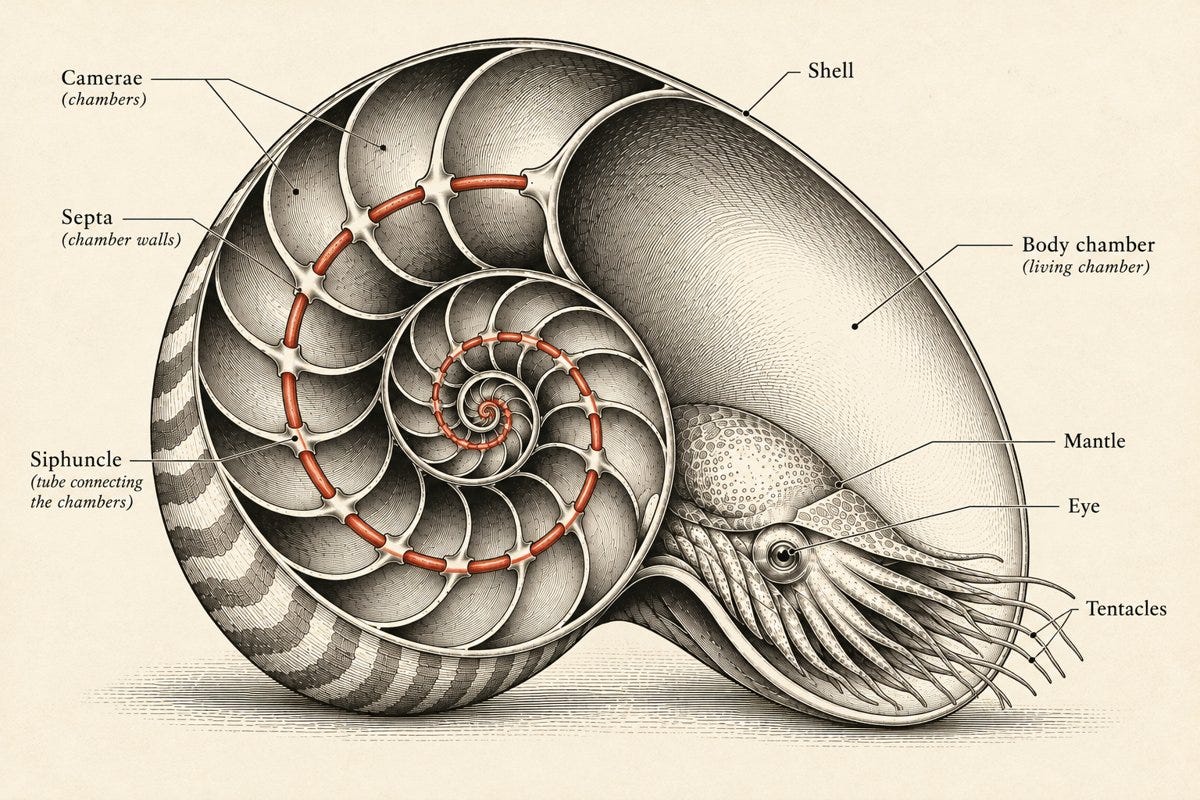
The siphuncle has a limit. It senses the chambers, not the sea. That is why the narrator so often could not know. It never felt the water warming, could not see where the basin’s current came from, and took a dying reef for shelter because its shape had not changed. Only once did anyone try to see the animal from outside: the child at the harbour window who drew its shell. When the storm broke the glass, the drawing was lost.
Whether a rebuilt system rises or sinks depends on one condition, an honest account of what went wrong. Rebuilt on a false account, a system repeats its mistake in a better disguise and reaches its next crisis sooner. The spiral can turn downward.
The cycle can also stall. Many systems lock into restriction, where a protected position, scarcity and little accountability allow value to be taken out without being reinvested. Such systems rarely change unless a shock from outside forces them to. The three laws describe what should happen. Restrictions describe what usually happens.
Coherence Economics is a research framework, not yet a validated theory, and its claims are hypotheses open to testing. The nautilus does not prove them. It makes them visible.
Now look again at the Institute’s emblem on the title page. It shows the spiral and the chambers. It does not show the siphuncle. The most important part of the symbol is the one you cannot see.
Afterword
The Nautilus and the New Bookshelf
Economics has spent centuries studying how societies produce wealth, distribute it, price it, finance it, and grow it. These are indispensable questions. They are not sufficient.
A society can become richer while the relationships that sustain its prosperity become weaker. Output can rise while adaptability declines. Institutions can remain standing after the trust, knowledge, ecological capacity, or material flows on which they depend have begun to fail.
The Bonjourhi Institute proposes another bookshelf in the library of economics. We call it Coherence Economics.
Coherence Economics studies the conditions under which the parts of a system remain capable of working together, the processes by which those relationships deteriorate, and the means through which they can be renewed.
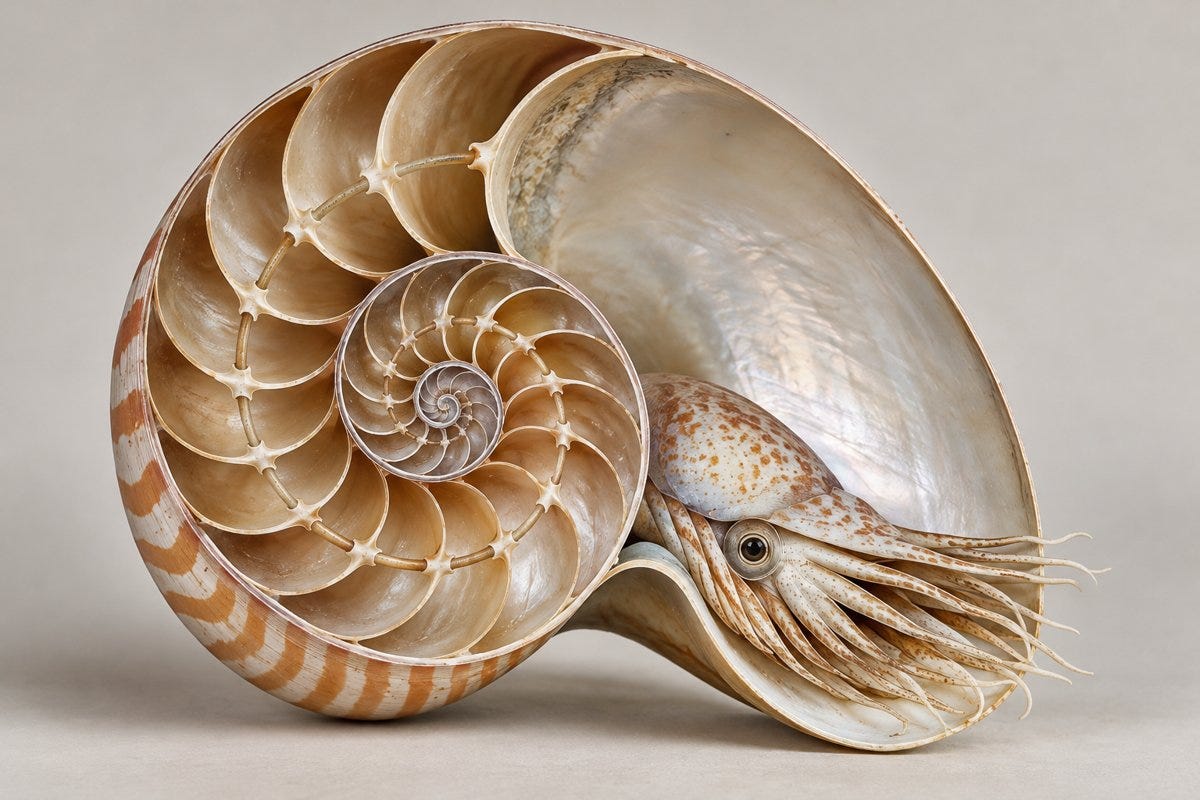
The shell makes one dimension of this problem visible. Its sealed chambers are a record of accumulation, and the siphuncle turns that record into lift. It pumps salts out of the liquid in each chamber, water follows by osmosis, and gas takes its place.
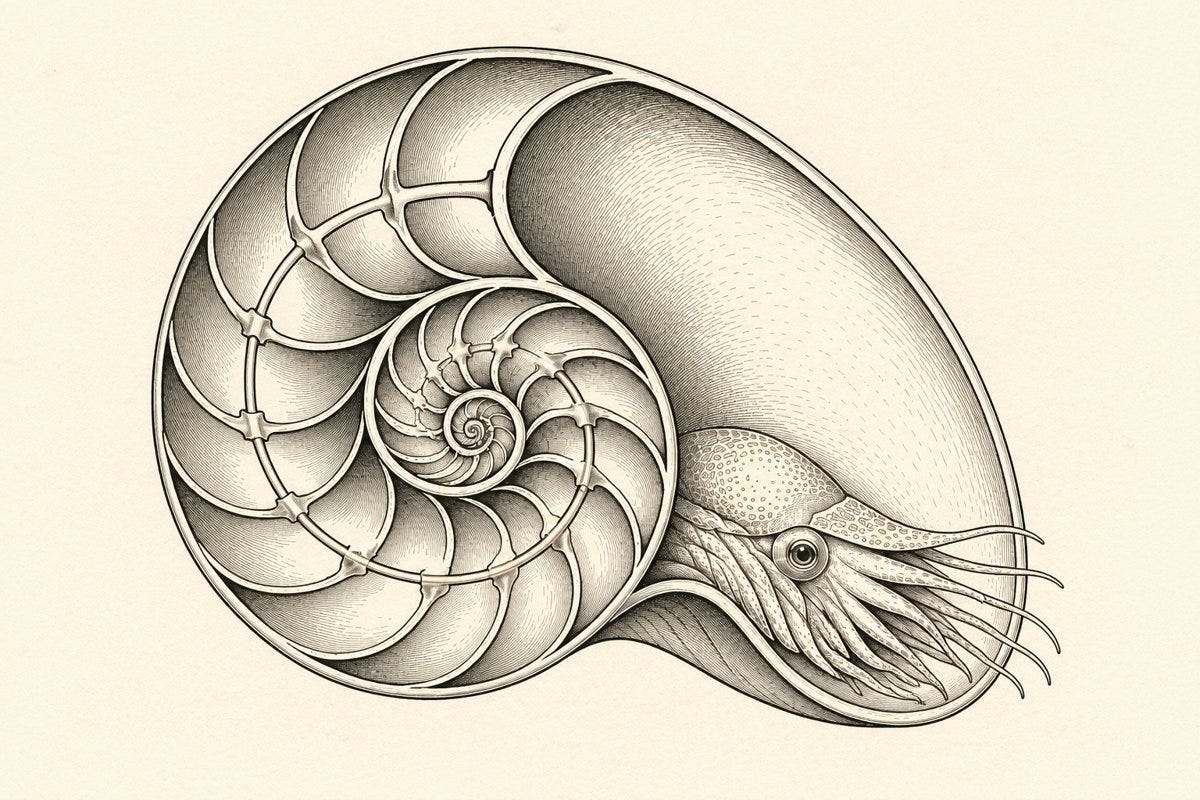
Two features of this mechanism matter for the argument. The lift is earned, because the siphuncle never stops working. It also has a price. Gas in the emptied chambers sits far below the pressure of the surrounding sea, so the rooms that buoy the animal also set the depth below which its shell will fail. Sealed history becomes support only through ongoing work, and that support carries its own limit.
But the shell is not self-sufficient. It cannot provide food, restore a damaged reef, control a current, or preserve the chemistry of the sea. A perfectly formed chamber guarantees nothing about the next.
That distinction matters in economics. Capital stock is not the same as productive coherence. A logistics network can be vast and efficient yet hang on a single narrow dependency. Markets sometimes report record values while the conditions beneath them deteriorate, and cities have kept their buildings long after the flows that made them useful stopped.
The harbour introduces human agency. Unlike the nautilus, people can preserve knowledge outside their bodies, test assumptions, redesign institutions, and warn generations not yet born. The drawing at the window matters because it is an act of attention and transmission. It is the beginning of an inheritance no shell can provide.
None of this makes coherence a synonym for stability. Living systems must change. The nautilus survives by leaving rooms and habitats that no longer fit its needs. The economic question is not how to freeze an arrangement in place. It is how to distinguish adaptation that preserves future possibility from expansion that consumes it.
Nor is the shell a complete economic model. For Coherence Economics to earn its shelf, it must produce definitions that can be challenged, measurements that can be replicated, causal accounts that can be tested, and decisions that improve under scrutiny.
Its proposed contribution is a shift in what we learn to observe. We still ask how much a system produces, but we also ask what must continue to hold for production to remain possible. Is the supporting web of relationships strengthening, or is it being drawn down? After a shock, has the system learned, and can it renew itself?
The nautilus does not know these questions. It hunts, hides, grows, mates, and ages. Its world is not a classroom. That is why the story comes first.
The symbol does not promise permanence. It asks whether another chamber can be built, and whether another life can begin.
Progress survives only when meaning keeps pace with speed.
Notes on Sources
The story is a work of fiction, but its natural history is meant to be accurate. These notes give the sources for the factual claims made in the story, the preface, and the afterword.
On the nautilus. The modern chambered nautilus, Nautilus pompilius, belongs to a lineage of shelled cephalopods whose earliest widely accepted members, such as Plectronoceras, appear in the late Cambrian, roughly 490 million years ago. Fossils described in 2026 may carry siphuncle-bearing cephalopods back into the early Cambrian. The standard scientific reference is W. Bruce Saunders and Neil H. Landman, editors, Nautilus: The Biology and Paleobiology of a Living Fossil (New York: Plenum Press, 1987; reprinted with additions, Dordrecht: Springer, 2010). Peter D. Ward, In Search of Nautilus: Three Centuries of Scientific Adventures in the Deep Pacific to Capture a Prehistoric, Living Fossil (New York: Simon and Schuster, 1988), tells how the animal’s biology, including its buoyancy, came to be understood.
On buoyancy and the siphuncle. The chamber-emptying mechanism described in the afterword was established by E. J. Denton and J. B. Gilpin-Brown, “On the Buoyancy of the Pearly Nautilus,” Journal of the Marine Biological Association of the United Kingdom 46, no. 3 (1966): 723-759, with later work collected in Saunders and Landman. The gas in an emptied chamber is mostly nitrogen, held below one atmosphere of pressure. Emptying a new chamber takes weeks to months, so the process trims buoyancy as the shell grows; rapid changes of depth are made by swimming.
On the spiral. The growth of the shell as an approximately logarithmic spiral was described by D’Arcy Wentworth Thompson, On Growth and Form (Cambridge: Cambridge University Press, 1917). Measurements showing that nautilus shells do not follow the golden ratio appear in Clement Falbo, “The Golden Ratio: A Contrary Viewpoint,” The College Mathematics Journal 36, no. 2 (March 2005): 123-134.
On reproduction. The mating described in The Other, in which the male transfers sperm through the spadix, a structure formed from modified tentacles, and the long development of the single large egg described in The Hidden Place, follow the accounts collected by Saunders and Landman. A nautilus egg has never been observed in the wild; what is known comes from aquariums, where eggs take roughly a year to hatch and the young emerge with shells already divided into chambers.
On the shell trade. Nautiluses are caught in baited traps lowered to the reef slope, chiefly for their shells. In 2016, at its seventeenth Conference of the Parties in Johannesburg, the Convention on International Trade in Endangered Species of Wild Fauna and Flora (CITES) listed the family Nautilidae in Appendix II, which regulates international trade in the animals and their shells without banning it.
On the changing sea. Coral bleaching under warming water, declining dissolved oxygen at depth, and ocean acidification are reviewed by the Intergovernmental Panel on Climate Change in its Special Report on the Ocean and Cryosphere in a Changing Climate (2019).
On the framework. The three laws, the master theorem, and the condition governing the direction of the spiral are stated in The Three Laws of Coherence Economics: A Reference (Montreal: Bonjourhi Institute Analytics), the Institute’s canonical statement of the framework.
List of Illustrations
Cover. The Nautilus, engraved shell with the siphuncle traced in red.
Figure 1. The young nautilus leaving its shelter, at Part One, The First Ocean.
Figure 2. The reef in its abundance, at Part Two, The Broken Reef.
Figure 3. The narrow gate of the basin, at Part Three, The Ocean of Plenty.
Figure 4. A passing hull and the line on the seabed, at Part Four, The Invisible Current.
Figure 5. Two nautiluses meeting, at Part Five, The Living Spiral.
Figure 6. Cross-section of a Nautilus shell, in Reading the Shell.
Figure 7. The chambered shell with the animal in its outermost chamber, in the Afterword.
Figure 8. A photographic-style rendering of Nautilus, in the Afterword.
About the Author
Pierre Somers is the Founder of the Walter Group and Chief Editor of the Bonjourhi Institute Analytics. He spent most of his career leading Walter Surface Technologies, a transnational manufacturer of industrial tools for the metalworking industries.
He is the architect of Coherence Economics and the author of The Escort Fee, the analytical series The Fragile Miracle, and the speculative novel The Second Fall. He lives in Montreal.
About the Bonjourhi Institute
The Bonjourhi Institute, based in Montreal, develops Coherence Economics, a framework for reading economic, institutional, and political systems through the alignment of their parts.
Its work appears in the Bonjourhi newsletter, in historical case studies that test the framework against the record, and in the Coherence Economics Bookshelf, a planned library of twelve volumes. Readings of present systems are made with the Institute’s analytical instrument, the Translation Machine, and entered in a prediction ledger scored by the Brier method, so that each reading can be checked against what follows. The Institute also writes from the Holahi Campus in Marbella, Spain.
Also from the Bonjourhi Institute
The Three Laws of Coherence Economics: A Reference
Three Rooms That Read Calm: Chernobyl, Enron, and the Rating Agencies