
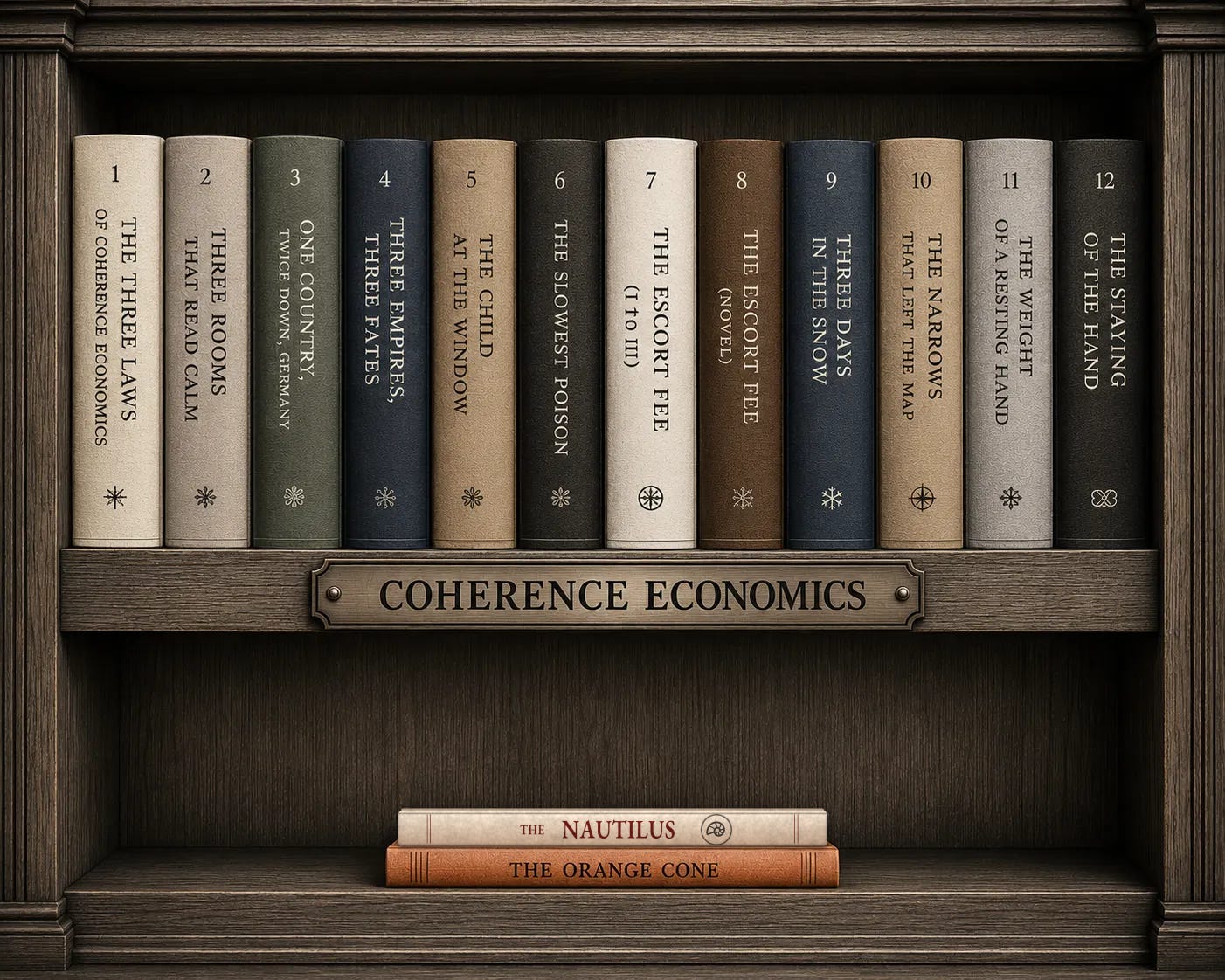
Coherence Economics is a way of reading systems, economic, institutional, political, personal, by asking a single question. Are the parts of the system aligned, so that they reinforce one another, or misaligned, so that they drain one another. Alignment, here, is called coherence. Its loss is decoherence. Its honest rebuilding is recoherence.
Three laws govern the movement between these states. One theorem governs whether the movement can be seen. This page states them, and is meant to be the reference other work points to.
The Laws, In Short
Coherence compounds. Decoherence extracts. Recoherence recompounds.
And the theorem beneath them. A system can obey these laws only while it can still see its own state. The instruments of observation are the first thing any decoherence disables, because nothing can be extracted from a system that can still watch itself being drained.
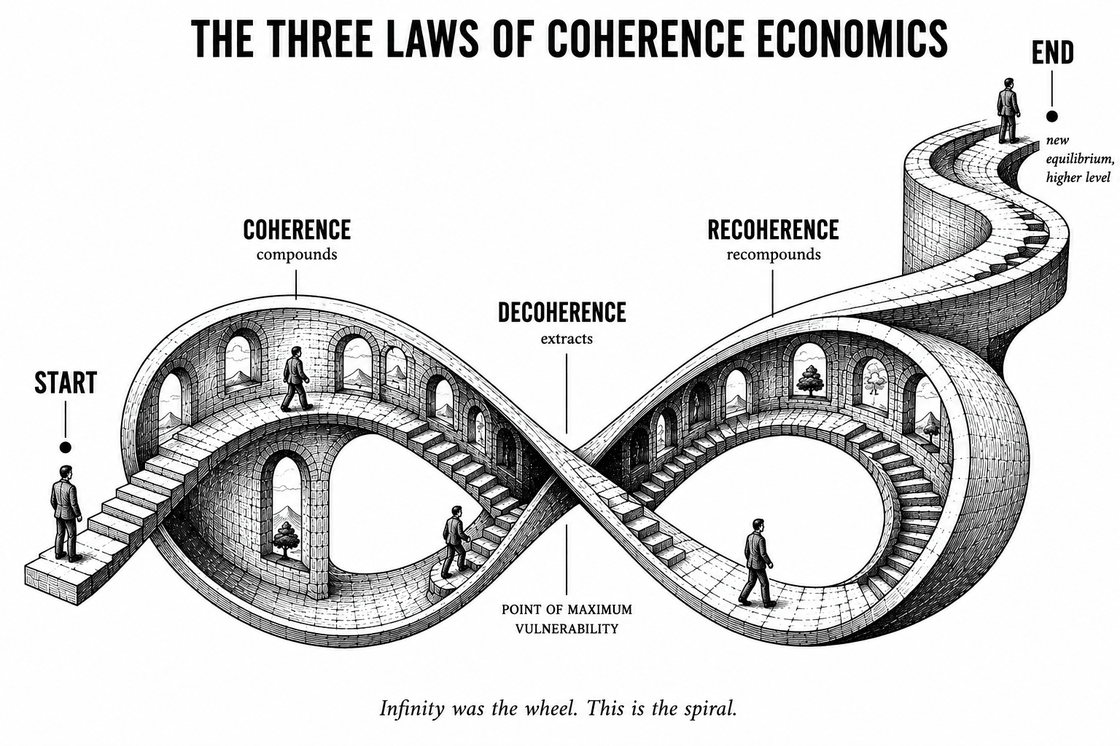
The rest of this page develops each in turn. The drawing holds the whole of it.
The Figure On The Stair
A figure begins low, on the left, and the ground rises under him as he builds. Arch upon arch. For a while the structure seems to climb on its own.
Then the path narrows to a single spine, one crossing where the whole weight must pass through the thinnest point. He crosses. The ground opens again, into a second hall larger than the first, built from the same stones carried over the bridge.
And the path does not close. It climbs out of the frame, ending higher than it began, on ground that did not exist when he set out. The three laws are the parts of that walk, named.
The First Law. Coherence Compounds
Where the parts of a system are aligned, they reinforce one another, and the reinforcement builds on itself.
A structure that holds makes it easier to lay the next stone. Trust, once established, lowers the cost of the next agreement. Order is cheaper to extend than it was to create.
This is the rising half of the walk. It has the quiet menace of all compounding. Slow at first, and then not. The building seems to lift itself, and nothing about the ascent suggests it will ever end.
The Second Law. Decoherence Extracts.
Where a part falls out of alignment, it does not merely stop contributing. It begins to draw.
The misaligned element drains the system to serve itself, and it does this most efficiently where it can least be seen.
Note where the narrowing sits in the drawing. Not at the edge. At the center, where the two halves meet, where everything built must cross a bridge no wider than a man. This is the point of maximum vulnerability. Every system has one. It is almost always the place the system was least willing to look.
The Third Law. Recoherence Recompounds.
What follows the narrowing is not a repair. The rebuilt system is a new equilibrium, never the old one, and it begins to compound again.
The word is chosen with care. Not restores. Not returns. Recoheres. The far side of the crossing is built from the same stones carried across, but it rises into space the first half never reached. The old equilibrium is not available, because it was disproven by its own collapse.
Reinvestment was never restoration. It deploys what survived into something that did not exist before, and hands the process back to the first law, one level higher.
The Master Theorem. The Instruments Go First.
The three laws describe how coherence moves. One condition governs whether that movement can be seen at all, and it sits beneath all three.
Return to the second law, and to a question it raises but does not answer. Why does extraction not trigger an immediate correction? A healthy system that sees itself being drained responds. It closes the leak.
So for the draining to continue, something must come first. The system’s ability to perceive the draining must be disabled. The alarm is silenced before the theft can run.
This is why it is a theorem and not a fourth law. It is not one principle added beside the three. It is a consequence forced by them, the precondition every one of them quietly assumed, that the system can still tell which state it is in.
A system holds coherence only while it can still perceive its own state. The earliest sign of decoherence is not the loss. It is the loss of the ability to see loss.
The instruments by which a system observes itself, its measures, its audits, its honest reporting, its free press, its historians, are not outside the system. They are part of it, and they decohere like any other part. But they hold the one position that governs the correction of every other part. Capture them and you have not disabled one function. You have disabled the correction of all functions at once.
This is why maintenance is not, first, the repair of what breaks. It is the defense of the capacity to know what is breaking. Guard the instruments before the value. The value cannot be defended once the instruments are gone, because the loss will register, on a calm and unmoving dashboard, as peace.
The Spiral, Not The Wheel
Return now to the third law, and to the shape it gives the whole cycle. This is why the framework’s image is an infinity symbol that refuses to close.
A true infinity symbol is a wheel. It would return the system to its own footprints, the same start, forever. The three laws describe something else. The cycle does not return to where it began. It returns to how it began, to compounding, on new ground. Same mechanism, new position.
That single refusal, the line that climbs out instead of rejoining, is the difference between a system that survives and one that evolves. It is also why the framework holds at three laws and one theorem. The climb is already inside the third law. To name it separately would be to state that law twice.
The Condition
One clause governs the direction of the spiral, and it joins the third law to the theorem.
The rebuilt system rises higher only if the collapse was reckoned with honestly, and reckoning is the work of the instruments. Rebuilt on a blinded account of what broke, the system does not rise. It reproduces the same flaw in better disguise, and reaches its next narrowing sooner.
The spiral can turn downward. What decides its direction is not effort or fortune, but whether the system could still see itself at the crossing.
NOTES AND SOURCES
This page is the canonical statement of the framework. It is intended to be referred to rather than argued from; the case studies published alongside it are where the framework is tested against the historical record.
On the vocabulary. Coherence, decoherence, and recoherence are used here as defined terms, not as their looser everyday senses. Coherence denotes the alignment of a system’s parts such that they reinforce one another; decoherence, the loss of that alignment; recoherence, its honest rebuilding into a new equilibrium. The master theorem is a consequence of the second law, not a fourth law.
On the illustration. The framework’s permanent image is the open infinity symbol, the loop that climbs out rather than closing, with the line “Infinity was the wheel. This is the spiral.” It renders the central claim that recoherence returns a system to its mechanism, compounding, at a new level, rather than to its starting point.
Status. Coherence Economics is a research framework and an interpretive instrument, not, at this stage, an empirically validated theory in the formal economic sense. Its claims are offered as a lens for reading systems and as hypotheses open to test, and it should be read in that spirit.
Coherence compounds. Decoherence extracts. Recoherence recompounds.
Infinity was the wheel. This is the spiral.
The Child at the Window
What 2008 was, and the one system that was kept from playing.
Bonjourhi!
Here is the thing no one tells you about the men who nearly ended the world economy in 2008. They were not criminals or geniuses. They were playing games. Simple ones, the kind you played as a child, in a yard, before dinner.
Strip the jargon from what happened, the tranches and the swaps and the special purpose vehicles, and underneath it you find three plain playground games, played in sequence, for real stakes, with other people’s houses. First hide and seek. Then tag. And when it was over, kick the can, which they are playing still.
The horror of 2008 is not that it was sophisticated. It is that it was childish, and the childishness was wearing a suit.
First Game. Hide And Seek.
Hide and seek has a shape everyone knows. One player covers his eyes and counts, honestly, by the rules, while the others hide. That part is fair. The count is not the cheat. The game turns on what happens next: the seeker is supposed to open his eyes and come looking. Everything depends on the seek that follows the count.
What was hidden was risk. Bad loans, the kind that would never be repaid, were tucked inside bundles of good ones, and those inside other bundles, until the danger was buried so deep that the people holding it could tell themselves it was not there. Debt was moved off the edges of balance sheets, into vehicles built for the purpose of not being seen. Concealment dressed as innovation: the more cleverly the risk could be hidden, even from its owners, the more of it could be made.
And the seeker? The one whose whole job was to stop counting and find the risk, the agencies that graded how dangerous the paper was, never came looking. Not because a blindfold was forced on them, but because the hiders paid them to keep their eyes shut and go on counting. That is its own story, told in the companion piece, Three Rooms That Read Calm. For years the endless count felt like safety, because nothing had been found. But nothing had been found because no one was looking. And in hide and seek there is one iron rule: everything hidden is found in the end. The only question is who is still in the yard when it is.
Second Game. Tag.
When house prices turned and the hidden loans began to fail, the risk was found, all at once, and the second game began.
In tag, the danger is not in one place. It moves, by touch, from whoever has it to whoever they can reach. When Lehman Brothers fell in September 2008, it did not fall alone, because it was not standing alone. It was tied to the others by nearly a million contracts, and when it went down it reached out and touched everyone it was bound to. They were now it. The insurer AIG had promised to catch so many players that its own fall would have tagged the entire room, so it was caught, at a cost of a hundred and eighty-two billion dollars, to stop the touch from spreading.
This is the cruelty of tag played with a whole economy: you could have made no mistake that morning and still be tagged by the fall of someone across the room you had never met, because you were tied to them through three others. Soon no one would lend to anyone, because no one could tell who had just been touched. Even businesses that had never played, never bought a scrap of the hidden paper, found the whole yard frozen, because in this version of tag being touched meant being finished.
The Child Who Was Kept Inside

Now the part that turns this from a story into a proof.
Not everyone was on the playground. Just to the north, a whole banking system had been kept inside by a strict parent, and made to watch through the window.
Canada’s banks wanted to play. In the years before the crisis they had wanted to grow into giants like the American houses, to merge and to leverage and to chase the same returns, and the regulator would not let them. Canada set a hard cap on how far the net could come down: no bank could carry more than twenty dollars of risk for each dollar held back, and in practice they carried about eighteen, while the American players ran past twenty-five and the Europeans past thirty. The Canadian banks were made to keep their reserves, forbidden to hide risk off their books the way their neighbors did, kept small enough and careful enough that they could not really play any of the three games at all.
For years this looked like a punishment. Canadian banking was mocked as dull, provincial, over-regulated, too small, too cautious, a child kept in while the others whooped in the yard. And then 2008 came, and the games ended the way these games end. In the United States, banks failed and were bailed out and the worst recession since the 1930s followed. In Canada, not one bank failed. Not one needed rescuing from collapse. All six of the big banks stayed profitable straight through, and the country was ranked, that autumn, as having the soundest financial system in the world.
This is the whole argument, and it needs no metaphor to carry it, because it happened. Same continent, same access to the same poisoned paper, the same global storm passing over both. One variable was different. One system was allowed to play the games, and one was kept inside. And when the ambulance came, it came to the playground, not to the window. The child who had been mocked for missing the fun was the only one who walked into the next decade unhurt. Slack, the boring reserve that earns nothing on a good day, was the only thing that mattered on the one day it was needed.
Third Game. Kick The Can.
You would think a room that had just been carried out on stretchers would put the games away. It did not. It only changed to the last one, the one you play when the real reckoning is too frightening to face: you kick the can down the road.
The fury after 2008 was real and just. There were hearings, named villains, a long complicated law. Some of it helped. But look at what was not done. The players were not made smaller; they were made bigger, because the way you saved a falling giant was to feed it to a larger one. The reserves were never raised to anything like Canada’s unglamorous cap. Barely half the promised rules were finished, and a decade on, even those were loosened.
You do not have to imagine that last part. In the spring of 2023 it happened in front of us. Silicon Valley Bank, undone by the same plain math as ever, too little held back against a shift it should have survived, fell in one of the largest bank failures in American history, and Signature Bank fell days behind it. First Republic was handed a thirty-billion-dollar lifeline by the giants, failed anyway, and was swallowed by JPMorgan, the largest bank, made larger. In Switzerland, Credit Suisse, a bank the whole world was wired to, was pushed overnight into the arms of its bigger rival UBS. And the small, telling detail: part of what left Silicon Valley Bank exposed was that a loosening of the rules a few years earlier had lifted it out of the tighter scrutiny it would once have faced. The kick had a consequence, and it arrived on schedule. The regulators guaranteed the deposits, arranged the mergers, and told us the system was resilient, which is what you say as you wind up for the next kick.
Each rescue was a kick, pushing the reckoning past this quarter, this election, this bonus. And here is the thing everyone learns as a child and then, in a suit, forgets: the can does not get lighter. It gets heavier, because the fragility you defer keeps compounding while you defer it. You are not kicking the same can down the road. You are kicking a heavier one every year, toward a horizon nearer than the kicking makes it feel.
The Yard At Dusk
So here is where the games have left us, and why this is not a story about the past.
One player, held back from the game against its will, walked away unhurt. That tells you the whole catastrophe was a choice, not a weather event. And instead of learning the lesson that child was living proof of, the room went back to the games, and has been kicking a heavier can ever since.
You are not a banker, so take the one thing here that is yours. The pressure to remove slack is constant, and it is always disguised as virtue: a leaner company, a tighter schedule, a life with no wasted margin. When you next hear that something has been made more efficient, ask the Canadian question. Ask where the net went, and what small ordinary shock this newly efficient thing can no longer survive.
The men in the suits are back in the yard. The risk is being hidden again, somewhere, cleverly, because it always is. The ropes are being tied. And down the road, in the dusk, there is a can, heavier than it was, waiting for the next kick. We heard the same song in 2023, and in 2008, and in every crash before them, the same verse each time, when will they ever learn, and each time we have answered by kicking the can a little further and going back to the game. The only open question in the whole story is whether we finally leave the can alone and go inside, or wait, as we always have, for the ambulance to remind us which child was right.
Coherence compounds. Decoherence extracts. Recoherence recompounds.
Infinity was the wheel. This is the spiral.
NOTES AND SOURCES
This essay is a case study in the framework set out in the reference, The Three Laws of Coherence Economics. Beneath the playground conceit it reads 2008 through the second law, decoherence as the extraction of a system’s safety margin, and the condition, the direction a recovery takes depending on the honesty of the reckoning. The framework is kept deliberately in the background. The credit-rating thread, the covered eyes of the seeker, is the master theorem and is treated in full in the companion study Three Rooms That Read Calm.
Leverage and hidden risk. The pre-crisis leverage of the large American investment banks, in the region of twenty-five to one and above, with several past thirty, and the use of off-balance-sheet vehicles to conceal exposure, are drawn from the standard accounts and the Financial Crisis Inquiry Commission. The reading of most participants as behaving sensibly by their own lights rather than criminally follows the mainstream scholarly view of the crisis as a systemic rather than chiefly moral failure; it is an interpretation, offered as such.
Interconnection. Lehman Brothers’ role as a highly connected institution, its close to one million derivative contracts, and AIG’s rescue at about one hundred and eighty-two billion dollars to protect its counterparties, are from the public record and the FCIC findings.
Canada, the control case. No Canadian bank failed and none required a solvency rescue in 2008; all six large banks remained profitable, and Canada was ranked the soundest financial system in the world by the World Economic Forum in October 2008. Canada’s binding leverage cap, an asset-to-capital ratio of 20 to 1, kept its banks near 18 to 1 against American ratios above 25 and European ratios above 30; the government had also refused proposed bank mergers in the late 1990s. Two honest caveats belong here: Canada was not untouched, it entered recession in late 2008, hurt by falling commodity prices and by stress in its asset-backed commercial paper market; and Canadian banks did receive substantial government liquidity support (by one Canadian Centre for Policy Alternatives estimate, up to roughly $114 billion in combined Canadian and US facilities, including mortgage purchases), though this was liquidity rather than insolvency rescue and was repaid. The claim made here is the accurate one: no Canadian bank failed or needed saving from collapse, which remains the striking fact and the point of the comparison.
The heavier can. The claims that the largest banks grew bigger and more concentrated after 2008, that post-crisis reform was only partly implemented and later loosened, and that further bank stress followed, are drawn from a range of post-crisis analyses. Whether reform left the system meaningfully safer is genuinely debated; the essay takes the framework’s view, that the recovery reset and compounded the fragility rather than removing it, and presents it as an interpretation, not a settled fact.
2023. The 2023 failures are drawn from contemporary reporting. Silicon Valley Bank failed on March 10, 2023, at the time the second largest US bank failure in history, and Signature Bank was closed two days later. A consortium of large banks extended First Republic Bank a thirty-billion-dollar lifeline on March 16, but it failed anyway and was seized and sold to JPMorgan Chase on May 1, 2023; at roughly 229 billion dollars in assets it became the second largest US bank failure, displacing SVB to third. Credit Suisse was taken over by UBS in a government-brokered rescue announced on March 19, 2023. By one measure the year was worse than 2008: total assets at failed US banks in 2023 reached about 550 billion dollars, against 365 billion in 2008 (S&P Global Market Intelligence). The observation that a 2018 raising of the Dodd-Frank stress-test threshold left banks of SVB’s size under lighter scrutiny is widely noted, and the link between that loosening and SVB’s vulnerability is an interpretation shared by many commentators though contested by some.
Framework. See the reference for the second law and the condition, and Three Rooms That Read Calm for the master theorem.
A Reconstruction: The Memo That Was Not Written
What follows is a thought experiment, not a document. Coherence Economics did not exist in 2007, and no one wrote this memo. It is composed now, with full hindsight, to answer a fair challenge: any framework can explain a crash afterward, so what would this lens actually have shown someone using it on the eve, before the fall? The rule imposed on the exercise is strict. It may use only what was genuinely public in 2007, and it must stop exactly where real foresight stopped. Read it as a reconstruction, not a prophecy.
The memo, dated to the eve, would have read something like this:
The system has removed its slack. The large houses now carry twenty-five to thirty dollars of risk for each dollar held back, which means an ordinary fall in asset values, three or four percent, the kind that happens in a normal bad year, is enough to erase them. The instruments that should be reading this danger are compromised: the agencies grading the risk are paid by the sellers of it, and are grading it safe. The risk itself has been hidden, off balance sheets and inside instruments too complex to price, so that even its holders cannot say how much they carry. And the houses are tied so tightly to one another that the failure of one will not stay with one. Every condition the framework treats as decoherence is present at once: the slack extracted, the instruments blinded, the parts overcoupled.
The conclusion the lens forces is limited but firm. This system is fragile, and it cannot survive an ordinary shock, because it has engineered away its capacity to absorb one. A fall is coming.
And here the honesty of the exercise matters most, because the memo must also say what the lens cannot see. It cannot tell you when. It cannot tell you which house falls first, or that the trigger will be housing rather than something else, or that the break will come in a particular month. Fragility is diagnosable in advance; the timing and the trigger are not. A lens that reads structure can tell you a thing is ready to fall. It cannot tell you which gust will push it, or on what afternoon. Anyone claiming otherwise, then or now, is reading the date back into the past from a present that already knows it.
One honesty in closing. The framework would not have been alone: real observers did see the fragility and say so before the fall, and were mostly dismissed, which is itself the master theorem at work on the people who should have listened. The lens organizes what careful eyes already glimpsed; it does not claim to have been the only eye open. That the memo reads as obvious now is the whole point. The danger was visible; it was hidden less by its complexity than by the calm the blinded instruments reported, and by how much everyone was being paid not to look. The memo could have been written. That almost no one wrote it in time is not a failure of information. It is the failure the framework is named for.
BONJOURHI! INSTITUTE ANALYTICS · MONTREAL · 2026


