
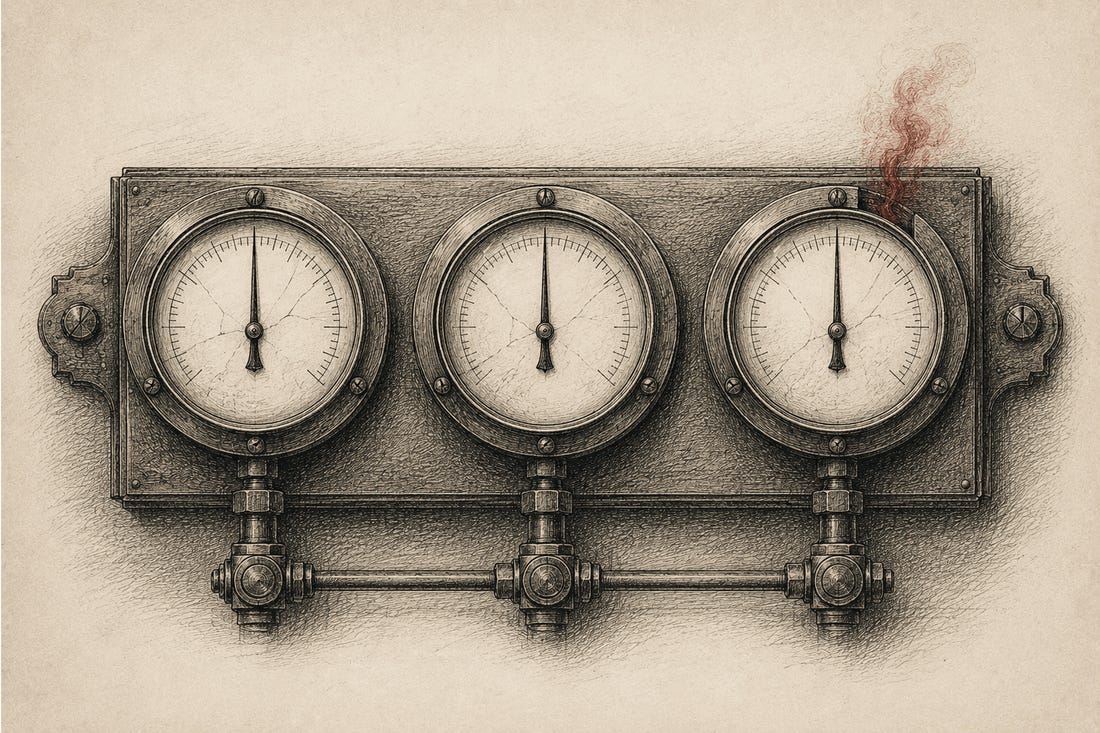
Three systems, three substrates. In each, the alarm was silenced before the failure it would have named.
Bonjourhi!
Of everything the framework claims, this is the one it stakes the most on. So it is the one to test first. The master theorem, in its canonical words:
A system holds coherence only while it can still perceive its own state. The earliest sign of decoherence is not the loss. It is the loss of the ability to see loss.

FROM THE REFERENCE, THE THREE LAWS OF COHERENCE ECONOMICS
Stated more plainly: the instruments by which a system observes itself are the first thing any decay disables, because extraction cannot run in a system that can still watch itself being drained. Blind the watcher first, and only then can the draining begin.
The obvious objection is that this is a fact about machines, about reactors with alarms and gauges. So the three cases here are chosen to answer it by changing the setting each time. A machine, a company, a market. If the same sequence appears in all three, the theorem is not about machines. It is about anything that must observe itself to live. Where a case strains the claim, it is said plainly. A test that can only pass is not a test.
THE REACTOR
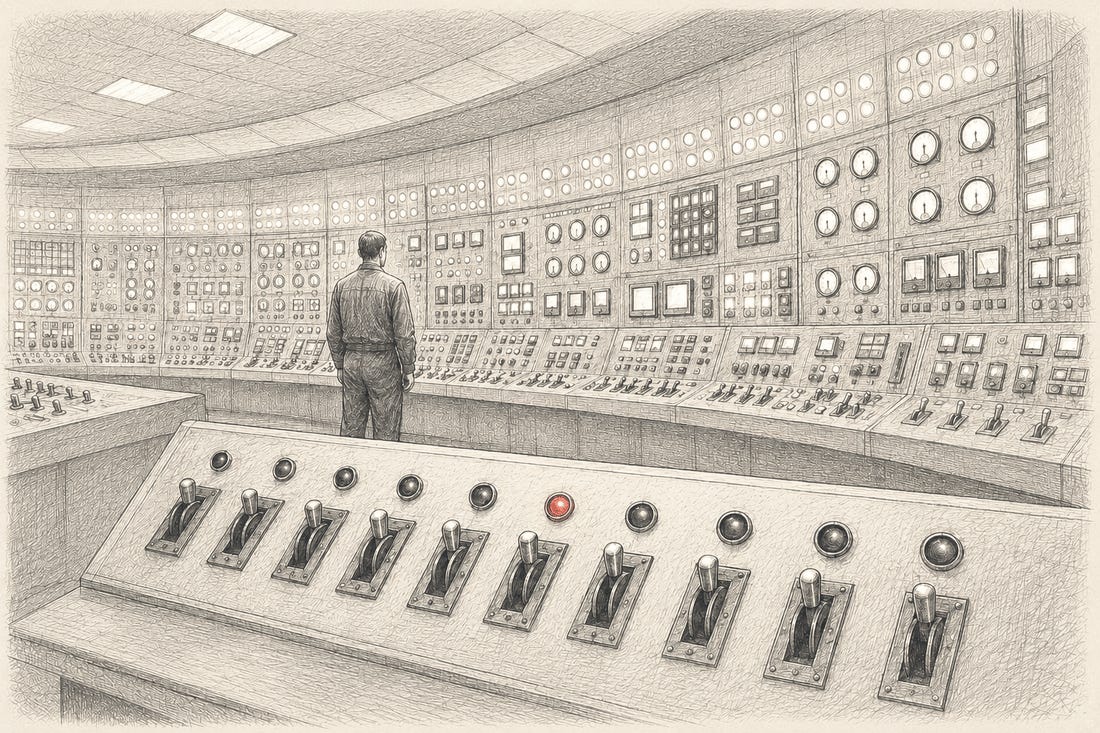
To run the safety test, they switched off the safety systems.
Begin where the theorem is not a metaphor but the literal order of events.
Soviet nuclear power had compounded for years. Standard designs, a trained cadre, a fleet of plants each cheaper than the last. Real coherence. Then, one night in April 1986, an engineer set out to run a safety test on the reactor at Chernobyl.
To run it, he had the emergency core cooling system disabled, so it would not interfere. Then the automatic shutdown signals were blocked, because those alarms would have aborted the test. Consider what that means. The instruments were not blinded by an enemy, or worn down by time. They were switched off deliberately, from inside, by capable people, because the alarms stood between them and the thing they had decided to do.
This is the whole theorem in a single decision, and it is why the case is almost unbearable. It was a safety test. The pursuit of safety, conducted by disabling the measurement of safety. Power fell into the unstable range the design most feared. A supervisor overruled his own staff and pressed on. By the time the fuel channels began to jump, the correction the alarms would have forced was hours gone. The room read calm because it had been made unable to read anything else.
The strain, stated honestly: the recoherence that followed, reshaped global reactor safety standards and, by Gorbachev’s own later account, strengthened the case for glasnost by exposing how thoroughly the state had lied to its own people, was imposed from outside the immediate system rather than chosen within it. That is a real effect, though a contributing one; the Soviet collapse five years later had many causes, and it would overclaim to make the reactor their trigger. On the theorem itself, the case is airtight. The instruments were switched off first, and the disaster followed into the dark they left.
THE LEDGER
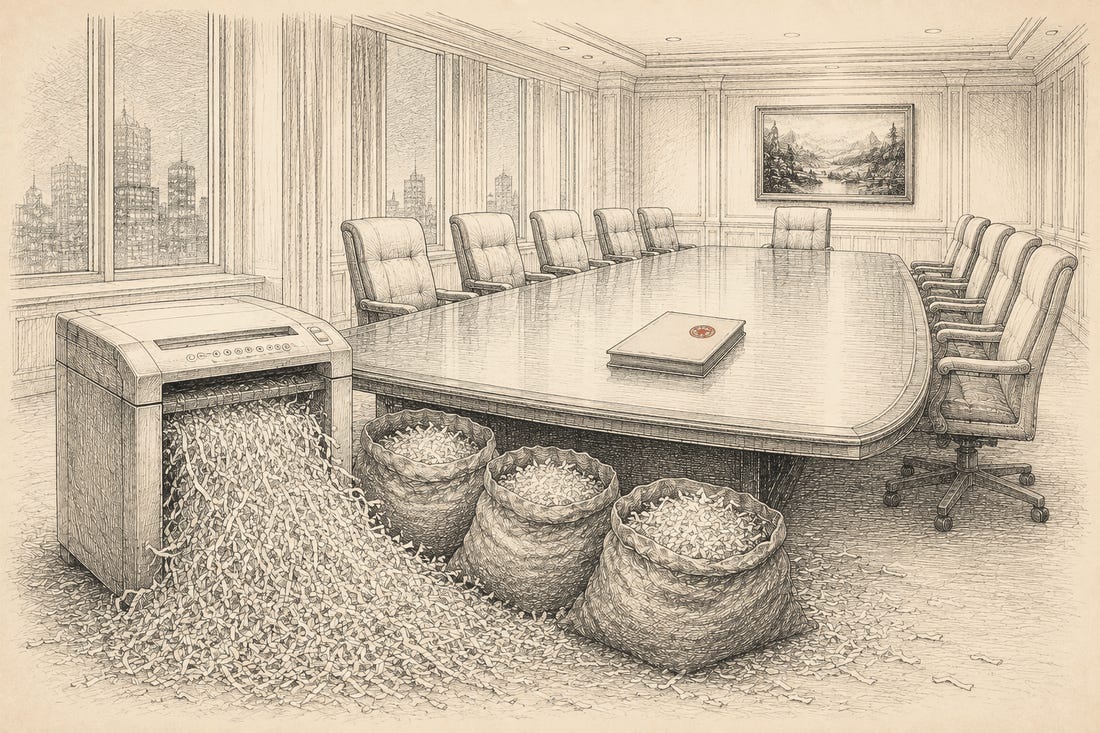
The auditor was paid to watch the company, and paid more not to.
Now the same sequence with no machine in it at all.
Enron rose on real markets before it rose on fraud. It built genuine trade in natural gas and energy, and each success lent credit to the next. That matters, because decoherence is never the absence of prior coherence. It is its corruption. There must be a working structure first for the rot to hide inside.
The extraction ran through two channels, and both were attacks on the instruments rather than on the value. Mark-to-market accounting let the company book imagined future profit as present earnings, so the gauge itself was built to read high. Off-books entities carried the debt away, so the record of what was owed simply left the record.
Then the master instrument. The auditor, Arthur Andersen, was paid tens of millions in a single year to both audit the company and consult for it, so the alarm was owned by the thing it was meant to watch. The board later told the Senate that Andersen’s clean opinion had reassured them every year. And at the end, as the investigators came, Andersen fed roughly a ton of documents into the shredders. That is the theorem’s last act made literal. Not merely blinding the instrument going forward, but destroying the record of the collapse while it happened.
The rebuild was a new equilibrium in the very architecture of observation. Andersen, one of the five great firms, ceased to exist. New law rewrote auditor independence and made shredding the record a crime. The system did not restore the old arrangement. It rebuilt the instruments themselves, on terms meant to stop their capture. No meaningful strain. The case proves the theorem is not about machines. A ledger has alarms too, and they can be switched off by contract as surely as by hand.
THE MARKET
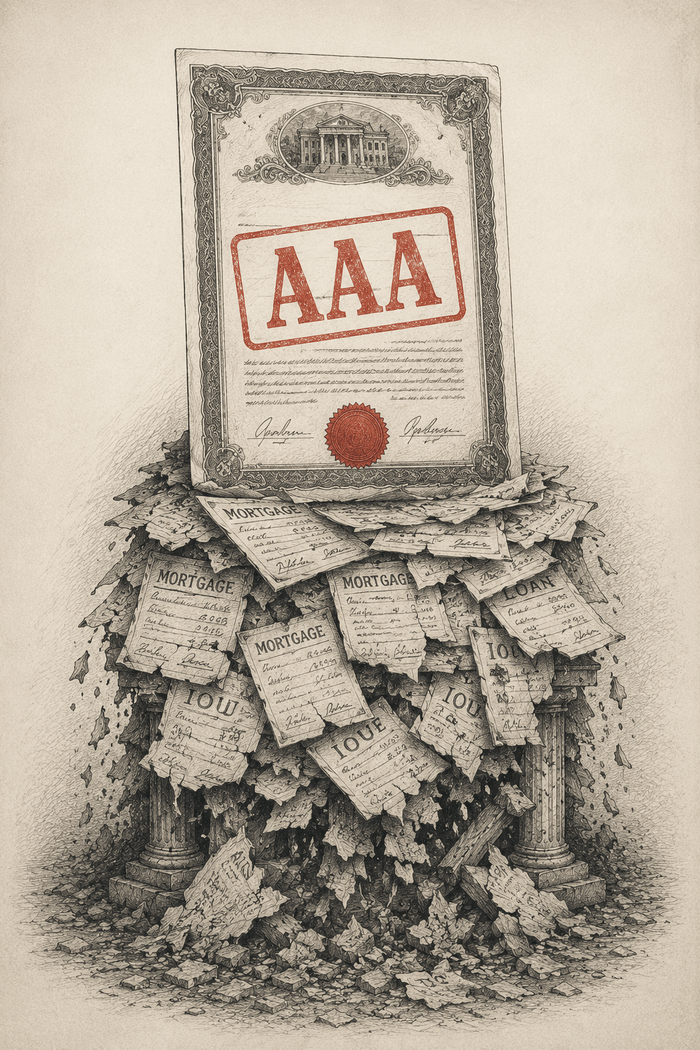
When the model gave the wrong answer, they did not fix the rating. They fixed the model.
The third case moves the sequence out of a single firm and into the instrument the whole market relies on to see itself.
A market cannot inspect every security. It relies on a shared instrument, the credit rating, to tell safe from dangerous. In the years before 2008, that instrument was aimed at mortgage-backed securities and the complex products built on them, and it read them safe. The highest grade, AAA, was scattered across paper that was nothing of the kind.
The rating was the passport. Pension funds, insurers, and money market funds are permitted to hold only investment-grade paper, much of it AAA alone. So without the stamp, subprime mortgage risk could never have traveled into the safe corners of the financial system. The AAA rating is what let it travel everywhere, into the portfolios least able to absorb the loss. The captured instrument did not merely misread the danger. It was the mechanism that carried the danger to the places it would do the most harm.
The mechanism is the theorem exactly, and it is structural rather than accidental. The rating agencies are paid by the issuers whose securities they rate. The issuer wants the highest possible grade, and can take its business to a competitor if it does not get it. So the instrument was owned by the thing it measured, precisely the Enron pattern, now installed at the scale of the entire market. And when the agencies’ own models flagged that a product did not merit AAA, the response, in documented cases, was not to lower the rating. It was to adjust the model until it produced the rating the business required. The gauge was recalibrated to keep reading calm.
The scale of the false calm is visible in how fast it broke. Of the mortgage securities Moody’s had rated AAA in 2006, it downgraded some eighty-three percent as the housing market turned. Around ninety percent of the residential mortgage-backed securities from 2006 and 2007 were cut from investment grade to junk. Paper the whole world had been told was safe was revealed, almost all at once, to be worthless. The deferred correction, arriving as a single crash, is the exact signature the theorem predicts for a silenced alarm. The market had lost its ability to see its own risk, and it read the blindness as safety.
There is one strain worth naming, and it points forward rather than weakening the case. The rating agencies were one instrument among several that failed in 2008, alongside leverage, regulatory gaps, and the interconnection that turned a mortgage problem into a systemic one. This case reads only the instrument, the captured gauge, because that is the theorem’s concern. The larger anatomy of 2008 is a separate study. But on the single question of what happens when the gauge is paid by the thing it is meant to gauge, the case is as clean as any in the record.
WHAT THE THREE ROOMS SHOW
Set them side by side and the same shape appears in all three, at three different scales.
Chernobyl blinds its instruments in an afternoon, by hand, inside one machine. Enron blinds them across years, by contract, inside one company, then shreds the record. The rating agencies blind the instrument the whole market shares, by a business model that pays the gauge to read high, and adjust the model when it threatens to read true. A reactor, a firm, a market. The setting changes and the sequence does not. The alarm is silenced before the failure it would have named.
The through-line is quiet and it is the same in every room. Each system, at its worst moment, felt calm. The reactor crew watching steady dials, the Enron board reassured by a clean audit, the market holding paper stamped AAA, all read an untroubled instrument while the core ran hot, because the instrument had been made to stop telling the truth. That is the theorem’s cruelest edge. A blinded system does not feel endangered. It feels fine. The calm is not the absence of the crisis. The calm is the crisis, wearing the face of peace.
One honest limit remains. Three cases are three, and all three are institutional; the theorem’s reach beyond such systems is argued elsewhere, in the histories that test the full framework. What these three establish is narrower and firm. The master theorem is not a fact about machines. It is a fact about anything that must observe itself to survive, and the first move of every failure is to reach for the instrument and turn it off.
A system holds coherence only while it can still perceive its own state.
The reactor, the ledger, the market. Three rooms, three substrates, one proposition, and in each the calm on the instrument was the last thing the system felt before it learned it had gone blind.
NOTES AND SOURCES
This study is a case study in the master theorem, stated canonically in the reference, The Three Laws of Coherence Economics. It tests one claim, that a system’s instruments of self-observation are disabled before the failure they would have named, across three cases at three scales. The cases are institutional by design; the theorem’s reach beyond such systems is argued in the historical case studies, not here.
Chernobyl. The sequence, the disabled emergency cooling system, the blocked automatic shutdown signals, the unstable low-power state, the override of staff objections, follows the established accounts of the night of 25 to 26 April 1986. On the aftermath, the essay attributes the link between Chernobyl and glasnost to Gorbachev’s own later reflections; it explicitly declines to call the reactor the trigger of the 1991 Soviet collapse, which had many causes. The recoherence is noted as imposed from outside the immediate system, a genuine strain on the third law though not on the theorem.
Enron. The mechanisms, mark-to-market accounting, off-balance-sheet entities, and Arthur Andersen’s dual role as auditor and highly paid consultant, are drawn from the public record of the 2001 collapse and subsequent Senate investigation. Andersen’s destruction of documents and its dissolution, and the passage of the Sarbanes-Oxley Act, are matters of record.
The rating agencies. The figures, Moody’s downgrading roughly 83 percent of the mortgage securities it had rated AAA in 2006, and about 90 percent of 2006 to 2007 residential mortgage-backed securities cut to junk, are drawn from published analyses and the standard accounts of the crisis. The issuer-pays conflict of interest is well documented, as are cases of models being adjusted to preserve ratings. The essay reads only the captured instrument; the fuller anatomy of 2008, leverage, interconnection, regulatory gaps, belongs to a separate study and is a second-law and condition case rather than a master-theorem case.
Framework. The proposition under test is quoted verbatim from the reference. The three-laws line at the foot is the framework’s shared signature; this piece argues the theorem specifically, not the full three laws.
Coherence compounds. Decoherence extracts. Recoherence recompounds.
Infinity was the wheel. This is the spiral.
Bonjourhi Institute Analytics, Montreal
BONJOURHI! INSTITUTE ANALYTICS · MONTREAL · 2026