

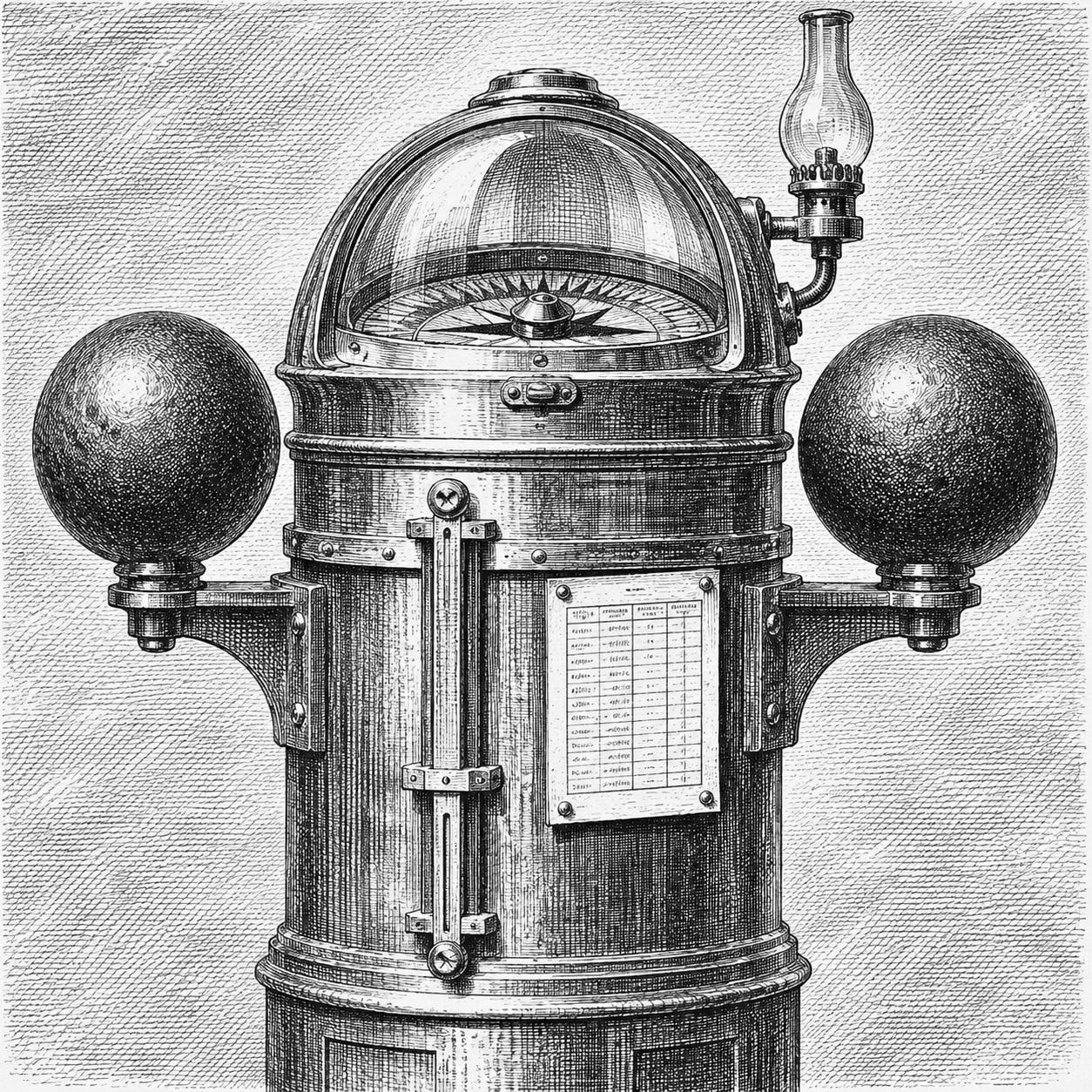
* The binnacle is the stand that houses a ship's compass in front of the helm. Its soft-iron spheres, often called Kelvin spheres, apply a principle George Airy established in 1838 in trials aboard an iron ship. Lord Kelvin built them into his binnacle design in the 1870s. The vertical bar is named after the navigator Matthew Flinders.
In February 1781, a French finance minister did something no royal servant had dared. He published the King's accounts. Readers bought them by the tens of thousands, and for a few months France believed its books were in order.
Two hundred and forty-five years later, France publishes its accounts all the time. Forecasts, targets, revisions, revised revisions. Nothing is hidden.
And yet the markets behave as if something were.
To see why, it helps to look at a small printed card that once hung beside the compass of every iron ship.
The card beside the compass
In January 1854, the Tayleur¹ left Liverpool for Melbourne. She was new, fast and built of iron, which was still a novelty for a ship of her size. Two days out, in fog, she ran onto the rocks of Lambay Island, north of Dublin.² Hundreds of passengers drowned. The inquiry pointed, among other causes, to her compasses.
A magnetic compass reads the Earth. An iron hull has a magnetism of its own, and it pulls the needle away from north. The error is not fixed. It changes with the direction the ship is pointing.
Engineers answered iron with iron. Beside the compass they mounted two soft-iron spheres, placed to pull the needle by as much as the hull pulled it the other way. A vertical bar on the front of the stand and small magnets hidden inside it dealt with the rest. Correction, however, is never perfect. Something always remains.
Sailors learned to live with this. Before a voyage, the ship was swung in harbour, turned slowly through every point of the compass while its readings were checked against known bearings on shore. What remained was written down, heading by heading, on a small printed sheet called the deviation card.
A compass with a known error is a good compass. The navigator simply applies the correction and steers.
The card has one weakness. It holds only while the ship's magnetism stays the same. New iron settles in its first months at sea. Cargo shifts, repairs are made, a long passage on one heading slowly remagnetizes the hull. When that happens, yesterday's corrections no longer apply, and nobody aboard knows by how much.
A careful navigator who stops trusting the card does not abandon the compass. He slows down. He sounds the depth more often. He gives every coastline a wider berth.
That berth is never free. It costs time, fuel and cargo delivered late. It is the price of an instrument that can no longer be corrected.
The practice has not disappeared. A modern ship steers by satellite and gyrocompass, yet international rules still require a properly adjusted magnetic compass aboard, its deviation table kept current.³ Ships are still swung after a refit or a stay in dry dock. The old card survives for a simple reason. It belongs to the needle a crew turns to when every screen on the bridge has gone dark.
Half a card
France in the 1780s was a ship with a badly magnetized hull. Deficits had become chronic. Interest on the royal debt absorbed a growing share of revenue, close to half of spending by the end of the decade. Ministers came and went. Every serious reform ran aground on the privileges of those it would have taxed.⁴
The country also carried an older wound. Since the collapse of John Law's system in 1720,⁵ the French had distrusted paper and the institutions that issued it. France would spend some eighty years without a trusted central bank, until the Banque de France opened in 1800.⁶ A Hand on the Wall, released alongside this essay, tells how that wound was made.
Into this, Jacques Necker⁷ published his Compte rendu au roi.⁸ It showed a surplus of about ten million livres.⁹
The figure was not invented. It held for the ordinary account, the routine income and spending of the state. What the document left out was the extraordinary account, where the cost of the American war¹⁰ sat. It had been paid for with loans, the only lever left once new taxes were off the table.
Necker did not falsify the compass. He published half the card.
Readers applied no correction because they did not know one was needed. Six years later, Calonne¹¹ stood before the Assembly of Notables¹² and disclosed a deficit of more than a hundred million livres. From then on, no figure a minister produced could be taken at its word. Within two years, the Estates General¹³ were meeting at Versailles.
A card that will not hold
Today's problem is not concealment. It is movement.
In 2025, the deficit came in at 5.1% of GDP, better than the 5.4% the government had aimed for. A pleasant surprise.
Then 2026. The multi-year path¹⁴ had promised 4.6%. The budget, adopted after long negotiation, settled on 5.0%. In September, with growth cut in half, from 1% to 0.5%, the finance ministry conceded 5.4%. Weaker activity, energy support and heavier interest payments each played a part.
For 2027, the old path pointed to 4.1%. The new target is 5.0%.
None of these numbers is a lie. Each was defensible when it was written. But look at the pattern. One year the error ran in France's favour. The next, it ran against it, and grew with each revision.
That is a hull whose magnetism keeps changing. No one can write a deviation card for it.
So the markets have done what any navigator would, and given France a wider berth. On October 30, Fitch¹⁵ kept France at A+ but turned its outlook negative, noting that French borrowing costs had risen faster than those of most comparable countries since its August review. It also judged the prospects for deficit reduction after next spring's presidential election¹⁶ to be uncertain.
In a bond market, that berth has a name. It is called a spread.¹⁷
The new chamber
The numbers are the easy part. Beneath them lies something harder, and the nautilus¹⁸ shows it best.

The creature grows by leaving. When its living space becomes too tight, it moves forward and seals a wall behind it, closing off the room it has outgrown. It never goes back. Its shell is a spiral record of every chamber it has abandoned.
A new chamber gives no lift at first. It is born full of liquid, which the animal draws out slowly over the following weeks. Until then, it carries more weight, not less. Buoyancy arrives later, as the reward for having built.
France has outgrown its chamber. The model that served it for half a century, generous pensions and high public spending carried by steady expansion and cheap borrowing, no longer fits a country with slower growth, an older population and interest rates that have returned. A lost decade is a real risk. Not because France lacks talent or capital, but because the move forward keeps being postponed.
A nation, however, is not a mollusc. It has to agree to build. Much of the French public is not yet ready to accept that the old chamber is closing, and every attempt to seal the wall has met the street, the Assembly, or both.¹⁹
Beneath it all sits a question no forecast can answer: who carries the weight while the new chamber fills? Retirees or workers. Firms or the wealthiest households. Or the young, through debt they never chose. Each group can argue, with some justice, that another should go first.
A deviation card cannot settle that. Only consent can, and unlike a forecast, it cannot be revised every September.
Swinging the ship
In Coherence Economics,²⁰ the instruments go first. A system can correct only what it can still read.
A ship relies on two kinds of instrument for that. The spheres reduce the error, and the card discloses whatever is left. For a state, fiscal rules and independent institutions play the part of the spheres, while its forecasts are the card. France needs both, and each is under strain.
France's instruments were captured in 1720 and half-published in 1781. Today they are intact but fraying, and each missed forecast teaches investors to discount the next one. That is how decoherence begins in a democracy. Not by decree, but by credibility leaking away one revision at a time.
The remedy is old and unglamorous. Ships were swung in harbour, before departure, while the water was calm and there was time. France is about to change hands. Not by the guillotine this time, but at the ballot box, which is how a democracy swings its ship. The harbour is the first budget after the election. Whoever governs will have one chance to publish a target modest enough to be met, then meet it, then do so again.
This would not cure the debt. It would repair the card, and everything else depends on that.
The danger was never that France's forecasts are wrong. Forecasts always are. What matters is that nobody can say any longer by how much.
In 1781, France trusted a card that was incomplete. Now the card is complete. What is missing is the trust.
Bonjourhi Institute, Montréal
Notes
1. The Tayleur, an iron-hulled clipper launched in 1853 and chartered by the White Star Line, was wrecked on her maiden voyage on January 21, 1854. Of some 650 people aboard, around 380 died. The inquiry cited compass errors caused by the iron hull, along with other shortcomings of ship and crew.
2. Lambay Island lies off the coast of County Dublin, Ireland, a few kilometres north of Dublin Bay.
3. The International Convention for the Safety of Life at Sea (SOLAS), Chapter V, requires seagoing ships to carry a properly adjusted standard magnetic compass and a deviation table or curve.
4. Under the Ancien Régime, society was divided into three orders: the clergy (First Estate), the nobility (Second Estate) and everyone else (Third Estate). The first two enjoyed broad exemptions from the main direct taxes.
5. John Law (1671 to 1729), a Scottish financier, founded a royal bank in Paris issuing paper money and merged it with the Mississippi Company, which held France's colonial trade monopolies. The scheme collapsed in 1720, ruining many investors and leaving lasting distrust of paper money and banks.
6. The Banque de France was founded in January 1800 under Napoleon Bonaparte, then First Consul.
7. Jacques Necker (1732 to 1804), a Genevan banker, directed French royal finances from 1777 to 1781. Recalled in 1788, he was dismissed again on July 11, 1789, an event that helped spark the storming of the Bastille three days later.
8. The Compte rendu au roi (Report to the King), published in February 1781, was the first public statement of French royal finances.
9. The livre tournois was the money of account of the French monarchy until it was replaced by the franc in 1795.
10. France entered the American War of Independence in 1778 as an ally of the United States. Its cost, often estimated at about one billion livres, was financed largely by borrowing.
11. Charles Alexandre de Calonne (1734 to 1802) served as controller general of finances from 1783 to 1787. He was dismissed after the notables rejected his reforms.
12. The Assembly of Notables, convened at Versailles in February 1787, was a hand-picked body of nobles, clergy and officials. It refused Calonne's proposal for a universal land tax.
13. The Estates General, representing the three orders, had not met since 1614. Convened in May 1789, it became the starting point of the French Revolution when the Third Estate proclaimed itself the National Assembly in June.
14. The medium-term fiscal trajectory France submitted to its European partners, which aims to bring the deficit below 3% of GDP by 2029.
15. Fitch Ratings is one of the three major credit rating agencies. A+ is the fifth-highest grade on its scale. A negative outlook signals that a downgrade is possible, typically within one to two years.
16. The presidential election is held in two rounds in April and May 2027. The incumbent, Emmanuel Macron, cannot seek a third consecutive term.
17. The spread is the difference between the yield on French ten-year government bonds (OATs) and that on German ten-year bonds (Bunds), the eurozone's benchmark. A wider spread means investors demand more to hold French debt.
18. The chambered nautilus (Nautilus pompilius), a deep-water mollusc of the Indo-Pacific, builds its shell as a spiral of sealed chambers and regulates its buoyancy through a tube, the siphuncle, that runs through them.
19. The 2023 pension reform, which raised the retirement age from 62 to 64, drew months of mass protest and was later suspended until after the 2027 election. In the National Assembly, the Barnier government fell to a censure motion in December 2024, and the Bayrou government lost a confidence vote in September 2025.
20. Coherence Economics is an analytical framework resting on three laws: coherence compounds, decoherence extracts and recoherence recompounds. Decoherence describes the loss of alignment between a system's instruments, institutions and reality.
21. Source, Fitch outlook revision, October 30, 2026: Morningstar / Dow Jones; Sovereign Magazine.
22. Sources, deficit path and revisions: France's elusive €54bn fiscal fix; OECD Economic Outlook, France.