

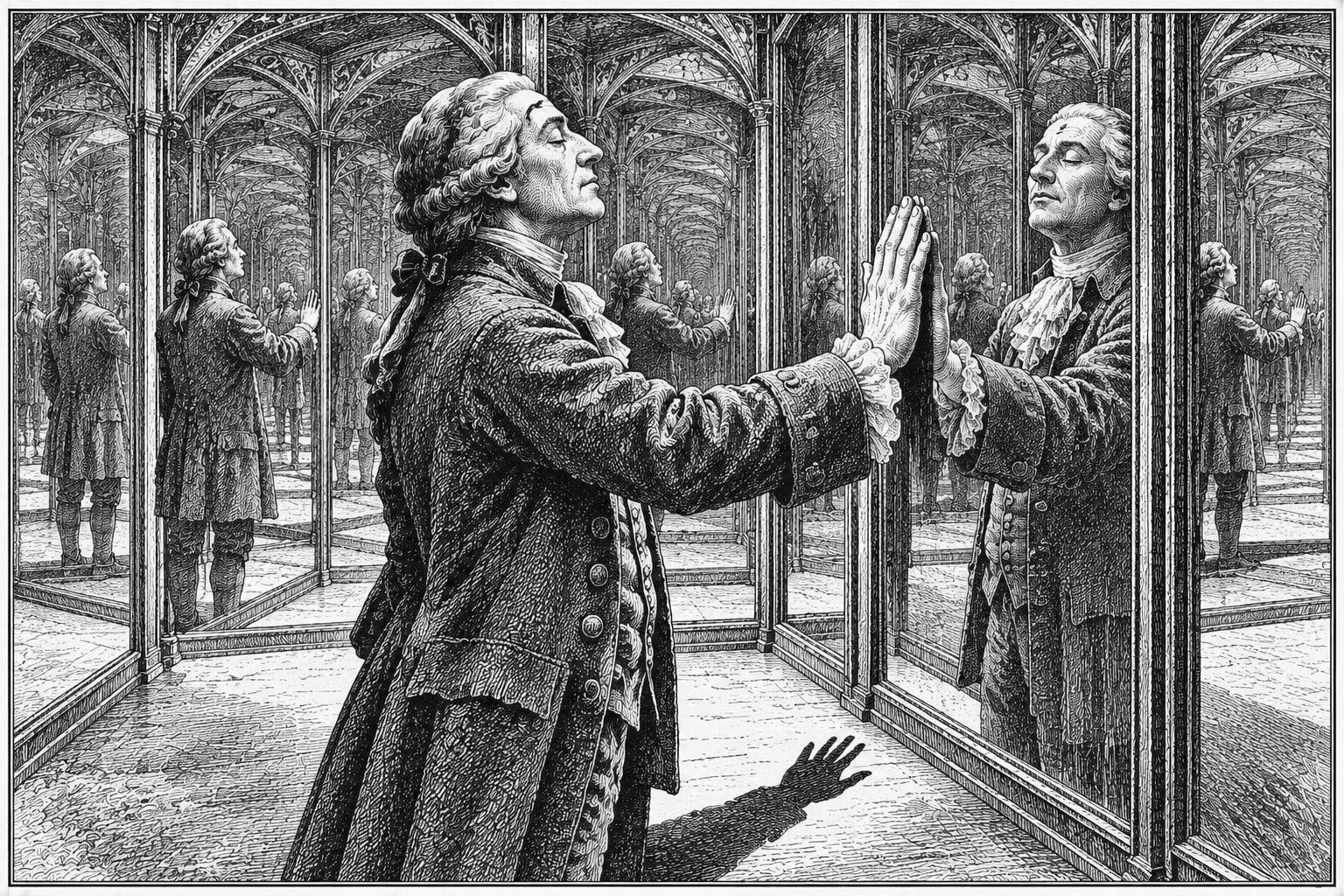
In 1720, three of the richest cities in Europe fell for the same idea within a single year. Paris went first, London second, Amsterdam last. The idea was clever and partly right, which is exactly why sensible people believed it.
Today another promising idea is pulling in money faster than most of us have ever seen. Artificial intelligence works; nobody serious disputes that. What deserves a closer look is how we measure its worth, and whether those measurements still describe the world or have started describing each other.
The empty gallery
In the summer of 1720, the Hall of Mirrors at Versailles stood almost empty. Louis XIV had died five years before, leaving war debts his kingdom could not pay, and the Regent governing for the boy king had moved the court to Paris. Out in the gardens, a hedge maze built by Le Nôtre held thirty-nine fountains, each acting out one of Aesop's fables to teach a young prince where vanity leads.
Nobody was looking at either. Paris was busy buying and selling paper on the rue Quincampoix.¹
The idea that worked
John Law was a Scottish gambler with a gift for numbers. His proposal sounded sensible: replace scarce gold with paper money, make credit cheaper, and hand the state's debt to a great trading company whose future profits would pay it off. For two years it worked. Shops reopened, trade picked up, and France breathed again.
Then the scheme kept growing. The Mississippi Company took over France's colonial trade, the collection of its taxes and the minting of its coins. A share bought for 500 livres was soon worth close to 10,000. The French needed a new word for the people this made rich, and they found one: millionaire.²
The turn
In March 1720, the bank fixed the price of a share at 9,000 livres and promised to swap shares and banknotes on demand. From then on, the paper money set the price of the shares, and the shares gave the paper its value.
A rising price came to look like proof of value, and that proof became the reason to pay more. The measuring stick had become part of the thing it was supposed to measure.
The mirror maze
Anyone who has been inside a mirror maze at a fair knows the feeling. Walking in is fun. Light bounces everywhere, corridors seem to open in every direction, and each turn looks perfectly reasonable.
Getting out is another story. The opening ahead turns out to be glass. The exit you see is the entrance behind you, reflected. People who rush bump their heads.
The ones who find their way out stop believing their eyes. They put a hand on the wall and walk slowly, feeling as they go. Glass is smooth and cold; an opening lets in air. A hand cannot be fooled by a reflection.
Paris outlaws the hand
Early in 1720, the Prince de Conti, reportedly annoyed at being refused more shares, sent wagons to the bank and demanded that his banknotes be paid out in gold and silver. Other wealthy holders followed. The government's answer was astonishing: a new rule said no household could keep more than 500 livres in coin.
Coin was the one thing paper could not fake. Holding it was now against the law.
Belief in Louisiana needed propping up too. According to stories told later, the authorities gathered beggars off the streets of Paris, gave them new picks and shovels, and marched them through the city as miners heading for the colony's gold.³ Within weeks, many had sold their tools and wandered back.
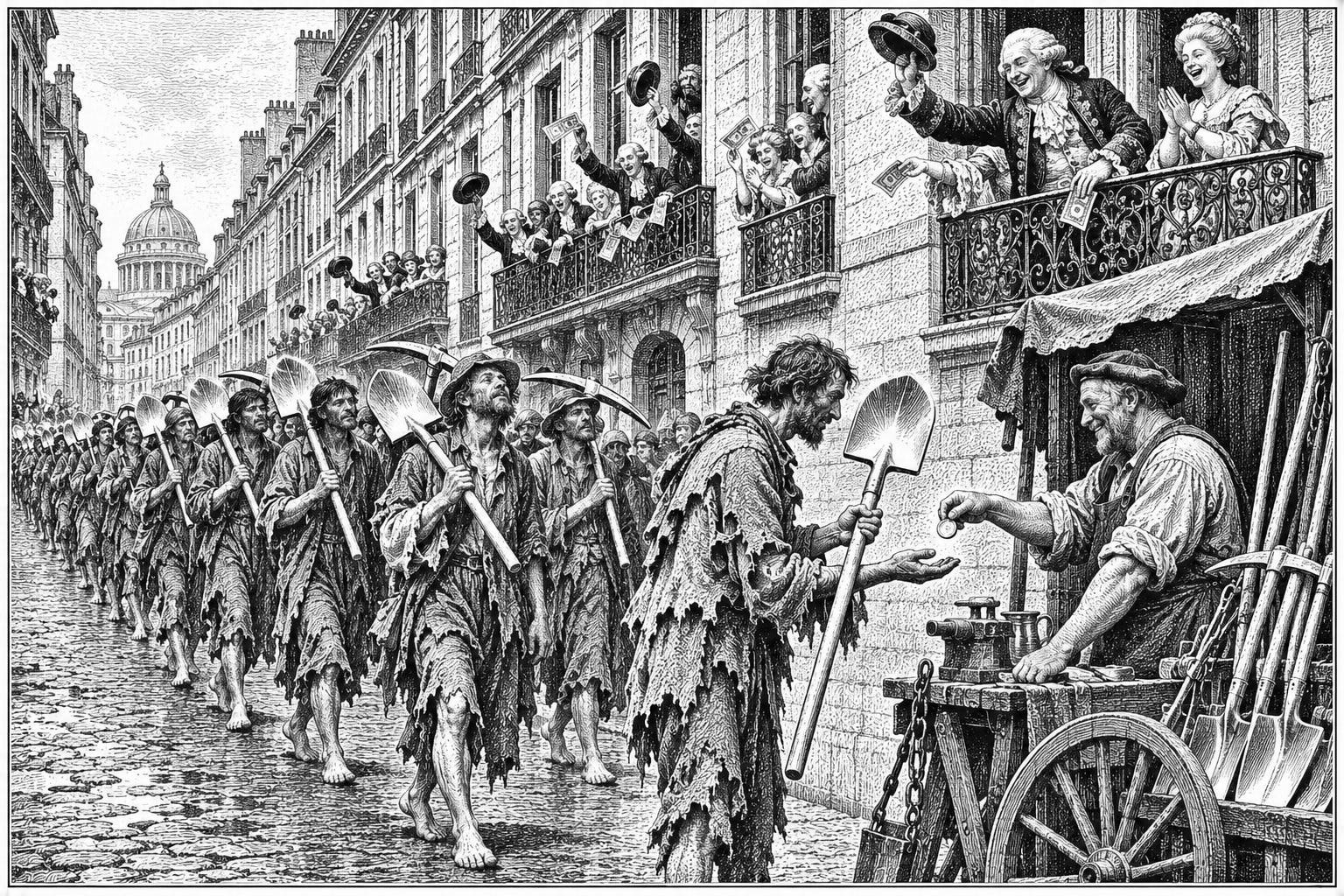
Outlawing the hand did not remove the wall. In May, a decree began cutting the value of shares and notes step by step. It was cancelled a week later, but the damage was done. By December, its architect had fled the country.
London
Britain ran its own version through the South Sea Company, set up in 1711 with the sole right to trade with Spain's American colonies, a right that never earned much. Its real job was holding government debt.⁴
In 1720 it offered to take over most of what Britain owed. Bondholders could swap their government paper for South Sea shares, and the company paid the Treasury generously for the privilege. A catch was built into the deal. The swap was done at the share's market price, so the higher the price climbed, the fewer shares the company had to hand over and the more it retained to sell for itself. The directors earned most when the price rose fastest.
So they made sure it rose. Shares were sold on easy terms, a small deposit now and the rest later. The company lent people money to buy more of its own stock. Ministers and members of Parliament were quietly given shares for free. In January a share cost about 128 pounds; by late June it was close to 1,000. Isaac Newton, the story goes, sold early, jumped back in near the top, and lost a fortune.
In June, Parliament passed what became known as the Bubble Act, banning new companies that lacked a royal charter. The directors were delighted, since rival schemes were drawing money away. But when the authorities moved against those rivals in August, their investors suddenly needed cash and sold whatever they could, starting with the easiest thing to sell: South Sea shares. The barrier built to keep competitors out ended up hemming the company in. By the end of the year its shares had lost more than four fifths of their value.
What happened next set Britain apart from France. The directors' fortunes were seized, and the Chancellor of the Exchequer, John Aislabie, was locked in the Tower of London. Robert Walpole patched together a settlement, and the Bank of England came through intact. One thing lingered: the Bubble Act remained law until 1825, so for a century starting a company in Britain required the government's blessing.
Amsterdam
The Dutch caught the fever last, launching around forty new companies in provincial towns over a single summer. Most were gone within months.
The Dutch had seen this before. During the tulip craze of 1637 they had coined a word for trading in things that did not exist: windhandel, the wind trade. In 1720 they reached for it almost at once. Amsterdam, the busiest money market in Europe, refused to charter any of the new schemes, so the fever burned in smaller towns while the big city stood aside.
Two of the provincial companies lasted more than a century: an insurance company in Rotterdam, and a trading house in Middelburg whose ships would later carry enslaved Africans across the Atlantic, a trade that still shames the country. Neither was admirable. Both were solid. Each was paid at the moment it delivered something, a policy signed or a cargo landed, so its money came from customers outside the frenzy and continued once it ended.
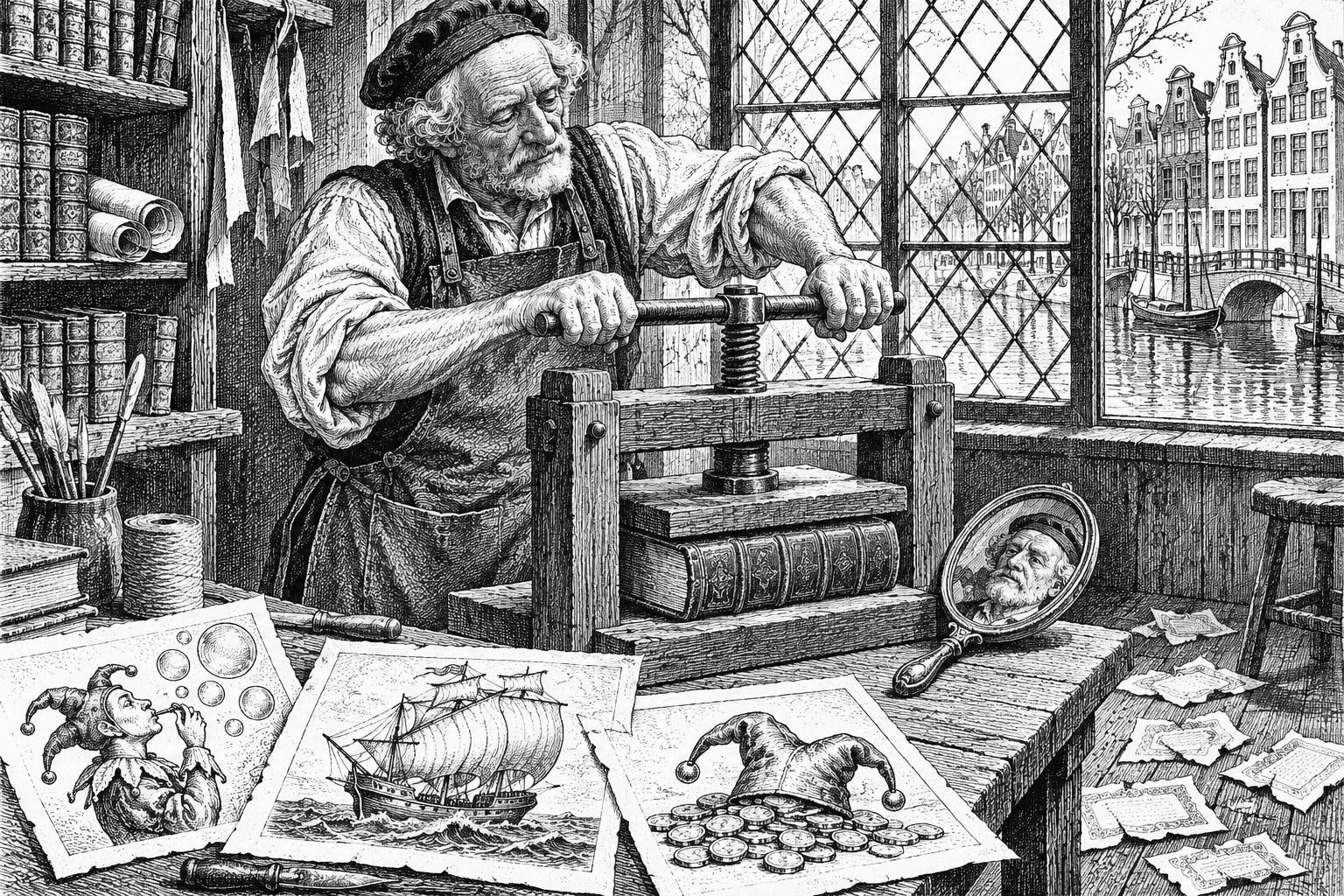
Then came the book. Late in 1720, publishers began selling a collection called Het Groote Tafereel der Dwaasheid, The Great Mirror of Folly.⁵ It gathered dozens of satirical prints alongside comic plays, poems, mock advertisements and the genuine prospectuses of the failed companies. Fools blew soap bubbles, investors were swept off by the wind, Fortune drove her chariot over a cliff. Booksellers added pages as new prints appeared, so hardly two surviving copies are alike.
It was not a lament. It was a public accounting, done with laughter instead of lawsuits. By printing the promises beside the caricatures, it let readers compare what had been sold with what had been delivered. Ridicule served as memory: a merchant who had laughed at a projector blowing bubbles would hesitate before buying from the next one.
The lesson held. Amsterdam remained Europe's favorite lender for most of the century, financing other governments, Britain's among them. The Dutch did not ban speculation or close their exchange. They kept their instruments and added one more: a mirror.
What each city kept
The three cities came out of 1720 very differently, and the difference had less to do with how much they lost than with what they kept.
Paris lost faith in paper itself. For generations the French distrusted banks and banknotes, and the state paid for that suspicion every time it needed to borrow, a story our companion piece, The Deviation Card, follows to the eve of revolution.
London held on to the Bank of England and a bond market people trusted, and through the 18th century borrowed more cheaply than its rival,⁶ though it carried a restriction it no longer needed for a hundred years.
Amsterdam preserved its instruments and gained a memory.
Money was not the lasting loss. Trust in the tools was.
The instruments go first
At the Bonjourhi Institute we call this pattern the master theorem of Coherence Economics: the instruments go first. Long before a system breaks, the tools we use to measure it stop telling the truth. They keep producing numbers, so nobody notices.
What those tools end up measuring is what we call the Faith Premium: the extra value people place on confidence about the future rather than on results today. Faith is necessary. Every factory is built before its first customer walks in. Faith becomes dangerous when all it pays for is more faith.
1720 followed the pattern step by step. First, the March peg corrupted the price. Then the damage spread out of sight, because every share price and every banknote seemed to confirm the others. Next came a sudden collapse, in a single week of May. Rebuilding trust took far longer than losing it.
The same steps can be tracked today. The first is already visible. The second, by its nature, cannot be seen from the inside. The last two are not inevitable, as long as the measuring tools are repaired before the glass breaks.
The AI corridors
Today's AI build-out rests on technology that works and on millions of users, much as the Mississippi scheme's first years rested on genuine growth in trade.
But a familiar pattern has appeared. A chipmaker or one of the giant cloud companies invests in, or lends to, an AI developer, and that developer then commits to buying the investor's chips for years to come.⁷ In October, the Bank for International Settlements, often described as the central bankers' bank, studied more than a thousand AI firms and found that much of the industry's financing and business runs in circles between the same players.⁸ Between 2021 and 2025, it found, 55.2 percent of the money invested in AI firms came from other AI firms.
Money that leaves a supplier comes back to it as sales. Companies are valued by comparison with others valued inside the same circle. The original hope returns dressed up as evidence.
Every dollar spent on data centers is revenue for someone. That does not make it lasting value. A trillion dollars added to stock market value does not mean a trillion dollars' worth of new factories, skills or services now exists. It means investors have agreed to price the future higher.
The parade of miners has a modern version too: announced partnerships and huge capacity plans that move share prices before any contract is signed. In November 2025, Nvidia's own quarterly report admitted there was no guarantee it would reach a final agreement with one such announced partner.⁹
And the rule on coin? Nobody forbids investors from checking. The trouble is that these circular deals hide risk in places ordinary financial statements struggle to show.⁷ Complexity does quietly what the Regent did by decree.
Three mirrors
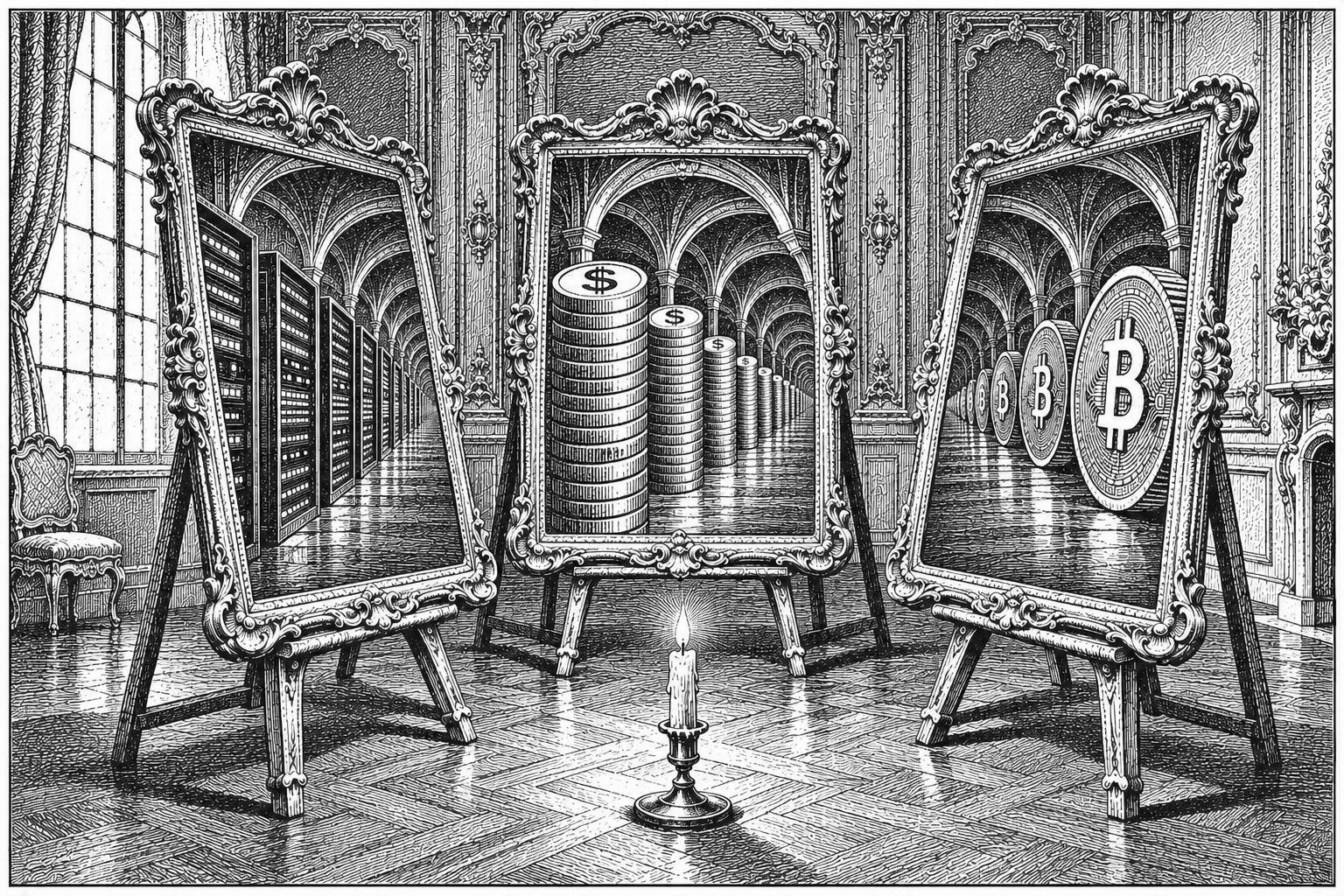
The Paris system of 1720 tied three things into one knot: money, government debt and a speculative asset. All three are back today, joined for now by loose threads rather than a knot.
The first is the AI circle just described.
The second is a new kind of private money. Stablecoins are digital tokens meant to be worth exactly one dollar, and their issuers back them mostly with short-term US government debt. Since 2023 those issuers have added more short-term US debt than Japan, the largest foreign holder.¹⁰ Washington welcomes the demand, as the Regent welcomed buyers for France's debt. The difference is that stablecoins rest on sound government paper rather than hope. The danger runs in reverse: if holders rush to cash in their tokens, issuers must sell that debt in a hurry, so a crypto panic could become a problem for the US Treasury.¹¹
The third is bitcoin. Nothing ties it to any currency. But some listed companies now sell shares and borrow money specifically to buy bitcoin, and the rising bitcoin price then lifts their shares, which lets them raise more money to buy more. It is the March 1720 loop, rebuilt inside a single company.
Index funds could pull the three closer together. When a company's share price rises, it takes up more room in the major stock indices, so the funds that copy those indices must own more of it. Trend-following traders pile in, and analysts raise their forecasts to keep up. What looks like millions of separate decisions may be a few assumptions echoed through many channels.
For now, each mirror still faces the room. The moment to watch is when they start facing each other: rules on stablecoin reserves loosened, token issuers lending to data-center builders, AI companies holding crypto on their balance sheets. Point mirrors at one another and you see an endless corridor, and nothing else.
The Hand on the Wall Test
The Rotterdam insurer shows where the solid walls are. Four simple checks, which any investor or board member can ask for, show whether an AI business stands on that kind of ground.
Money from outside. How much of the company's income comes from customers outside the AI industry, paying with money they earned elsewhere? Money circling inside the industry is a reflection. Money arriving from outside is fresh air through an open door.
Chips against loans. Will the chips remain useful when the loans that bought them come due? Equipment that a newer generation makes obsolete in three years, paid for with seven-year debt, is a corridor that ends in glass.
Power against promises. How much electricity has actually been secured, compared with the capacity announced? A data center without power is a shovel without a mine.
Customers after the discount. Do clients keep paying once the introductory price ends? Demand that exists only because of a subsidy disappears with it.
A business that passes all four resembles the insurer. One that fails them may have a good idea, but it is standing in a hall of mirrors.
The closing turn
Law died in Venice in 1729, broke and still sure he had been right. In a sense he was: two centuries later, paper money ran the world. His idea won; the way he built it failed.
What society gains and what investors earn sit in separate books. Railway shareholders lost fortunes on lines that served a continent for a hundred years. Dot-com investors paid for fiber cables the internet still runs on.
AI will probably travel the same road: the technology will last, while part of the money piled around it will not. The real question is what is left standing after the shakeout. In 1720 the answer turned less on who lost money than on who could still trust what their instruments told them.
When the reflections multiply, how can we tell whether the room itself has grown? Only one way: reach out and feel for the wall.
A market can live with its mirrors. What it cannot survive is losing the freedom, or the means, to touch what is real.
Bonjourhi Institute, Montréal
Notes
1. The rue Quincampoix, a narrow street in central Paris, became the open-air market for Mississippi Company shares in 1719. Crowds grew so large that the authorities closed it to trading in March 1720, and dealing moved first to the Place Vendôme and later to the gardens of the Hôtel de Soissons. See Antoin E. Murphy, John Law: Economic Theorist and Policy-Maker, Oxford University Press, 1997.
2. The word itself was born in this crash. French millionnaire first appeared around 1719 to 1720, when speculators in Mississippi Company shares grew rich overnight on the rue Quincampoix. It began as mockery of bubble fortunes, and English borrowed it only decades later.
3. The parade is best known from Charles Mackay, Extraordinary Popular Delusions and the Madness of Crowds, 1841, which puts the number at several thousand and reports that many sold their tools and returned within weeks. Historians treat Mackay's details with caution, but the forced dispatch of vagrants and convicts to Louisiana in 1719 and 1720 is well documented.
4. On the South Sea scheme, see John Carswell, The South Sea Bubble, 1960; Richard Dale, The First Crash: Lessons from the South Sea Bubble, Princeton University Press, 2004; and Helen J. Paul, The South Sea Bubble: An Economic History of Its Origins and Consequences, Routledge, 2011.
5. Het Groote Tafereel der Dwaasheid, published anonymously in Amsterdam in 1720. For the modern edition and scholarly study, see William N. Goetzmann, Catherine Labio, K. Geert Rouwenhorst and Timothy G. Young (eds.), The Great Mirror of Folly: Finance, Culture, and the Crash of 1720, Yale University Press, 2013.
6. On comparative borrowing costs, see Douglass C. North and Barry R. Weingast, “Constitutions and Commitment,” Journal of Economic History, 1989; and François R. Velde and David R. Weir, “The Financial Market and Government Debt Policy in France, 1746 to 1793,” Journal of Economic History, 1992.
7. Saf Malik, “What is circular financing in AI infrastructure, and should telecoms and data centre operators be worried?” Capacity, 25 August 2026.
8. Jon Frost, Rudraksh Kansal, Kumar Rishabh, Vatsala Shreeti and Leanne Si Ying Zhang, “Circular relationships among AI firms,” BIS Bulletin No 137, Bank for International Settlements, 1 October 2026. The study covers 1,246 AI firms; the 55.2 percent figure refers to the value of investment received by AI firms between 2021 and 2025.
9. Eric Laursen, “AI’s Financial Circle Game,” Global Finance, 17 February 2026, quoting Nvidia’s quarterly report of November 2025 on its announced agreement with OpenAI.
10. Sylvain Leduc, Luiz Edgard Oliveira and Aleisha Sawyer, “Stablecoin Issuers’ Growing Appetite for Treasury Securities,” FRBSF Economic Letter 2026-26, Federal Reserve Bank of San Francisco, 28 September 2026.
11. Competition Policy International, “A $300 Billion Crypto Market Is Propping Up US Government Debt,” PYMNTS, 9 March 2026.