

Bonjourhi!
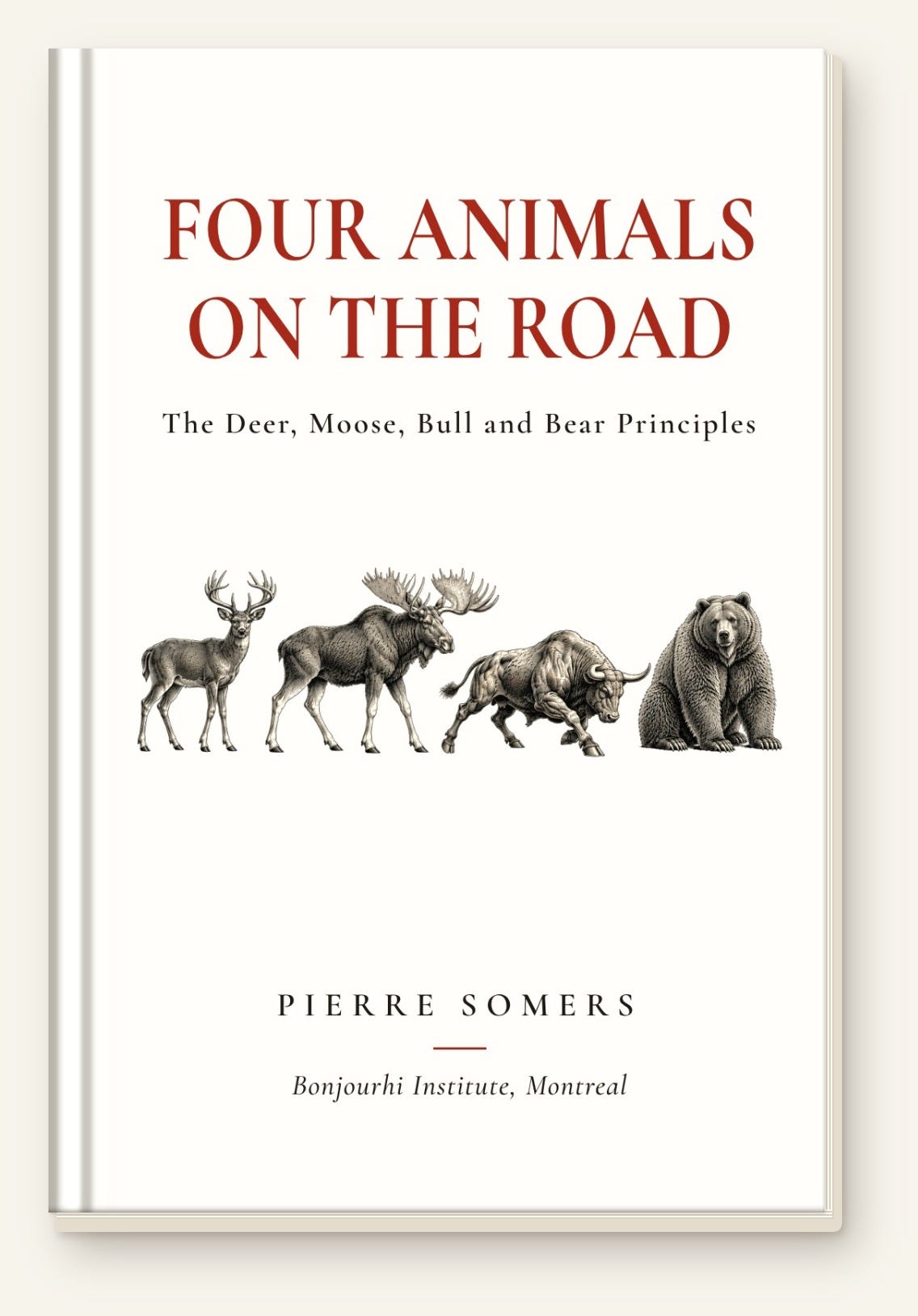
Here is Four Animals on the Road, a short book in four parts on the deer, the moose, the bull, and the bear, and what each teaches about protecting a company, a portfolio, or a family’s capital.
The interview below precedes the book and serves as its introduction and launch note: a conversation about where the book came from, and what it does and does not claim.
Warm regards,
Pierre Somers
Bonjourhi Institute, Montreal

Four Animals
on the Road
A conversation with Pierre Somers about his new book
The danger was never the animal. It was the collision.
Friction. Shock. Euphoria. Endurance.
The one-minute version
Four Animals on the Road began as four Bonjourhi essays. Each opens with an animal on a road at night and ends in boardrooms, balance sheets, and portfolios.
The road is the economy, the vehicle any enterprise travelling it, and the headlights whatever its owners can see. The animals are the forces that end journeys: quiet friction, sudden shock, euphoria, and long decline.
Beneath them lie the three laws of Coherence Economics and its master theorem: the instruments go first. A system stays healthy only while it can measure its own alignment, so every collision in the book begins as a failure to see.
The four animals, in plain terms
The deer. Small, steady frictions that compound until they are the main cause of loss.
The moose. The rare, heavy shock that arrives above the line of sight.
The bull. Euphoria, which spends great force on whatever happens to be moving.
The bear. The long decline, survived by diagnosis and reserves rather than courage.
Revised as a single volume, the book adds an introduction and an appendix of nineteen questions. We asked its author where it came from, and what it does and does not claim. The answers are lightly edited for length.
On the beginning
A wildlife magazine statistic is an unusual starting point for a book about business. How did it begin?
With a sentence I could not stop thinking about. A piece in BBC Wildlife pointed out that the most dangerous animal in America is the deer, the shy one on the Christmas card. Not the shark, not the grizzly. I read that and recognized it immediately, because I had watched the same thing happen inside companies for years. The losses that finish a business are rarely the dramatic ones. They are the ordinary ones, met every day, that nobody thinks to fear.
Why did one essay become four?
Because the road would not stay empty. Once the deer was there, a Canadian cannot avoid the moose, which kills more people on our roads despite being far rarer. Then the bull and the bear asked to come in, and I resisted for a while. They are the most worn clichés in finance. I only wrote them once I found something true in the real animals. A fighting bull charges the cape because it moves, not because it is red. A bear survives winter on what it stored in autumn. Those details earned their place. The market nicknames did not.
The losses that finish a business are rarely the dramatic ones.
On the animals
Which of the four do readers underestimate most?
The deer, by design, because it is the one people meet daily. But the bull is the more dangerous mistake. Nobody fears a rising market. We put up statues to it. The decisions that ruin enterprises are often made at the top of a cycle, with the most confidence and the best intentions, and they are applauded at the time. That is what makes them so hard to catch.
You corrected yourself while writing the bear essay. What changed?
My first draft said there were two kinds of decline, cyclical and structural, and that survival depends on telling them apart. That is true, but it was too tidy. Parks Canada warns that colour is a poor way to identify a bear, since black bears can be brown and grizzlies can look nearly black. You have to read the structure. That made me see a third case. Sometimes the market itself has changed underneath you. Passive funds, algorithms, and institutions with mandates now move prices in ways the old field guide never described. An investor who judges a decline by its colour may be facing an animal he has never met.
Is that the mistaken bear?
Yes. And the mistake is not in the market. It is in the reader of the market, whose map has stopped matching the ground. That is decoherence in its most personal form.
An investor who judges a decline by its colour may be facing an animal he has never met.
On the master theorem
How does the book connect to the idea that the instruments go first?
It is the thread through all four parts, though I only saw it clearly at the end. Every collision in the book is an instrument failure before it is anything else. The deer is hit because the driver is moving faster than his headlights reach. The moose is missed because its eyes sit above the beam and do not shine. The bull is followed because the dashboard reads green while prices rise. The bear is misjudged because the field guide is out of date. In each case the damage proceeds unseen, which is exactly what the theorem predicts.
And the audits in the appendix?
They are instruments, nothing grander. Nineteen questions meant to be asked aloud at a board table, while conditions are calm. A question is the cheapest instrument there is, and the one most often switched off, because the honest answer is uncomfortable.
On what the book does not claim
Isn’t an animal analogy simply storytelling?
Partly, and I would rather say so. An analogy is a teaching device, not a proof. It earns its keep if it moves a reader’s eyes somewhere useful, and it should be dropped the moment it starts doing the thinking for him. The deer has no intent, for instance, while some extraction in business is deliberate. The book says where each image strains, and I would encourage readers to push on those places.
Your table of bull markets ends with the current one, its final columns left blank. Are you predicting a crash?
No, and I took care not to. Informed opinion is genuinely divided, and I cite both sides in the notes. The blank row is not a forecast. It is a mirror. Every other row is history, and readers know how each story ended. The last one is the only row they are living inside, which is the only place a question can still change the outcome.
The blank row is not a forecast. It is a mirror.
On the reader
Who is the book for?
Anyone steering something that must last: a company, a portfolio, a family’s capital. It reads in under an hour. I hope the questions take much longer.
What should a reader be able to do tomorrow?
Pick one question from the appendix and put it on the agenda of the next meeting that matters. Not all nineteen. One. If the room goes quiet, it was the right one.
The last question
Which animal worries you most today?
The honest answer is the one I have stopped noticing. That is always the deer, almost by definition. The moose and the bear announce themselves, and the bull is cheered so loudly that it is hard to miss. The quiet friction I have grown used to is the one I would least want to look for, which is precisely why I should.
The animal that worries me most is the one I have stopped seeing.
Four Animals on the Road is published by the Bonjourhi Institute.
Bonjourhi Institute, Montreal

Four Animals on the Road
The Deer, Moose, Bull and Bear Principles
Pierre Somers
Bonjourhi Institute, Montreal
© 2026 Bonjourhi Institute, Montreal. All rights reserved.
First edition, October 2026.
This book is for general information and does not constitute investment, legal, or financial advice.
Part of the Bonjourhi Institute Coherence Economics Bookshelf.
Contents

Introduction
This book began as four issues of the Bonjourhi newsletter in the autumn of 2026. Each opens with an animal on a road at night and ends in boardrooms, balance sheets, and portfolios.
The road is the economy, the vehicle any enterprise travelling it, and the headlights whatever its owners can see. The animals are the forces that end journeys: quiet friction, sudden shock, euphoria, and long decline.
Beneath every part lies Coherence Economics and its three laws:
Coherence compounds. Aligned people, capital, and purpose grow stronger over time.
Decoherence extracts. Misalignment drains value, usually in amounts too small to notice.
Recoherence recompounds. Enterprises that restore alignment after a shock begin compounding again.
A master theorem binds them: the instruments go first. Coherence compounds only while a system can measure its own alignment. Decoherence turns into extraction when the instruments are blinded, which is why the damage goes unseen. Recoherence requires restoring them first, since a system cannot rebuild honestly what it can no longer read.
The three laws describe what should happen. Restrictions describe what usually happens. Enterprises can often recohere by their own effort, while whole systems usually wait for a shock.
Each part stands alone, yet together they make one argument: the forces that destroy enterprises are rarely the ones their owners watch for, and the structures that save them are built long before they are needed.
The appendix gathers nineteen questions, one set for each animal. They are instruments in the sense of the master theorem, ways of reading alignment while it can still be restored, and are best asked aloud while conditions are calm.
The road will always be dark in places. This book is meant to help you see a little further ahead.
Pierre Somers
Montreal, October 2026
Part I of the series
The Deer Principle
Why gentle forces kill enterprises, and how the same mathematics builds fortunes
Bonjourhi!
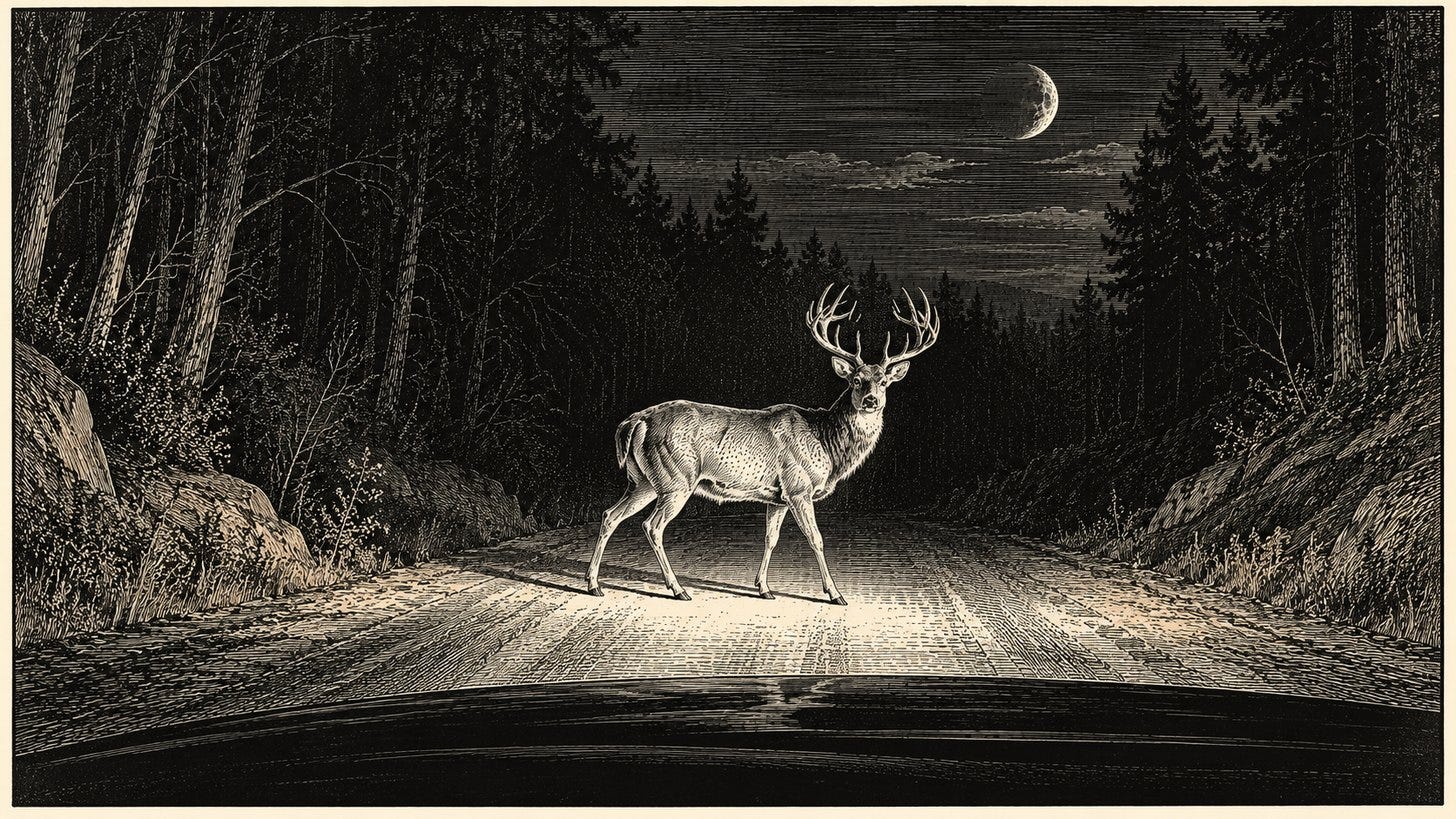
Ask anyone to name America’s deadliest animal and they reach for teeth. Sharks, grizzlies, rattlesnakes. Yet the creature that kills the most people appears on Christmas cards. It never attacks, it simply stands where a fast-moving system meets an ordinary moment.
Business harbours one too, as do the economy and every portfolio. More surprisingly, so does value creation.
The animal nobody fears
Collisions with deer are blamed for as many as 440 American deaths a year¹ (in Canada, the moose is the leading killer on the road, and a large animal, usually a deer or moose, is struck somewhere in the country four to eight times every hour).² Exposure, not ferocity, explains the toll. Each encounter is rarely lethal, but millions occur on roads cut straight through the animal’s habitat.
Velocity does the rest. At thirty kilometres an hour, a deer dents a bumper. At one hundred and twenty, it ends a life.
The deer in business
Companies fear their sharks: the crash, the fraud, the war, the hostile bid. Because such events are rare and visible, defences get built against them.
What actually ends enterprises is quieter: a reasonable fee layered on another, a weekly meeting that settles nothing, a well-liked manager who never refuses, two divisions slightly out of step for a decade.
None of these strikes. Each merely skims. The second law of Coherence Economics names the mechanism: decoherence extracts, and at sufficient exposure, small losses become the leading cause of death.
Physics states the same principle more sternly. The second law of thermodynamics holds that disorder rises in any system left to itself, and enterprises obey it faithfully. Decoherence is not the exception but the default state, and coherence is the work done against it every day.³
Speed beyond sight
Physics supplies the cruellest detail. Kinetic energy grows with the square of velocity, so quadrupling speed multiplies the force of impact sixteen times.⁴ The animal never changed. Only the pace of the car did.
Night drivers face a subtler hazard. Headlights reach roughly one hundred metres,⁵ and beyond a certain speed, stopping requires more distance than the beams reveal. Every obstacle then appears too late, however alert the driver.
The modern economy is overdriving its headlights. Capital moves in milliseconds and decision cycles have collapsed from quarters into days, while our information horizon has not lengthened. Boards see a quarter forward. Regulators see a year behind.
Misalignment carried slowly is an inconvenience. Carried fast, its damage scales geometrically: a firm moving twice as quickly with unchanged friction loses four times as much. Disciplined enterprises often outlast brilliant ones for this reason. Their frictions are no smaller, merely met at survivable speed.
Danger peaks at dusk, and organizations have their own: successions, mergers, the handover of a family enterprise. Speed is not the killer. Speed beyond sight is.
The swerve
Many victims of deer collisions never touch the animal. A startled driver yanks the wheel, leaves the road, and meets a tree. Instructors teach the opposite reflex: brake firmly and hold the line.⁶
Institutions swerve too. A company hit by one poor quarter abandons a sound strategy, cuts the capabilities it will need next, and lurches toward whatever looks safe. Governments answer a shock with reversals that outlast the shock itself. The impact was survivable, the overcorrection often is not.
Recoherence, the third law, works the other way. Brake, stay steady, and let structure absorb the blow.
The small number
A one point rise in interest rates sounds modest. From five percent, it adds a fifth to the cost of money. From one percent, it doubles it.⁷ The lower the floor, the more violent an identical move.
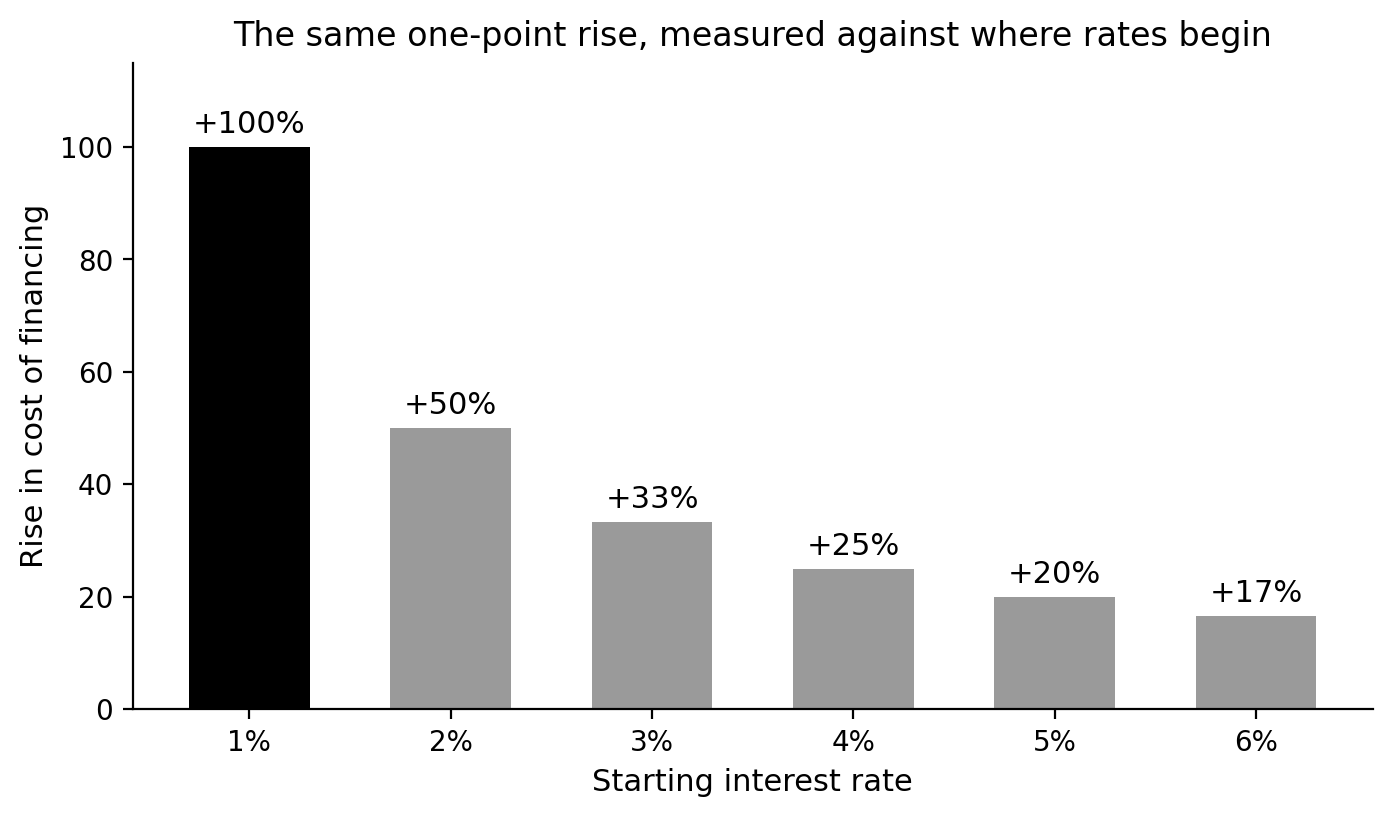
Here the deer reappears. Nothing dramatic arrives, only a familiar figure meeting a system that had learned to travel fast on cheap money. Property bought on thin yields, buyouts resting on inexpensive leverage, and startups valued on cash flows a decade away were all priced on the floor staying low.
Asset values behave like fractions with the rate underneath. Income valued at two percent loses about a third of its worth when rates reach three, though rent never fell and the building never aged.⁸ A thirty-year bond starting near one percent can surrender more than a fifth of its value from a single point, as Silicon Valley Bank discovered in 2023.⁹,¹⁰
Cheap money had masked decoherence, because carrying friction cost almost nothing. Rising rates did not create weakness. They priced it. Coherent firms felt an inconvenience, decoherent ones an impact.
The turn
Now the moment worth carrying away. Mathematics has no loyalty. What destroys value on a thin base creates it just as violently, provided you are the one moving the number.
Picture a company earning two percent on one hundred million in sales, two million in profit.¹¹ Lift the margin one point through coherence alone: fewer handoffs, cleaner pricing, less waste, each decision made once instead of three times. Profit rises by half. A second point doubles it, with revenue unchanged.
The rate you set yourself
Every borrower pays two rates stacked together. A central bank sets the first. The second is the spread, a premium lenders charge for doubt about you in particular: unclear governance, inconsistent reporting, an unexplained succession, a strategy that shifts with the weather.
That spread is the market’s price for your decoherence, and trust is cheaper money. When base rates are low, narrowing your own spread by a single point can halve what growth costs to finance. No bank will grant you that. You can grant it to yourself.
Then the gains stack. Higher margins lift earnings, while lower risk lifts the multiple investors pay for them, so value rises on both sides of the fraction. This is the first law in its purest financial form: coherence compounds, fastest of all where margins are thinnest.
Everyone watches the rate the central bank announces. Fortunes are made on the one you set yourself.
Where the opportunity hides
Look for businesses the market has priced as dull: thin margins, steady demand, untidy internals. The cheap-money decade ignored them in favour of glamour. They are the deer of value creation, unremarkable to the eye, enormous in aggregate, standing exactly where the road turns.
The return of patience
Every period of acceleration ends in a reckoning about what was real. Rates have come back to earth, and a dollar earned this year is again worth visibly more than one promised in ten. That single change restores the oldest discipline in investing: knowing what you own, what it earns, and why it will keep earning.
Recoherence will not arrive as an event. It will return slowly, like gravity. Owners of disciplined businesses will compound quietly, while those who panicked spend years repairing the damage.
Value investing will come back, though not in its old clothes. Its next generation will be measured less by cheap ratios than by coherence: aligned owners, clear governance, honest reporting, steady hands. Those qualities lower a firm’s own rate, and so raise what it is worth.
The patient driver was never slow. He was simply the only one who could see ahead.
Notes to Part I
1. BBC Wildlife Magazine, “What’s the most dangerous animal in the USA?”, bonus issue, October 2026. The figure is an upper estimate.
2. Traffic Injury Research Foundation (TIRF), wildlife-vehicle collision fact sheet drawn from its National Fatality Database, sponsored by Desjardins. Between 2000 and 2020, 570 people died in such collisions in Canada, slightly more than half involving moose and nearly a third involving deer. The hourly frequency comes from the Wildlife Roadsharing Resource Centre operated by TIRF (wildlifecollisions.ca).
3. Nicholas Georgescu-Roegen, The Entropy Law and the Economic Process (Cambridge, MA: Harvard University Press, 1971), the foundational attempt to apply thermodynamics to economics. The law is used here as an analogy, not as a literal description of markets.
4. Kinetic energy equals one half of mass times velocity squared. Four times the speed therefore carries sixteen times the energy.
5. An illustrative figure. Actual reach varies by vehicle and beam setting, with low beams lighting markedly less road than high beams.
6. TIRF found that one in three wildlife collisions in Canada resulted from drivers swerving to avoid the animal. The Canada Safety Council advises drivers not to swerve.
7. Bonjourhi calculation. The proportional increase in financing cost equals the size of the rise divided by the starting rate, as shown in the chart.
8. Simplified perpetuity valuation, in which value equals annual income divided by the rate, ignoring growth. Income worth fifty times itself at two percent is worth about thirty-three times at three percent.
9. Bonjourhi calculation for a thirty-year bond paying a one percent annual coupon. Its price falls from par to roughly 78 when market yields rise to two percent, a loss of about 22 percent.
10. Board of Governors of the Federal Reserve System, Review of the Federal Reserve’s Supervision and Regulation of Silicon Valley Bank, April 2023.
11. An illustrative example, not a specific company.
Part II of the series
The Moose Principle
Why rare, heavy shocks decide outcomes, and how coherent enterprises survive the impact
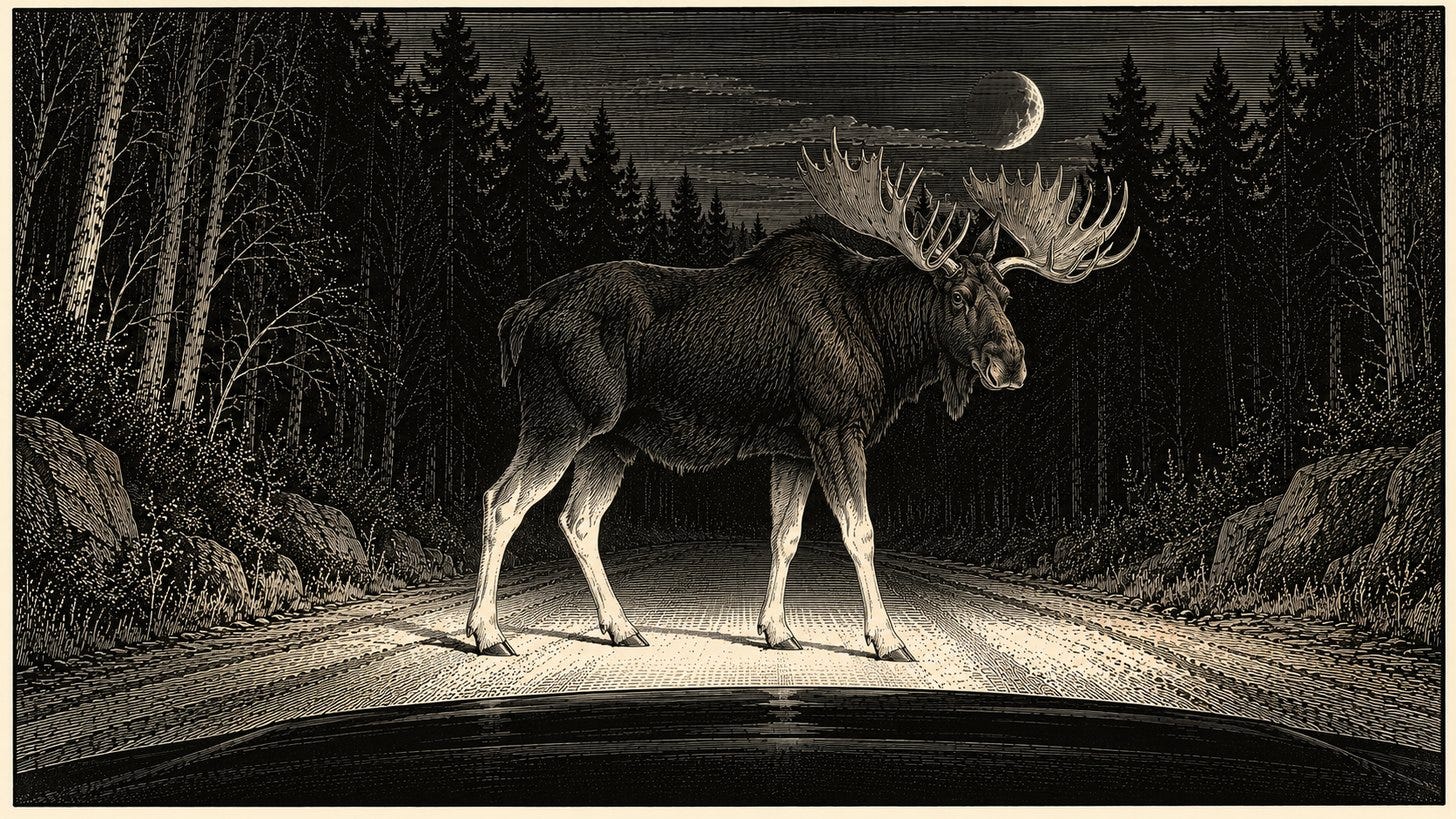
Part I followed a deer onto the road: the gentle, constant friction that wears enterprises down one small loss at a time. Part II turns to its larger cousin. Across most of Canada, drivers strike deer far more often than moose, yet moose account for more than half of the country’s wildlife collision deaths.¹
Frequency kills slowly. Mass kills at once.
The animal you cannot miss
A mature moose can weigh 600 kilograms and stand two metres at the shoulder.² Its body rides above the hood of most cars. When a vehicle strikes one, the bumper takes out its legs and the full weight comes down on the windshield and roof.
Drivers in moose country tell a grim joke about the quickest way to turn a sedan into a convertible. The punchline, unfortunately, is literal.³
Nothing about the moose is subtle. Size does not hide it, yet drivers still hit it, because it appears so seldom that they stop expecting it.
Why averages lie
Most years contain no moose. A risk model built on ten ordinary years will conclude, quite reasonably, that the road is safe. Then one year arrives that outweighs the other nine combined.
Financial history is a record of such years. 1987, 2008, and 2020 each compressed years of ordinary movement into weeks. Long-run results are often decided by how an investor endured a handful of months, not by the hundreds that surrounded them.
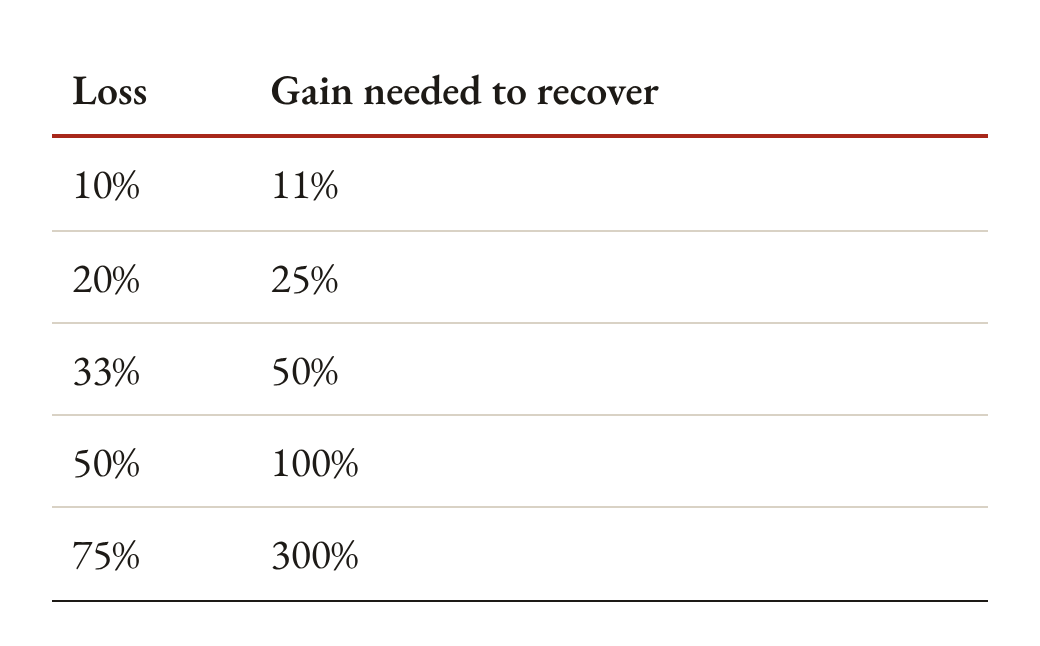
The deer teaches that small losses compound. Its larger cousin teaches something harder: one great loss can end the compounding altogether. A portfolio that falls by half must double merely to recover.⁴
The windshield problem
Cars are engineered for impacts at bumper height, where most collisions occur. The moose strikes above that level, into the cabin where the people sit.
Enterprises make the same engineering choice. They insure operations, hedge currencies, and diversify customers, protecting the bumper against familiar knocks. Rare shocks pass over all of it and land on leadership, liquidity, and governance.
Every board should ask where its cabin is, and what would remain standing if something heavy came through the glass.
Eyes above the beam
Deer eyes shine in headlights, giving drivers a warning. A moose’s eyes usually sit above the beams of an ordinary car, so they rarely reflect.⁵ Wildlife officials add a quieter detail: headlights often reveal only the legs, which are roughly the colour of the pavement.⁶
The rare shock looks like the road until it is upon you. Its early signs resemble normal conditions: credit spreads a little wider, a supplier a little late, a counterparty a little vague. Dashboards calibrated for routine weather will report that all is well.
Seeing the moose requires looking above the line of ordinary sight. That means stress tests built on the worst year rather than the average one, and leaders who ask what is missing from the report instead of what is in it.
A cabin built to hold
No driver can guarantee avoiding a moose. What can be chosen in advance is the strength of the structure that meets it.
For an enterprise, that strength takes three forms. Liquidity buys time, so no asset must be sold at the worst moment. Low leverage lets the impact bend the frame rather than break it. Redundancy in critical people and suppliers keeps one failure from becoming many.
A fourth form is easiest to overlook. Decision rights must be settled before the crisis, because a collision is no time to discover who holds the wheel. Coherent organizations absorb shocks along clear lines of authority, while decoherent ones split along their old seams.
Bracing for impact
Maine’s transportation department offers striking advice for a collision that cannot be avoided. Brake hard, then ease off just before impact, so the front of the car rises slightly and the animal is less likely to come through the windshield.⁷
Enterprises have an equivalent. When the shock becomes certain, cut early and decisively, then release enough pressure to keep the business standing tall: preserve key people, customer relationships, and the capacity to resume. Firms that brake to a dead stop often survive the impact and expire in the months that follow.
After the collision
The third law of Coherence Economics holds that recoherence recompounds. Shocks do not merely destroy, they redistribute. During a crisis, assets, talent, and market share flow toward those still able to act.
The autumn of 2008 offers a clear case. As financial firms scrambled to survive, Berkshire Hathaway invested $5 billion in Goldman Sachs, receiving preferred shares paying 10 percent a year plus warrants on the common stock.⁸ That same year, JPMorgan Chase absorbed Bear Stearns and the banking operations of Washington Mutual.⁹ Both moves rested less on brilliance than on liquidity at a moment when others had none.
Many of the strongest enterprises were built in the aftermath of the worst years. Their owners were not braver than everyone else. They were simply upright while competitors were still repairing.
The aim is not to emerge undamaged. It is to emerge first.
You will meet the deer every day. You only need to survive the moose once.
Notes to Part II
1. Traffic Injury Research Foundation (TIRF), wildlife-vehicle collision fact sheet drawn from its National Fatality Database, 2000 to 2020. Of 570 deaths, slightly more than half involved moose and nearly a third involved deer. Deer outnumber moose on the roads of most provinces, Newfoundland being a notable exception.
2. British Columbia Ministry of Transportation and Infrastructure, TranBC. Weight varies widely by sex, age, and region.
3. Wildlife Collision Prevention Program, cited by Ontario Provincial Police, Northwest Region, May 2020. The program notes that the force of a moose collision can sometimes remove the entire roof of a car.
4. Bonjourhi calculation. After a 50 percent loss, a 100 percent gain is needed to return to the starting value.
5. Royal Canadian Mounted Police, Saskatchewan, news release of November 12, 2024, following five moose collisions within thirty minutes.
6. New Hampshire Fish and Game Department, Department of Transportation, and Highway Safety Agency, Brake for Moose campaign.
7. Maine Department of Transportation, Wildlife Safety guidance. Cited here for its analogy, not as driving instruction.
8. Goldman Sachs, press release of September 23, 2008, announcing Berkshire Hathaway’s $5 billion investment in perpetual preferred stock carrying a 10 percent dividend, with warrants.
9. JPMorgan Chase completed its acquisition of Bear Stearns in May 2008 and acquired the banking operations of Washington Mutual from the FDIC in September 2008.
Part III of the series
The Bull Principle
Why good times hide the deepest decoherence, and how to stay standing while the crowd cheers
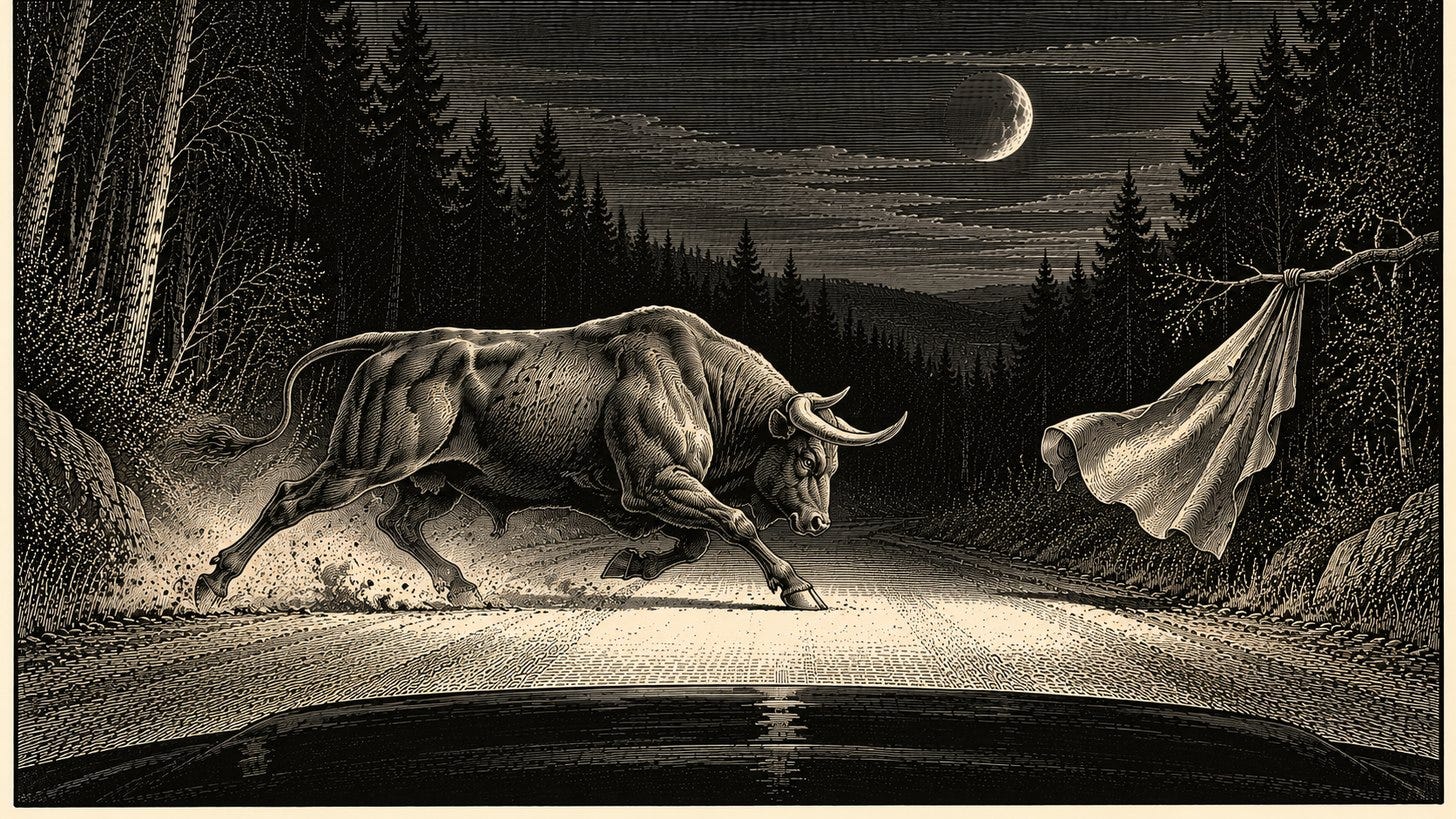
Nobody fears a deer or a moose grazing at the forest edge. What drivers fear is hitting one. Part III concerns an animal people actually celebrate.
A bronze bull stands in Lower Manhattan, and rising markets carry its name.¹ No other creature in this series is greeted with applause, which is precisely what makes it dangerous.
The cape, not the colour
Popular belief holds that red enrages a bull. In fact, cattle cannot distinguish red from green.² A fighting bull charges the cape because it moves, and a still red cloth draws no attack at all.
Investors in a boom behave the same way. They charge what is moving rather than what has substance: the stock that rose yesterday, the sector everyone is discussing, the deal a competitor just won.
History records the stampedes. The Nasdaq lost nearly four fifths of its value between its peak in March 2000 and its trough in October 2002.³ In 2021, special purpose acquisition companies raised record sums for businesses they had not yet identified, while meme stocks rose on enthusiasm alone.⁴
Success masks decoherence
Growth covers a multitude of sins. Costs swell, hiring standards slip, and incentives drift away from owners, yet every quarter looks better than the last.
Part I showed how cheap money made friction feel free. Climbing prices perform the same trick, hiding misalignment until the market stops paying for it.
The consequences arrive late, but the decisions are made early. Many of the worst acquisitions in any cycle are struck near its top, at the richest valuations, with the greatest confidence.
The matador’s discipline
A matador survives by holding his ground while the bull charges the cape at his side. His safety lies in knowing what the animal will pursue, and placing himself elsewhere.
Business offers the same posture. Refuse to overpay when competitors do. Decline the deal the crowd applauds, and resist hiring for a growth rate that cannot last.
Discipline has a visible cost. For a season, the matador looks timid beside those running with the herd, and patient capital trails reckless capital for as long as the run lasts.
Warren Buffett paid that cost in full. In December 1999, Barron’s ran a cover story asking what was wrong with him, after Berkshire Hathaway lagged a market he refused to chase into technology.⁵ By the autumn of 2002, the frenzy had collapsed, and the matador had not moved.
The moment of truth
Spanish bullfighting calls its final act la hora de la verdad, the moment of truth.⁶ Markets have one too. It arrives when buyers stop paying the price, and every decision made during the charge is tested together.
Leverage taken on at the top must be serviced at the bottom. Acquisitions priced on peak earnings must be justified by ordinary ones. What looked like brilliance is revealed as momentum, and the bill is presented in full.
Five charges and one in progress
The pattern can be read at a glance. Most bull markets die of their own excess. Some are killed from outside: the run that began in 2009 fell to a pandemic, the moose of Part II.
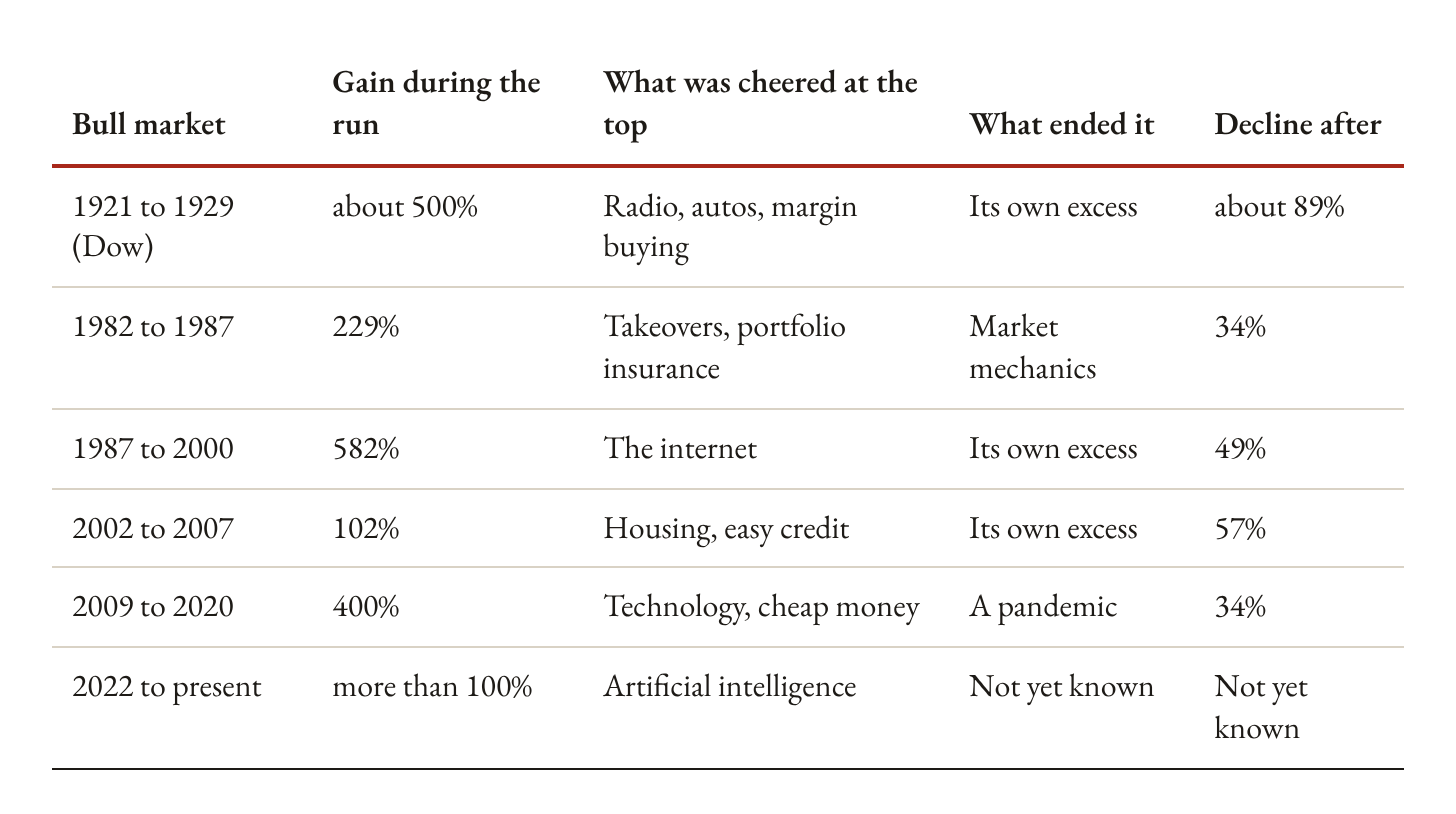
Every completed row tells a story whose ending readers already know.⁷ The final row is still being written.⁸ Whether it ends from within, from outside, or not for years is exactly what the Bull Audit in the appendix is designed to ask.
The bull never charges the matador. It charges what moves.
Notes to Part III
1. Charging Bull, bronze sculpture by Arturo Di Modica, installed in Lower Manhattan in December 1989.
2. Cattle have two types of colour receptors and cannot distinguish red from green. Experiments show bulls respond to the movement of the cape rather than its colour.
3. The Nasdaq Composite closed at 5,048.62 on March 10, 2000, and at 1,114.11 on October 9, 2002, a decline of about 78 percent.
4. According to SPAC Research, more than 600 special purpose acquisition companies went public in 2021, raising over $160 billion, more than in all prior years combined.
5. Barron’s, cover story of December 27, 1999, “What’s Wrong, Warren?”
6. The Spanish term refers to the final phase of the bullfight, in which the matador must face the bull directly.
7. S&P 500 figures except the first row, which uses the Dow Jones Industrial Average. Gains run from bear market low to bull market peak, and declines from that peak to the following low, as widely compiled from S&P Dow Jones Indices data. Figures are rounded.
8. The current bull market began from the S&P 500 closing low of 3,577.03 on October 12, 2022, and had more than doubled by its fourth anniversary (Benzinga, October 2026). Opinion on its future is divided: Carson Group notes that bulls reaching four years have historically continued into a fifth, while BofA reported in late 2025 that prices exceeded March 2000 levels on nine of twenty valuation metrics (Kiplinger).
Part IV of the series
The Bear Principle
Why long declines demand diagnosis before action, and how enterprises survive the winter
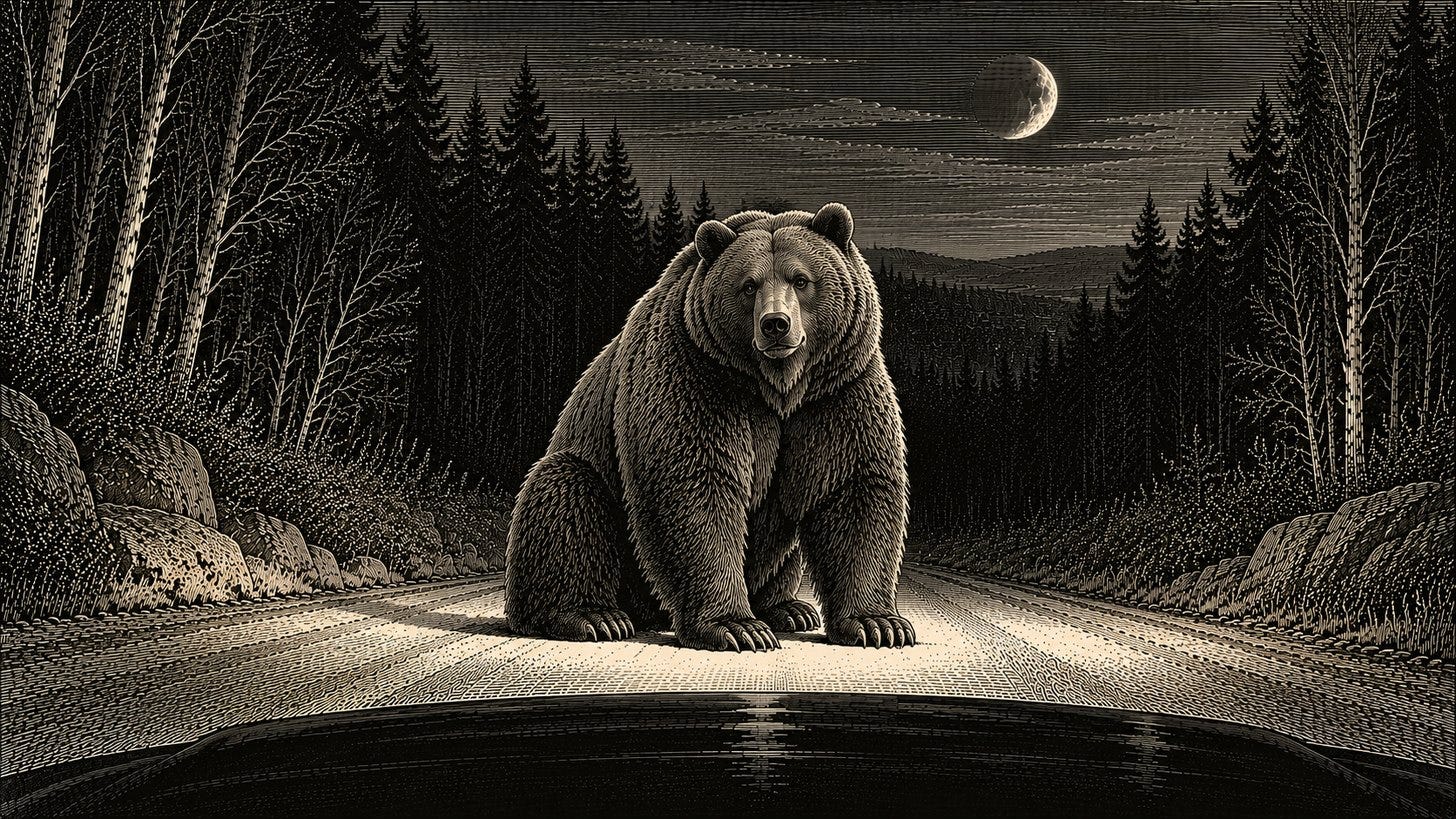
A deer collision grinds, a moose collision crushes, and the bull spends its force on whatever moves. The bear does something different. It sits down in the middle of the road and does not leave.
This final animal teaches that the danger of a decline lies less in its depth than in its duration. A fall of thirty percent is survivable within a year. Endured for a decade, it reshapes every decision an enterprise makes.
Two kinds of attack
Parks Canada’s guidance on bear encounters turns on a single diagnosis. A bear attacking defensively, surprised or protecting its cubs, is best met by lying still and playing dead once it makes contact. A bear that treats a person as prey must be fought with everything at hand.¹
The two responses are opposites, and each is fatal when applied to the wrong attack. Survival depends less on courage than on reading the animal correctly in the first seconds.
Bear markets divide the same way. A cyclical decline, driven by recession or tightening credit, rewards those who hold still and buy. A structural decline, driven by broken fundamentals, punishes exactly that behaviour.
The long winter
Japan offers the starkest case. The Nikkei 225 peaked in December 1989 and did not close above that level again until February 2024, more than thirty-four years later.²
For American investors, buying every dip worked for decades. In Tokyo, the same reflex consumed a generation of savings. The strategy was identical. Only the bear was different.
Before choosing to wait or to fight, an enterprise must first ask whether its market is resting or broken.
The mistaken bear
Even that question has a trap. Parks Canada warns that colour misleads: black bears may be brown or cinnamon, and grizzlies can appear nearly black.³ The dependable signs are structural, such as the shoulder hump, the profile of the face, and the length of the claws.
Investors make the same error when they judge a decline by its colour: the size of the drop, the tone of the headlines, the speed of the fall. Structure is harder to read and far more revealing. Sometimes the animal on the road matches no description in the old field guide, because the market itself has changed.
Three such changes have reshaped modern markets. Passive funds, which buy and sell regardless of price, now hold more American fund assets than active managers.⁴ Algorithms execute most equity trades, by most estimates, at speeds no human can follow.⁵ And most shares are now held not by individuals weighing value but by institutions bound by mandates, benchmarks, and redemptions.⁶
Each change alters how a downturn behaves. On May 6, 2010, American shares plunged and recovered within minutes, a bear in appearance that was in truth a machine malfunction.⁷ Index flows can lift or sink a stock whatever its earnings. Institutions compelled to sell by their own rules create prices that say more about the seller than the asset.
Coherence Economics names the deeper danger. When an investor’s map no longer matches the territory, the decoherence lies not in the market but in the mind reading it. Recoherence begins with a new field guide.
The diagnosis therefore has three answers, not two:
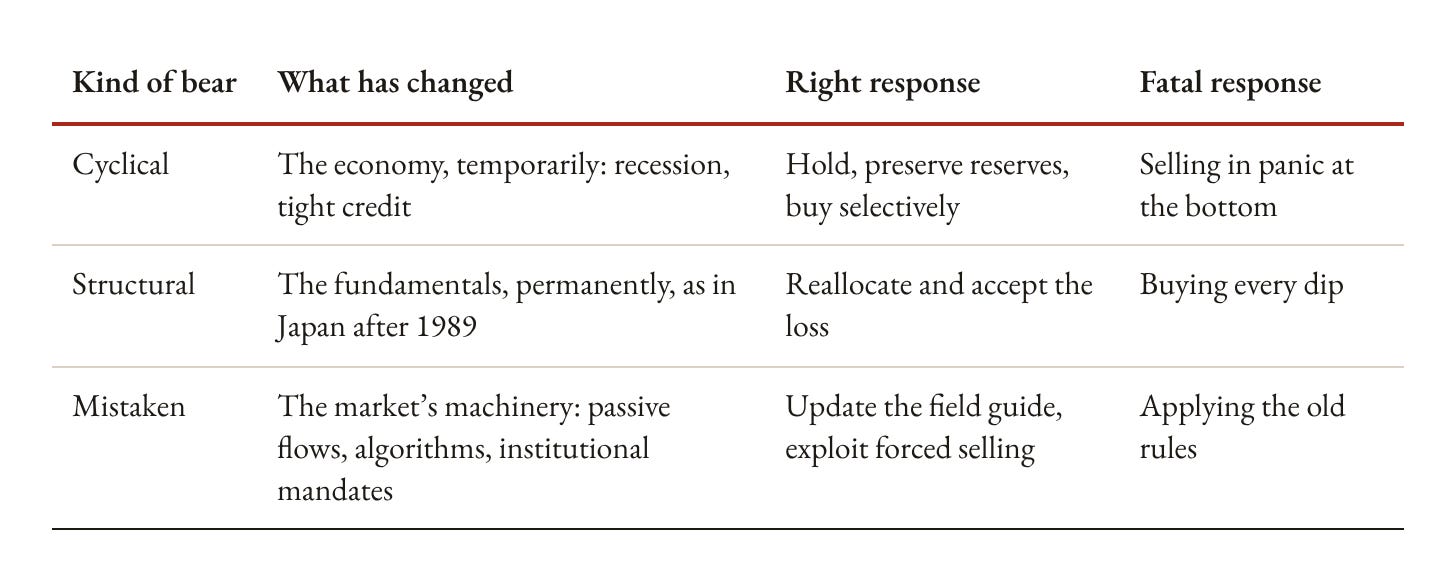
The mistaken bear is also where patient capital finds its edge. When institutions must sell and machines amplify the move, an owner free of mandates can buy what others are forced to abandon.
Built in autumn
A bear survives winter on reserves gathered beforehand, feeding intensely through late summer and autumn.⁸ Nothing it does in the den adds strength. It lives entirely on what it stored.
Enterprises are no different. Liquidity raised during a bear market is scarce and costly, while liquidity raised during a bull market is plentiful and cheap. Discipline practised in the good years becomes survival in the bad ones.
Lowering the metabolism
Hibernating bears do not shut down. Their metabolism slows sharply and their heart rate falls, while body temperature drops only a few degrees, so they can rouse quickly if disturbed.⁹
The business equivalent is disciplined reduction that keeps the core alive. Part II’s advice on bracing for impact applies here over years rather than seconds: slow hiring, defer expansion, and trim only what can be restored. Panic cuts, by contrast, leave nothing to wake.
Spring
Every winter ends. Bears emerge into a landscape thinned of competitors, and those that stored well are first to feed.
This is recoherence on its longest timescale. Enterprises that endured with their structure intact begin compounding again, and the arithmetic that once worked against them turns in their favour.
Four animals, one road
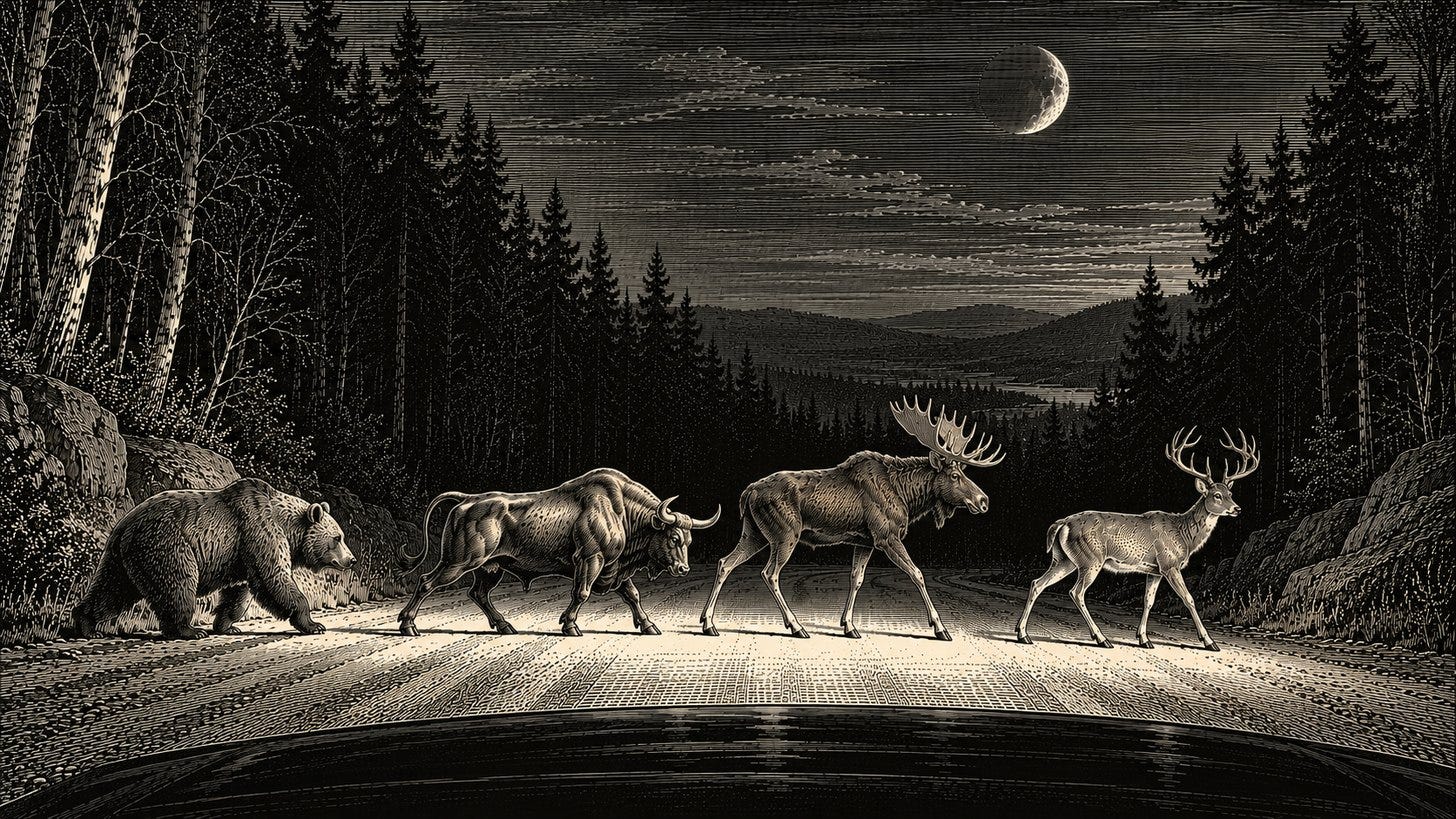
The series ends where it began, on a dark road with a vehicle moving through it. Four animals wait there. The deer is friction, constant and quiet. The moose is shock, rare and heavy.
The bull is euphoria, celebrated until it turns. The bear is endurance, measured not in days but in years.
No enterprise chooses which it will meet. Each can choose how it is built, and every part of this series has supplied a component: speed kept within the reach of its headlights, a cabin strong enough to hold, the matador’s stillness before the cape, and reserves laid down in autumn.
Rebalancing binds them together, trimming what the bull has inflated and buying what the bear has discounted. A portfolio built this way will rarely win the race. It is designed instead to finish the journey.
The bear does not ask how strong you are. It asks how long you can last.
Bonjourhi Institute, Montreal
Notes to Part IV
1. Parks Canada bear safety guidance, as reported by CBC News. In a defensive attack, Parks Canada advises playing dead once the bear makes contact. If the bear appears to treat a person as prey, it advises acting aggressively, using bear spray, and fighting back.
2. The Nikkei 225 closed at 38,915.87 on December 29, 1989, and surpassed that record on February 22, 2024.
3. Parks Canada bear identification guidance. Coat colour varies widely in both species; the shoulder hump, facial profile, ears, and claws are more reliable markers.
4. Morningstar reported that assets in US passive funds surpassed those in active funds for the first time at the end of 2023.
5. Estimates of the algorithmic share of US equity trading vary with method, but are commonly placed between 60 and 75 percent.
6. Federal Reserve Financial Accounts data show the share of US corporate equities held directly by households falling from roughly nine tenths around 1950 to well under half today.
7. US Securities and Exchange Commission and Commodity Futures Trading Commission, Findings Regarding the Market Events of May 6, 2010, published September 30, 2010.
8. This period of intense pre-winter feeding is known as hyperphagia.
9. Unlike small hibernating mammals, bears maintain a body temperature only modestly below normal through winter, which allows them to wake relatively quickly.
Appendix: The Audits
Nineteen questions, one set for each animal, for board meetings, investment committees, and annual reviews.
The Deer Audit
For the quiet frictions of Part I.
1. Which small recurring costs, fees, or delays have we stopped noticing because they never change?
2. How many times is a typical decision made before it becomes final?
3. Are our commitments longer than our planning horizon, so that we are driving faster than our headlights reach?
4. Which of our assets or deals only made sense when money was nearly free?
5. What would lenders need to see before narrowing our spread by a point?
The Moose Audit
For the rare, heavy shocks of Part II.
1. If revenue fell by a third for a year, how many months could we operate without selling assets or raising capital?
2. Which single person, supplier, or customer would hurt us most if lost overnight?
3. Who holds decision authority in a crisis, and is it written down?
4. What would our lenders do if covenants were breached?
5. What would we buy, and with what money, if competitors were forced to sell?
The first four protect the cabin. The fifth turns survival into advantage.
The Bull Audit
For the good years of Part III.
1. Which of our results would disappear if prices stopped rising?
2. Have our acquisition multiples drifted upward without any change in fundamentals?
3. What spending have we approved that we would never approve in a flat year?
4. Are we being rewarded for coherence, or merely for being in a buoyant market?
Honest answers are uncomfortable while prices climb. That discomfort is the cheapest insurance an enterprise will ever buy.
The Bear Audit
For the long decline of Part IV.
1. Is this decline cyclical or structural, and what evidence would change our view?
2. Has the market’s machinery changed in ways our models do not capture?
3. How many years, not months, could we sustain current operations?
4. What can we slow without losing our ability to restart?
5. What will we own when spring arrives?
About the Author
Pierre Somers is the founder of the Walter Group in Montreal, whose investment activities span four platforms: Walter Public Investments, Walter Capital Partners, Walter Global Asset Management, and Walter Ventures.
He spent most of his career as Chief Executive Officer of Walter Surface Technologies, a transnational manufacturer of industrial tools for the metalworking industries.
He is Chief Editor of the Bonjourhi Institute and the architect of Coherence Economics, a framework resting on three laws and a master theorem.
The deadliest animal on the road is not the one you fear.
In four short essays, Pierre Somers follows four animals onto a dark road and into the life of every enterprise. The deer is quiet friction, small losses that compound unseen. The moose is the rare, heavy shock no model expects.
The bull is euphoria, hiding decoherence while the crowd applauds. The bear is the long decline that rewards diagnosis over courage.
A book for anyone steering a company, a portfolio, or a family’s capital who means to finish the journey.
Bonjourhi Institute, Montreal