
Bonjourhi!
Every series needs a lens, and this one has an unusual one. It reads the largest shift in modern warfare through the oldest trade in one American family: the business of the landlord.
That choice needs a word of explanation before we begin, because it can be misread.
This is not a political series. It takes no side, endorses no party, and carries no verdict on the current administration. What it uses is a matter of public record, and only that. Fred Trump, the father, built his fortune in federally subsidized housing, and in 1954 he was called before the United States Senate Banking Committee to answer for profiteering on federal housing loans.1 That is documented history, not opinion. His son learned the family trade in those same buildings and later turned it into something the father never attempted. Also documented.
We use this history for one reason: it is the clearest available model of a particular way of thinking. The landlord who owns what others cannot do without, and who treats dependence as a thing to be extracted from rather than a trust to be kept. That mindset explains more about the present arms economy than any ideology does, and it happens to have a well-recorded origin. To decline to use it because the name is charged would be to trade a sharp instrument for a dull one out of caution.
So read the landlord in these pages as a structure, not a slur. The argument would hold if the name were different. It simply reads truer because the name is not.
What follows is a study in six parts of how the world’s great arms suppliers, by treating their customers as tenants who could never leave, taught them to leave. Where the metaphor touches the family that inspired it, it rests on the record and stays there.
Pierre Somers
Chief Editor, Bonjourhi Institute
Montreal, Quebec – September 2026
The Art of the Loss
How the world’s great arms suppliers taught their customers to leave

A Bonjourhi series in six parts
III. The Tenant Who Learned to Build
IV. The Stake in Ten Other Buildings
V. The Landlord Who Raised the Rent
A note before the series
There is a kind of business that does not sell a thing so much as control access to a thing people cannot do without. The classic form is housing. A landlord who owns the only decent housing in a district does not have customers in the ordinary sense. He has tenants, which is a different relationship, because a customer can walk away and a tenant, for a while, cannot. The temptation in that position is always the same. To treat the people who depend on you not as buyers to be kept, but as a captive source of rent to be extracted.
The temptation of that position, as the foreword set out, has a well-documented history in one American family. The business rests on a single stable insight. Tenants who have nowhere else to go can be squeezed, because the cost of leaving is higher than the cost of staying, right up until the day it is not.
From that inheritance a particular art was made, first of the arrangement, then, across a long career, of its collapse. This is the study of one such collapse, the largest yet arranged, and of the quiet party who profits when a slumlord’s building finally empties.
This series will follow two landlords, America and Russia, who owned the district of global arms between them, and the tenants who learned to leave. But keep one eye on a third figure who appears only at the edges until the end. He owns no buildings and demands no rent. He merely supplies the wiring, the pipes, and the weatherproofing that every building in the district requires, old and new alike. He is patient. He is the last one anyone thinks to worry about. And he is executing, in slow and deliberate motion, the largest acquisition in the story.
Watch three words as you read. Leverage. Default. Creditors. And a fourth, which will arrive only when the other three have done their work. Foreclosure.
Bonjourhi Institute Analytics, Montreal
Part I - The Building and the Rent

Bonjourhi!
Every industrial nation tells itself the same comforting story. That its factories make the things people want. Cars, phones, washing machines, the ordinary furniture of a good life. But look closely at what the great powers are actually building now, and a different picture emerges. The United States spent two decades letting its civilian manufacturing drift to China. Russia converted what remained of its economy into a machine for producing shells. Europe, which believed it had retired from all of this, is being told to build again. Not refrigerators. Ammunition. And under the ammunition, one object almost nobody set out to build a war economy around. The chip.
Something has shifted in what a factory is for. And once you see it, the question is no longer whether the world is arming. It is who will own the buildings when the arming is done, and who will own the ground beneath them.
The old bargain
For most of the postwar era, making and defending were separate conversations. A country made things to sell. It made weapons to deter. The two economies touched at the edges but stayed distinct. The civilian side was where prosperity lived. The military side was insurance, expensive and quiet, hopefully never fully used.
The logic held because peace was assumed. You built commercial scale because there were customers. You built arsenals slowly because there was time. Nobody expected to need ten thousand shells a month, because nobody expected a land war in Europe to last for years.
Both assumptions are gone. The customers went abroad, and much of what America once made at home is now made somewhere else. The peace ended in Ukraine. The first collapse hollowed the factories. The second sent everyone rushing to fill them again. And where the world turned for the parts to do it will matter more, in the end, than either.
The landlord’s district
Think of the global arms trade as a district of housing, and the two great suppliers as the landlords who own most of it.
For seventy years the arrangement was simple. America owned the best towers, the finest apartments, and most of the district paid rent to live in them. Russia owned the cheaper blocks, older and rougher, but affordable, and a wide belt of the world lived there because it could not afford anywhere better. Between them the two landlords housed nearly everyone.
And here is what made the district possible, so obvious it was never said aloud. The buildings were expensive to build, and expensive to keep standing. Only a landlord with immense capital could raise a tower, and only one with a permanent staff could maintain it. The expense was the moat, in two parts.[2] A weapon that costs a fortune to make can only be made by those who have fortunes. And a weapon that costs a fortune to maintain keeps paying rent to its maker for as long as it stands.
A landlord in that position stops thinking like a seller. He thinks like a holder of leverage. He knows the tenant cannot easily leave, so the relationship is not about keeping the tenant happy. It is about how much can be drawn from a household with no other address, at the sale and at every service call after it.
The shift
The new arsenal changed the buildings themselves.
The old weapon was a finished object, costly to buy and costly to keep. A tank was a tank, its price beyond most who might have wanted one, and its upkeep a lifetime obligation to the maker. The new weapon is a process that never stops, and it is cheap, and it is disposable. A drone costs the price of a used car, is flown until it is lost, and is never serviced at all. What a country needs now is not the expensive object with its lifetime of maintenance, but the capacity to keep making the cheap one.
And capacity to make a cheap, disposable thing can be acquired by almost anyone. That single fact deserves a part of its own.
The rent was never the point of the district. The dependence was. And the dependence has just lost its foundation.
Bonjourhi Institute Analytics, Montreal
Part II - The Spreadsheet That Lost
Bonjourhi!
Wars have always been decided by many things. Courage, terrain, supply, luck. But beneath all of them has always run a quieter ledger, the cost of destroying the enemy’s things set against the cost of the things themselves. For most of history that ledger favoured the rich, because the tools of destruction were expensive and only the wealthy could field them at scale. This is the ledger that has now flipped, completely, and the flip is the physical fact under everything else in this series. The cheap thing now destroys the expensive thing, and the gap between the two prices has become a chasm no fortune can fill.
The numbers, which are almost unbelievable
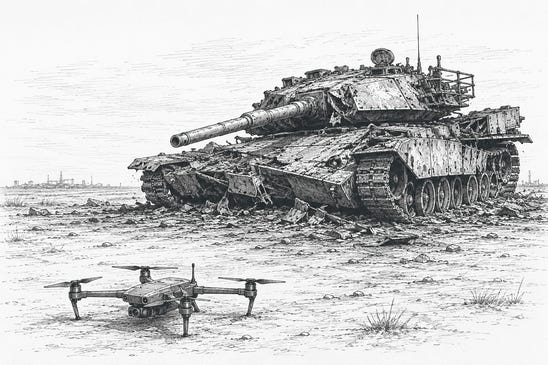
Start on the ground. A first-person-view drone costing around five hundred dollars add a primitive bomb and it can destroy a main battle tank costing five million. That is several thousand to one, in the attacker’s favour, and analysts reach for the invention of the rifled musket against massed cavalry to find any comparison at all.[3] The most expensive thing on the battlefield is killed by one of the cheapest, at a ratio no armour or budget can absorb.
Now look up, at air defence, where the ledger is potentially even worse. A Shahed attack drone costs perhaps twenty to fifty thousand dollars. The Patriot interceptor fired to stop it costs around four million. A THAAD interceptor, twelve to fifteen million. Set a cheap drone against a naval interceptor and the ratio can reach two hundred and thirty-five to one.[4] The defender wins the engagement and loses the war, unable to afford to keep winning.
This is not theory. When Iran struck the Gulf states across early 2026, intercepting the attack reportedly cost the United Arab Emirates about a billion dollars a day.[5] In the first three days, more than eight hundred Patriot interceptors were expended.[5] The arithmetic was summarised by one analyst in a single sentence. Iran is spending pennies to force the coalition to spend dollars.
The moats nobody counted
The price of the old weapon was never just the sticker. It was the tail. The spares, the depot overhauls, the trained technicians, the sustainment contracts that ran for decades and were, quietly, the most profitable part of the business. A landlord does not make his fortune selling the building. He makes it on the rent that never stops, and for the old arsenal the maintenance contract was that rent. A modern fighter costs more to keep flying over its life than it cost to buy, and only its maker can service it. That was the deeper lock. Buy once, then pay the maker forever.
The cheap weapon has no tail. It is expended, not maintained. There is no depot, no overhaul, no thirty-year contract, no technician who only the landlord can supply. When a drone fails, you do not repair it. You reach for the next one. So the most lucrative and most binding moat the old landlords ever held, the endless rent of maintenance, does not shrink. It disappears. The tenant who buys the cheap weapon owes the maker nothing after the sale, and the maker, if he still thinks in the old way, has just lost the income that was the point of the arrangement.
And there is a fourth moat, larger than all the others together, that the cheap weapon drains to nothing. The most expensive thing in any army was never the tank or the jet. It was the person. A soldier is not a purchase. He is recruited, trained, housed, fed, paid, insured, treated when wounded, and pensioned for decades, and if he dies his cost does not end but passes to his family and his survivors. Around him runs a tail that dwarfs the weapon itself, the fuel and food to sustain him, the medical chain to save him, the base to shelter him. In the American budget the people already cost more than the arms, some two hundred billion dollars for personnel against a hundred and sixty for weapons, and that counts only the serving.[6] Add the training, the lifelong healthcare, the veterans care running to hundreds of billions more, and the human being is the single most expensive object the old arsenal ever fielded.[7]
Now see what that expense was for. The armour, the redundancy, the medical evacuation, the engineering built to never fail, none of it existed for its own sake. It existed to keep a person alive long enough to operate the weapon. The costly apparatus of the old arsenal was, at bottom, the price of protecting an irreplaceable operator. The unmanned weapon removes the operator, and with him the reason the platform had to be expensive at all. A drone needs no salary, no barracks, no field hospital, no pension, no evacuation. When it is lost there is no casualty, no funeral, no twenty-year obligation to a grieving family. The most expensive line in the ledger simply leaves the battlefield, and takes the justification for the expensive arsenal with it.
Why cheapness is the weapon
Cheapness is not a feature of the new weapon. Cheapness is the weapon. A weapon that is cheap arrives in swarms no small stock of costly interceptors can meet. It can be lost without grief. And, most important for this series, it can be made by almost anyone, because its parts are the parts of civilian life. Motors, batteries, sensors, airframes, the components of a hobby shop and a phone. The thing that makes the new weapon cheap to fire is the same thing that makes it cheap to build, and cheap to build means the moat is gone.
But hold that list of parts in your mind. Motors, batteries, sensors, magnets. Ask where they are made. We will return to that question, and the answer will reorganise everything.
The implication
Every later part of this series rests on this floor. The tenant can learn the trade because the trade is cheap. The stakes can be spread across ten buildings because each is cheap to seed. The landlord’s shelves empty as he fires million-dollar answers at thousand-dollar questions. His maintenance income vanishes, since the new weapon needs none. And the vast human cost that was the true bulk of his budget now buys less and less of what wins. For a century, the ability to afford what others could not, to service it forever, and to field the trained soldiers to use it, was what made a superpower. The spreadsheet has turned all of it into liability.
The rich landlord is losing at every line of the ledger. But a ledger has two sides, and someone is on the other one.
Bonjourhi Institute Analytics, Montreal
Part III - The Tenant Who Learned to Build
Bonjourhi!
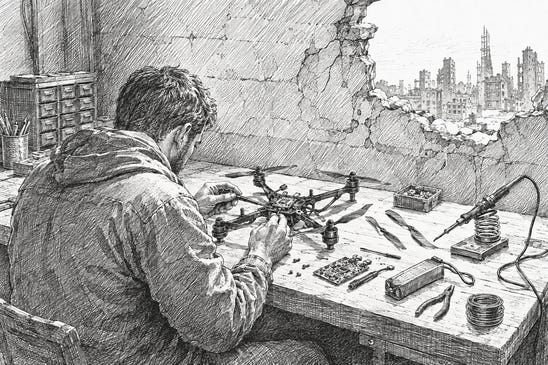
For four years the story of Ukraine was a story of asking. For weapons, for shells, for the air defence to survive the winter. Then this year something turned over so quietly that most people missed it. The tenant stopped only asking and started building. And he could start building for one reason above all, the reason set out in the part before this one. The thing that needed building had become cheap enough for him to make.
What the bombs could not reach
Russia spent four years trying to destroy Ukraine’s ability to make weapons, and largely succeeded at the obvious part. The plants that could be found were found. But the buildings were never the industry. The industry was in the engineers who redesigned a drone between one week’s losses and the next, in a feedback loop running at the speed of a live front. You can level a workshop. You cannot level the knowledge of how to build the next one, better, by Friday, especially when the next one costs five hundred dollars and its parts arrive in ordinary boxes.
The tenant with the trade
For years the tenant lived where the landlords put him and called on them for every repair. He could not build his own home because homes were expensive, and expense was what he lacked. The tenant who cannot afford to build is a tenant for life.
Then his building caught fire, again and again, and the cost of building quietly collapsed. So he learned, out of necessity, and for the first time within his means. Ukraine was producing no drones of its own in early 2022. By late 2025 it was making a hundred and fifty thousand a month.[8] That ramp was possible only because each unit was cheap, and cheap things can be made in numbers no foundry of elaborate platforms could match. The tenant did not just learn the trade. He out-produced the landlords who once housed him.
The parts that came in ordinary boxes
But recall the question left open in Part Two. Where do the parts come from. When Ukraine opened those boxes, it found motors, cameras, batteries, and flight controllers, and it found that the great majority of them were made in China.[9] The tenant had escaped the landlords’ walls only to discover that the materials he was building with all came from a single supplier, one who was not in the war and answered to neither side.
Ukraine understood the danger at once and began, urgently, to localise those components, knowing that a supply which can be cut is not sovereignty but a longer leash. Hold that unease. It runs quietly beneath the triumph, and will surface, fully, only at the end.
The implication
The lesson is the spreadsheet applied to people. Dependence on the old landlords was always going to end once the cost of building fell. Ukraine proved it under fire, on camera, at scale, and every other tenant is drawing the conclusion.
But the tenant did not become wholly free. He traded a landlord who sold him finished buildings for a supplier who sits beneath every building now going up. He does not yet feel it as rent. The rent is deferred, not absent.
Bonjourhi Institute Analytics, Montreal
Part IV - The Stake in Ten Other Buildings
Bonjourhi!
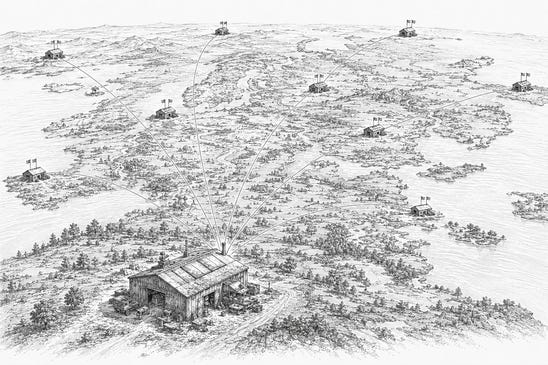
A tenant who has mastered the trade faces a choice. Rebuild on the same burning lot, or take the trade somewhere safer. This year Ukraine chose the second, seeding its production into ten other countries, factories it neither built alone nor fully paid for, yet partly owns. With one move, the tenant became a part-owner of buildings across the city, and could do it only because each new building costs so little to raise.
The four returns
The share bought four things at once. Safety, since a factory in Copenhagen sits behind a nuclear alliance’s air defence while a factory in Kharkiv is a set of coordinates. Financing, with the partner supplying the capital and Ukraine the knowledge. A client base, a weapon made in Germany to European certification selling across the continent where the Ukrainian original could not. And ownership, real equity in each venture, a piece of an industry that will still stand when the war ends.
Four gaps, four closures, one decision. The decision was to trade sole possession of a burning building for a stake in ten safe ones, and the cheapness of the new building is what made the trade multipliable across ten places at once.
The ground under all ten
And yet. Build ten factories in ten countries, and each still needs the same magnets, the same cells, the same sensors. Dispersal across Europe protects the workshops from Russian missiles. It does nothing about who supplies what goes inside them. Spreading the work across the map does not diversify the foundation. It copies a single dependency ten times over, a fact this series will return to at its close.
The implication
The old landlords owned expensive buildings at a single address and could be burned out or bankrupted. The new builder owns fragments of many cheap ones and can be neither. That is a genuine upgrade, and Ukraine has earned it.
The tenants built a new district. They do not own the quarry the whole district is built from.
Bonjourhi Institute Analytics, Montreal
Part V - The Landlord Who Raised the Rent
Bonjourhi!
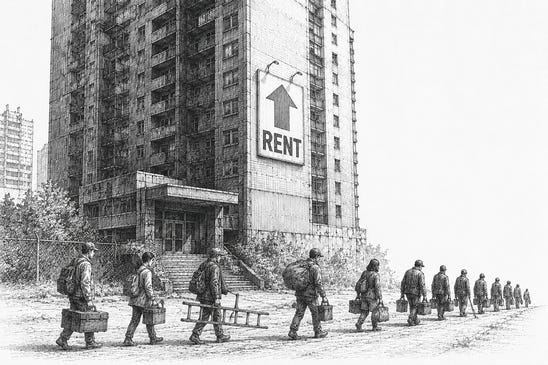
For years the American demand to its allies was the same. Spend more. Carry your weight. Stop relying on us. This year they finally did, and the money, every euro of the surge America spent a decade demanding, will eventually be flowing to European and Ukrainian factories rather than American ones. The landlord raised the rent to discipline his tenants, and the tenants used the money to move out.
The landlord’s miscalculation
Here the metaphor stops being a metaphor, because the family shaping this policy learned the landlord’s trade at first hand, in the housing blocks of New York, where the art was to extract the most from tenants who had nowhere to go. The instinct carried into statecraft intact. Treat the allies as tenants. Raise what they owe. Assume they cannot leave. It is the reflex of a man who has only ever known one kind of power, the leverage of a landlord over a tenant with no other door.
They agreed the buildings needed work. But they did not hire him to do it. They pooled the higher sums he forced them to spend, and built their own, now that the buildings were cheap to raise. The rent hike simply handed them the capital to do the one thing that had recently become possible.
The three defaults
The same decision cut America three times. The first was on the customer, shut out of the largest defence outlay in generations.[10] The second was on the shelf, the spreadsheet made flesh, as the landlord answered thirty-thousand-dollar drones with four-million-dollar interceptors and could not restock fast enough or cheaply enough, the wait for his premier interceptor stretching toward a decade.[11] The third completed the circle. Having emptied his shelves and lost the market, the landlord has begun to buy the new cheap weapons from the tenants who moved out. The household that was begging three years ago is now the vendor, and the landlord is the buyer. Three defaults, and behind each one the same wronged party: the allies and clients who had extended their trust on the promise that the arsenal would hold. They were the creditors, and a landlord who defaults three times teaches his creditors to stop lending.
The tariff, and the trap beneath it
Then, to bring the making home, he raised tariffs. The blanket tariff is sold as reshoring, but for the cheap weapon it points backward, because the cheap weapon is cheap precisely by being built from ordinary, globally sourced parts. The tariff taxes exactly those parts. It taxes the cheapness itself, making the American version of the cheap weapon dear.
But here the story turns. The tariff exposed something he had not reckoned with. When America moved to build its own drones, it found it could not. The magnets that turn every drone motor, ninety percent of them, are made in China. The battery cells, ninety-nine percent.[12] The sensors, the controllers, the refined rare earths under all of it, overwhelmingly Chinese. America banned the Chinese drone and then discovered it could not build the replacement, which runs on Chinese materials the tariff cannot conjure at home. The landlord raised a wall against the very supplier he could not do without.
And that supplier had been waiting. As Washington and Beijing traded measures, China tightened export controls on magnets and drone components, layer by layer, pausing under a truce but leaving the architecture in place and the clock running.[13] These moves look less like trade policy than like a campaign, each one testing a different valve in the pipe that feeds every arsenal, old and new. The landlord thought he was disciplining his tenants. A larger hand was quietly testing whether it could, at a time of its choosing, turn off the water to the whole district.
He raised the rent to keep them dependent, and the rent built their independence. He taxed the cheap parts to bring the work home, and found they were never his to bring. He had two ways to bind his tenants and used both, and each one loosened his grip while tightening someone else’s.
Bonjourhi Institute Analytics, Montreal
Part VI - The Reverse Takeover
Bonjourhi!
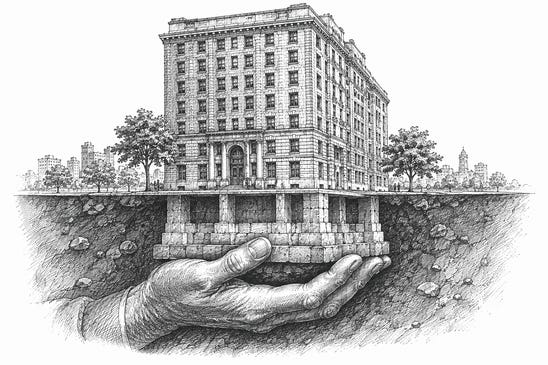
We have spent five parts on two landlords who bankrupted themselves, and it is time to name the party who profits from the wreckage. In finance there is a manoeuvre called the reverse takeover, in which a smaller or quieter firm gains control of a larger, more famous one from underneath, often through the larger firm’s own distress, and ends up owning the marquee name it once merely supplied. That is the transaction this series has been describing. China never fought either landlord. It supplied the materials beneath every building in the district, old and new, and waited for the owners to default. It is now foreclosing.
Russia, already acquired
Look first at what is already complete. Russia, the second landlord, is no longer an independent power in this trade. It fights with Chinese engines, control systems, and navigation gear shipped to the makers of its drones.[14] NATO calls China the decisive enabler of Russia’s war. Russia sells China its energy at a discount, depends on Beijing to sustain its industry, and could not continue the war for long if the supply were withdrawn. This is not alliance. It is vassalage. One of the two old landlords has already been taken over from underneath, reduced from a rival superpower to a supplier of raw materials and a buyer of Chinese parts. The reverse takeover of Russia is done. Most people have not noticed. Russia still flies its own flag over the building it no longer controls.
America, in progress
The takeover of the first landlord is further from complete but running on the same rails. At least eighty thousand components across nineteen hundred American weapons systems depend on Chinese rare earths.[15] Not only the drones. The fighter, the cruise missile, the submarine’s propulsion, the guidance and the sensors of nearly every platform the Pentagon fields. China controls, by most estimates, some ninety-eight percent of the world’s rare earth magnet manufacturing.[15] The phrase used by those who study it is stark. Beijing can ground America’s drone fleet with a single phone call.[14] That is not a supplier. That is a party holding a lien on the entire arsenal, able to foreclose at a moment of its choosing.
This is the debt that was always beneath the others. Part Five described America defaulting on its allies. But America itself is the debtor to China, and the collateral is the arsenal. The landlord who spent his fortune squeezing tenants was, the whole time, mortgaged to the supplier of his own foundations, and he accelerated toward the reckoning by picking a fight with the one party he could not replace.
The last constraint, removed
There is one more turn, the darkest, and it explains why the contest reduced to supply in the first place. The true limit on great-power war was never money. It was bodies, and above all dead ones. A democracy can absorb a budget overrun. It cannot easily absorb a stream of coffins, and that intolerance for its own dead was the one discipline that reliably ended its wars, the constraint that closed the long campaigns of the earlier part of this century. The soldier was expensive to keep and unbearable to lose, and the unbearable loss was the brake.
The unmanned weapon releases the brake. When the thing destroyed is a machine and not a man, there is no coffin, no funeral, no grieving town, no political price for the loss. War stops being limited by a nation’s tolerance for its own dead and becomes limited only by how many machines it can build. It reduces, in other words, to a pure contest of industrial supply. And a pure contest of supply is precisely the contest the party who owns the components was always going to win. Removing the soldier from the battlefield did not make war more humane. It handed the outcome to whoever owns the factory floor, and the factory floor, as the next section shows, was quietly bought long ago.
Why the tenants’ victory is only half a victory
And the tenants. Ukraine, Europe, the middle powers who learned to build and spread their stakes across ten safe cities. They escaped the old landlords, and that was real. But every one of them builds on Chinese magnets, Chinese cells, Chinese sensors. They swapped a landlord who sold them finished buildings for a landlord who owns the quarry every new building is cut from. Ukraine knows this, which is why it races to localise its components, understanding that a supply which can be cut is not freedom but a longer tether.
So the democratization of making, the great liberating force of this series, turns out to have been shallow. It freed the assembly and left the foundation monopolized. Anyone can now bolt together a drone. Almost no one but China can supply the magnet at its heart, the cell that powers it, the refined earth beneath both. The tenants won the top floor of the building and discovered the deed to the land was held by a third party who had been buying up the district, patiently, layer by layer, while the two old landlords fought over the rent.
The implication
Step back and see the shape of the whole transaction. Two aging landlords, America and Russia, sat on a district built from materials they had, over decades, allowed a quieter party to come to supply. That party never needed to raise a rival tower. It needed only to own the wiring, the magnets, the pipes, the pour of every foundation, and then wait. When the weapon turned cheap and disposable, demand for those materials exploded, and the supplier’s grip closed on everyone at once, the old landlords and the new tenants alike. The distress of the two superpowers was not a threat to this plan. It was the plan. A reverse takeover feeds on the target’s collapse.
Russia it has taken outright. America it holds by the arsenal’s throat. The tenants it supplies and can therefore, when it wishes, throttle. The deliberate patience of it is the part that should be studied. No armies, no invasion, no single dramatic act. Only the steady accumulation of the layer beneath the layer, the ground under the district, held quietly until the day the owners default and the deed changes hands without a shot.
The three words came due, and then the fourth. The leverage was the trust of allies and the reach of an arsenal, borrowed against by a landlord who thought he was collecting rent. The default was the moment that arsenal could no longer honour what it promised, at home or abroad. The creditors, the allies, walked out with the trade. And beneath them all, the foreclosure, quiet and total, on a district whose foundations one patient party had been buying the entire time.
Fred Trump’s fortune rested on tenants who could not leave. His heir inherited a grander version, an arsenal the whole world depended on, and spent it fighting the tenants while mortgaged to the one supplier he could not replace.
He prepared the foundation for the greatest bankruptcy of his life. He did not notice that the foundation was already owned. The name stays over the building. The building, and the ground it stands on, and the district around it, now belong to the quiet party who supplied the concrete and waited.
Bonjourhi Institute Analytics, Montreal
NOTES ON SOURCES
1. Fred Trump’s subsidized-housing fortune and the 1954 U.S. Senate Banking Committee inquiry into profiteering on federal housing loans, in which he was cited for overstating Beach Haven charges by $3.7 million (The New York Times; Senate Banking Committee records, 1954; Will Kaufman, The Conversation, 2026).
2. A note on scale: defence manufacturing is a small share of output but an outsized share of discretionary federal demand. All U.S. manufacturing is about 9.4% of GDP (~$2.96tn, BEA 2025); aerospace and defence together are roughly 1.6% of GDP (~$500bn, AIA 2025), and pure defence is less. Yet defence is the largest discretionary line in the federal budget (~$886bn, FY2025) and nearly half of all discretionary funding (Peterson Foundation; CBO). The categories above it, Social Security (~$1.5tn) and health programmes (~$1.7tn), are mandatory transfers that buy almost no manufactured goods, paying benefits directly to individuals rather than to contractors (USAFacts; Fed-Spend, 2026). Defence is therefore the single largest pool of federal money spent by choice on domestic manufactured output, which is why its influence over the industrial base, R&D priorities, and supplier survival far exceeds its share of GDP.
3. Ratio is arithmetic: $5,000,000 / $500 = 10,000. Force-multiplication framing from 2026 drone-warfare analyses (The Board; drone-warfare.com).
4. European Policy Centre, “The New Economics of Warfare,” March 2026; CSIS and RUSI cost estimates, 2026. Shahed $20–50k; Patriot ~$4M; THAAD $12–15M; Shahed vs SM-6 ~235:1.
5. During Operation Epic Fury (early 2026), the UAE engaged more than 1,627 incoming drones, and roughly $2.4bn in Patriot interceptors were fired over about five days, a consumption pattern that triggered an emergency U.S. foreign military sales package (drone-warfare.com; ORF Middle East, 2026).
6. Peter G. Peterson Foundation, “Budget Basics: National Defense,” 2026 (FY2025: personnel $207bn; procurement $162bn), from DoD/OMB data. CBO: roughly one-quarter of the DoD budget is personnel.
7. Congressional Budget Office, “Costs of Military Pay and Benefits in the Defense Budget” (pub. 43574): nearly 10 million people eligible for military health benefits.
8. Industry and CSIS figures, 2026: Ukraine went from no domestic drone production in early 2022 to roughly 150,000 units per month by late 2025.
9. DRONELIFE, March 2026, citing CSIS: modern drones depend on Chinese-produced motors, cameras, batteries and microelectronics; Ukraine is localising components.
10. Courthouse News, 2025: EU roadmap requiring most procurement from European or Ukrainian makers by 2030; Germany’s plan directing roughly 8% to U.S. suppliers. On the dispersal itself: Ukrainian “Build with Ukraine” joint ventures span Germany, Denmark, the United Kingdom, Poland, the Baltic states, and others, with 40-plus agreements signed across 20-plus countries by mid-2026 (Reuters; RUSI, 2026).
11. International Policy Digest, January 2026, and U.S. Army budget documents: Patriot interceptor wait times approaching a decade; U.S. holding roughly a quarter of required interceptors.
12. The Next Web, May 2026, citing the U.S. Commerce Department Section 232 finding: China controls ~90% of rare-earth processing, ~99% of drone battery cells, and ~90% of permanent magnets.
13. DRONELIFE, August 2026 (China MOFCOM Announcement No. 34, case-by-case export review); Semantic Visions, 2026, on sequenced export controls.
14. Stars and Stripes, May 2026 (“ground the fleet with a single phone call”); NATO designation of China as a “decisive enabler” of Russia’s war; Reuters investigation into Chinese components in Russian drones.
15. China controls roughly 90% (some estimates to ~98%) of global rare-earth magnet manufacturing; CSIS reports ~80,000 components across ~1,900 U.S. weapons systems depend on Chinese rare earths (Select Committee on China; CSIS; Goldman Sachs, 2025–2026).
BONJOURHI! INSTITUTE ANALYTICS · MONTREAL · 2026