


The Community
Bonjourhi Institute studies the systems that hold.
Economies, institutions, markets, enterprises and societies are not static structures. They accumulate history. They inherit decisions made in earlier periods. And as they grow more complex, their ability to understand their own condition becomes the question that matters most.
Bonjourhi Institute Analytics is a weekly analytical publication for those who need to understand the world before they can act in it. Each issue examines one question from several angles, with the patience current events rarely allow: geopolitics, capital markets, institutional coherence, and the long arcs of history that make the present legible.
It is not a news digest. It is not a briefing. It belongs to the tradition of journals that take their readers seriously.
Published from Montreal. Read internationally. Once a week, on average.
What is the Nautilus?
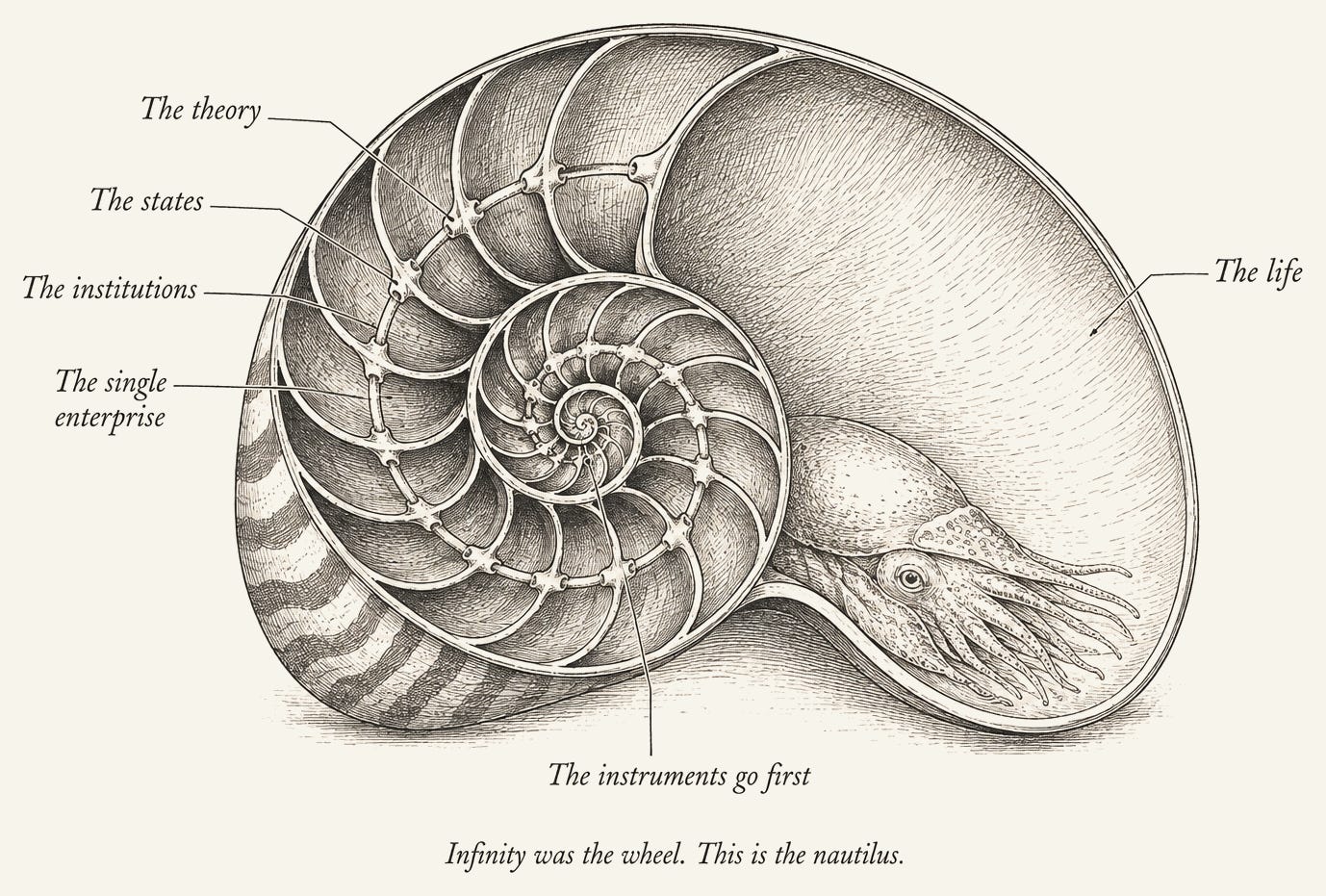
The nautilus is the mark of the Bonjourhi Institute and the subject of its book, The Nautilus: Coherence Economics and the Logic of Living Systems. It is not simply a decorative shell. It stands for a particular idea of progress.
How it grows. When the chambered nautilus outgrows its chamber, it builds a new one, seals the old one behind it, and moves forward. Nothing is thrown away: every earlier chamber remains part of the shell. Growth does not require forgetting, and adaptation does not require starting again. The past remains inside the present.
What the chambers mean. The Institute reads the chambers as levels at which a system can be understood: theory at the centre, then states, institutions and the single enterprise, and finally life. That outer chamber is where consequences arrive and systems become real.
The part you cannot see. A slender living tube, the siphuncle, runs through every chamber. It does not propel the animal; the funnel does that, and the animal decides where to go. The siphuncle empties the sealed chambers so the heavy shell can stay up in the water. For the Institute it stands for the instruments a system uses to know where it stands. That gives the framework its master theorem: the instruments go first. A system can still look intact while its ability to read its own condition is already failing.
The wheel and the spiral. A wheel returns to the same place. A spiral meets familiar problems at a new scale. The three laws of Coherence Economics trace that spiral: coherence compounds, decoherence extracts, recoherence recompounds.
For the Bonjourhier. Coherence Economics is a research framework, not yet a validated theory, and Bonjourhi is not a prediction machine. The nautilus proves nothing; it makes the argument visible. It asks one question of every system the Institute studies: can it keep growing without losing the ability to understand itself?
The Instruments
Running through every chamber of a living nautilus is a slender tube called the siphuncle. It does not propel the animal; propulsion comes from the funnel. The siphuncle does quieter work. It regulates liquid and gas within the sealed chambers, making a heavy shell compatible with controlled position in the water.
The instruments are not the engine. They make intelligent movement possible.
Before a complex system visibly fails, the means by which it understands itself often begin to deteriorate. Measures become less representative. Signals distort. Ratings describe yesterday’s structure. Dashboards continue to report calm.
That is the thread Bonjourhi Institute Analytics follows. Our Analytics mark is drawn with open arcs, deliberately: no instrument observes everything.
Who is the Bonjourhier?
The Coastal Surfer reads the wave. The Pelagic Navigator reads the current.
Every reader of the Institute is a Bonjourhier: a temperament rather than a profession, curious about what moves beneath the surface and content with orientation in place of certainty. But not all Bonjourhiers read that water from the same depth. Some work the surf. Some have left the sight of land.
The Coastal Surfer. The surfer works where the landmarks still hold, and reads the wave that is breaking now with real skill. This is no lesser craft; judging live water takes timing and nerve. In the Institute, the surfer comes for the sharp account of the moment, the current essay, the timely read on a market turn or a technology crossing its threshold. It is how most Bonjourhiers arrive, carried in by one piece that named something they had felt but not yet framed, and often the reader who presses that piece into a friend's hands.
The Pelagic Navigator. The navigator has gone beyond the coast, into open water where the familiar references disappear. Out there the breaking wave matters less than the current carrying it, a current that may have begun thousands of kilometres away. This reader is engaged with the framework itself: Coherence Economics, the instruments, the longer arguments. They do not ask what happens next. They ask which current is running, and where its kind has led before. This is the reader in whom the Institute compounds, because someone who sees through the lens of the framework does not drift off when the news cycle turns. They were never reading the cycle.
One journey. These are not two readerships but two positions on one water, and the passage runs one way. A reader arrives in the surf, begins to notice the current beneath the wave, and one day finds they have paddled past the last buoy without deciding to. The timely piece is the shoreline; the framework is the open water; the essays are the way out. Neglect the surf and no one arrives. Neglect the open water and no one stays. For most readers the honest answer is both, depending on the tide. What unites them is not distance from shore. It is that both read the water rather than ignore it.
Every Bonjourhier reads the ocean.
The Editor

Pierre Somers is the founder of the Walter Group, a Montreal-based investment firm spanning public markets, private equity, and asset management. Over more than three decades, he transformed a family industrial enterprise into one of Canada’s most quietly influential investment groups.
At Bonjourhi Institute Analytics, he writes as Chief Editor, applying the same disciplined, long-horizon thinking he brought to building institutions to the questions that shape the world his portfolio inhabits.
He holds a B.Sc. in Mechanical Engineering from Clarkson University and completed the Harvard Business School YPO/MBA program. He is fluent in English, French, and German. He writes from Montreal.
Senior Publications Manager

Darlene Hunt has worked alongside Pierre Somers for eighteen years. Over the past two years, as the Bonjourhi Institute’s work has grown, she has taken on a central role in bringing its publications to readers.
As Senior Publications Manager, she guides Pierre’s essays and manuscripts from draft to finished form. That work includes the Bonjourhi newsletters, the Institute’s case studies and white papers, and the digital editions of his books. She has also worked with her Institute partners to shape the website and visual identity.
