
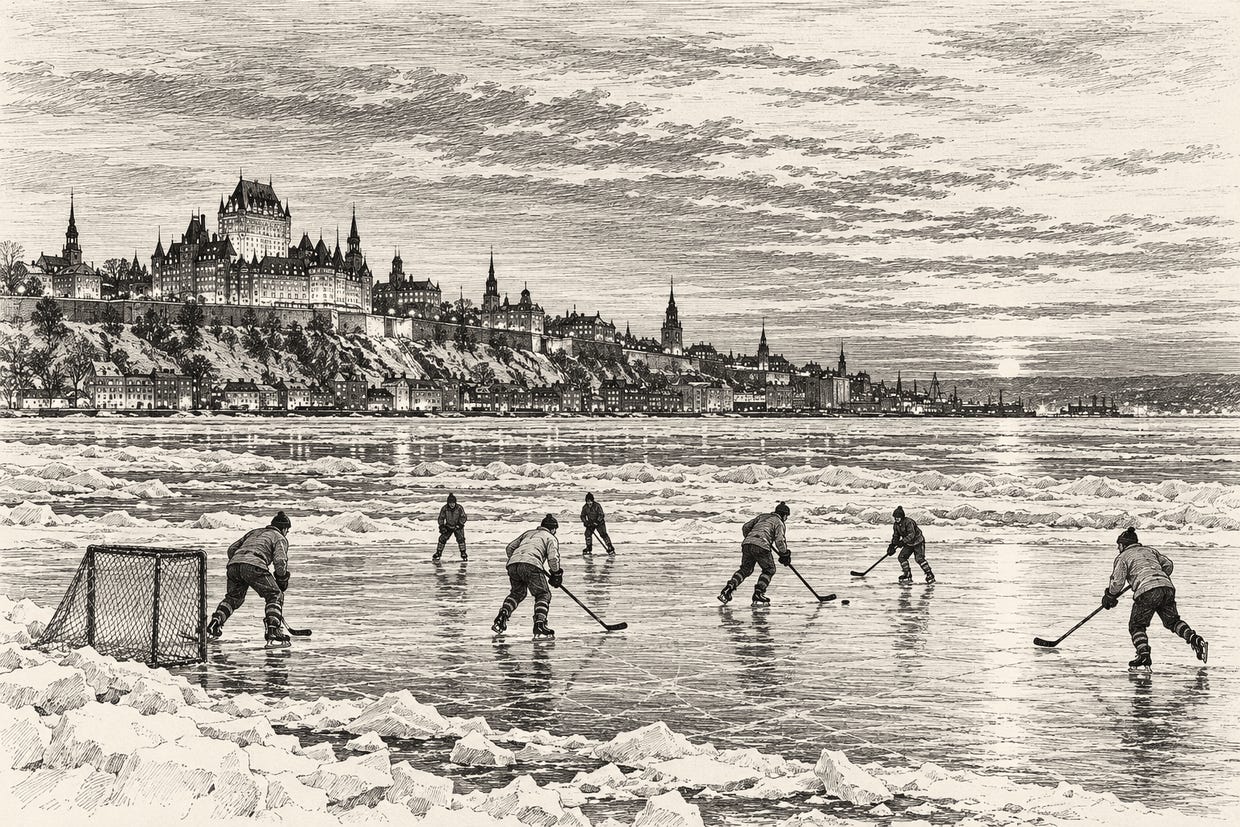
Shinny on the St. Lawrence, below Quebec City.
Bonjourhi!
For years, people have asked me the difference between a Canadian and an American. My answer has never changed.
Americans want to win. Canadians do not want to lose.
It sounds like a joke about temperament. It is actually a description of two operating systems, visible in how each country lends money, builds banks, and now fights a trade war. The best way to see it is on the ice, in a system invented by a Montrealer and made famous by an American team.
THE TRAP
In the spring of 1995, the New Jersey Devils swept the Detroit Red Wings to win the Stanley Cup.1 Detroit was the more gifted team, fast and dazzling. New Jersey was coached by Jacques Lemaire, a quiet man from LaSalle, Quebec, who had won eight Cups as a player in Montreal.
Lemaire’s system was called the neutral zone trap. His players did not chase the puck. They held their positions in the centre of the ice, closed the passing lanes, and waited. Every opponent who rushed forward met a wall of patient bodies. Sooner or later, the attacker forced a pass that was not there. The puck turned over, and the Devils went the other way.
Fans called it boring. Commentators said it was bad for hockey. The league eventually rewrote its rules to open the game up again.2
The Devils kept the Cup anyway.
TWO WAYS TO PLAY
A team that plays to win measures itself by goals scored. It forechecks hard, takes risks, and accepts that some nights it will be burned. A team that plays not to lose measures itself by goals against. It gives up spectacle in exchange for being very hard to beat.
Neither approach is wrong. They simply fail in different ways. The attacking team loses big when it loses. The trapping team rarely loses big, and rarely wins big either.
ON THE BALANCE SHEET
Look at how each country finances a home. The American system is a forecheck. It offers a 30-year fixed rate, rewards leverage with a tax deduction on mortgage interest, and lets banks lend with enthusiasm.3 When it works, it creates vast household wealth. In 2008, it produced the largest financial crisis in eighty years, and more than four hundred American banks failed in its wake.4
The Canadian system is the trap. Borrowers are stress-tested against rates higher than they will actually pay. Terms are short. Low down-payment loans must be insured.5 Canada came through 2008 without a single bank failure, which is the most Canadian triumph imaginable. Nothing happened.6
Behavioural economists would recognize the pattern. Daniel Kahneman and Amos Tversky showed that most people feel a loss about twice as sharply as an equal gain.7 Canada may be the only country that turned that finding into banking regulation.
ON THE TRADE WAR
The same two systems now face each other at centre ice.
Washington is forechecking. Tariffs, deadlines, escalation, every shift a rush toward the net. Each round is designed to win something now: a concession, a headline, a better deal before the whistle.
Ottawa is setting the trap. New ports, pipelines to other coasts, trade agreements with Europe and Asia, the slow removal of barriers between its own provinces. None of it scores a goal this season. All of it closes a lane.
And the trap works as Lemaire designed it. The harder the attacker presses, the likelier the turnover. Every tariff that pushes Canadian oil, lumber and metals toward other buyers is a pass forced into traffic. The discount America once enjoyed on Canadian resources is the puck going the other way.8
THE SCOREBOARD, SECOND PERIOD
Read the numbers carelessly and the forecheck looks like it is working. American employers added 162,000 jobs in August, and unemployment sits at a low 4.1%.9 Canada’s rate is 6.4%, and the country shed 42,000 jobs the same month.10
Look closer, and the game changes. American wages rose just 3.1% over the year, the weakest gain since May 2021, while fuel has hit record prices and tariffs cost the typical household around $1,100 annually.11 Plenty of Americans are employed and still falling behind. In Canada, the jobless rate is 0.7 points below a year ago, despite the tariffs.12
Today, Americans are paying for a victory that has not arrived. North of the border, the bill is for insurance that has yet to pay out. The difference is that insurance, unlike a promise, does not depend on the other team’s mood.
THE WEAKNESS OF THE TRAP
Honesty requires the other half of the story. A team that only plays not to lose cannot come from behind. When you trail in the third period, patience does not score.
Canada knows this weakness well. Its productivity has lagged America’s for decades. Its most ambitious founders and engineers often go south to build their companies. The same caution that protected its banks in 2008 has made it slow to produce the giants that American risk-taking creates. A country that never loses big also rarely wins big, and its young people notice.
The trap is a defence. It is not yet a strategy for building.
THE CLOSING TURN
Winning is a result. Not losing is a system. Results can be spectacular and brief. Systems are dull and durable.
In 1995, the flashier team went home without the Cup, and the patient one lifted it. Lemaire’s lesson was not that defence beats offence. It was that the side willing to wait usually gets to choose when the game turns.
One country wants to win. The other refuses to lose. Over a long enough season, the second tends to still be skating.
Bonjourhi Institute Analytics, Montreal
THE TRAP, DRAWN
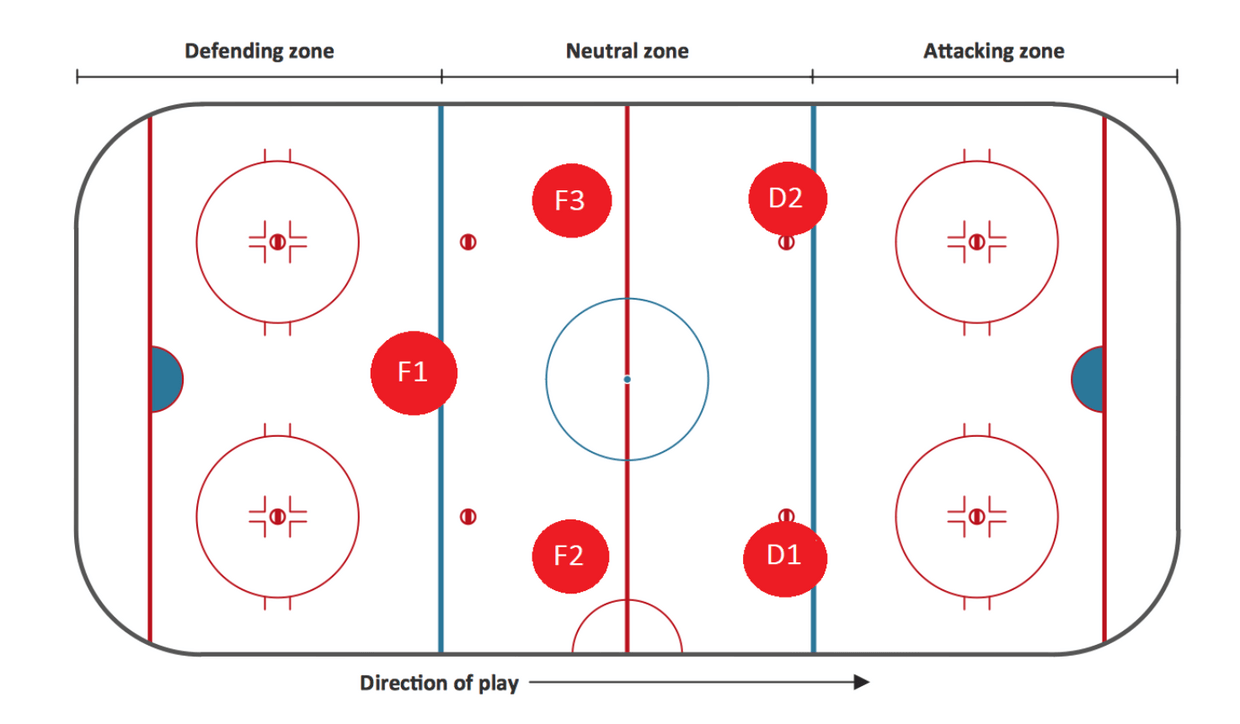
The 1-2-2 neutral zone trap. Zone labels follow the opposing team’s direction of play.
The opposing team breaks out from the left, skating in the direction of the arrow. F1, the lone forechecker, meets the puck carrier near his own blue line, not to steal the puck but to steer him toward the boards. F2 and F3 wait along the centre red line, one on each side, sealing the lanes the carrier would use to escape. D1 and D2 hold their own blue line, ready for anyone who slips through.
By the time the carrier reaches centre ice, five opponents stand before him in the shape of a funnel. Forward passes meet a stick or a skate. Most rushes end in a dump-in the trapping side has already prepared for, or a turnover that sends play back the other way.
NOTES AND SOURCES
1. New Jersey defeated Detroit four games to none in the 1995 Stanley Cup Final, the franchise’s first championship. Jacques Lemaire, born in LaSalle, Quebec, won eight Stanley Cups as a player with the Montreal Canadiens.
2. Following the 2004 to 2005 lockout, the NHL eliminated the two-line offside pass and introduced a strict standard on obstruction, changes widely described as aimed at defensive systems such as the trap.
3. U.S. Internal Revenue Code, Section 163(h). Interest is deductible on up to $750,000 of acquisition debt for taxpayers who itemize, a limit set in 2017 and made permanent in 2025.
4. Federal Deposit Insurance Corporation, Failed Bank List. Roughly 465 U.S. banks failed between 2008 and 2012.
5. Office of the Superintendent of Financial Institutions, Guideline B-20, which sets a minimum qualifying rate for mortgage borrowers. Under federal law, mortgages from regulated lenders with less than 20% down must carry mortgage default insurance, principally through CMHC.
6. Michael Bordo, Angela Redish and Hugh Rockoff, “Why Didn’t Canada Have a Banking Crisis in 2008 (or in 1930, or 1907, or …)?”, Economic History Review, 2015.
7. Daniel Kahneman and Amos Tversky, “Prospect Theory: An Analysis of Decision under Risk”, Econometrica, 1979; Amos Tversky and Daniel Kahneman, “Advances in Prospect Theory”, Journal of Risk and Uncertainty, 1992, which estimated a loss aversion coefficient of about 2.25.
8. Western Canadian heavy crude has historically traded at a steep discount to the U.S. benchmark because nearly all exports flowed south. The differential narrowed after the Trans Mountain Expansion opened a route to Pacific markets in May 2024; see Canada Energy Regulator market reports.
9. U.S. Bureau of Labor Statistics, The Employment Situation, August 2026, released September 4, 2026.
10. Statistics Canada, Labour Force Survey, August 2026, released September 4, 2026.
11. Wage growth: Associated Press, September 4, 2026. Record diesel prices: AAA national average of $6.51 per gallon, reported by CNBC, September 24, 2026. Household tariff cost: Yale Budget Lab, State of U.S. Tariffs, updated August 24, 2026.
12. TD Economics, Canadian Employment, August 2026.
BONJOURHI! INSTITUTE ANALYTICS · MONTREAL · 2026