
Bonjourhi!
On August 5, President Trump said the Strait of Hormuz would reopen soon. That same week, the count of ships actually passing through it sat near ten a day, against a normal flow of roughly a hundred.
Anyone who drives in Quebec already knows how this ends. We have a word for a repair that is always about to happen. We put it on the road in bright orange, and we drive around it for years.
This is what a modern forever war looks like. Not a front, not an armistice, not a day the fighting stops or a treaty anyone signs. Just a disruption that never resolves and never quite ends, absorbed into the price of things until it becomes the ordinary cost of moving through the world. The old wars had battles. This one has a toll.
The Cone
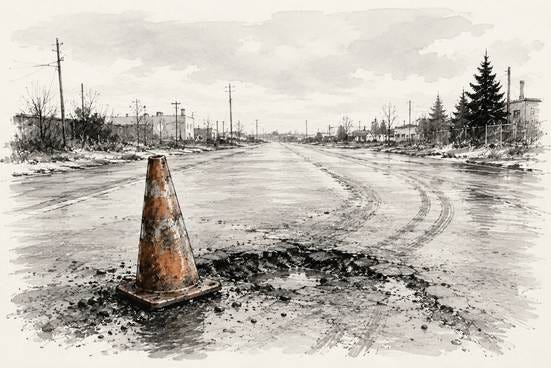
There is a stretch of road near you with a cone on it. You know the one. It was placed there to mark something temporary, a crew coming, a hole to be filled, a surface to be redone. The cone is a promise. It says: this is being handled, the repair is close, the inconvenience has a horizon.
Then the crew does not come. Or it comes, does part of the work, and leaves. The cone stays. It fades from orange to a chalky pink in the sun. The hole beside it deepens through a winter of freeze and thaw. And something quiet happens to everyone who drives that stretch. They stop reading the cone as a promise. They learn the swerve. The lane shifts a foot to the left, permanently, in the muscle memory of every driver who uses it, and the swerve becomes the road.
Nobody announces that the repair is cancelled. There is no press conference to say the hole is now permanent. Removing the cone would mean either fixing the road or admitting it will not be fixed, and both cost more than leaving it where it is. It is cheaper to signal a repair forever than to perform one once. This is the most honest object in Quebec. It shows you exactly how an emergency becomes a condition, at a price low enough that no one ever quite decides to stop paying it.
For years the swerve is free. The cost is small and spread thin, a little more wear, a few seconds lost, a risk low enough to ignore. That is what makes the cone survivable. The tax is real but quiet, and a quiet tax is one a society will pay forever rather than fund the fix. Quebec’s roads now carry a maintenance deficit of 24.5 billion dollars, more than half the province’s entire infrastructure shortfall, with 44 percent of the network rated poor or very poor. That figure is a million small swerves, compounding. It is also the cone’s deepest trick: deferral costs nothing right up until it is catastrophic, and nothing marks the day it turns.
The Same Cone, Larger Road
Hormuz is a road with a cone on it. The reopening language is the marker, and it has been placed and replaced for months. A ceasefire in April. A memorandum in June promising free passage for sixty days only. A suspension in July. A reimposed blockade in August. Each announcement is a fresh cone set on the same broken road, and each time, the people who actually move goods across that water have learned to drive around it.
The swerve is real and it is priced. Where one strait used to carry the traffic, there are now three contested routes, Iran’s own territorial lane, the Omani coastal route, and the old main channel that vessels enter at their own risk. War-risk surcharges run near twelve million dollars per tanker. Insurers will not write the crossing at the old price. Ships route the long way round, or run dark, or wait. None of this responds to the cone. It responds to the hole.
And the hole is deepening while the repair is described as imminent. The buffers that absorbed the first shock are thinner now. The March reserve release, four hundred million barrels, the largest in history, cannot be redrawn at will. United States distillate stocks sit near their lowest since 2000. European gas storage is at 57 percent against a 90 percent winter target. Each is a freeze-thaw cycle widening the crack while the marker promises a crew is on the way. The water will set its own timeline, not on a day a press conference schedules, but on the day a tanker is hit, an insurer withdraws entirely, or a reserve drawn down for the last emergency is not there for the next one.
And as with the road, the marker does not merely fail to fix the problem. It prevents the fix. A refiner does not build alternative sourcing if normalization is six weeks away. A government does not rebuild a reserve it assumes it will not need. Every month the disruption is called temporary is a month no one adapts to it being permanent. The cost falls downstream, on everyone who drives the road. The shipper absorbs it first, in surcharges and the long way round. It reaches the household next, folded into the price of fuel, at the moment the buffers that once hid such costs are nearly spent. And the public treasury pays the residual, rebuilding at tomorrow’s prices what was drawn down at yesterday’s. None of them set the charge. All of them cross, because there is no other way across. This is the war, and it is being fought the way modern wars are increasingly fought, not with a battle anyone can point to, but with a cost that never switches off. The active phase was billed at roughly a billion dollars a day, and it was supposed to end in June. The agreement was signed, the war was declared over. Then the memorandum collapsed in July, the blockade returned in August, and the ships never left. The meter that was meant to stop simply kept running, which is the only thing a meter like this reliably does.
What the Cone Costs
The deal in the speeches may still arrive. It will not undo the swerve. Even a settlement tomorrow leaves the surcharge priced in, the reserve half full, the route redrawn to three lanes where there was one. The road does not return to what it was before the cone. It becomes the road with the swerve in it, and the swerve outlives the hole, because a generation has learned to drive it and no longer remembers why.
That is the real cost, and it is not the one the accountants tabulate. It is not the twelve million per tanker or the twenty-four billion in deferred repair. It is that a society driving around enough cones for enough years stops believing roads can be straight. It recalibrates. It budgets for the swerve, plans around the swerve, teaches the swerve to its children as simply the shape of the road. The deficit that compounds is not only fiscal. It is the slow lowering of what people believe they are entitled to demand. A war with battles ends, and the ending is visible. A war that is only a permanent charge has no such mercy. It does not end. It is merely paid.
A fifth of the world’s oil now moves the way a Montrealer drives Notre-Dame Est. With a learned flinch, at a cost nobody itemizes, past a repair nobody expects.
The danger was never that the cone would fail to signal a repair. The danger is that we come to prefer it. The cone asks nothing of us. The repair asks everything. So the cone stays, the swerve becomes the road, and one morning you find you have forgotten the road was ever straight, on your own street and in the Gulf both. That forgetting is the invoice. It is paid in full, by people who no longer know they are paying.
Sources: direct US military expenditure averaging about one billion dollars per day is drawn from Pentagon briefings to Congress and the Brown University Iran War Cost Tracker. Quebec road figures are from the March 2026 provincial budget. Strait of Hormuz transit, routing, insurance, and reserve figures are as reported through August 2026.
BONJOURHI! INSTITUTE ANALYTICS · MONTREAL · 2026