
Bonjourhi!
Two readings of the same season. The world is building walls again, and this issue looks at both sides of one.
The first essay stands where the wall is raised, and asks what it quietly takes from the people behind it. The second stands where the wall is aimed, at a country that cannot stop producing, and asks what happens when the channels finally close.
A barrier looks the same from either side. What changes is whether the hand that raised it can still say why.
Pierre Somers
Chief Editor, Bonjourhi Institute
Montreal, Quebec – September 2026
Not a Fish, Not a Tax

The lure that catches by looking like nothing the water has produced.
Bonjourhi!
For thirty years, trade policy chased one shape. Make the good move like water. Lower the barrier, smooth the port, until the border stopped mattering. This summer the thing that catches looks nothing like water. It is blunt, artificial, and it is landing what it aims at. The shift tells us more about power than about trade.
THE LURE
There is a fishing lure having its moment. Born in Japan, smaller than a tennis ball, covered in tentacles. People call it an alien, a meteor, a cat toy. Shops cannot keep it in stock. The one shape it does not take is that of a fish.
For most of the history of the craft, a lure earned its place by imitation. Painted eyes, a body cut to swim like real prey. The tentacled thing abandons that. It works because it looks like nothing the water has produced. The old craft tried to disappear into the natural order. This object announces that a hand made it.
WHAT OPPENNESS WAS
Free trade was sold as the natural state. Water finding its level. Remove the distortions and commerce settles into the form it was always meant to hold. That was the lure that looked like a fish.
Openness was never the absence of design. It was treaties, tribunals, decades of talks, painted so well to resemble the given order that people forgot it had been assembled at all. It moved so smoothly it seemed to be the water itself. That forgetting was its coherence, and for a while it held.
TWO OBJECTS, NOT ONE
The barriers came back ugly. Aimed by hand, admitting a hand aimed them. But there are two of them in the box, and confusing them is where the commentary fails.
The tariff is the urchin. Loud, blunt, plainly artificial, sitting in plain view. It frightens people precisely because they can see it.
The other stays quiet. The standard, the license, the safety threshold, the carbon rule. This one still wears the paint and the lifelike fins. It looks like the natural order caring for your health and your children, and it does most of the catching. For the majority of exporters the invisible barrier now costs more than the visible one. The frightening object is the safer of the two.
This is also why the story is no longer about a single country. One capital raised the urchin loudest, but the disguised lure is everywhere. Steel shields in Europe, import surcharges in Mexico, new walls across Latin America. The instinct to build while calling it something else belongs to the season, not to one government.
THE CATCH YOU CAN COUNT
The tariff reliably does one thing. It raises money. Customs receipts more than tripled in a year, a wall of revenue collected at the border without a vote. And it reliably fails at its stated purpose. The trade gap is wider than before, the factories no fuller, the balance unfixed.
These are not two scorecards. They are locked against each other. A tariff earns only while goods keep crossing, so it collects most when it is failing hardest to stop them. One that truly worked, that brought the plant home, would collect almost nothing. A lure that catches on every cast is snagging the bottom. The goods keep swimming past, paying the toll as they go.
THE WALL THAT CHANGED ITS STORY
Then the strangest chapter. The country with the loudest wall had its legal ground knocked out. The high court ruled that the emergency law invoked to raise it never authorized it. The ruling came in the morning. By afternoon the wall was back up on other footing, a payments statute, an unfair-practices probe, a century-old labor clause. The rebuild had been rehearsed weeks earlier by the Treasury, which said openly the same structure could be recreated under other authorities.
The court struck the reason, and the wall did not fall. It changed its story and stood. A coherent policy is one where the stated reason and the real function are the same thing, so cutting the reason ends the function. Here they had come fully apart. The emergency, the payments problem, the labor clause were costumes, swapped as each was ruled out. A structure that outlives its own justification was never standing on it. It was standing on a preference, reaching for whatever authority lay within arm’s length.
A TAX WITH NO NAME
So what is the object for, once every stated reason has been tried on and dropped? It raises tax without being called tax. Collected at the dock, not the register. Borne at home, not abroad. Falling hardest on the households with the least room. Over two hundred billion in a year, near seventeen hundred dollars a household, with no line on any return to point at. A charge you can find, you can vote against. This one cannot be found.
The shelf price has barely moved yet, and the reason is the same chaos that keeps the wall standing. Firms swallowed the charge and ran down old stock rather than reprice, unsure which law would hold next month. The confusion did not soften the tax. It hid it. The bill was rung up at the border and the receipt withheld. It arrives later, folded into the price of ordinary things, long after the moment it was levied, under a law struck down and rebuilt twice in between. By then no thread joins the higher price to the policy. That severed thread is the design, not an accident of it.
NOT A FISH, NOT A TAX
The lure does not look like a fish. The tariff does not look like a tax. Each was shaped so the target would not know what it faced or feel the moment it was taken from. The fish strikes the thing it never learned to fear. The citizen pays the charge that appears on no form.
Whether these barriers are good or bad is the wrong question. The object carries no memory of why it was raised, and looks the same whether aimed with reason or merely grabbed because grabbing is what the season rewards. The coherence was never in the object. It was in knowing why the hand chose it, and in whether the hand can still say. What the thing costs you depends entirely on whether you can still see that hand.
Not a Gift, Not Forever
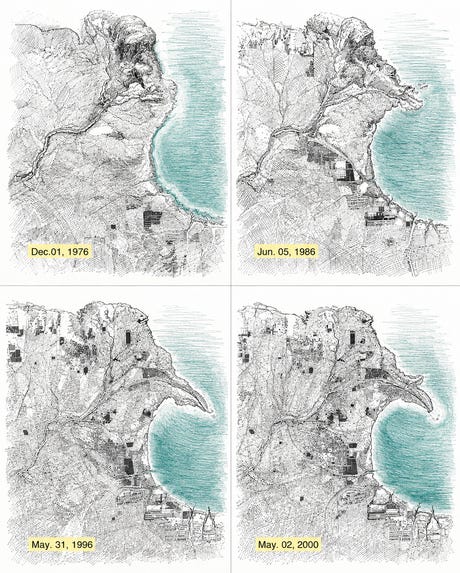
The Yellow River delta across twenty-four years. Each panel shows land the river built by depositing what it could not stop carrying. The current that extends the coast is the current that will one day close it.
Bonjourhi!
For twenty years the world worried that China made too much. It was the wrong worry. The danger was never that China would flood the world. It is that the world is running out of room to be flooded. China’s trade surplus reached 1.2 trillion dollars last year, growing three times faster than global trade itself, which is to say the machine is now larger than the market it was built to feed. To see why that cannot continue, it helps to leave economics for a moment and think about a river.
Consider a river delta.
A great river carries silt down from the mountains for a thousand years. The silt is not a flaw. It is how the delta was built, fan of new land pushed out into the sea, fertile, expanding, the reason cities rise at the mouth. For centuries the arrangement works because the sea is wide and the channels are many. The river deposits, the tide disperses, the land grows. Everyone downstream benefits from the richness the current brings.
Then the delta reaches the open water, and two things begin to close its channels at once. The first is the river’s own success. The channels fill with the very sediment they were built to carry, each new load raising the bed a little higher, until the water has nowhere left to go. The second comes from downstream, where those who once welcomed the flow begin to wall off their own stretches of coast, unwilling to take any more. Silt from within, barriers from without. Either force alone raises the water. Together they lift it toward the banks.
This is China’s position, translated into silt and water.
The silt is manufacturing capacity. Sixty percent of the market share behind it came from subsidy, and the clearest subsidy is the credit that lets firms build without minding profit. Nearly a third of Chinese industrial firms now lose money and keep building anyway, because local governments depend on the factories for revenue and the banks roll the debt rather than let anyone fail. The Chinese have a word for this. Neijuan, usually translated as involution. Picture a crowd at a concert. One person stands to see better, so the row behind stands, then the whole hall is standing, and no one sees any better than when everyone sat. Effort rises, the view does not, and no one dares be the first to sit back down. That is the Chinese factory floor. Each firm cuts its price to hold its place, every rival cuts to match, and they end exactly where they began, except poorer, and building faster than before. A river that runs harder and deposits more, and rises higher against its own banks for the trouble.
The old world absorbed the silt willingly. Cheap goods lowered prices everywhere and the political price of losing a few low margin industries felt worth paying. That bargain has closed. Germany, the country that argued longest for open trade with China, watched its car exports to Beijing fall by two thirds in three years while its metal and engineering sector shed close to ten thousand jobs a month. Europe has begun raising duties. Washington has begun assembling coalitions around minerals. The channels are silting shut, and each country closing its own is raising the bed a little higher for everyone.
Here is the part the delta makes plain that the trade statistics obscure.
A river cannot choose to carry less. The silt comes from upstream, from a watershed of provinces whose officials are promoted for hitting output targets, whose budgets come from selling land to build more factories, whose entire fiscal life is arranged around the current never slowing. To rebalance toward consumption is not a policy tweak. It is asking a river to run backward up its own watershed. Beijing knows the destination. It has known for fifteen years. The difficulty was never knowledge. It was that the whole apparatus, from Beijing down to the smallest county financing vehicle, is built to keep the silt moving.
So the flow continues, and a simple limit waits at the mouth. There are only so many buyers.
There is no next channel. Property built the delta once, then cratered. Infrastructure built it again, then ran out of cities that needed rail. High value manufacturing, the electric vehicles and solar cells and batteries, is the current channel, and it is already backing up. Consider the cars alone. China can now build roughly twenty-five million electric vehicles a year. Its own drivers want about twelve million, and the entire world wants around twenty-three. The capacity to build already exceeds every buyer on earth combined. Commercial aircraft and AI hardware, the channels Beijing eyes next, are too narrow to carry a river this size. When a delta silts shut, the water does not vanish. It floods back across everything the current spent a century building.
The flood would not stay in China.
Upstream of every river is the country that feeds it, the hills whose ore and grain wash down to keep the current moving. China’s watershed is the commodity world. Australia, Brazil, and Chile send between a quarter and forty percent of their exports into the Chinese bid, and some African economies send far more. When Chinese investment merely slowed a decade ago, copper fell forty percent and iron ore fell seventy, and sub-Saharan growth collapsed to its lowest in a generation. That was only a slowing. A genuine silting shut would be worse, and it would arrive in a world with less room to respond than in 2008. Public debt in the rich economies has climbed from seventy percent of output to near one hundred and ten. The cheap borrowing that funded the last rescue is gone. Trust in the country that led it is thinner still.
There is a way to dredge early, before the flood. A revaluation of the renminbi in stages rather than a shock. Subsidies to the priority sectors ratcheted down over years. A real social safety net, so Chinese households spend what they now hoard against an uncertain old age. And on the other side, protectionism from China’s partners tuned to the pace of the transition rather than thrown up all at once in a panic. The precedent exists. In 1985, five countries met at the Plaza Hotel in New York and agreed to talk down an overvalued dollar in a coordinated fashion, and it worked. The same could be attempted now, aimed this time not at a currency but at an unbalanced economy. The venue is even available. The G-20 meets in Miami this December, hosted by Washington for the first time since the last crisis it managed.
The lesson of the delta is quieter than the trade debate allows. The silt was never the enemy. Silt is what makes a delta the richest ground on earth, and China’s productive power was never the sin. The danger was that a system built only to deposit was never given a way to disperse. A river that can only add will, given enough time, bury the very land it made.
There is a reason the dredging has not begun, and it is not ignorance. To rebalance toward consumption is to hand economic power to households, to let hundreds of millions of individual choices decide where money flows rather than the state directing it through favored channels. A people with savings, mobility, and independent means is a people harder to command. This is why Beijing calls consumption an individualistic distraction. The objection was never economic. The rebalancing that would save the economy is the same act that would loosen the Party’s grip on it, and a one-party state does not willingly dredge away the ground it stands on. Beijing is not choosing bad economics out of stubbornness. It is choosing to survive as it is for as long as it can.
And waiting makes the fall harder, not softer. When Japan’s bubble broke in 1991, it fell from a great height onto a soft floor. It was among the richest nations on earth, its institutions were sturdy, and it had the room to spend a decade recovering slowly. China would fall from lower down onto harder ground. Its people are, on average, half as rich as Japan’s were then and a third as rich as Americans are now, its working-age population is already shrinking, and its institutions are built to command growth, not to manage decline. A lost decade is the optimistic version. The longer Beijing defers the turn to keep its grip intact, the worse the terms when the turn finally comes, because each year of delay spends down the output, the demography, and the credit that a recovery would need. The delay is not a pause before the reckoning. It is part of what makes the reckoning severe.
The question is not whether China’s export markets close. Several already have. It is whether anyone dredges while the water still runs, before the bed rises past saving. And dredging takes foresight, which is the one thing a crisis never supplies. The choice is old and familiar. Act now, while acting is still cheap, or wait for the flood to make the argument for us, at the worst possible price.
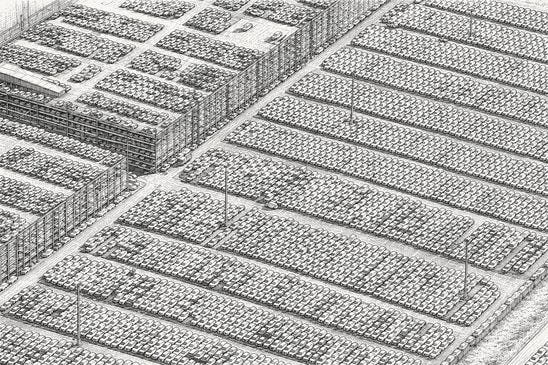
An export yard filled with finished cars, waiting for buyers. This is what capacity looks like when it outruns demand: not a shortage anywhere, but a surplus with nowhere left to go.
SOURCES AND NOTES
First essay, tariff revenue. U.S. customs duties reached roughly 195 billion dollars in fiscal year 2025, about two and a half times the prior year, per the U.S. Treasury and the Committee for a Responsible Federal Budget. Measured over the 2025 calendar year, collections were higher still, near 287 billion dollars per the Richmond Federal Reserve, and Customs and Border Protection reported more than 200 billion dollars collected between late January and mid-December 2025. The essay’s point that revenue rises while the trade gap does not is consistent with these figures.
First essay, household cost. Estimates vary with which tariffs are counted and when. The Yale Budget Lab estimated the 2025 tariffs at an average household cost of roughly 2,400 dollars in the short run as of August 2025, with earlier April estimates as high as about 3,800 dollars, and lower figures under scenarios where the emergency-power tariffs are struck down. The essay’s reference to roughly 1,700 dollars reflects an earlier and narrower estimate. Readers should treat any single number as an approximation of a figure still in motion.
First essay, the legal chapter. The tariffs described were imposed largely under the International Emergency Economic Powers Act. Lower courts ruled that use unlawful during 2025, and on February 20, 2026, the Supreme Court struck it down in a six-to-three decision. Roughly equivalent tariffs were then reinstated under Section 122 of the Trade Act of 1974, and refunds of the earlier tariffs began in May 2026. The essay was drafted before that final ruling, and its argument that the structure outlived each stated justification is borne out by the sequence.
Figures throughout are drawn from reporting available through mid-2026 and are current only to that point. The two illustrations of the delta and the export yard, and the Pink Coike tentacled lure, are interpretive drawings rather than documentary photographs.
Bonjourhi Institute Analytics, Montreal
BONJOURHI! INSTITUTE ANALYTICS · MONTREAL · 2026