
Bonjourhi!
Bitcoin did not fall on February 28, 2026. It failed an audition it had rehearsed for a decade. When missiles crossed into Iran, the asset sold as digital gold slipped below sixty-four thousand dollars, less than half its October 2025 peak of one hundred twenty-six thousand.
Real gold hit a record the same week. The exchanges stayed open. BlackRock still held it. Fidelity still held it. The claim did not survive the one night it was made for. Which raises a plainer question than the price. What is this thing, and what was it ever actually for.
The Gum Came First
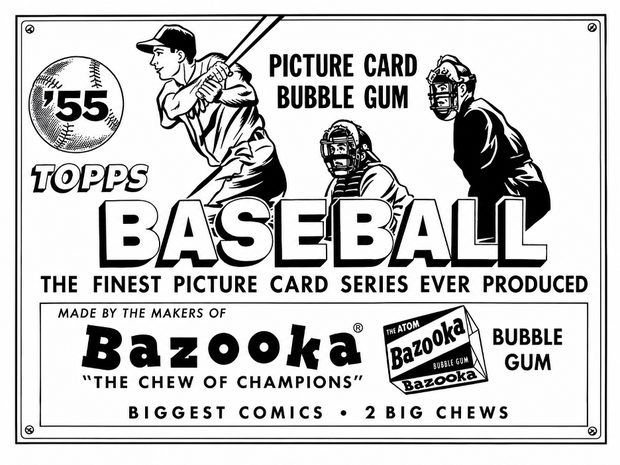
In the 1930s, an American company had a problem that was not about cards. It made chewing gum, in a market full of gum, and it needed a reason for a child to reach for its pink slab over the identical one beside it.
So it slipped a small, printed card into each pack. A ballplayer, a boxer, an actor. The card was not the product. It was the lure, the thing that settled the choice at the counter. You paid for the sweet. The card came free, packaging around a purchase you were already making.
The sweet was the point. The card was the wrapper around the point.
When The Wrapper Outlived The Thing It Wrapped
Then something quiet happened over decades. The sweet stayed cheap and forgettable. The cards did not.
Children kept them, sorted them, traded them in schoolyards on terms no adult set. A secondary market formed around objects that had been given away for nothing. What was meant to be eaten was gone within minutes. The card survived. And slowly the accounting inverted. People began buying the pack for the picture and throwing away the rest, until the companies stopped pretending and sold the cards alone.
The purpose had been consumed. What remained was the packaging, now trading for real money on scarcity and agreement, while the thing it once advertised was forgotten. Nobody found this strange, because it happened one schoolyard trade at a time.
Four Names For One Card
Bitcoin arrived as the sweet, not the card. It was built to be spent, peer to peer cash, money that moved without a bank in the middle. That was the purpose printed on the wrapper.
Then the use was spent and set aside. It turned out to be slow, expensive, and volatile, and better instruments took the job. Stablecoins now do the everyday dollar, faster and steadier, for the person in Buenos Aires or Lagos who simply wants value that holds. Payment rails move payments.
Gold holds the haven trade with a five-thousand-year head start.
So the thing was renamed. Peer to peer cash became a hedge against inflation. The hedge became digital gold. Digital gold, having failed in February, is becoming a permanent fixture that needs no justification at all, because the institutions have arrived. Each label was retired the moment reality tested it. The use is long gone. We are now trading the card.
The Worse Collectible
Here the comparison turns against the thing it describes. On every axis a collector cares about, the printed slip wins.
You can hold a card. It sits in a shoebox for fifty years at no cost, ages slowly and visibly, and cannot be taken by a stranger on another continent who guessed a string of characters. Bitcoin inverts all of it. There is nothing to hold. Ownership is a secret number, and the instant that number is seen by the wrong eyes the asset is gone, with no issuer to call and no entry to reverse. Roughly a fifth of all coins ever mined already sit behind dead keys nobody can reach [1]. No shoebox has ever emptied itself because its owner mistyped.
And it costs nothing to keep. Bitcoin costs without pause, a network burning the power of a mid sized country to stay honest, and an owner paying in hardware, backups, and the daily fear of losing a phrase. The paper asks nothing after purchase. This asks vigilance forever.
Its single advantage is the absence that causes all of that. You cannot send one to Lagos in ten minutes, or carry ten thousand of them across a border in your head. The lack of a body is the one thing a body cannot do. Its defect and its only genuine use are the same property, and that use serves the rounding error we already counted.
What Is Left, And How Fast It Spoils
The most valuable card ever printed was itself an insert, slipped into cigarette packs a century ago to move a product built to be burned. The tobacco is long since ash. The card sells for millions. It is a wrapper made priceless by scarcity alone, and by nothing it was ever for.
Bitcoin reaches for that kind of money on that kind of logic, minus the shoebox. Subtract the purpose, the touch, the free storage, and the safety, and one ingredient remains holding the price. The fear of being the one who sat out.
That ingredient is the most perishable of all, and it decays in a way nothing on a shelf does. It is used up by being satisfied. The moment you are in, you have nothing left to miss, and the fear passes to the next person still outside. The whole structure runs on those who have not yet bought, and it burns them as it climbs.
Where Our Thinking Moved
We have run with the card for a while now, across more than one issue, and it holds. But the longer we watched the asset, the less it explained. A collectible wants to be seen. You frame it, you show it, the looking is the whole pleasure. Bitcoin is not like that. Nobody displays a wallet. Its worth does not come from being looked at, or held, or used. It comes from the opposite. So our thinking has moved, and it is worth saying so plainly rather than pretending the first reading was the last word [2].
So the question was never whether it disappears. Collectibles rarely go to zero, and there is no coupon to default on, no maturity to force a reckoning, no seller the market can compel. It can drift for years. The question is what holds it up while it drifts, and the answer is not the face on the card. It is the seal.
A rising price manufactures the wanting. A flat price starves it. A falling price turns it inside out, into the fear of being the last one still holding, and the same feeling that lifted the thing then dumps it. It does not fade quietly. It reverses. Which is why the card was never the point. Something else was keeping the thing shut.
The gum was perishable and we knew it. We chewed it and moved on.
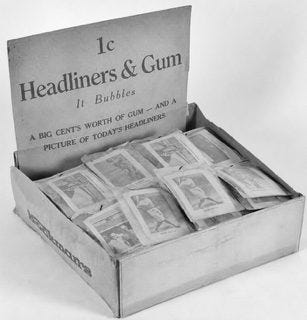
What sits in that display is the opposite bargain. A thing built to be swallowed, kept sealed for a hundred years, worth a fortune precisely because no one ever did. The face on the pack belonged to a headliner nobody now recalls. The penny on the lid is a joke against what a collector would pay today. This is the asset. Not the sweet, not the picture, but the agreement not to look inside.
This is the holder’s question, and it is older than any market. To open, or to endure. To open the thing is to end it, to spend the coin, test the claim, ask out loud what it is for, and discover the value was the seal. To leave it shut is to keep something you can never use and never quite trust, and to call that patience. He cannot act without destroying it and cannot rest while it sits there. So he does the only thing the position allows. He holds, and names the holding conviction.
Bitcoin is that box. Its price is a shared promise never to ask what the thing is for, held aloft only until someone breaks it. The uncomfortable part is not that this describes Bitcoin. It is how much of what we call wealth turns out to be the same wager, a thing we have all quietly consented not to open, and how much older and calmer the rest of those bets are.
Notes
[1] An oddity follows. Every coin lost to a dead key is gone for good, which quietly shrinks the supply that can still trade and, all else equal, supports the price of what remains. It is the rare collectible in which the permanent loss of some units is a structural comfort to the holders of the rest. The card at least burns in a fire someone can see. These vanish in silence, and the market never holds a funeral.
[2] A second threat waits further out. A large enough quantum computer could one day derive private keys from the public keys already exposed on the chain, which would put the oldest and most dormant coins, the very ones presumed safely lost, within reach of whoever built the machine first. The supply everyone assumed was destroyed could walk back into the market. The consolation is faint and almost funny. Such a machine is likely a decade or more away, and on the evidence of these pages, the thing it would plunder may by then be a curiosity, studied rather than held.
Bitcoin has a $Trillion Market Capitalisation and no present value, because present value requires a future the asset does not produce.
Even the electricity is not a floor. The cost of mining a coin is set by its price, not the other way around, so when the price falls the cost follows it down, and the vast energy spent turns out to prop nothing at all.
What we have left is not much beyond greed and the fear of missing out.
Maybe the next video clip, can be of use ...
The question in the title is not ours. and it was never about money. To hold or to end it, to endure the not knowing or to act and destroy the thing you were protecting. Andrew Scott, at the Almeida, gives it the reading it deserves.
William Shakespeare, Hamlet, Act 3 Scene 1, The Soliloquy.
BONJOURHI! INSTITUTE ANALYTICS · MONTREAL · 2026