

Bonjourhi!
We all know the story of July 14, 1789. The crowd, the fortress, the fall of the Bastille. It is the date France celebrates and the image the world remembers. But two nights earlier, Paris had already caught fire somewhere else, at the edges of the city, where ordinary people met the state every day. What they burned first was not a prison. It was a place where some paid and others passed. This week’s essay asks why that distinction lit a revolution, and why a version of it is now being built in Washington.
Pierre Somers
Chief Editor, Bonjourhi Institute
Montreal, Quebec – October 2026
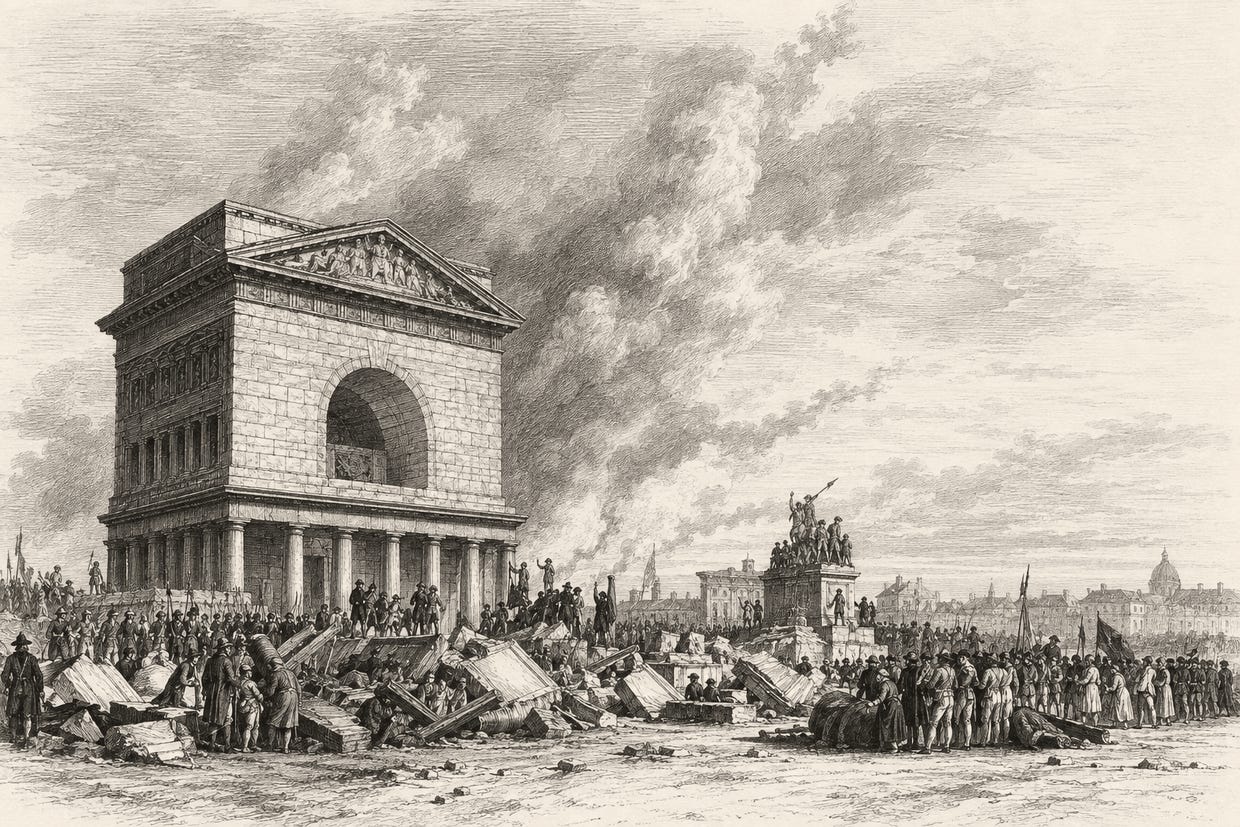
On the night of July 12, 1789, Paris caught fire at its edges.
The flames did not start at the Bastille. That fortress would fall two days later and take the credit. They started at the city’s customs gates, where crowds with torches moved from one tollhouse to the next until some forty of them were burning. By morning, the wall that had encircled Paris for barely five years stood open.
That wall was not built to keep enemies out. It was built to make everything coming in pay. Three meters high and twenty-four kilometers long, it ringed the capital so that every cart of wine, grain, wood or cloth passed a checkpoint where the Ferme générale, the private company that had bought the right to collect the king’s taxes, took its cut.
The wall’s most persuasive champion was a financier who also happened to be the greatest scientist in Europe. Antoine Lavoisier had bought a share in the tax farm at twenty-five and used its profits to build the finest chemistry laboratory of his age. There he named oxygen and hydrogen and showed that matter is neither created nor destroyed. At the tax farm he brought the same precision to contraband, and concluded that Paris needed a wall to stop it.1
Parisians hated it on sight. They punned that the wall walling Paris kept Paris murmuring. A playwright quipped that the tax farmers had decided to put the city in prison to fatten their accounts. One writer described the ornate tollhouses as tax offices disguised as palaces with columns.
What they resented most was not the toll. It was the gates. The connected passed; the ordinary paid. And whatever avoided the checkpoints went over or under the wall, carried by a prosperous class of smugglers who lived on the gap between the price outside and the price within.
On July 12, those two groups discovered a common cause. French historians have shown that the assault on the barriers was led jointly by the people of Paris and the smugglers.2 The wall the great chemist had championed to defeat contraband was brought down with its help. We remember the Bastille, where seven prisoners were found.3 The revolution began at the tollbooth.
Two and a half centuries later, America is building a wall of its own, and it too has gates.
Whether high tariffs are wise is a separate argument. My concern is narrower. A tariff applied equally is a policy. A tariff with openings for friends is a market in exemptions.
Consider how the openings have worked. Last summer, Switzerland was hit with a 39 percent tariff, the highest imposed on any developed economy. The president later explained that he had planned 30 percent but raised it after the Swiss president rubbed him the wrong way. Months of official negotiation went nowhere. Then, in November, the heads of Rolex, Richemont and other Swiss firms visited the Oval Office bearing a custom gold Rolex desk clock and a one-kilogram gold bar engraved with the numbers 45 and 47. Ten days later, the rate fell to 15 percent. The White House said the gifts were accepted for the presidential library, and the delegation said it had broken no laws. At Davos, the president summed it up himself: Rolex came to see him, and he brought the rate down.4
Other gates were cut to measure. Nvidia and AMD were licensed to sell advanced chips in China in exchange for 15 percent of the revenue, after the president said he had first asked for 20.5 Enforcement of the law against bribing foreign officials was paused, and the Justice Department unit that pursued oligarchs’ fortunes was disbanded.6
Brazil showed the political version, in the episode Anne Applebaum recounts in The Atlantic.7 A 50 percent tariff was imposed to pressure the courts trying Jair Bolsonaro for plotting a coup, while nearly 700 products were carved out: Embraer’s jets flew through as a coffee grower in Minas Gerais paid the full rate. The judge presiding over the trial was placed under Magnitsky sanctions, lifted five months later with an administration official citing an amnesty bill passed by Brazil’s lower house.8
Little of this required a bribe in the old sense. It required knowing which gate to approach, and what to carry.
The smugglers have arrived as well. They always do, because a tariff opens a gap between the world price and the domestic one, and that gap is income for anyone willing to cross it illegally. America learned this once already. Prohibition did not end drinking; it financed the syndicates, and its own exemptions for medicinal whiskey and sacramental wine became rackets.9 In August, the White House reported that goods are being rerouted through more than forty countries to disguise their origin, and its own economists put the trade at roughly $60 billion a year.10 A Mexican customs broker has pleaded guilty to bribery charges tied to securing customs approvals.11
Then, in October, the president pardoned Changpeng Zhao, the founder of Binance, who had served prison time for failing to stop criminals from moving money through his exchange. Months earlier, a fund in the United Arab Emirates had used $2 billion of the stablecoin issued by World Liberty Financial, the Trump family’s crypto venture, to buy a stake in his company.12 Every border that charges a toll eventually grows a profession devoted to getting around it, and sooner or later that profession is offered a gate of its own.
Here is what should trouble anyone expecting this to pass quickly. An exemption is valuable only while everyone else pays. Each carve-out granted therefore recruits a defender of the tariff. The company holding a waiver does not lobby to tear down the wall; it lobbies to keep its gate. The smuggler wants the wall kept too. A barrier with private openings is not a temporary measure. It is a constituency.
That is the lesson of July 1789 that the Bastille obscures. Governments survive heavy taxes; France had endured them for centuries. What becomes combustible is a toll that some are excused from paying, because it breeds two resentments that eventually find each other: citizens who can see the gates, and smugglers who profit from avoiding them. Paris burned when the honest and the dishonest found themselves on the same side of the wall.
Markets sense this before crowds do. Once England’s Parliament stripped its kings of the power to grant favors and cancel debts at will, the country’s borrowing rate fell from 14 percent in 1693 to 3 percent by 1739.13 France, which kept selling privilege, never earned that trust. In the first half of 2025, the dollar posted its worst start to a year since 1973,14 as though investors had begun charging a small surcharge for discretion.
Anyone wanting a better gauge than headlines should watch what I call the exemption spread, the distance between the rule as published and the rule as applied. When that distance is narrow, a country is governed by statute. When it widens, it is governed by audience.
In February, the Supreme Court tried to dismantle the wall lawfully, ruling that emergency powers do not permit the president to impose tariffs, since the power to tax belongs to Congress.15 Within hours, a new global tariff arrived under a different law.16 Within five months, Brazil faced a fresh 25 percent tariff, with beef, orange juice and aircraft once again spared.17
Paris saw that coming as well. Among the barriers burned in July 1789 was the Barrière d’Enfer, the Gate of Hell, on the road to Orléans. By January 1790 it had been repaired, renamed the Equality Gate, and was collecting again.18
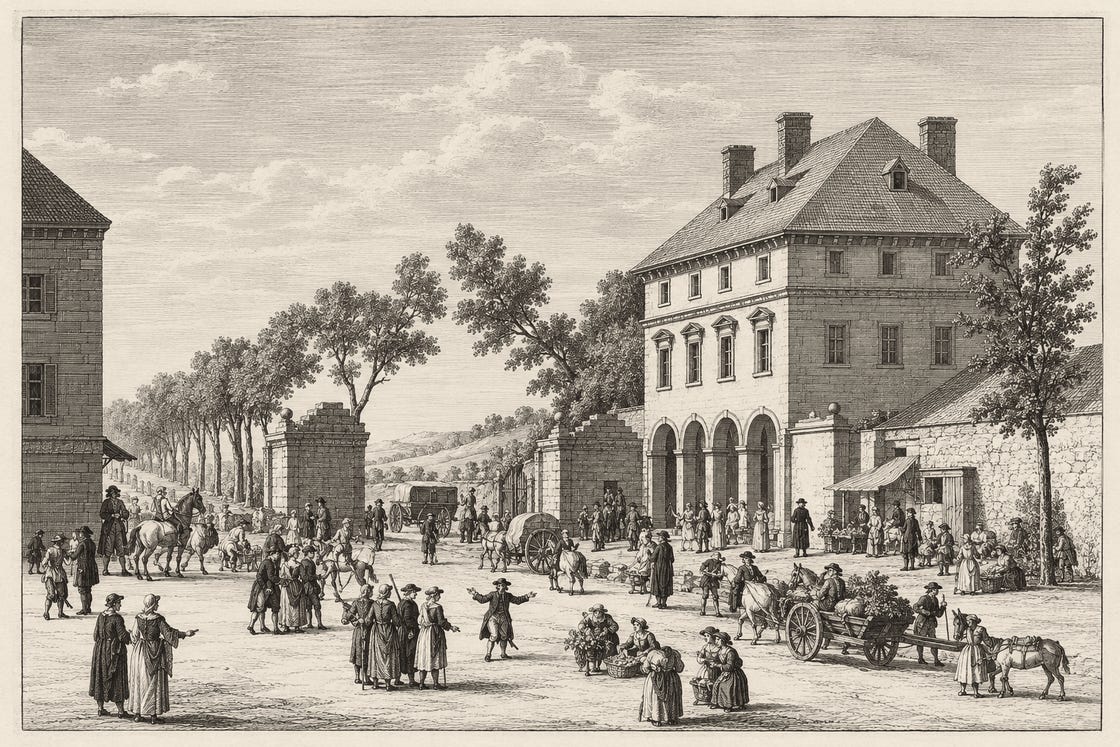
Walls rarely fall by ruling. They fall when no single hand holds the power to open them. England learned that in 1689, when its Bill of Rights condemned the dispensing power, the royal practice of excusing favored subjects from laws that bound everyone else.19 It did not merely replace the man at the gate. It abolished the gate. America wrote the same principle into its Constitution a century later. Congress can reclaim the tariff authority it has lent away. Allies can insist that trade terms be written, general and open to review, rather than bargained one visitor at a time.
Lavoisier never saw what his wall became. On May 8, 1794, he was guillotined alongside twenty-seven fellow tax farmers, his father-in-law among them. His friend, the mathematician Joseph-Louis Lagrange, remarked that it had taken only a moment to cut off that head, and a hundred years might not produce another like it.20
Trust in a system behaves the same way. It is built slowly, by people who pay the same price at the same gate, and it is lost quickly, the moment they learn that others do not.
History remembers the fortress. The revolution began at the gate.
Bonjourhi Institute Analytics, Montreal
Pierre Somers is Chairman and Chief Executive of Walter Capital Management and Chief Editor of Bonjourhi Institute Analytics in Montreal.
Bonjourhi Institute Analytics Note: Removal, Rulings or Rule
Some Americans look to impeachment as the remedy. The arithmetic says otherwise. The House can impeach by simple majority, but conviction requires 67 senators, the same threshold as overriding a veto. Trump has been impeached twice and acquitted twice. No president has been removed by the Senate.
What a new Congress could do without a veto-proof majority is narrower but real. It controls appropriations, where limits on tariff authority can ride on spending the government needs. It chairs the committees that can subpoena the record of how each exemption was granted. A Senate majority confirms the officials who run trade policy. And temporary tariff powers that require renewal can simply be allowed to lapse.
The structural remedy, a law requiring congressional approval for tariffs, awaits either a bipartisan supermajority or a president willing to sign it.
NOTES
1. Arthur Donovan, Antoine Lavoisier: Science, Administration, and Revolution (Oxford: Blackwell, 1993).
2. Momcilo Markovic, “La Révolution aux barrières : l’incendie des barrières de l’octroi à Paris en juillet 1789,” Annales historiques de la Révolution française, no. 372 (2013).
3. Simon Schama, Citizens: A Chronicle of the French Revolution (New York: Knopf, 1989).
4. Senator Ron Wyden, letter to U.S. Trade Representative Jamieson Greer on Swiss tariffs, January 29, 2026; Reuters, January 29, 2026.
5. Associated Press, “US will get a 15% cut of Nvidia and AMD chip sales to China under a new, unusual agreement,” August 11, 2025.
6. Executive Order, “Pausing Foreign Corrupt Practices Act Enforcement to Further American Economic and National Security,” February 10, 2025; Attorney General memorandum of February 5, 2025, disbanding Task Force KleptoCapture.
7. Anne Applebaum, “MAGA Is Making the World Safe for Corruption,” The Atlantic, October 2026.
8. Executive order of July 30, 2025, imposing an additional 40 percent tariff on Brazil, Annex I exemptions; U.S. Treasury removal of Justice Alexandre de Moraes from the sanctions list, December 12, 2025, reported by the Associated Press.
9. Daniel Okrent, Last Call: The Rise and Fall of Prohibition (New York: Scribner, 2010).
10. White House Office of Trade and Manufacturing Policy, “The Great Transshipment Scam,” August 13, 2026, citing the Council of Economic Advisers estimate.
11. Guilty plea of a Mexican customs broker under the Foreign Corrupt Practices Act, reported in National Law Review, “Red Flag Rising,” December 2025.
12. Associated Press, “Trump pardons Binance founder Changpeng Zhao,” October 23, 2025.
13. Douglass C. North and Barry R. Weingast, “Constitutions and Commitment: The Evolution of Institutions Governing Public Choice in Seventeenth-Century England,” Journal of Economic History 49, no. 4 (1989): 803-832.
14. CNBC, “The declining dollar faces more headwinds after posting worst first-half return in 52 years,” July 7, 2025.
15. Learning Resources, Inc. v. Trump, No. 24-1287 (U.S. February 20, 2026).
16. National Taxpayers Union, “Reclaiming Trade Authority: Members of Congress Introduce Reforms to Rein in Presidential Tariffs,” 2026.
17. Office of the U.S. Trade Representative, Section 301 action on Brazil, effective July 22, 2026, Docket USTR-2025-0043.
18. Catacombes de Paris, history of the Barrière d’Enfer and its renaming as the Barrière Égalité, catacombes.paris.fr.
19. Bill of Rights 1689, 1 William and Mary Session 2 c. 2.
20. Donovan, Antoine Lavoisier. Lagrange’s remark is as commonly attributed.
BONJOURHI INSTITUTE ANALYTICS · MONTREAL · OCTOBER 2026