

Series Summary
The waiting room is not a metaphor. It is the actual structure of power. Every system that has ever concentrated authority, from the pharaoh’s throne room to the Federal Reserve, has built the same arrangement. One party inside. Everyone else outside. The wait is not a side effect of the system. It is how the system demonstrates, renews, and enforces the relationship between the person who holds what you need and the person who needs it.
The four rooms. The Egyptian throne room, where the chair itself was the argument. The Roman atrium at dawn, where the patrician was already inside and the salutatio renewed the social order every morning. The Hall of Mirrors at Versailles, where Louis XIV turned the waiting room into an instrument of state so total it required no guards and no force. Ellis Island, where the queue replaced the room, the number replaced the name, and administration replaced relationship.
The invisible room. The Federal Open Market Committee meets eight times a year in Washington and sets the price of time. The President nominates the people in those chairs and then waits with everyone else. The waiting room has become the size of the world.
The learning. The person who knows they are in the waiting room watches the door, reads the adjacent rooms, and understands that the interval between decisions is when the next one is already being formed. The person who does not know is startled every time the door opens.
The closing argument. Tutankhamun’s chair survived thirty-two centuries not because it was gold but because of a network, and the meaning and purpose that network shared. The deal between the boy king and the priests who protected him is still the most reliable architecture for durable value that history has produced.
The Waiting Room arrives this week. It is part of the ongoing work of the Bonjourhi Institute as it builds the Coherence Economics bookshelf.
Pierre Somers
Chief Editor, Bonjourhi Institute
Montreal, Quebec
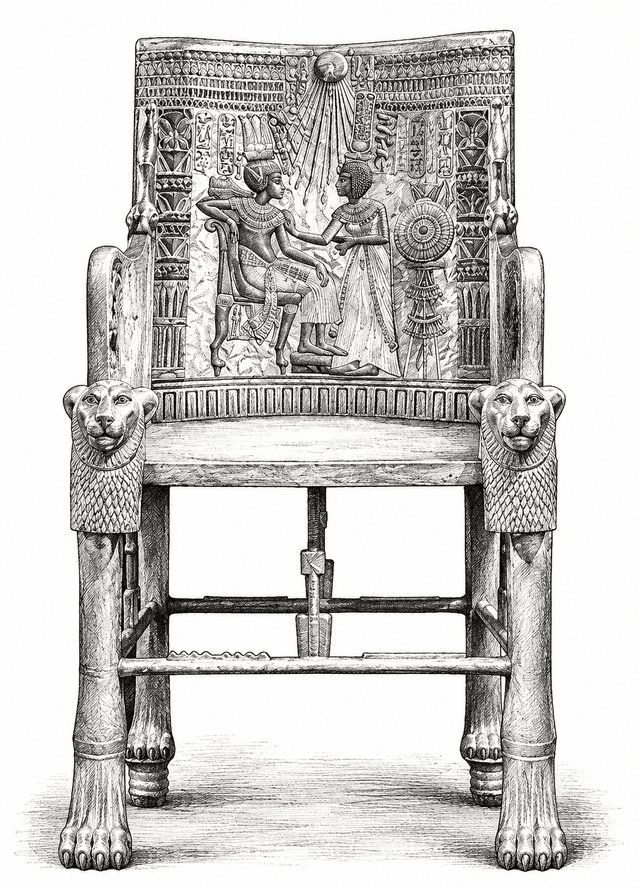
Throne of Tutankhamun, c. 1323 BC. Egyptian Museum, Cairo.
Bonjourhi!
In the great museum of Cairo, there is a chair that belonged to the pharaoh.
It is not a comfortable chair. It was never meant to be. The wood is covered in gold. The armrests end in the heads of lions. The back panel shows the king and his queen attended by gods, rendered in lapis and carnelian and silver, as though the scene depicted is not a moment but a permanent condition. This chair does not suggest rest. It suggests permanence. The person who sat in it was not pausing. He was presiding.
The lion feet are the detail that holds the argument. The chair does not touch the floor the way ordinary objects do. It stands on the feet of the animal that kills. Every person who approached that chair came at ground level, looking up, past the carved feet, past the gods, to the figure seated above them.
That distance, between the floor and the seat, between the one who waits and the one who decides, is what this series is about.
This is also the room that Coherence Economics keeps finding, whatever system it reads. The country changes. The century changes. The room does not.
Every civilization in recorded history has built some version of the same room. A space where one kind of person waits and another kind of person decides. A stone antechamber in Memphis. A Roman atrium at dawn. A gilded gallery at Versailles. A registry room in New York harbor where millions arrived at the threshold of a new world wearing numbered tags. A conference table in Washington where the world waits outside for what comes through the door.
The furniture changes. The century changes. The relationship inside the room does not.
One party controls access. The other party needs it.
What the waiting room looks like tells you what the civilization believes. About time, and whose time is valuable. About need, and who is permitted to show it. About power, and how it prefers to be approached. The room is not incidental to the system. It is the system, made physical.
Tutankhamun’s chair is three thousand three hundred years old. It was buried with him in the Valley of the Kings, and when Howard Carter opened the tomb in 1922 it looked as though it had been finished the previous afternoon. It has outlasted every dynasty, every empire, every institution that surrounded it.
The relationship it represents has not. He took the chair with him into the tomb. The object that made everyone else wait went into the longest waiting room ever built.
The chair in Cairo is behind glass now. Tourists photograph it. Children look at it without knowing what it meant.
But the relationship it sealed inside that tomb is still open.
You are in it already.
Issue One: The Atrium
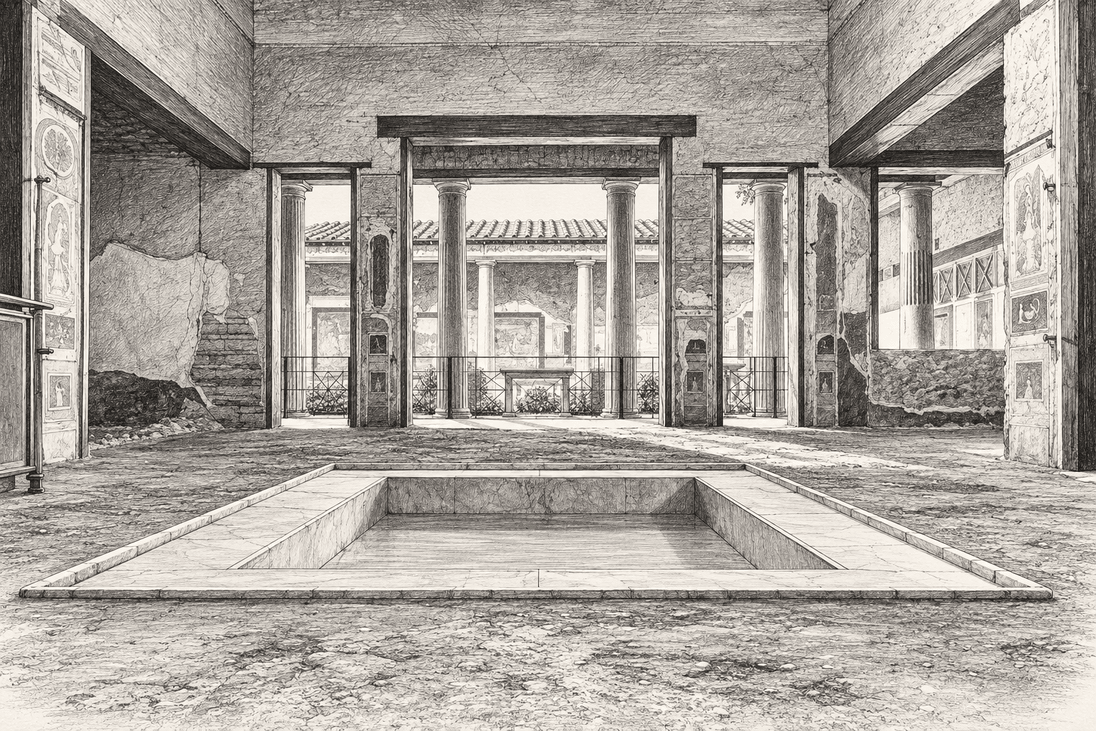
The atrium of the House of the Vettii, Pompeii, first century AD. The garden visible through the columns was not for the clients.
Bonjourhi!
The patrician was inside.
That is where the story begins. Not with the clients gathering at dawn, not with the togas and the dark streets and the shuffled waiting. With the man who did not come to the door. Who was already there, on the other side of it, in the interior of his house, unhurried, while the city assembled itself outside.
Everything that follows is a consequence of that single fact.
Before the forum filled and before the courts convened, the clients came. They came on foot, through streets that smelled of last night, wearing their togas despite the hour, because the toga was not clothing. It was a signal. It said: I am a citizen. I have standing. I am here to be seen.
They gathered at the door. They waited to be let in. And then they waited again, inside, in the atrium, for the man himself to appear.
This ritual had a name. The salutatio. The greeting. It happened every morning across the Roman world, in a thousand houses, in a hundred cities, from the hills of Latium to the edges of Britain. It was so ordinary that the Romans barely remarked on it. And it was, in its quiet and repeated way, the most sophisticated instrument of social control that the ancient world produced.
The atrium was the first room you entered in a Roman house of any consequence. It was open to the sky at the center, with a shallow pool below the opening to catch the rain. Light came from above.
The man of the house would receive visitors in the light. The visitors gathered in the shadow and waited.
Nothing in Rome was accidental. The atrium was designed to be read. Its proportions, its materials, its paintings and statues and family masks displayed on the walls, all of it communicated the standing of the man who owned it. To enter the atrium was to receive a lesson before a word was spoken.
The client who waited there was performing. He was demonstrating, in his dressed body and his early rising and his patient stillness, that he needed something from this house. That need was the transaction. Not what he would ask for. Not what he might receive. The need itself, made visible, was what the morning required of him.
The patrician would emerge eventually. He moved through the room with his secretary beside him, who whispered names and reminders. He stopped for some clients, passed others, offered a word here, a nod there. The meeting, when it happened, was measured in minutes. The client had been awake since before dawn. He had walked through dark streets. He had stood in a shadowed room for an hour or more.
The imbalance was not incidental. It was the product.
What the patron received from the salutatio was not information or advice or loyalty in any abstract sense. What he received was a daily, physical, witnessed demonstration of his position in the social order. The men who came to his atrium were men who needed him. Their presence, repeated every morning, confirmed that fact. The ritual did not create the power relationship. It renewed it. Every day. In the body. In public.
The client received something too, or he would not have come.
Access. The word of the patron with a magistrate. A contract extended. A debt reconsidered. A letter of introduction. These were not large things, taken individually. But they were the texture of a life in Rome. The city ran on patronage the way it ran on water and grain. The aqueducts brought the water. The roads brought the grain. The salutatio distributed everything else.
To be without a patron was to be outside the system. Not illegal. Not dangerous in any immediate sense. Simply unconnected. And in Rome, unconnected was its own kind of poverty.
So the client came. He rose before dawn. He put on his toga. He walked to the house of the man who could help him. He waited in the atrium, in the shadow, looking toward the light at the center of the room.
He waited to be seen.
What made the system durable was that it ran in both directions, and the Romans knew it.
The patron needed the clients too. Not for any single thing they provided. For the aggregate. For the crowd at his door. For the visible evidence, legible to every neighbor and rival and political enemy who passed in the street, that this house had weight. That this man had reach.
A Roman nobleman with no clients was a man whose power was already draining away. The empty atrium was a public statement. The full one was a political fact.
This is what distinguished the ritual from simple servitude. The client was not a servant. He was a free citizen performing a ritual that cost him his morning and his dignity in exchange for access and protection. The patron was not a master. He was a man whose social position was made legible every dawn by the number of people willing to wait for him.
The waiting room was not a room for the weak. It was a machine that produced and reproduced the social order. Every morning. In the bodies of the people who moved through it.
When the empire contracted, when the cities thinned and the great houses lost their reach, the ritual faded with them. Not abolished. Not reformed. Simply no longer necessary.
The system worked as long as no one crossed the Rubicon.
The logic did not disappear.
It moved. It found new architecture, new names, new furniture. It traveled north and west, into the courts of medieval lords, into the antechambers of Renaissance princes, into the gilded galleries of a palace being built on a marsh outside Paris, where a king was about to discover something important.
That if you built the room large enough, and filled it with people who had no choice but to be there, you did not need a sword to govern.
You needed mirrors.
Issue Two : The Palace
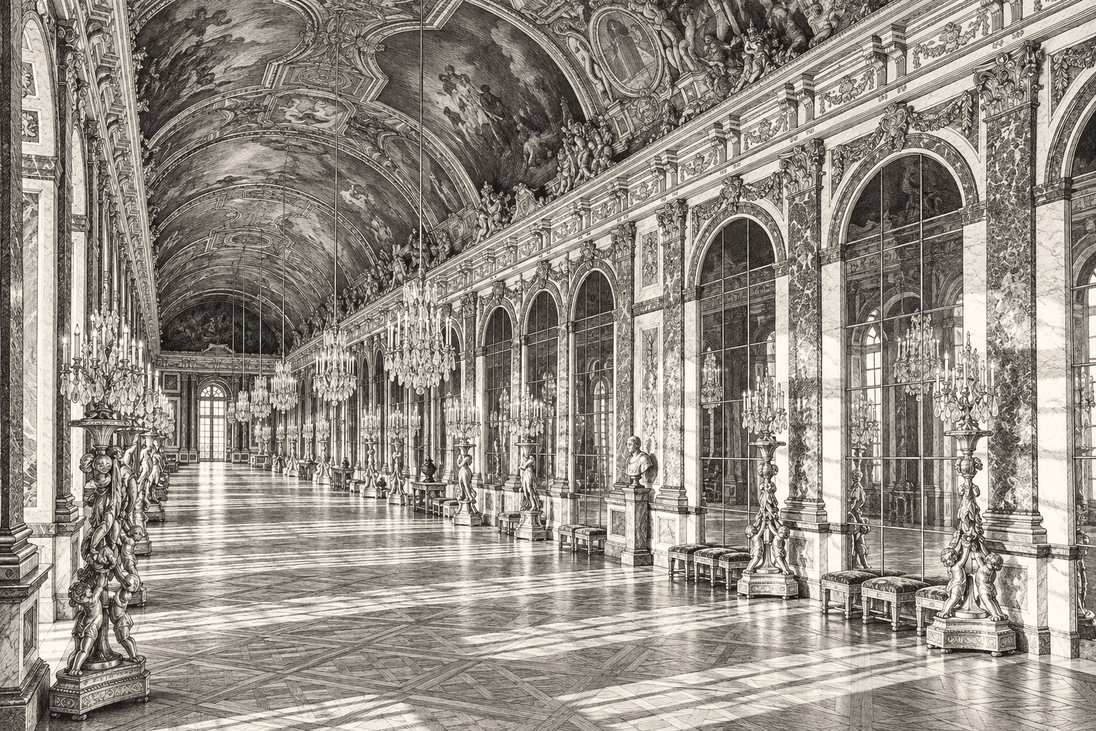
The Hall of Mirrors, Palace of Versailles, 1682. Three hundred and seventy feet long. Nowhere to hide.
Bonjourhi!
Louis XIV had a problem that no sword could solve.
He was king of France, the most powerful monarchy in Europe, heir to a throne that had spent two centuries fighting off nobles who believed their bloodlines entitled them to share in its authority. The Fronde, the aristocratic rebellion that had terrified the young Louis and driven him from Paris as a child, had taught him something that most kings never learned in time. The danger was not the enemy at the gate. The danger was the man in the next room.
The nobility of France was not weak. It was ancient, armed, wealthy, and distributed across the provinces in a thousand fortified estates, each one a small power center, each one capable of raising men and money and trouble. You could not imprison them all. You could not execute them all. And you could not simply ignore them, because ignored aristocrats with armies were the most dangerous kind.
Louis found a different solution. He invited them in. And then he made them wait.
In 1682, Louis XIV moved the court of France from Paris to Versailles. This is remembered as an aesthetic decision, the construction of the greatest palace in Europe, a statement of royal magnificence in stone and gold and water. It was not primarily an aesthetic decision. It was a political one, and it was one of the most ruthless acts of statecraft in the history of the modern world.
Versailles was a trap. A beautiful, gilded, mirrored trap, and the nobility of France walked into it willingly, because the alternative was to be absent from the only place that mattered.
To be at Versailles was to be close to the king. To be close to the king was to have access. To have access was to have power, or the possibility of it, which in the economy of the French court amounted to the same thing. And so they came. Dukes and princes and marshals and bishops. They came with their households and their servants and their debts and their ambitions. They took apartments in the palace. They attended the lever, the king’s morning rising, the coucher, his evening retirement, the promenades and the hunts and the endless ceremonies that structured every hour of every day.
They waited.
The lever of the king was the waiting room made into morning ritual.
Louis rose at a fixed hour. The doors of the royal bedchamber opened in sequence, admitting first the princes of the blood, then the great officers of the household, then the nobles of lesser rank, each wave permitted to witness a slightly more dressed and slightly more public version of the king. To be admitted to an earlier stage of the lever was a mark of favor so legible that the entire court could read it. To be excluded was equally legible.
The king said little. He did not need to. His attention was the currency and he distributed it with the precision of a man who understood exactly what he was doing. A glance. A word. An invitation to walk beside him in the gardens. These were not courtesies. They were political appointments, made in public, witnessed by everyone, recorded in the memory of the court with perfect fidelity.
The waiting was the mechanism. A nobleman who spent three hours standing in an antechamber hoping for two minutes of royal attention was a nobleman who was not in his province raising an army. He was here. Contained. Watching other men receive what he needed.
Louis understood something that the Roman patrician had understood at the scale of a single house. The waiting room does not merely delay the petitioner. It transforms him.
The man who waits long enough begins to organize his entire existence around the wait. He rises when the schedule requires. He dresses for the room he hopes to enter. He learns the rituals, the precedences, the invisible rules that govern who stands where and who speaks first. He becomes, over time, a student of the system that controls him. And in becoming a student of it, he becomes invested in it. He cannot dismantle the thing he has spent his life learning to navigate.
This is the deepest genius of Versailles. Louis did not break the nobility. He did not humiliate them or strip them of their titles or confiscate their estates. He made them complicit. He gave them a game worth playing and then controlled every rule of the game. The lever happened every morning. Absence was noticed. The man who had ridden to Versailles with thoughts of rebellion found himself, within a season, more concerned with his position at the lever than with anything happening in his provinces.
The palace had eaten him.
He made it easier to stay than to leave. And for those who left regardless, he kept the family. The wife had her apartments. The children had their place in the household. The man who rode back to his estates rode back alone. And alone in the provinces, without his family, without his position at court, without the daily confirmation that he was inside the room where things were decided, he was already losing. He was free in the way that a man is free when everything he values remains behind the door he has just closed.
The Hall of Mirrors is three hundred and seventy feet long. Seventeen arched windows face the gardens. Opposite each window, a mirror of the same dimension reflects the light back into the room. When the hall is full, as it was every day of the court’s residence at Versailles, you can see yourself in every direction. You can see who is standing near the king and who is not. You can see your own face, watching.
This was not decoration. The mirrors were an instrument of government.
In the Hall of Mirrors you could not pretend. You could not have a private conversation, take a discreet position, arrange your face into neutrality and disappear. Everything was reflected. Everything was visible. The court watched itself watching itself, and in that visibility the king was everywhere at once, because his favor and his displeasure were the only things anyone in the room was actually looking for.
The room is empty now. Stripped of its courtiers and its politics and three centuries of accumulated ambition, the shadows still fall at angles across the mirrors. The room designed to eliminate darkness could not eliminate it entirely. There were always corners. There were always angles the light did not reach.
The waiting room had become total. It was not a room anymore. It was a world. And the man at the center of it never had to raise his voice.
Louis did not invent this. The Habsburgs had built their own version a century earlier, Philip II governing from behind a window at the Escorial, almost never seen, granting audiences so rarely that the waiting room was not a gallery but a correspondence, conducted over years through intermediaries in a machine with no visible edges. The Medicis before them, the Ottomans in parallel, every concentrated court in the early modern world had understood the same principle. Louis did not discover the waiting room. He perfected it. He gave it gold and mirrors and three hundred and seventy feet of gallery and made it so total that the room became indistinguishable from the system itself.
The system worked for as long as Versailles remained the only game. When it ceased to be, when the finances of the monarchy collapsed and the provincial estates regained their relevance and the men who had spent generations waiting in gilded antechambers discovered that the thing they had been waiting for was bankrupt, the palace emptied with a speed that astonished everyone who had believed in its permanence.
In October 1789, the royal family was escorted from Versailles to Paris by a crowd that had run out of patience entirely.
The waiting room does not last forever. It lasts only as long as what is on the other side of the door is worth waiting for.
When it is not, the door comes off its hinges.
Issue Three: The Queue
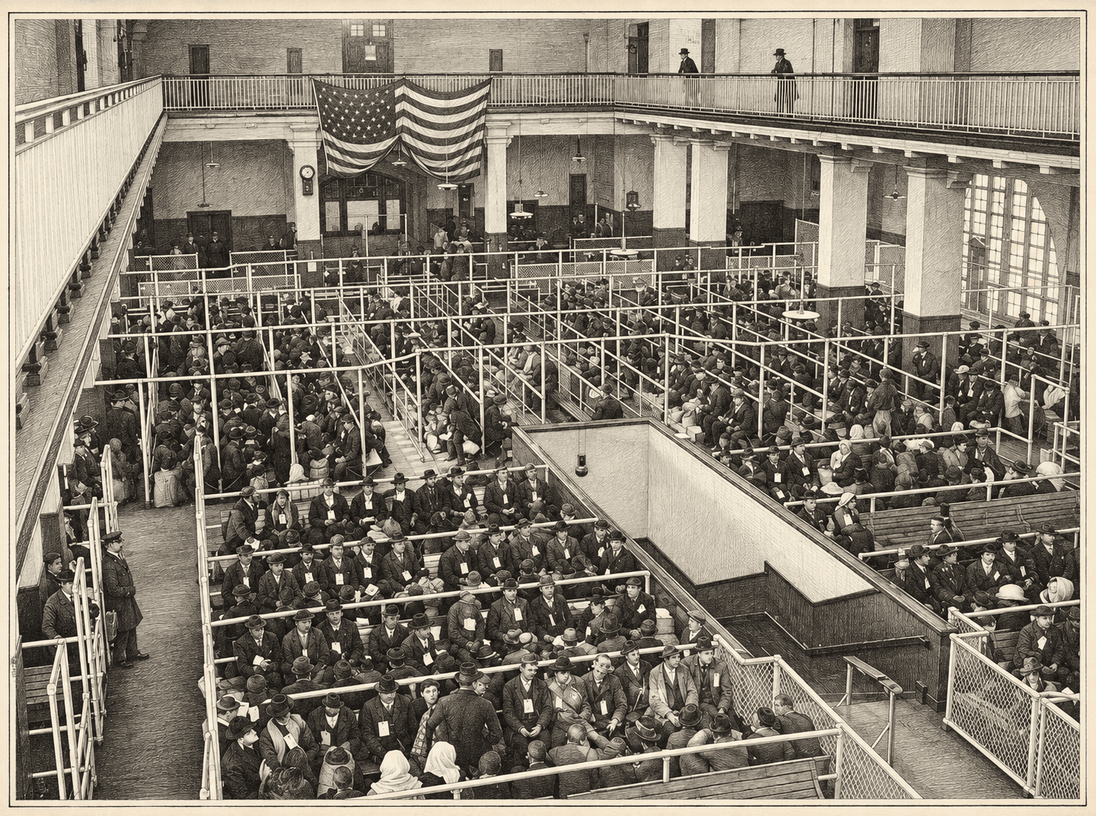
Ellis Island Registry Room, circa 1902. Each person wears a numbered tag. The flag hangs above them. The windows face the harbor.
Bonjourhi!
At some point in the nineteenth century, the waiting room stopped being a room.
It became a line.
Not a line of nobles in gilded galleries, performing proximity to power in clothes that cost a year’s income. A line of people. Ordinary people, in ordinary clothes, standing on ordinary ground, waiting for something that was not favor or access or the attention of a king. Waiting for work. For a train. For a counter to open. For a number to be called. For a door to unlock at a fixed hour regardless of who was standing in front of it.
The queue was democracy’s waiting room. And like most things that arrive under the banner of equality, it was more complicated than it appeared.
The industrial city produced the queue the way it produced everything else: as a solution to a problem of scale.
Before the city, before the factory, before the railway and the telegraph and the mass movement of people and goods across distances that had previously taken weeks, the waiting room had been a personal transaction. You waited for a specific man, in a specific room, and the waiting was a relationship. It had texture. It had hierarchy. It had the quality of an encounter between two parties who both understood what was being exchanged.
The industrial queue had none of that. It had volume.
Thousands of people arriving at the same gate at the same hour. Hundreds of applicants for the same position. Tens of thousands of passengers moving through the same terminal in the same day. The system that had worked at the scale of the Roman atrium or the Versailles antechamber could not work at this scale. You could not know the names. You could not dispense attention in measured doses. You could not make the waiting into a performance of relationship.
So the line replaced the room. And the number replaced the name.
Look at the photograph. The Registry Room at Ellis Island, around 1902. The iron railings divide the floor into channels. The people sit inside the channels in rows, each one wearing a numbered tag pinned to their coat. They have crossed an ocean. They have arrived at the threshold of the country they came for. The Statue of Liberty is in the harbor outside these windows. And they are sitting in a pen, wearing a number, waiting to be processed.
The flag hangs above them. Enormous, ceremonial, draped from the balcony like a declaration. It is the only ornament in the room. Everything else is functional. The railings, the benches, the counters, the inspectors moving along the lines with their chalk and their clipboards. The flag is the promise. The railings are the procedure. Between the promise and the person stands the procedure, and the procedure will take as long as it takes.
Two figures stand on the upper balcony, looking down. They see the whole room from above. The people in the channels below can see only the railing in front of them, the person beside them, and the counter in the distance where something will eventually be decided about their future.
The queue gave you information. You could see the line. You could count the people ahead of you. This felt like progress. It was also a method of controlling behavior through visibility. The person who can see the line accepts the line.
The waiting room had been stripped of its ornament and its hierarchy and its personal texture, and what remained was the bare structure underneath. The gold was gone. The mirrors were gone. The secretary whispering names was gone. What was left was the line, and the counter, and the person behind the counter who would see you when they were ready and not before.
The queue democratized the wait. It did not democratize the power.
The person behind the counter still decided. They still controlled the pace, the process, the criteria, the outcome. The line organized the people waiting but it did not change what waiting meant. It meant that you needed something and they had it and you would demonstrate that need by standing in the correct position until your turn arrived.
What changed was the ceremony. The toga was gone. The bow was gone. The elaborate grammar of approach and address dissolved into the simple instruction to take a number and wait to be called.
There is a particular quality to the industrial waiting room that neither Rome nor Versailles had produced. Call it anonymity.
The client in the Roman atrium was known. His name was whispered by the secretary. His relationship to the patron had history, obligation, texture. The courtier at Versailles was visible, legible, his position in the room a public statement read by everyone present.
The person in the queue was neither of these things. They were a body in a line. A number on a ticket. A case in a file. The system did not need to know who they were, only where they stood in the sequence. The waiting room that had once been organized around the recognition of persons had become organized around the management of volume.
This is the moment the waiting room completed its transformation from instrument of relationship to instrument of administration. And administration, unlike the patrician in his atrium or the king in his palace, does not look up when you enter the room.
The iron railings at Ellis Island were removed long ago. The building is a museum now. Tourists walk through the Registry Room and look up at the vaulted ceiling and read the plaques on the wall, the names of the families who passed through. Some of those names are not the names those families arrived with. The plaques do not say so.
They do not have to imagine very hard.
Issue Four : The Invisible Room
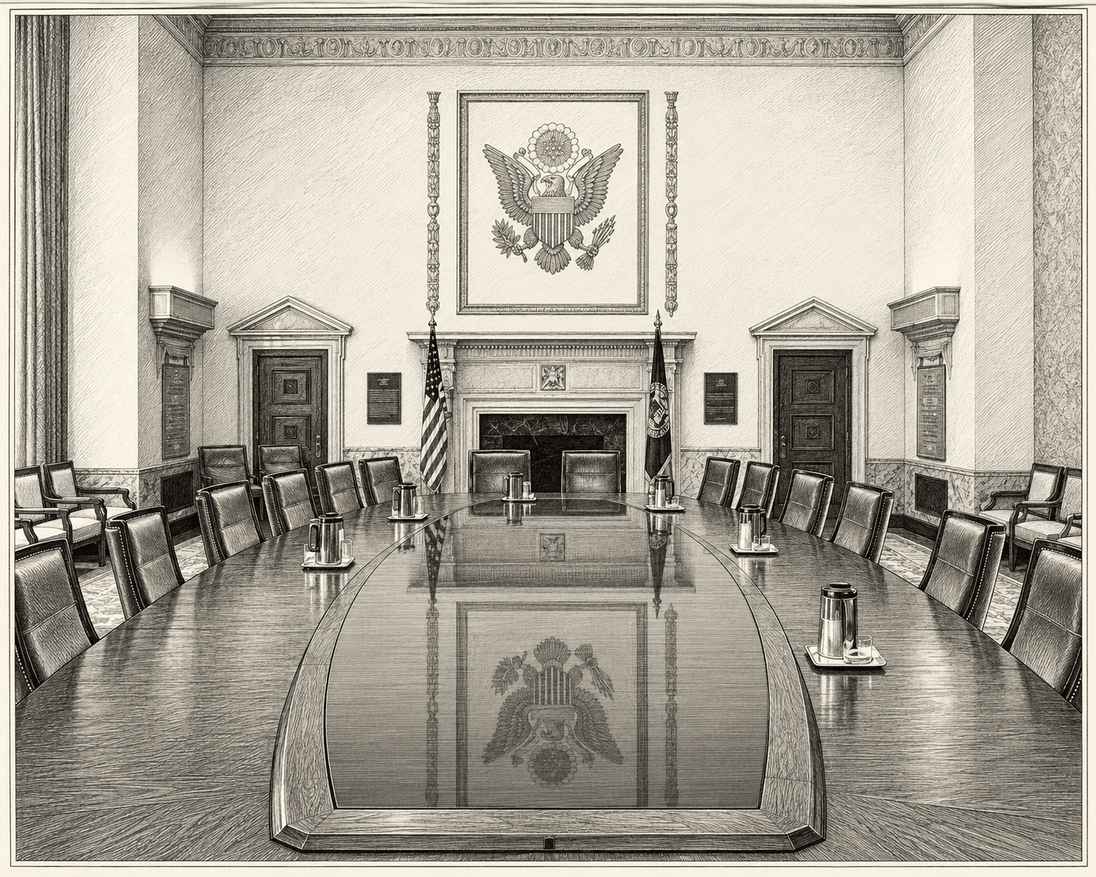
The Federal Open Market Committee Room, Marriner S. Eccles Building, Washington D.C. The chairs will fill again. You will not be in one of them.
Bonjourhi!
The room in the photograph is empty.
The chairs are there. Nineteen of them, leather and wood, arranged with precision around the conference table, each with a microphone and a nameplate. The presidential seal hangs on the wall. The flags stand at attention. The fireplace is cold. Everything is in its place.
Eight times a year, nineteen people take those chairs. They review the data, hear the presentations, debate the variables, and vote. The meeting takes two days. The decision takes a sentence. And that sentence, released at precisely two in the afternoon on the second day, moves through the global economy faster than any army has ever moved through any territory.
You are not in the room. You have never been in it. You are waiting outside, for a decision you cannot influence, on a timeline you cannot know.
Each stop on this series stripped something away. The Roman atrium lost its gold when it became the industrial queue. The queue lost its ceremony when it became the algorithm. The algorithm lost its face when it became the rate decision. What remains is the bare structure underneath. The terms of access are set by the party that holds what you need.
The Federal Open Market Committee sets the federal funds rate, the price at which banks lend to each other overnight, from which every other price in the credit system descends. Mortgage rates. Car loans. Corporate borrowing. Government debt. The cost of starting a business, or keeping one alive. All of it flows from the number those nineteen people agree on.
Interest is the price of time. The people in that room set the price of time. Everyone else waits to find out what their time is worth.
The modern waiting room has one feature none of its predecessors had. It is global.
Each of the earlier rooms was local. You could leave. You could find another patron, another court, another country. The system was powerful within its walls and diminished beyond them.
There is no beyond the walls of the Federal Reserve. When that committee raises the price of money, it raises it everywhere money moves. Which is everywhere. The Brazilian farmer waiting for a loan. The German manufacturer calculating expansion costs. The young family in Montreal trying to understand what their mortgage will cost in three years. None of them are in the room. All of them are waiting for what comes out of it.
The waiting room has become the size of the world.
The President of the United States nominates the people who sit in those chairs. He shapes the room, at least in part, through the power of appointment. And then he waits with everyone else. He cannot call the meeting early. He cannot change the vote. At two in the afternoon on the second day, he watches the same screen as every trader, every banker, every mortgage holder, every farmer with a loan coming due.
The waiting room has no exemptions. Not for the most powerful elected official in the world. Not for anyone.
This room is not a museum. The chairs will fill again in weeks. The world will reorganize itself around a number, as it always has.
The waiting room is always open.
You have always been in it.
Epilogue : Now That You Know
The series does not end with a solution. There is no solution. The waiting room is a permanent feature of organized human life, as permanent as the pyramids that housed its oldest version, as current as the number that moved on your screen this morning while you were doing something else.
There is a difference between waiting without knowing and waiting with open eyes. The person who knows watches the door. They understand that the interval is always temporary, that the decision was never personal, that the adjacent rooms are always speaking before the next one opens.
The room is not the enemy. Knowing it is the beginning of using it.
Coherence Economics was built to read this room in any system it is pointed at. The overlays change. The country changes. The institution changes. The architecture underneath does not. The Waiting Room is one title on that shelf. The others are being built.
The series began with a chair that belonged to a boy king who died at nineteen. His tomb contained more gold than almost any other in the Valley of the Kings. Not because he was great. Because he honored a relationship and the relationship held. Whether the entrance was hidden by fortune or by grateful hands, the gold stayed where the priests put it for thirty-two centuries.
The chair survived because of a network, and of the meaning and purpose it gave to those who were part of it.
The chair is still there. Behind glass in Cairo. Three thousand years from the hands that made it and the hands that protected it.
Build accordingly.
Bonjourhi Institute, Montreal
BONJOURHI! INSTITUTE ANALYTICS · MONTREAL · 2026