
Bonjourhi!
You know this one. A goose lays golden eggs, a farmer grows greedy, the farmer cuts the goose open to take all the gold at once and finds nothing, having killed the thing that made him rich.
We tell it to warn against greed. But we have been telling it slightly wrong, or at least telling the easy half. In the version that matches our own moment, the goose was never one man’s to kill. And no one uses a knife.
Pierre Somers
Chief Editor, Bonjourhi Institute
Montreal, Quebec
PART ONE. THE FABLE
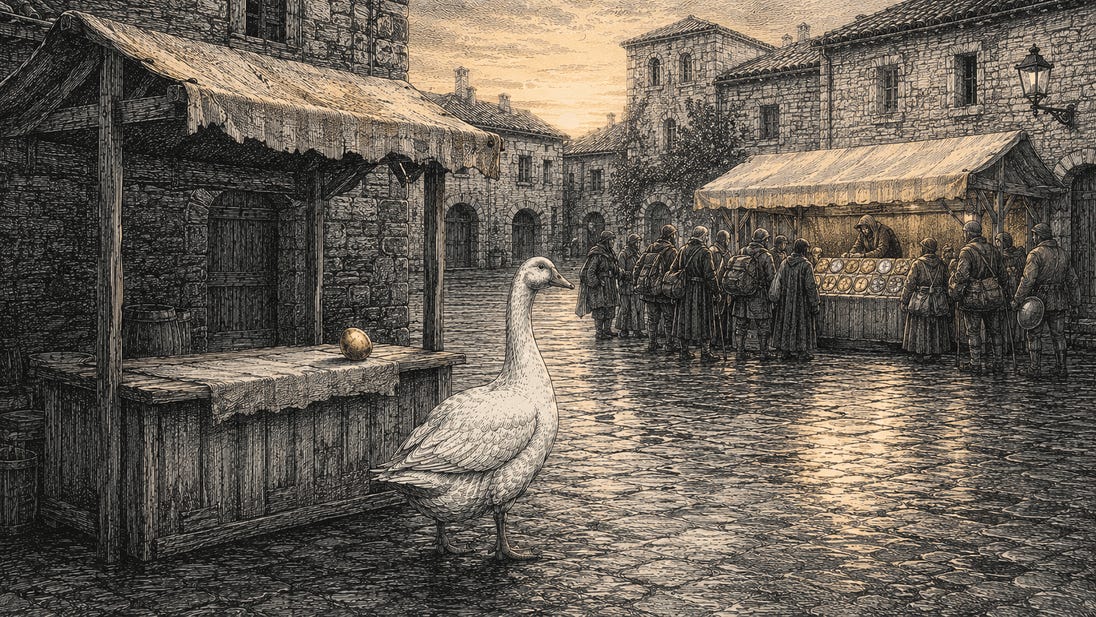
The Village Goose
There was a village that kept a goose, and the goose belonged to all of them.
Every morning it laid one golden egg, and here is the part the village half forgot over the years. The goose laid gold only because strangers trusted the village.
Merchants from far countries brought their savings to its vaults and took the village’s paper in return, certain of repayment, and that returning trust was what the goose spun into gold. The egg was never the gold. It was the trust, made holdable.
It sat in the square, where the sight of it each morning told every stranger the trust still held. A thing owned and trusted by everyone makes each person quietly richer.
That was the arrangement, and for a long time it held.
Now the village passed an ordinance, openly, in daylight, to applause. Any household might set up a stall beside the goose and hand out tokens good for bread anywhere in the market, quicker and lighter to carry than the old coin. The far traders, forever short of the village’s coin, wanted them most of all.
But the ordinance carried one more line, and it was the old moneylenders who had asked for it. No stall’s token could ever pay its holder a penny of return, by law, a token that spent but never earned.
The moneylenders had a reason. If the tokens paid, every villager would empty his account at the lending house to hold them instead, and the lenders would have nothing left to lend; better a barren token, so the deposits stayed put.
Many households opened stalls anyway, for the traffic was real. The busiest was the mayor’s own, and it was the mayor who had signed the ordinance and who licensed the stalls.
But a goose has only so much gold in it. To feed the stalls, it was made to lay a second time each day, a smaller, paler egg, and every morning the stalls carried that second egg away.
The token-holders did not feel robbed, and in a plain sense were not; most had never wanted the gold, only the token, the ease of it, the way it crossed the market in a blink. The second egg was drawn from them without their minding, or noticing.
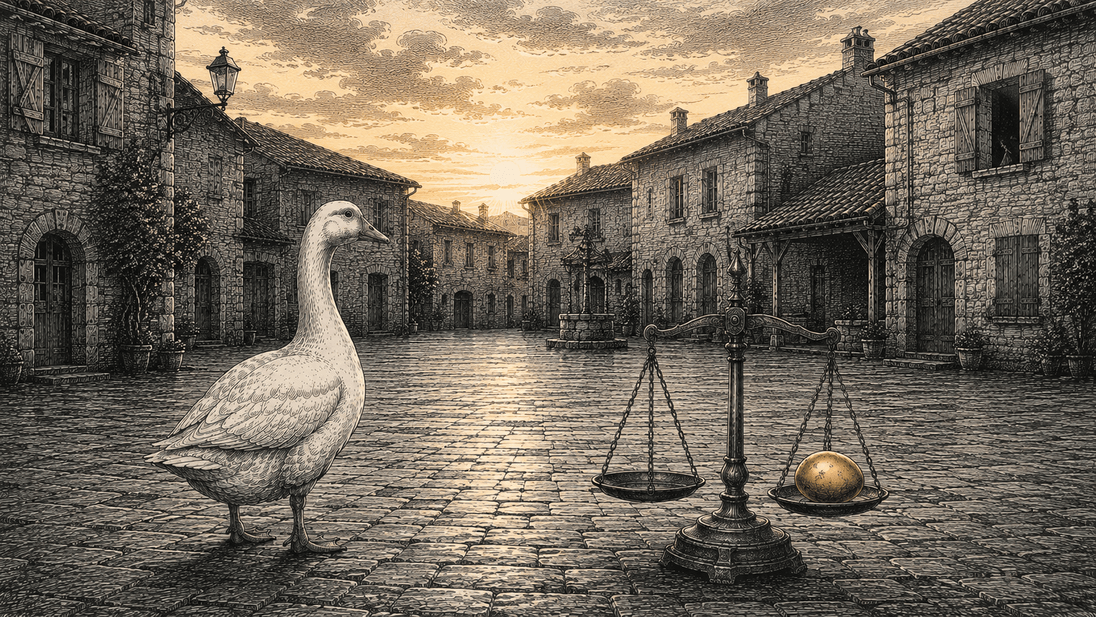
What none of them saw was where the second egg came from. The goose was no larger than before; its gold was only divided now, and every crumb that went into the small egg the stalls kept was a crumb gone from the great egg in the square. The more the stalls drew, the lighter the village’s own egg came.
So the great egg came lighter, season by season, not from any theft in the night but from simple division, the goose worked twice where it had been worked once. Not enough to alarm anyone. Just enough that a careful hand might notice.
There was one child who weighed it.
She had held the old eggs, years before, and she knew their weight. The egg in the square this morning was lighter.
She said so, to the other children, who shrugged, and to the grown people, who smiled the way you smile at a child who has noticed something true and inconvenient. There is an egg every morning, same as always, they told her, and the stalls are busier than ever. How could there be less?
She could not answer that in a way they would accept. She only knew the egg did not weigh what it should, and that no one seemed to be watching the weight at all. She said this too, and they stopped asking her to speak.
And there was one more thing the child could not have known, because it had only just begun. A stranger from another valley had opened a stall at the far end of the square.
His token was backed not by the village’s paper alone but by a little of many valleys’ paper, and a little gold besides, so it leaned on no single place and feared no single ruler. And bound by no village ordinance, it paid whoever held it a small something for the holding.
The far traders, who had only ever wanted a token that crossed the market in a blink, began to take his instead. Not all at once, not with any quarrel, a few each morning, drifting to the brighter awning, their backs to the goose they were leaving.
And here the story should end with the morning the goose lays nothing. That is how the old tale ends, cleanly, with a corpse and a lesson.
But this goose is not dead, and that is the whole trouble. This morning there was a gold egg on the counter, and there will very likely be one tomorrow.
The goose still stands in the square. Its side is only quieter, the stranger’s busier, the egg a little lighter, and no single morning is the one it ends. The knife, the corpse, never comes, and because it never comes, no one believes anything is ending at all.
Back to Our Own Goose
I will not name the goose for you; you knew it before the first egg. I will tell you only what the child knew.
A thing that made everyone richer, because it was the only one of its kind, can lose that place without being stolen and without anyone doing wrong. The goose need not be killed. It need only, one quiet morning, stop being the only goose whose eggs the market will take.
Not with a theft anyone could prosecute, but with a brighter awning across the square and a few travelers drifting toward it, and then a few more.
The old story is a comfort: the goose dies and the greedy man is punished in the same stroke, the lesson paid on delivery. Our version withholds that comfort. The stalls are warm, the fees are paid, and the morning the market no longer needs the village’s goose is somewhere ahead, unfixed, deniable, always one more dawn away.
The fable knows how these things end. It does not know the date, and anyone who gives you one is selling you the knife.
Weigh the egg.
PART TWO. THE MACHINE
What the Goose Is
Bonjourhi!
You have just read a story about a goose. It never says what the goose stands for; a fable that will not name its subject is only a decoration. So here is the other half, the machine in plain terms, the parts named, the caveats kept honest.
The Borrowing Privilege
It is the thing that has made America rich for eighty years and is so familiar almost no one names it: the ability to borrow the world's money in a currency the United States alone can print. Other nations borrow in currencies they do not control, and fear the day their own falls.
America borrows in dollars, and the world lines up to lend, holding trillions in Treasuries as the safest asset there is. The privilege lets it borrow cheaply, lowering the cost of nearly everything: mortgages, car loans, the price of imports. A French minister once called it exorbitant privilege, and it is.
We are told the privilege rests on trust. It does, but not wholly. It rests, more than anyone admits, on the absence of a usable alternative.
Wanting out of the dollar and being able to get out have always been two different things. No rival had the depth, the reach, the liquidity; the switching cost was the moat that quietly protected the goose. What is being built now lowers it. Here is how the parts fit.
The Parts, Named
The law. In 2025 Congress passed the GENIUS Act, regulating dollar stablecoins, digital tokens pegged to the dollar.[1] Its author, Senator Bill Hagerty, said openly he designed it to create demand for U.S. debt and cement the dollar’s dominance.[2] That is the stated purpose, and in the near term it may work. But a law can serve its purpose and its opposite at once, on different clocks.
The rails. A stablecoin does not live in a bank. It lives on a blockchain, the same general-purpose rails, Ethereum and its faster rivals, that carry every other kind of crypto.
By making dollar stablecoins respectable, the law funds and legitimizes that infrastructure, the wallets, the exchanges, the chains. And the rails are indifferent: the same pipes that carry a dollar carry any token at all. America is building everyone’s plumbing under the banner of its own.
The handicap. To shield its banks from deposit flight, the law forbids any dollar stablecoin from paying its holder a cent of yield; the interest on the reserves stays with the issuer.[3] Most holders are not seeking yield in any case.
They are not American savers, who would just buy the Treasury bill and keep the coupon, but people abroad who want the dollar itself, fast and portable: someone fleeing a melting currency, a trader at midnight, a business settling across borders in seconds.[4] The clause was written for the banks, not against those holders, but note its reach: it binds only inside U.S. jurisdiction, and that is the hinge.
The rival. Nothing confines the model to the dollar. An issuer beyond America’s reach, in Dubai, Singapore, Hong Kong, can back a token with a basket of currencies, gold, and sovereign debt, and, facing no yield ban, share part of the return with holders to win them.
Set the two side by side. The dollar coin: convenient, earns you nothing. The basket coin: just as convenient, tied to no single government, and it pays. In a free field that is no contest, and the dollar coin has been forbidden by its own law from competing where it counts.
The lost ledger. On these rails a wallet is not anonymous but pseudonymous: the transaction is visible, the name behind it is not. The one tool that reliably pierced the pseudonym was the registry forcing American shell companies to name their owners, and in the same period that registry was gutted, then ended, with the records slated for deletion.[5] The infrastructure inheriting global settlement is being made harder to see into, deliberately, at the very moment it is being built.
The front. And here, the president’s family. A venture they co-founded issues a dollar stablecoin; they hold a large minority; their own administration’s regulator granted it a national trust charter, a first for a firm tied to a sitting president.[6] The instinct is to call this the center of the scandal. It is not: their coin is small, a few billion in a market of hundreds of billions.[7]
The family’s crypto interests are in fact broad, and mostly speculative, the $TRUMP and $MELANIA meme coins, a governance token, a mining venture.[8] Those are a separate story, a cash grab wired to nothing but hype. Only the stablecoin touches the goose: it holds Treasuries, it falls under the yield ban, it sought the charter. That is why it, not the louder ventures, is the one that matters here.
What the family supplies is not scale but legitimacy. A coin blessed by the president’s family and chartered by his government makes the whole category look safe and permanent, which is exactly what the larger players, the sovereign funds, the scaled issuers, the foreign centers readying their basket tokens, need and cannot manufacture without appearing to grab. The family can, and is paid for it.
Put the parts together and the danger is not the fee, nor even the family. It is that America, to entrench the dollar, is funding the rails on which the dollar becomes replaceable, then forbidding its own coin from competing on them.
The privilege was protected by the absence of an alternative, and an alternative needs two things: rails as frictionless as the dollar’s, and a reason to switch. The law supplies the first by legitimizing the infrastructure, and hands over the second by crippling its own coin, so an offshore basket token, free to pay its holders, can offer what the American one may not.
Where the Institute Stops, any Why
Almost none of the danger has arrived, and honesty requires saying so plainly. Basket tokens have no real traction today, the market is overwhelmingly dollar, and network effects are brutal in the incumbent’s favor; the head start may simply prove insurmountable.
Every forward-looking claim here is about where incentives lead, not where they have gone. Anyone who tells you the privilege is doomed is guessing, and so is anyone who tells you it is safe.
There is a serious reading in which all of this strengthens the dollar rather than dooms it. Force every stablecoin to hold Treasuries and you manufacture a vast new class of buyers for U.S. debt. Build the rails first and the dollar’s first-mover network may prove so strong that no rival ever reaches escape velocity, and America keeps the lead precisely by leading.
The yield ban has a real financial-stability defense, not only a bank-protection one, and the White House’s own economists have called the deposit-flight fear overstated. A reasonable person can read the whole thing as ordinary innovation, most issuers as honest businesses, and the family’s stake as an embarrassment rather than a mechanism. That reading deserves a hearing, and it sets the honest bar for this one.
The claim here is not that crime has been proven, nor that collapse is coming. It is narrower: that the same law sold as cementing dollar dominance quietly builds, handicaps, and obscures the means by which the dominance could end.
But every part named here is real, on the record, and each of the people who built it said in daylight what they were building. That is the whole point, and it survives every caveat: this was not smuggled. It was announced.
The Reckoning, and The Egg
The fable ended on a gap in time. Everything turns on it.
The fees are collected now, in full, lawfully, in daylight.
The cost to the privilege, if it comes, arrives years out and lands on everyone, on no date anyone can circle. A cost with no due date is one almost no one guards against, which is precisely why it can be run up in the open.
And the family, collecting handsomely at the first step, has likely not understood that it is the front and not the future. The very things that make its coin valuable to the larger players, the presidential blessing, the domestic charter, are the things that ensure it can never be the coin that wins, because the winner will be neutral, global, yield-sharing, politically weightless, everything a president’s family coin can never be.
They were paid to open the door. When the crowd has passed through it they will be left beside it, holding a stall the market has quietly stopped needing, slow to see that they were the useful name and not the lasting one.
There is no villain to catch and no theft to prove. That was never where the danger was.
The warning is that the country is teaching the world to raise geese, handicapping its own, dimming the lights in the barn, and paying a well-connected family to hold the door and not ask where everyone is going.
Bonjourhi Institute Analytics, Montreal
ENDNOTES AND SOURCES
1. The GENIUS Act (Guiding and Establishing National Innovation for U.S. Stablecoins Act), enacted 2025, requires payment stablecoin issuers to back tokens 1:1 with cash and short-term U.S. Treasuries (93 days or less).
2. Sen. Bill Hagerty, the act’s lead author, has said publicly he drafted it in part to create structural demand for U.S. Treasuries and cement dollar dominance, predicting stablecoin issuers will become the largest holders of Treasuries in the world (Bankless interview, 2025; statements reported 2026).
3. GENIUS Act Section 4(a)(11) bars issuers from paying holders any interest or yield. The stated purpose is to prevent deposit flight from banks; a yield-bearing dollar coin would compete with insured accounts and drain the deposits banks lend against. Over 40 banking associations, led by the American Bankers Association, lobbied to tighten it. The byproduct is that reserve interest is captured by issuers. The ban is leaky in practice: exchanges such as Coinbase route reserve income to holders as rewards, which the OCC’s 2026 proposed rule seeks to curtail (GENIUS Act S.1582; ABA comment letters; OCC NPRM; CRS IF13174).
4. Stablecoin demand is largely non-U.S. and utility-driven: dollar access in high-inflation economies, crypto trading settlement, cross-border payments. Holders seek the dollar as a medium, not yield on it. A U.S. saver seeking yield buys Treasuries or a money-market fund instead.
5. On the rails: stablecoins settle on public blockchains (predominantly Ethereum and faster chains), which are pseudonymous, transactions public, real-world identity undisclosed by default. Separately, the FinCEN final rule of August 11, 2026 permanently exempted U.S. companies and persons from Corporate Transparency Act beneficial-ownership reporting and committed to delete previously reported U.S.-person data, narrowing the law to foreign entities and removing the principal tool for linking shell companies to their owners (FinCEN/Treasury; Mayer Brown; Forbes).
6. World Liberty Financial, co-founded by the president’s family, issues USD1; the family holds roughly 38%, a UAE investment firm nearly 49%. The OCC granted preliminary, conditional approval of a national trust charter for the family’s entity in August 2026, a first for a firm tied to a sitting president; it permits issuance, redemption, reserve management, and custody, not deposit-taking or lending (company disclosures; Reuters; WSJ; OCC; American Banker).
7. USD1 is small in a crowded field. The stablecoin market exceeds $300 billion, with Tether (roughly $140 billion) and Circle (roughly $60 billion) dominant, and regulated entrants including PayPal/Paxos, Ripple, Fidelity, and bank issuers such as SoFi, JPMorgan, and Citi (DeFiLlama; issuer disclosures, 2026).
8. The family’s broader crypto portfolio includes the $TRUMP and $MELANIA meme coins (roughly $362M and $65M in reported profits), the WLFI governance token, American Bitcoin (a Nasdaq-listed mining venture), and Trump NFT collections. These are speculative and brand-driven, structurally unrelated to the dollar’s reserve function; USD1, the Treasury-backed stablecoin, is the only venture connected to the mechanism described here (financial disclosures; CBS News; CoinDesk, 2026).
9. On the rival: no basket-backed global stablecoin has meaningful traction today, and this displacement is a risk the architecture creates, not an event underway. Offshore jurisdictions (UAE, Singapore, Hong Kong) permit yield-sharing that the U.S. yield ban forbids, which is the asymmetry described.
10. On the limits: the displacement thesis is a contestable macro judgment, not a measured fact. A serious competing view holds that the dollar’s first-mover network in tokenized money entrenches its dominance rather than erodes it, that mandated stablecoin demand strengthens U.S. borrowing, and that a 2026 White House Council of Economic Advisers report found the deposit-flight effect small. Projections of stablecoin-driven Treasury demand span a wide range with a distant ceiling and are not forecasts.
BONJOURHI! INSTITUTE ANALYTICS · MONTREAL · 2026