
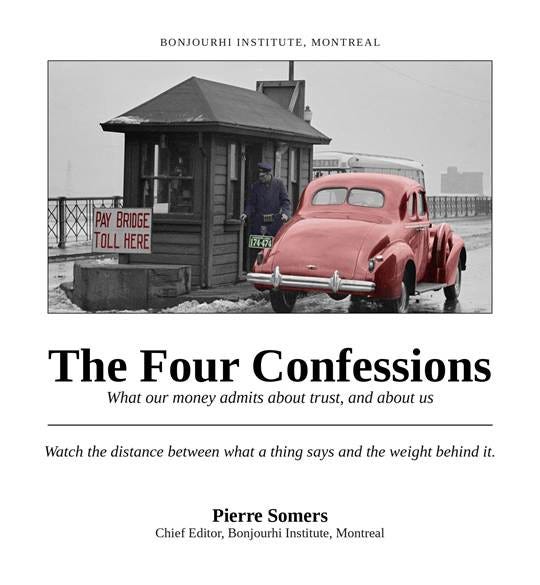
Bonjourhi!
When we released The Escort Fee, the two books, the argument and the novel, we expected the usual quiet. What we got instead was mail. Not about the parts we covered. About the parts we did not.
Reader after reader, several of you wrote in with a version of the same question. You traced the escort fee through oil, through grain, through the wire and the cable. But what about the one I pay? And then each of you named a different toll we had left untouched.
You were right. There are more, and some are larger than the ones we named. The card swipe that quietly takes two to three percent of nearly everything you buy. The app store that takes thirty percent for passage to a customer who can be reached no other way. The dollar clearing system that almost every cross-border payment must touch, a toll in peacetime and a weapon in conflict. The index that decides which companies receive the world’s passive money and which are starved of it. The license, the patent, the standard, each a gate on a road that producers must cross to reach a market, each with a keeper who collects.
The pattern under all of them is the one the books named. Value must move. Someone owns the ground it crosses. The charge for passage is set by the owner, hidden in the price, and paid by whoever has no other route.
We will come to those other tolls in time. The card, the app store, the clearing system, the index, the gate. Each will have its issue. But the first reply to your letters is not another toll on goods that move. It is the toll on the thing the goods are priced in.
This issue introduces The Four Confessions, the companion to the Escort Fee books. Where those traced the hidden charge on what moves through the world, this one turns the same lens on money itself. The escort fee was never a story about energy. It was a story about chokepoints, and the oldest chokepoint of all is the one every price must pass through. Trust.
The Four Confessions
The Four Confessions is the companion to the Escort Fee books. Where those traced the hidden toll on goods that move, this turns the same lens on money itself. It is a four-essay volume on a single question. When money is backed by nothing you can hold, what exactly are we trusting, and how can we tell what has earned it?
One measure runs through every page. The distance between what a thing claims and what actually stands behind it. Watch that distance and you can read any note ever printed.
The argument
Trust now does the work gold once did, and it behaves like money. It builds slowly while a thing keeps its word, drains quietly when word and substance part, and costs far more to rebuild than to keep. The four confessions are four forms of that one motion.
The four confessions
The dollar. In God We Trust went onto the paper in 1957, exactly as the gold began to leave. The words were once a fact. Now they are a request. A thing protests its honesty loudest when it has the least left to show for it.
The euro. A currency with no face and no founder, an arch that spans no real river, because no nation could agree whose bridge to carry. It is trust attempted sideways, among strangers, held together in its crisis by a single sentence from a central banker because the structure to back it did not exist.
The tulip and the coin. Value staked on belief with no one standing behind it. The tulip is that wager already lost, a price with nothing under it but the next buyer. Bitcoin is the same wager still being weighed, its scarcity enforced not by a promise but by a ledger no president can rewrite.
The two newest coins. Here the gap is opened on purpose. A coin built on a famous name extracts by never holding still. A stablecoin extracts by holding perfectly still, taking the yield on your dollar while the law forbids it from paying you a cent. The second is the escort fee itself, raised one floor above the molecule and laid across money.
Why it matters
The volume gives a reader a single tool. Doubt whatever advertises its own soundness, since the boast appears exactly where the substance wore through. Trust the thing that claims a little less than it could, because a claim smaller than its backing cannot be faked cheaply. It has to be paid for in years of keeping your word.
The closing line is the bridge to the companion work. Trust compounds. The escort fee extracts. One is what grows when value is left in place. The other is what is taken when it is pulled out too soon. They are one idea, seen from two sides.
The Four Confessions
Take the money out of your wallet and look at what each note printed, and what it left blank. None of it is backed by anything you could drive to and demand. The dollar surrendered the last of its gold in 1971. The euro never held any. The coins were designed to need no vault at all. What keeps them standing is one thing only, and that thing has no weight you can hold.
It is worth studying as closely as we study interest or inflation, because it now does the work gold once did. And it moves the way money moves. It builds slowly, year by year, as long as a thing keeps its word. It leaks away, usually without a sound, the moment the word and the thing come apart. And rebuilding it, once it has gone, costs far more than holding onto it ever would. Those three movements run under all four essays.
The shape of these four confessions is simple. The dollar runs downward, a government’s word to the people holding its paper, and it is being spent. The euro runs sideways, among nations that share a currency and almost nothing else. The tulip and the early coin try the thing with no one standing behind it. And the newest coins are the turn into something colder, money dressed in the language of trust while it works the opposite trade, extraction, once at full volume and once in total silence.
Carry a single measure through every page. The distance between what a thing claims and what actually stands behind it. Watch that distance and you can read any note ever made. And by the last essay you will find you have been reading two books at once. The companion work, The Escort Fee, traced that same distance through oil and food and freight, the unseen charge on anything forced to cross ground someone else controls. These four confessions follow it home, into the money itself. The escort fee is what is taken when value crosses ground you do not own. Trust is what is taken when the ground is your own word. They are one idea, and this is its other half.
Read them in order. The same quiet ending is waiting at the foot of each.
THE FIRST CONFESSION
In God We Trust
Four words that were once a fact and are now a request. They went onto the paper in 1957, just as the gold began to leave.
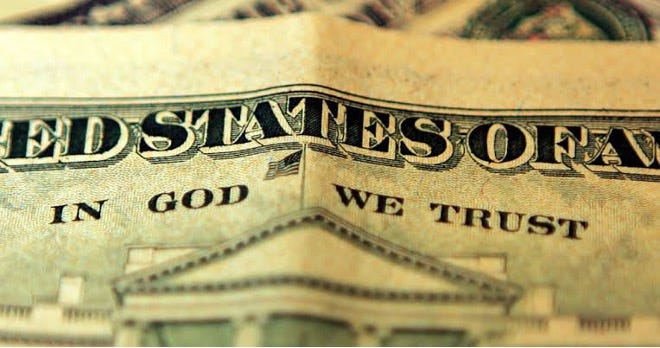
Read the four words above the great seal. We have passed our eyes over them so often that we no longer see them, which is a pity, because they may be the frankest words in modern finance. They are there because they are all that holds the note up. No gold sits behind them, nothing to cash in, only the promise and our willingness to take it. How those words arrived is the part worth telling, because they appeared at the precise moment the gold was walking out the door.
When the word was simply true
For most of its life the dollar never had to claim anything, because it could prove itself on the spot. You handed over the paper and walked out with metal, at a price everyone knew. That habit of delivering paid off. Each clean exchange left the next person a little more willing to hold a dollar, and that willingness pulled the rest of the world in behind it. A bank sets the interest it owes you. This kind of return sets its own rate, and the dollar earned it for so long, so reliably, that it became the most wanted object on earth. That is the whole meaning of reserve currency. Not a crown but a yield, paid to America in the readiness of strangers to hold its paper and never come asking for the gold.
When the word started doing the gold’s job
Then the metal went, and it went in stages, each one signed by a president, each leaning a little harder on the promise and a little less on the vault. Roosevelt moved first, in 1933, ending the citizen’s right to redeem at home. The signal came next. The country adopted In God We Trust as its motto in 1956, and in 1957 the line went onto the bills for the first time, just as the gold behind it started to thin. A thing protests its honesty loudest when it has the least left to show for it. Nixon shut the window for good in 1971.
None of it looked like a loss at the time, which is the cruel part. The dollar hardly moved. The store built up over the gold years was so deep that it could be drawn down for decades and still look full. But the draining had begun, and it had a direction, and the rate fell along with the balance, because a promise resting on politics is taken a little less at its word every time the politics are tested.
The spiral
What followed winds tighter with each turn. Every president inherited a dollar leaning harder on the promise, and found no move available but to lean harder still. The debt rose under both parties, because a currency held up by a word can always print a little more of the word. The dollar turned into a weapon, used to shut rivals out of the system, which worked, and which also taught those rivals to lay their own pipes so that one day they would not need it. The debt ceiling became theatre, each round a quiet confession that the promise now rests on a vote rather than a vault. No single step was a fall. Each was a little more claimed over a little less held, the story swelling with confidence as the ground under it wore thin.
What the four words are really saying
The line has not changed since 1957. Everything beneath it has. When the dollar said the words and would give you gold for them, they were a fact. Now that it says them and can give you nothing, they are a plea. Somewhere along the spiral the boast turned into a request. You do not advertise what you still have in hand. The dependable rarely talk about their dependability; they keep their word and let the quiet speak for them. It is when the vault runs low that the motto goes up on the wall, in the very place the metal used to sit.
THE SECOND CONFESSION
The Word a Continent Cannot Print
An arch that spans no real river, a window onto no real country. The only great currency that cannot say whose bridge it is.
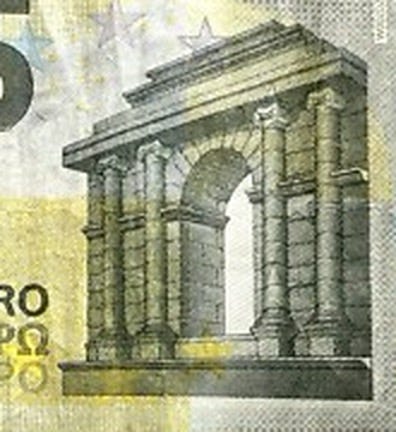
Pick up the euro and notice what is absent. No face, no founder, no hero. The arch looks like real architecture but exists nowhere, drawn to match no actual building in any actual country, because any real arch would have stood in one member and slighted the others. The dollar can name what it stands on. The euro cannot, because the question at its center is who the we even is. That silence is what makes it the boldest thing ever tried with money. Can a shared currency manufacture fellowship among peoples who spent a thousand years at war, or does it merely reveal whether the fellowship was ever there?
The decade the wager looked won
You could read the bet in what governments paid to borrow. Before the euro, Rome and Athens and Madrid paid far more than Frankfurt, because lenders remembered old devaluations and charged for the memory. When the single currency arrived, that gap shut. Money flowed to Greece almost as cheaply as to Germany, on the theory that a Greek euro and a German euro were one and the same. It was the dollar’s slow climb run at high speed, and for ten years the market took the promise at face value and priced it as fact.
The morning the market counted again
The bill had not been paid. It had been postponed. Under the single currency sat one central bank and no shared treasury, a separate budget and separate books for every member. The idea that a Greek euro equalled a German euro held only while no one tested it. In 2010 someone did. Once Greece’s true position showed, the market redid the arithmetic it had waved off for a decade and returned a brutal answer in a matter of months. The convergence came apart. The dollar’s decline had been slow, almost mannerly. The euro’s wound opened in public, because the gap had been held closed by conviction alone, and conviction, when it goes, goes all at once.
The sentence that held it up
In July 2012, with the market pricing the euro’s funeral, the head of the European Central Bank stood up in London, said the bank would do whatever it took, and asked the world to take him at his word. The spreads dropped almost immediately. Look at what actually happened. One man held a currency up with a sentence. He had no shared treasury to offer, none of the machinery that would make a Greek euro the true equal of a German one. He had words, spoken aloud precisely because the structure to back them did not exist. You can repair a broken promise, but only with a real and expensive deposit, and only into something everyone now knows can break. Europe made the cheap deposit, the spoken one, and has spent every year since dodging the costly one.
What the blank arch is saying
The bridge crosses no river and the window opens on no country, because no one could agree whose face belonged there. A currency that cannot name what it rests on has no single guarantor, only a circle of nations watching each other to see who picks up the cheque. The dollar shows what happens when a thing spends down what it built. The euro shows something braver, what happens when strangers try to build the thing from nothing. The silent confession is the more honest of the two, and for that reason the more fragile, because a promise that will not say its own name has not yet decided whether it means it.
THE THIRD CONFESSION
A Belief One Layer Deep
A bulb worth a house for a single winter, and a coin trying to build trust with no hand to sign it. What happens when there is no guarantor at all.
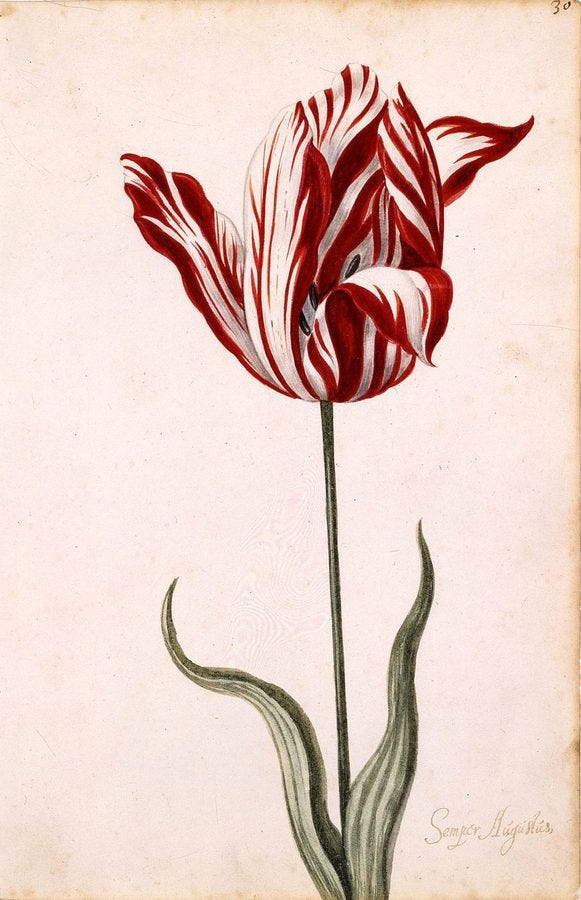
The first two confessions still had someone behind them, a government or a circle of them. Take even that away. Picture an object with no face, no founder, no treasury, nothing under it but what people are willing to think. History has tried this twice. In 1637 it gave us a tulip. In our time it has given us Bitcoin. Put them next to each other and they are the same experiment with two endings, one a failure already complete, the other still being scored.
The tulip, a belief one layer deep
The finest bulbs carried a feathered streak of colour no grower could repeat on demand. The rarity was genuine and so was the beauty. For a while the trade behaved honestly, and collectors paid real money because they wanted the flower. Then the price floated free of the bloom. Through the winter of 1636 and into 1637, people stopped buying tulips to plant them and bought them to pass them on. The bulbs sat in the cold ground, so what actually moved was paper, a note promising a bulb in spring, sold tavern to tavern, each hand paying more than the last. Nobody in the line wanted the flower. Everybody wanted the next buyer. The whole tower stood one storey high, and the wrong storey at that. Counting on the next fool is not the same as standing on solid ground; it is a rumour with a price attached. One February morning the bulbs met no bidder, and the number fell to nothing in days, because nothing had ever been holding it but the buyer who failed to show. No slow recovery followed, because there was nothing real to recover, only a spike that had briefly worn the costume of value.
The coin, a wager with no hand to sign it
Bitcoin has no face. Whoever made it took a false name and vanished, which may be the shrewdest thing about it. The euro left the arch blank; Bitcoin removed the hand. No one prints the word, because the entire point is that no hand can be trusted to. And it attempts the honest move. It claims less than a government does, not more. The supply is capped, twenty-one million coins and no more, and the cap is not a promise at all but a rule enforced by the ledger itself, by thousands of independent machines that must agree before anything is added. Where the dollar prints a slogan because the gold is gone, Bitcoin prints nothing and binds itself to arithmetic. To lift its ceiling you would have to corrupt the network, not persuade a president, which is a harder thing than any Roosevelt or Nixon ever had to do.
And yet most of what a coin is worth today comes from the bet that someone will want it tomorrow, which sits uncomfortably close to the tulip’s single storey. The test is the one this book keeps returning to, and it has not been settled. Is the foundation thickening, layer on layer, or is it just another spike? Here the coin pulls away from the bulb. The tulip faced one trial and failed it once and forever. Bitcoin has faced many, dropped hard, and come back, and every crash it walks out of is a public test it did not fail, adding one more thin year to a foundation the gold dollar took a century to pour. But it carries the euro’s flaw and deepens it. When the euro lay dying, a man in London revived it with a sentence, because a hand still existed to reach for the bill. Bitcoin cut that hand off on purpose. The very thing that makes it honest, that no one runs it, is the thing that guarantees no one can rescue it. Its strength and its danger are one fact wearing two faces.
What the blank coin is saying
Three notes in a row. The dollar prints the word and can no longer fully stand behind it. The euro cannot print the word, because no single hand can sign it. Bitcoin bets it can be done with no word and no hand at all. The tulip is that bet lost. A coin held widely and held for generations, should it ever get there, is that bet won. A price that doubles in a season is not yet anything. The proof comes after the price drops and the holders stay. The tulip had no one left when the price fell. Whether the coin will be the confession it has not yet finished making.
THE FOURTH CONFESSION
The Toll That Learned to Say Trust
Two newer coins, one loud and one silent. One extracts by crashing. The other extracts by holding perfectly still. The quiet one turns out to be an old acquaintance.
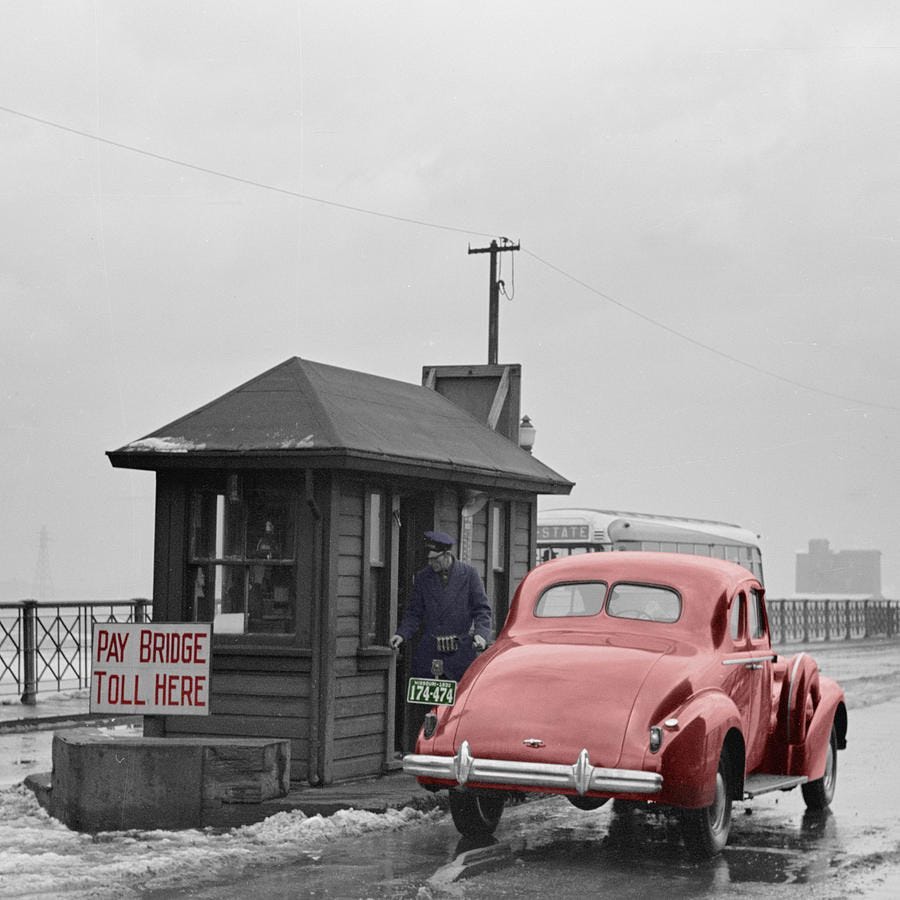
The first three confessions opened their gap by accident or by hope. No one set out to drain the dollar. The euro nearly broke from reaching too far. Even the tulip was a crowd fooling itself. This one is different. Here the gap is opened on purpose, in two opposite styles, by two instruments that share almost nothing on the surface. One is among the loudest objects in finance, the other among the quietest. One profits by never sitting still; the other profits by sitting perfectly still forever. They are two faces of a single verb, and that verb is the reverse of the one that built the dollar. The dollar grew what it had. These two drain it.
The loud coin, extraction by volatility
A coin minted on a famous name is the tulip with the flower cut away. What sells is the name, and the name is a label stuck where the value should be. A currency, in the end, is a vow to be dull. The gold dollar’s whole power was its dullness; you knew its next move because it repeated its last one, and a thing only grows in worth if it stays still long enough to be counted on. A coin tied to a personality follows the mood instead, the quarrel, the next sudden turn. It does not have to lie to collapse, only to be unpredictable, and a personality built to seize attention is unpredictable by trade. The first failure is structural, not moral. What kills it is not wickedness. It is volatility. The second failure runs colder. The tulip had no insider. A coin issued by a known name puts back the one thing the honest coins took out, a hand, a hand that can hold a quiet pile and sell into the very excitement the name stirred up. It fails twice over. It cannot grow, because its footing will not hold still, and it bleeds, because the issuer wins when the holder loses.1
The silent coin, extraction by stillness
The stablecoin makes the vow the loud coin could not keep. A dollar in, a dollar out. Dull by design. On the surface it is the opposite of the celebrity coin, which is exactly what makes it the sharper lesson. The loud coin had to crash before its take was visible. The quiet one takes the most when nothing happens at all. You hand over a real dollar and get back a token. The issuer puts your real dollar into Treasuries and pockets the yield. You hold the promise; they hold the interest. Under the law now written for these things, the issuer must keep a dollar in reserve for every dollar issued, and is barred from paying you a cent of what it earns.2 The take is not a loophole. It is the blueprint, signed into statute. A chequing account that pays the bank instead of the customer, and calls itself a coin. It collects most in calm, profitable stillness; the better it behaves, the longer its reserve quietly earns for one side while the other side holds a thing worth precisely what it cost. Watch who lobbies for it, and you learn the rest. The same dollar that would sit on a bank’s books as a deposit, weighed down by capital rules and reserve demands, can sit inside an issuer the law lets off those hooks. The house keeps the yield and drops the duty. It is the gold dollar’s good name with the caution scraped off, which is, almost word for word, the first confession over again.
The name of the silent coin
We have met the quiet coin before, in the other book. The escort fee is the charge for moving something you need across ground someone else holds, the spread between its price where it starts and its price where it lands, and its signature is that it shows up on no invoice. Every piece fits here. The thing being moved is a dollar. The ground it crosses is the issuer’s reserve, since you cannot hold the digital dollar without leaving a real one parked in machinery you do not run. The spread is the yield kept from you. And the hiding is complete, because the token shows a flawless peg while the charge lives entirely in the interest you never see, on the dollar you no longer hold. The escort fee, lifted one floor above the oil and laid across money itself. The driver at the pump pays a premium buried in the price of fuel, for safe passage through a strait he will never sail. The holder of the quiet coin pays a premium buried in the yield of a reserve he will never touch.
A tariff, as we said once, is the honest cousin, the toll that admits what it is, while the escort fee is the toll that passes for a price. The quiet coin closes the circle. It prints the most calming word money owns, stability, so the toll inside it never has to be named. And one last turn names the builder. The original escort fee had no architect; it extracted by the accident of how things were arranged. This one was drafted. Someone decided the holder gets none of the interest. The old fee was the price nobody set. This is the price somebody set, and then made it rude to ask about.3
What We Can Trust
If all of it rests on what people are willing to think, what is safe to lean on? Not nothing. The soft thing is not the weak thing. It is the thing now carrying gold’s old load. The question was never whether to trust, we have no choice, but how to tell what has earned it.
Doubt whatever advertises its own soundness. The note that prints the motto because it can no longer show the metal. The coin that prints a famous face because nothing else stands behind it. The token that prints the word stability across a toll. The boast shows up exactly where the substance wore through. Trust the opposite, the thing that claims a little less than it could. A claim smaller than what stands behind it cannot be faked cheaply. It has to be paid for, in years of keeping your word.
And we never really trust the dollar, or the euro, or the coin. We trust that everyone else will keep holding them tomorrow. A banknote is a bet on other people’s bets, which sounds like a house built on air until you notice how long these houses stand. That is not the weakness of paper money. It is what trust looks like at full strength.
So watch the gap, not the slogan. It is the same gap the other work called the escort fee. Trust is what grows when value is left where it sits. The fee is what is skimmed when it is pulled out too soon.
Trust compounds. The escort fee extracts. That is the whole of what the money has to confess.
APPENDIX
Who Collects the Escort Fee
The loudest collector is the smallest. The largest sit in near silence. A ranking, from the most hidden to the most seen.
The fourth confession named the stablecoin as the escort fee in its newest form, but not who collects it. The answer is a hierarchy, and its shape is the point. The collector everyone argues about is the smallest in it. The ones who take the most are the ones almost no one names.
The mechanism, briefly. You hand an issuer a real dollar and receive a token marked one dollar. The issuer puts your dollar into Treasuries, earns the yield, and by law keeps all of it. You hold the promise; it holds the interest. Across a market above three hundred billion dollars, that is more than ten billion a year, itemised on no statement. The rest is the question of whose pocket it reaches.
The Treasury, the collector no one names
Start at the top, with the one that takes no interest and gains the most. Every stablecoin dollar must sit in US Treasuries. The two largest issuers alone now hold on the order of a hundred and fifty billion dollars of government debt, and the Bank for International Settlements has measured the result: stablecoin inflows lower the yield the Treasury pays to borrow. The government has manufactured a captive, growing buyer for its own debt, funded by holders worldwide who are paid nothing to provide it, and it says so plainly, calling stablecoins a tool to drive Treasury demand and cement the dollar. It is the petrodollar of the first confession, one storey higher.
The big issuers, who take the most cash
Next, the two firms that take the most actual money. Tether holds reserves above a hundred and ninety billion, most of it Treasuries, and cleared more than ten billion in profit in 2025 with a staff that would fit in one room. Circle, behind it, earns the same way; the spread is the entire business. Together the two are more than ninety percent of the market. They were collecting before any law passed. The statute did not create them, it made them permanent and respectable.4
The banks and retailers, with a discount attached
Then the institutions moving in, and the reason the law welcomes them. A dollar taken as a bank deposit forces the bank to hold capital against it, insure it, and meet reserve rules. The same dollar inside a stablecoin is carved out of all that. So a bank or a retailer can take your dollar, earn the Treasury yield, pay you nothing, and carry a lighter burden than across its own counter. The escort fee with a capital break stapled on. That is what the lobbying bought.
The family, the collector everyone watches
Only now, smallest by size, do we reach the one that draws the attention. Through World Liberty Financial, a firm a Trump business reportedly mostly owns, the family issues USD1, whose few billion in reserves earn interest that flows toward the family. In dollars it is a fraction of what Tether collects in a quarter. What makes it singular is position, not scale: the hand that signed the law forbidding holders any interest belongs to the family collecting on its own coin. The booth was built and blessed by the hand at the till.
The holder, who collects nothing
At the bottom, the holder, and here the holder splits, which reveals who the machine is for. The foreigner has a reason. A worker in Lagos or Buenos Aires, holding dollars on a phone to escape a sinking currency and a brutal border, gets something real, a stable dollar that travels, and pays for it by surrendering his yield to the stack above him. Fair toll, real passage.
The American is the puzzle. His dollar already works and his deposits already sit insured, so mostly he does not use these at all, and the figures show it. The genuine American uses are narrow, the trader who needs a dollar on crypto rails, the firm settling over a closed weekend. What is sold to everyone else as convenience is something else in costume. The retailer’s coin chases the card fee it pays Visa. The yield platform helps him claw back, through hidden risk, the interest the issuer keeps by law. He is not escaping a toll. He is the surface across which one is moved.
So the ranking runs opposite to the attention. The Treasury, the issuers, and the banks take the river; the family dips a cup in full view while holding the pen. And beneath that sits the deeper split. Abroad the coin solves a real problem at a fair price. At home the dollar already works, so it solves nothing and merely shifts a toll from the card networks or the bank to a quieter booth, and calls the shift innovation. One question reads any pitch. Who used to collect this fee, and who collects it now? The loud coin was always what you were meant to watch. That is why so few watched the silent one, where the fee is actually taken. The noise is not a distraction from the system. The noise is the system.
A note on Tariffs, the honest cousin
One distinction needs guarding, because the books leaned on it. A tariff was called the escort fee’s honest cousin, the toll that admits it is a toll. That is true, but only on a condition, and the condition is uniformity. A tariff applied evenly is honest because it is blind. The rate is published, every importer pays it, and you can see exactly who set it and what it costs. You may hate it, but you cannot be fooled by it.
The exemption is what corrupts it, and it corrupts it in the exact direction of the escort fee. The moment some firms get a carve-out and others do not, the real price goes hidden, because the headline rate is no longer what anyone actually pays. A chokepoint appears where there was none, the exemption office, controlled by whoever grants the waiver. And the toll detaches from the crossing and reattaches to access. You are no longer paying for passage. You are paying for the relationship that gets you out of paying. That migration, from the visible thing to the controlled thing, is the escort fee’s signature move.
The record is not subtle. When the United States imposed its Section 301 tariffs on China, it opened a process to petition for exemption, decided case by case. Through January 2020 the government received 52,746 requests and granted 6,804, about thirteen in a hundred. The odds were not stable. Approval ran near thirty five percent under the first two rounds, then collapsed to five and seven percent under the next two. Same rule, the chance of escaping it swinging by a factor of seven depending on when you asked, and whom you knew.
Whom you knew turned out to matter most. A study in the Journal of Financial and Quantitative Analysis found that firms which had invested in political ties to the party in power were significantly more likely to win exemptions, and firms that had backed the other side were less likely, their requests not merely ignored but denied at higher rates.
One author called the process a spoils system, used to reward friends and punish enemies. The same study found no such pattern in the separate steel and aluminum exemptions, which tells you the swamp is not in tariffs as such. It is in the discretion to exempt. And the access industry forms around that discretion at once: white shoe firms now advertise exemption filing as a service, and the latest round of carve-outs was set not by any neutral rule but by a handshake at a summit between two presidents. You can watch the discretion operate in the open. In July 2019, the president settled one company’s request not through the agency or any published test but by announcement, declaring that Apple would get no waiver on the Chinese parts for its Mac Pro and should build them in the United States instead. The same administration denied exclusion requests from General Motors for a Chinese built Buick, from Tesla for vehicle components, and from Uber for electric bikes, while thousands of quieter requests were granted or refused out of public view. When a toll can be lifted by a single sentence from the top, the toll is no longer the policy. The sentence is.
So the honest cousin is honest only while it stays blind. Uniform, it admits what it is. Riddled with exemptions, it becomes the escort fee with a flag on it, the toll that calls itself policy. The test does not change. Watch the gap between what it says and what it does. A tariff that says everyone pays this and means it is honest. A tariff that says everyone pays this and then quietly does not is the swamp, which is only the escort fee with a permit office out back.
NOTES
1 The loud coin is not hypothetical. In January 2025, days before his second inauguration, Donald Trump launched a personal memecoin, TRUMP, followed shortly by a MELANIA token. Both spiked on the strength of the name and then fell sharply, and a large share of the supply was held by entities tied to the issuers, who were positioned to sell into the very enthusiasm the name created. It is the persona coin described above, in life rather than in theory.
2 The law is the GENIUS Act, the Guiding and Establishing National Innovation for U.S. Stablecoins Act, signed by President Trump on July 18, 2025, the first federal stablecoin framework in the United States. It requires issuers to hold one dollar of safe reserves, U.S. dollars or short-term Treasuries, for every dollar issued, and it expressly prohibits paying the holder any yield or interest. The issuer keeps what the reserve earns. The holder, by statute, receives none of it.
3 The conflict is on the public record. The Trump family launched its own stablecoin, USD1, through World Liberty Financial, a firm that directs most of its profits to the family, leaving it to collect the interest on more than two billion dollars of reserves under the very law the President signed. At the signing he remarked, of the GENIUS Act, that they named it after him. The booth, in this case, was built and blessed by the same hand positioned to collect at it.
4 The two firms are Tether, issuer of the dollar token USDT, and Circle, issuer of USDC. As of mid 2026 USDT stood near 188 billion dollars in circulation and USDC near 78 billion, the two together more than ninety percent of the market. Both work the same way. The dollars handed in are held largely in US Treasuries, and the interest those reserves earn accrues to the issuer, not to the holder. Tether reported roughly 1 billion dollars of profit in a single quarter of 2026, almost all of it this spread. That the yield flows to the issuer and never to the holder is not an abuse of the rule. It is the rule, the same design the GENIUS Act wrote into law.
BONJOURHI! INSTITUTE ANALYTICS · MONTREAL · 2026