

On November 3, Katharina Pistor asked whether a small brotherhood of tech founders was quietly replacing the state. Her case was serious, and much of it was true. Then the calendar moved. American voters turned on the candidates the industry had paid for. Nvidia's chief, the executive with the warmest seat in the White House, resigned. Brussels kept enforcing, Beijing tightened, Ottawa started building.
None of this means the brotherhood has lost.
It means something quieter, and more useful to understand. Every sovereign in the sky has depended on someone standing on the ground.
Bengal, 1772
In the summer of 1772, the East India Company governed Bengal. It collected the taxes, minted the coin, and kept its own army. London merchants spoke of it as a state that happened to issue shares.
Then a credit panic swept the City, and the Company could not meet its bills. It asked Parliament for a loan. Parliament said yes, and attached the Regulating Act of 1773: a governor-general answerable to London, a royal court in Calcutta, and inspectors reading the books.
The Company was not humbled by a rebellion. It was humbled by its balance sheet. The day it needed public money, the public wrote the terms.
How the brotherhood rose
For twenty years the wind was steady. Capital was cheap and patient. Users liked free things and asked few questions. Governments feared falling behind more than they feared the companies, so they cleared the runway.
That was the logic, and it worked.
What changed
Artificial intelligence changed the physics. Software floats. Power plants, transmission lines, water rights and chip export licences do not. The higher the industry builds, the more of it rests on land that some government zones, permits or taxes.
And the building is financed with debt. Two days after the midterms, roughly $2.5 trillion in market value vanished in a single session, on fears that the new Congress would slow the buildout.¹ A sovereign that needs a loan is a tenant with a good view.
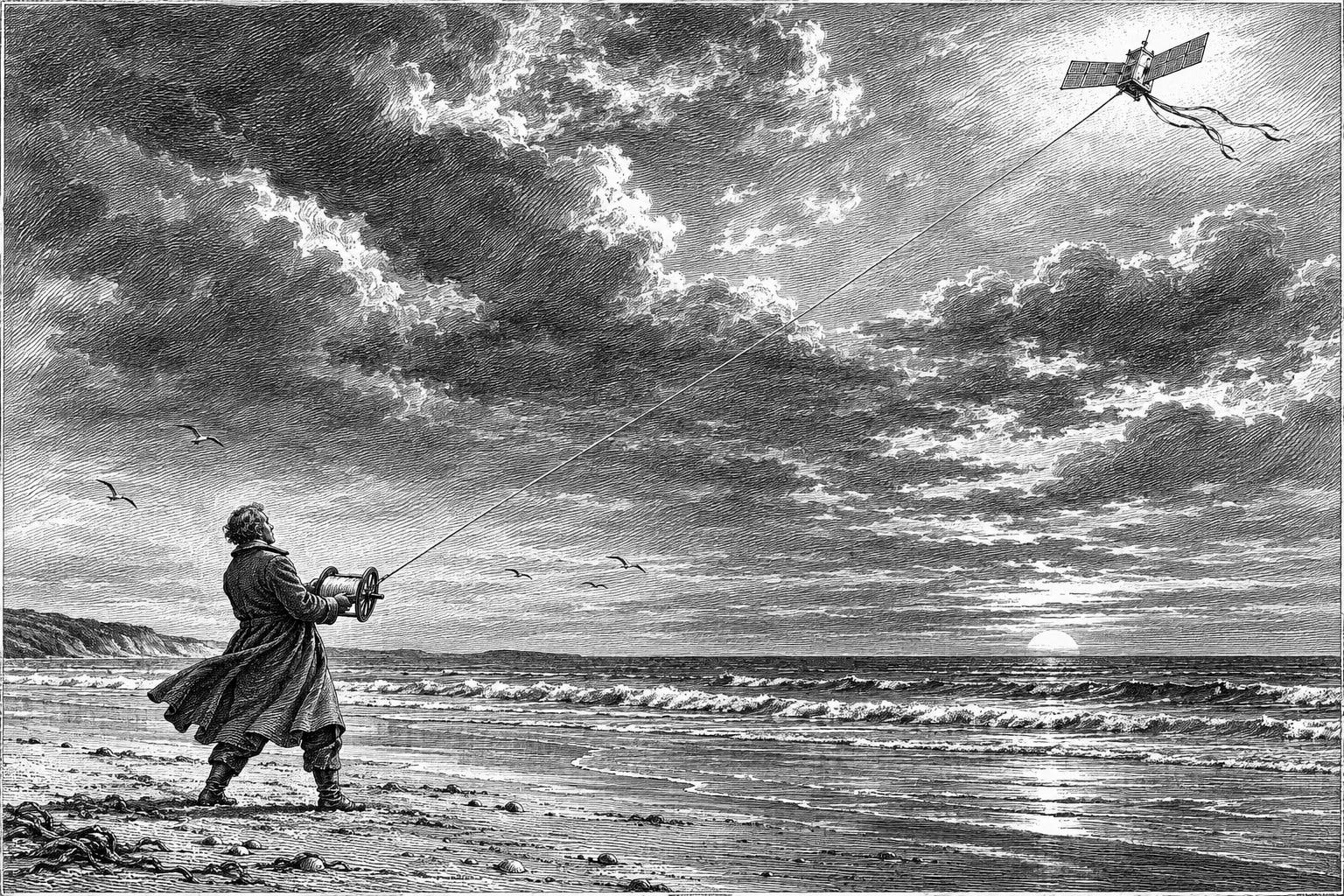
The kite
A kite does not fly against the wind. It flies because of the wind and because of the string. The tension in the line turns moving air into lift. Children learn this on their first windy afternoon: let go, and the kite does not soar. It tumbles.
The higher a kite climbs, the harder it pulls. From the beach, a high kite looks free. It is the most anchored object in sight, held by the greatest tension. When the wind drops, every kite returns to the hand on the reel, whether that hand wants it back or not.
Experienced flyers know two ways to lose one. Pay out too much line in a strong gust and the kite drags the flyer down the sand. Hold the line too short and it never leaves the ground.
Who holds the reel
Pistor wrote that Musk rules the skies. He does. Each satellite also went up on a launch licence, a spectrum allocation and a government contract. The platforms rose on charters, courts, grid connections and export permits. The string was never cut.
In the United States, Washington's grip had been relaxed, even feeding the kite slack. Then the midterms. Musk spent at least $474 million on the 2026 elections, and voters pushed back against billionaire influence, electing critics of the AI industry and approving limits on data centers.² In Washington, Democrats are now probing the administration's approval of Nvidia chip exports to China-linked companies.³ The grip has tightened, though the reel has not changed hands: the White House still controls the executive agencies and holds the veto.
Europe paid out line for years under rules it struggled to enforce. Now it is building its own reel, moving from the power to legislate toward systems it can steer, audit and sustain under pressure.⁴ The weakness is money. Its critics warn that a €1.0 billion Digital Europe budget falls far short of the scale required.⁵
China holds the shortest line on earth. When Beijing's new measures arrived, ByteDance and Alibaba pulled their AI companion features, and the government is weighing bans on public releases of frontier models, having already opened investigations into AI startups planning to relocate abroad.⁶ Order is guaranteed. Altitude is not.
The middle powers are learning to fly their own. Canada's AI for All strategy aims to reduce reliance on American tech giants and to treat AI as critical infrastructure.⁷ Yet the string still comes from the kite maker: Canada's compute capacity and India's AI mission both depend on Nvidia.⁸
In the week this was written, the beach itself shook. Microsoft's network went dark for most of a day. The next afternoon, every departing flight in the United States was held on the ground, not by the cloud but by air traffic routers too old to carry the load. Unrelated failures, one lesson: the reel is built from the kite maker's parts, and the flyer has let his own equipment age.
The craft
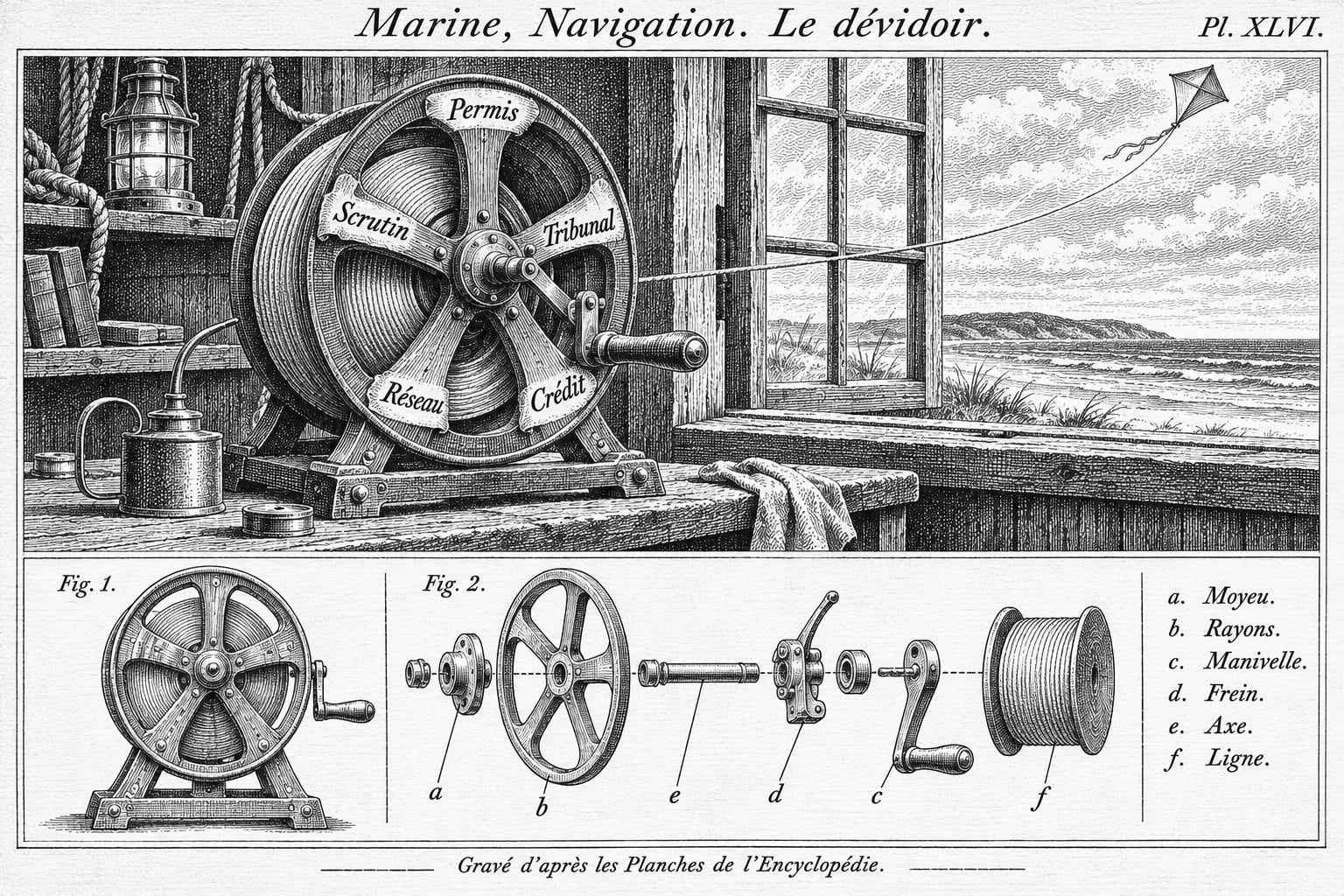
Three errors are now on display. Washington confused letting go with flying high. Beijing confuses grip with flight. And nearly everyone forgot the oil can. The craft avoids all three: enough line for the kite to climb, enough tension to bring it home when the weather turns, and equipment kept fit for both.
Pistor closed by calling for disloyalty from the many. That is where her diagnosis and this autumn part ways. Walking off the beach repairs nothing; it only leaves the reel to whoever stays. The many already have a hand on it. It is called a ballot, a permit, a court, a utility commission, a loan committee. The task is less dramatic than revolt and far more durable: stay, keep the gear in repair, and pull when it matters.
The instruments go first. This month, they still read true.
The question was never whether the kite could fly without the string. It is whether the people on the beach remember they are holding it.
Katharina Pistor, "The Tech Brotherhood Wants Sovereignty," Project Syndicate, November 3, 2026. Republished in full by The Korea Times, November 9, 2026: https://www.koreatimes.co.kr/opinion/20261109/the-tech-brotherhood-wants-sovereignty
Bonjourhi Institute, Montréal
Notes
1. CNN, "Massive tech sell-off wipes $2.5 trillion from the stock market," November 5, 2026.
2. CNBC, "Elon Musk suffers political setback in 2026 midterms," November 4, 2026.
3. CNBC, live coverage of the Jensen Huang resignation, November 12, 2026.
4. Dublin City University, "From Regulation to Control? The EU's Recent Push for Digital Infrastructural Sovereignty," 2026.
5. Tech Policy Press, "Can Europe Build Digital Sovereignty While Safeguarding Its Rights Legacy?"
6. Business Standard, July 6, 2026; Crypto Briefing, "China considers tightening controls on AI models amid security fears," 2026.
7. Result Sense, "Canada bids to lead middle powers on AI sovereignty," June 5, 2026.
8. German Marshall Fund, "Middle Powers' Bounded Ambition in AI," October 22, 2026.