

Bonjourhi!
Every diver knows that the most dangerous part of a dive is not the bottom. It is the way up.
The American ballots are counted, and Canada now begins its own ascent. Rise the wrong way, and the bill arrives in our factories, our power rates and our paycheques.
This edition comes in two tracks. The Coastal Surfer page gives you the essentials in a minute. The four short parts that follow, about six minutes each, are for the Pelagic Navigator who wants the full reading.
One date in it belongs on every Canadian calendar.
Read the page today, and the parts when the current takes you.
None of it is partisan. All of it is written from a Canadian and middle-power perspective.
Your thoughts are always welcome.
Pierre Somers
Chief Editor, Bonjourhi Institute, Montréal
The Slow Ascent, in one page
Coastal Surfers read the wave; Pelagic Navigators read the current. This page is for the first. The four parts that follow are for the second.
The way up is the danger. After the US midterms, Canada must rise in stages: no rush back to the old dependence at the first friendly signal, and no panic break in anger.
Rules have become deals. Duties of 50% now cover steel, aluminium and, since August, a wider range of goods. CUSMA is reviewed every year instead of renewed.
The dependence is easing, but remains substantial. The United States received approximately 68% of Canada’s merchandise exports in the first half of 2026, down from 76% in 2024. The shift is meaningful, although some of the diversification reflects increased gold and commodity exports rather than a broad restructuring of Canada’s industrial trade.
Quebec’s rivers are underpriced. Smelters pay about 3 cents a kilowatt-hour; new supply costs about 12. Moving a quarter of their power to the proposed data-centre rate could earn some $650 million a year: first, enough to carry the workers affected through the change; then, a real contribution toward Quebec’s target of a balanced budget by 2029-30.
The date to circle is July 1, 2036. CUSMA ends that day unless all three countries renew it, in the same window as Quebec’s largest remaining smelter contract and Ottawa’s export and defence deadlines.
The Institute’s reading: stressed, under a watch. Four forecasts are on the record, to be scored in public in November 2027.
The lesson from the shop floor. Give every partner the same terms, and open other doors. „Wer weiß, dass er nicht die einzige Tür ist, arbeitet härter, um die beste zu bleiben.“
The Slow Ascent
A series in four parts
I. The Bends
II. Quebec’s Energy Revolution
III. The Dive Table
IV. The Tenders
Bonjourhi Institute, Montréal
The Slow Ascent · Part I of IV
The Bends
A middle-power view of the road back
On November 3, Americans voted. In Ottawa, Brussels, Tokyo and Canberra, the results were read with an interest that had nothing to do with party.
For a middle power, the question was never who won. It is what kind of partner comes back, and how fast we should swim up to meet it.
The answer was worked out long ago, at the bottom of a river, by men building a bridge.
The bridge and the bends
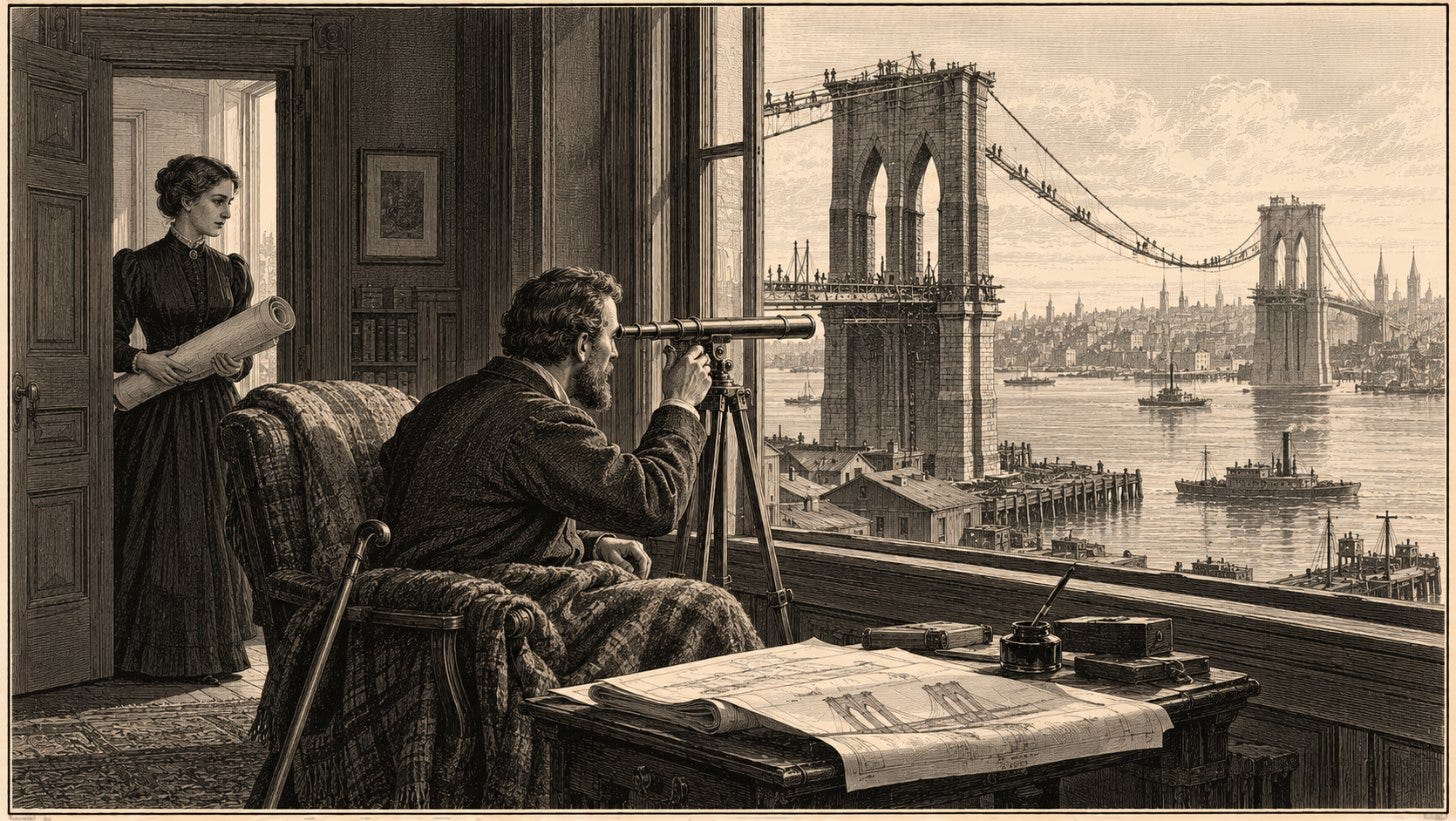
In 1872, Washington Roebling, chief engineer of the Brooklyn Bridge, came up too quickly from a pressurized caisson beneath the East River. Workers called the crippling pain that followed the bends, after the stooped walk it left them with.
Roebling never fully recovered. He finished the bridge from a window, through a telescope, while his wife, Emily, carried his instructions to the site.¹
The bridge was a triumph. The ascent had been a disaster.
The old bargain
For seventy years, a middle power’s arrangement with the United States was simple.
Security under the American umbrella.
Access to the largest market on earth.
Rules that bound the strong as well as the weak.
Disputes settled by panels, not phone calls.
Canada made the most of it. More than three quarters of our goods exports went south. It was the most profitable dependence in the world, and it never felt like dependence at all.
What changed
Rules became deals. Since 2025, tariffs of 50% have landed on Canadian steel and aluminium, exemptions have been granted case by case, and access has come to depend on the mood of a negotiation rather than the text of a treaty. At Davos in January, Prime Minister Mark Carney called it a rupture, not a transition.
For a middle power, the tariff is not the deepest wound. Uncertainty is. A rule can be planned around. A favour cannot.
The decompression stop
Picture a diver forty metres down, working on a wreck. The water presses on her with five times the weight of the air at the surface. With every breath, her body absorbs nitrogen, first into the blood, then the muscles, then the slow tissues: joints, bone, nerves.
She feels nothing. The gas simply accumulates.
The danger comes on the way up. If she rises fast, the pressure falls faster than her body can release what it took in, and the nitrogen fizzes into bubbles, like a shaken bottle opened too quickly. That is the bends, the same affliction that broke Roebling.
In 1908, after years of experiments with goats in pressure chambers, the physiologist John Scott Haldane gave the Royal Navy the cure.² Rise in stages. Stop at nine metres, then six, then three, and wait at each while the gas leaves. The deeper and longer the dive, the longer the stops.
She never ascends alone. Every diver has a buddy, and each watches the other’s gauges all the way up.
No one applauds a decompression stop. Hanging in blue water, staring at a rope, is the least heroic thing a diver does. It is also why she climbs the ladder unaided.
Canada in the water
The depth is our dependence: one dominant customer, one ally underwriting our defence. The time at depth is seventy years.
The nitrogen is what we absorbed without pain. Supply chains built for a single border. Pipelines and rail lines that run north and south. Provinces that trade more easily with American states than with each other. Defence budgets that assumed someone else would pay. None of it hurt. All of it is in the tissue.
The bends can strike in two ways. One is the rush back: treating a friendly election night or a warm phone call as the surface, and returning to full dependence before the gas has left. The other is the panic ascent: rupture, retaliation and grand gestures that cost more than they win.
The stops are patient, practical and dull:
New customers abroad.
Internal trade without provincial walls.
Infrastructure to tidewater.
Defence Canada controls.
Value added at home.
Several are already under way. Ottawa aims to double non-US exports by 2035.³ Brussels has floated making Canada the European Union’s first associate member, and Canadian aluminium is already finding new buyers across the Atlantic.⁴
The schedule is not ours alone to set. Some of its dates are fixed by others, and the ones that matter most fall in 2035 and 2036.
The buddy system
Divers pair up for a reason. Canada, the European Union, the United Kingdom, Japan, South Korea and Australia share one interest above all others: rules that hold whoever governs in Washington. None can write those rules alone. Together, their economies are larger than America’s.⁵
Carney put the choice bluntly at Davos: “if you are not at the table, you are on the menu.”⁶
Those who wait to be invited back will eat whatever is served. Those who set their own table will negotiate from it.
A lesson from the shop floor
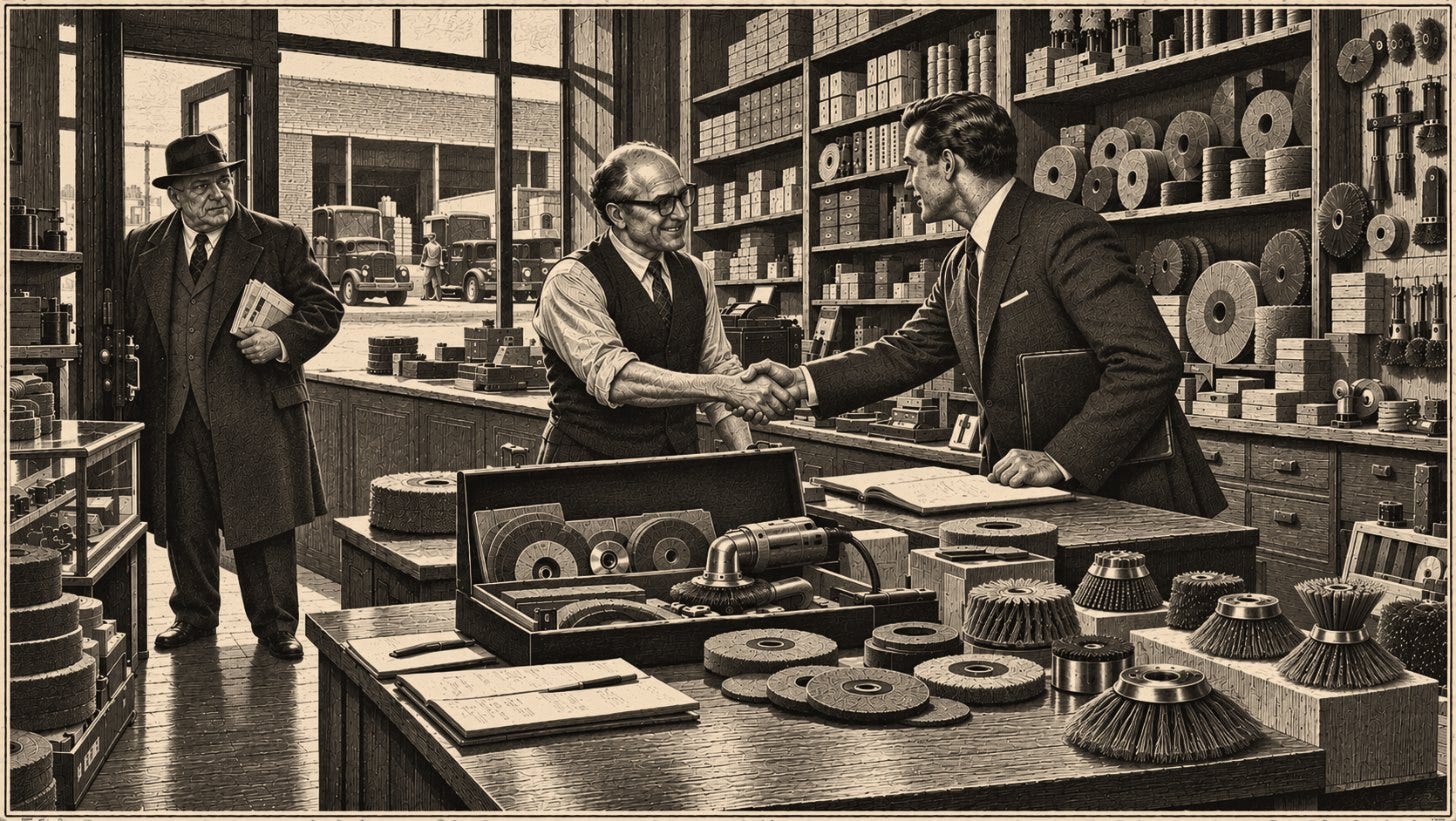
My father, who founded Walter Surface Technologies, had a rule for a distributor who had grown too comfortable and would no longer be proactive in launching our new lines. He did not threaten him or squeeze his margin. He was fair. Every dealer got the same terms and the same price, but he would open business with anyone willing to support our efforts, even a direct competitor.
The comfortable incumbent would not want to be left out and soon put our products first again. As my father would say: „Wer weiß, dass er nicht die einzige Tür ist, arbeitet härter, um die beste zu bleiben.“ The one who knows he is not the only door works harder to remain the best one.
The same rule serves a middle power. Offer every country the same terms, written down and predictable, the opposite of a world run on favours. Then open business with the competition, in Europe, in Asia and across the Americas. That is not hostility toward Washington. It is how a valued partner is reminded of what it gains by remaining one.
A fair word for the other side
The American case deserves a hearing. Many Americans, in both parties, believe open trade hollowed out their industrial towns, and protection for steel, autos and chips now has supporters on both sides of the aisle. Allies, Canada among them, spent decades underspending on defence. And diversification has limits: Europe is an ocean away, and no market will replace the one next door.
The United States will remain Canada’s largest customer for as long as anyone reading this is alive. That argues for a careful ascent, not for staying on the bottom.
The closing turn
Bridges outlast the people who rush them. The Brooklyn Bridge still carries traffic more than 140 years on. The man who built it never walked easily again.
Canada does not need to burn its bridge to the south. Whatever November 3 decided, we will be crossing it for generations.
The only question is whether we arrive on our own legs.
Bonjourhi Institute, Montréal
The Slow Ascent · Part II of IV
Quebec's Energy Revolution: A Smarter Future Beyond Aluminium
Originally published in 2025, and updated with new figures, recent reporting from The Wall Street Journal and recommendations.
Washington’s 50% tariff on Canadian aluminium was meant to protect American industry. Its first effect has been to raise costs along every supply chain that uses the metal, with smaller manufacturers hit hardest.¹
For Quebec, the duty makes a major export less competitive in its largest market. For American buyers, it means higher prices on everything from cars to beverage cans, and the cost falls hardest on the households with the least room to absorb it.
The Wall Street Journal reported from the Saguenay in late October that Canada supplies about 70% of American aluminium imports, and that the tariff has pushed US prices to a record premium over world benchmarks. Jérôme Pécresse, who runs Rio Tinto's aluminium business, explained why the metal keeps coming from Quebec: his people have always called it "solid electricity."²
For Canada, though, the tariff may open a door. Instead of fighting to sustain a low-margin, tariff-exposed industry, Quebec can rethink its energy allocation, sell its hydroelectric power at fair market rates, and steer it toward buyers and industries that pay more and create higher-value jobs.
If American buyers would rather pay more by making it themselves or by buying it elsewhere, that is their choice, and there is little Quebec can do to change it. What Quebec controls is its own response. European buyers are already taking the metal: Canadian shipments to Europe rose 77% through August.² And at home, every kilowatt-hour sold to a smelter at about 3 cents must now be replaced with new supply costing about 12.³ The sensible answer is not to plead at a closed door, but to sell what we have to those who want it, at what it is worth.
Seen this way, the tariff forces a question Quebec should have asked long ago: how best to spend clean power that has become scarce and costly to replace. Ottawa and Quebec City should not let the moment go to waste.
* * *
For more than a century, Quebec has thrived as a global powerhouse in aluminium production, leveraging its abundant hydroelectricity to power smelters that supply North America. But as demand for clean power soars, led by artificial intelligence and data centres, a growing number of economists and investors believe Quebec's energy is being vastly undervalued, and that a smarter strategy could yield greater economic, social and environmental benefits.
At the heart of this conversation is a simple question: who should get each kilowatt-hour, and at what price?
Bauxite, the ore aluminium is made from, is not mined anywhere in Canada. It arrives by sea from Guinea, the world’s largest producer,⁴ and from Australia, Brazil and Jamaica. Rio Tinto’s Vaudreuil plant in Saguenay refines it into alumina, and smelters then turn the alumina into metal with an electric current.
Without a single mine, Quebec still ranks among the world's leading producers, thanks to its know-how and its power. Yet most of its output is exported as unwrought aluminium (low-value ingots and billets) rather than transformed into higher-margin products like EV components or aerospace parts.
The Energy Gap: Why Aluminium No Longer Makes Sense
For decades, Quebec has provided aluminium producers with some of the cheapest electricity rates in the world, about 3 cents per kWh under long-term contracts often indexed to the price of aluminium.⁵ Meanwhile, demand for clean electricity from data centres, AI computing and neighbouring markets is soaring, with buyers willing to pay three to five times more for the same energy.⁶
Not a New Argument
None of this is new. In 1991, two Université Laval economists, Gérard Bélanger and Jean-Thomas Bernard, calculated that Quebec gave up about 3.2 cents on every kilowatt-hour it sold to smelters rather than exporting it: some $300 million a year for 24 years, or about $190,000 a year for each job the plants created.⁷ In 2007 they returned to the question after the Alcan agreement and found a steeper bill, about $336,000 a year per job, for thirty years.⁸
Marcel Boyer, writing for the C.D. Howe Institute in 2005, put it in plainer terms. The true cost of Quebec’s electricity, he argued, is not what it costs to produce but what it could earn elsewhere.⁹
The economists were right, and the contracts were renewed anyway, some of them into the 2040s.¹⁰ What has changed is the arithmetic. They compared smelters with exports. Today the metal faces a 50% tariff at the border, replacing the power it consumes costs four times what smelters pay, and data centres are waiting in line. The case was strong in 1991. It is stronger now.
Where Private Capital Fits
The 2025 version of this letter proposed buying smelters for their power contracts and reselling the electricity. That door has closed. Since 2025, any new allocation of 5 megawatts or more needs ministerial approval, contracts cannot simply be resold, and in the Saguenay, Rio Tinto generates more than 90% of its own power from private water rights.¹¹
The gap between old contracts and new prices belongs to the province, which owns the rivers. Private capital belongs where Quebec is short of it:
New generation. Hydro-Québec plans some 11,000 MW of new clean energy by 2035, much of it wind.³
Value-added manufacturing. Plants that turn Quebec ingots into finished parts.
Computing infrastructure. Data centres able to pay market rates for power.
Quebec has already seen the bet run the other way. Northvolt’s battery plant on the South Shore collapsed with its Swedish parent, and the province wrote off its $270 million investment.¹² The lesson is to back buyers who pay full price for power, not projects that need subsidies to use it.
The Climate Case
Quebec’s smelters are already among the cleanest in the world, emitting about 2 tonnes of CO2 per tonne of aluminium against a global average of 12 to 16, most of it from coal-fired power.¹³ Where smelting continues, that advantage is worth keeping, and European carbon pricing will reward it more each year.
The larger climate gain lies elsewhere. Power sent to neighbouring grids, such as the new line into New York, displaces gas-fired generation there, and industries built on hydropower start clean. Used well, the same rivers can lower emissions on both sides of the border.
A Defining Moment for Quebec's Economy
The numbers make a compelling case. Quebec can continue subsidizing a fading aluminium industry dependent on foreign raw materials and volatile global prices, or it can let its rivers earn what they are worth.
For Quebec, the choice is not aluminium or AI. It is whether to lead the new green economy or keep supplying it at a discount.
Recommendations
Five steps would turn this moment into a plan.
Retire or replace the most polluting lines first. The oldest potlines emit the most. Rio Tinto’s replacement of century-old pots at Arvida with its new AP60 lines will cut about 290,000 tonnes of CO2 a year, using its own private power. Where smelters draw on Hydro-Québec, retiring old lines also frees public power at the lowest cost to the economy.¹⁴
Phase down unwrought exports made with underpriced power. Canada exports about $11.3 billion of primary aluminium a year, about 90% of it from Quebec and 94% of it to the United States. Each tonne absorbs 13,000 to 15,000 kWh; at a gap of roughly 9 cents between the smelter rate and the cost of new supply, that is roughly $1,200 to $1,350 of forgone value per tonne. As contracts come up for renewal, from 2030 for Alcoa’s plants, price electricity at what it could earn elsewhere.¹⁵
Reallocate the kilowatt-hours. Smelters bought about 26 TWh from Hydro-Québec in 2023, nearly 15% of its total demand. Each terawatt-hour moved from a 3-cent contract to the proposed 13-cent data-centre rate, if approved, earns about $100 million more a year. Moving a quarter of the smelters’ volume, 6.5 terawatt-hours, would therefore earn about $650 million more a year.¹⁶
Add value to the metal that stays. Quebec’s smelters employ about 7,700 people; the firms that turn aluminium into products employ about 30,000. Quebec’s own 2015 strategy set out to double transformation within ten years. Favour plants that make finished parts for vehicles, aircraft and construction, so Quebec exports products rather than raw power.¹⁷
Put the windfall to work. Such a shift would affect roughly a quarter of the smelters’ 7,700 jobs, about 1,900 people. That $650 million a year equals about $340,000 for each of them, enough to fund early retirement, retraining and support for their regions within a few years, with the remainder going toward Quebec’s target of a balanced budget by 2029-30.
The rivers were always the asset. Aluminium was only one way to sell them.
Bonjourhi Institute, Montréal
The Slow Ascent · Part III of IV
The Dive Table
Canada’s ascent, measured: the stops, the dates and the odds
The tables
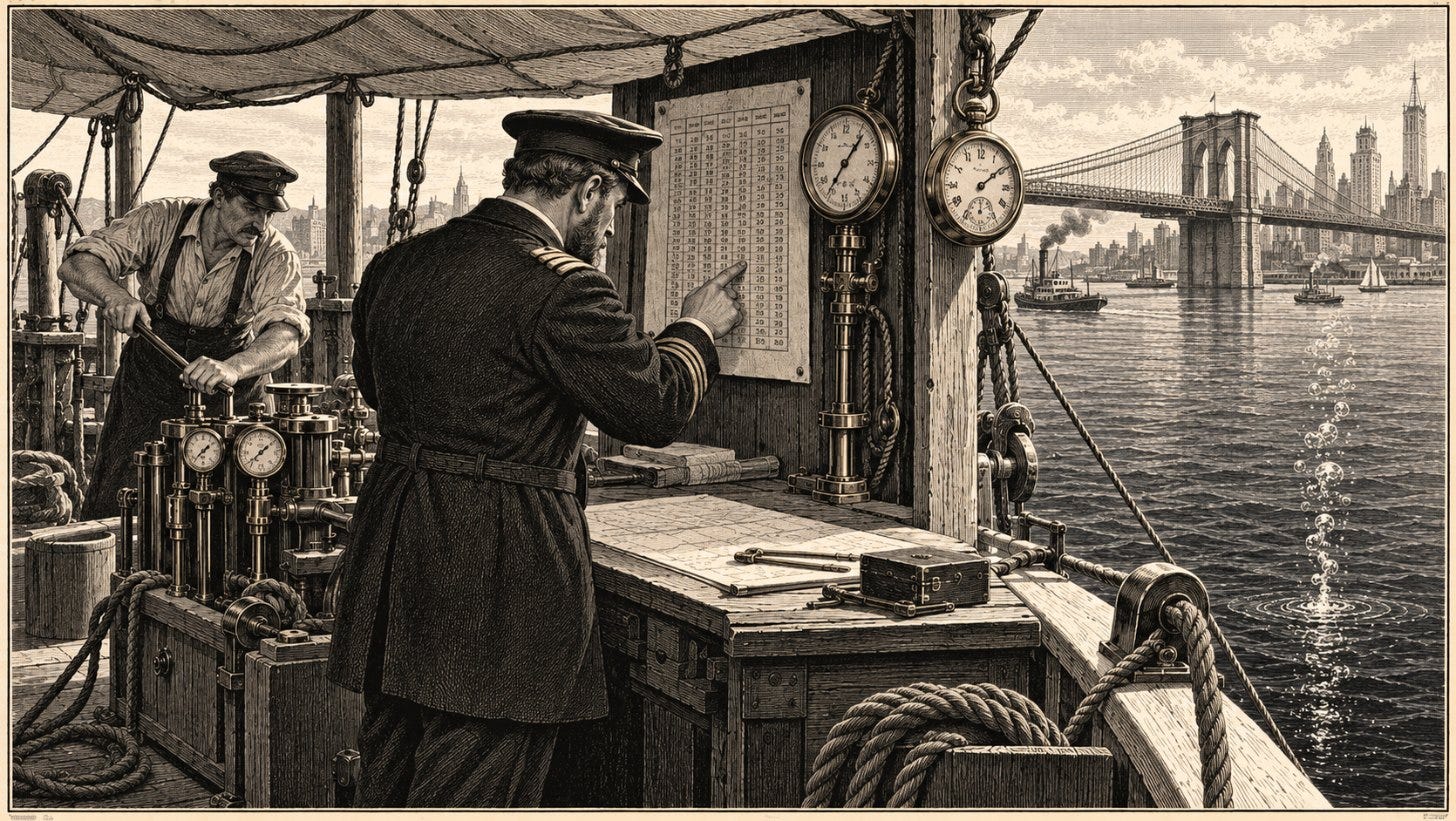
Haldane’s gift to the Royal Navy in 1908 was not a theory. It was a table, telling each diver how long to wait at every stop, depending on how deep she had gone and how long she had stayed. Divers survived because someone wrote the schedule down and they kept it.
The first rule of this Institute is that the instruments go first. A system cannot rebuild honestly what it can no longer read. Arguments are not enough; an ascent also needs readings. What follows reads the gauges, lays out the dates we do not control, and puts numbers on the odds.
Reading the gauges
The Institute reads a country the way a forecaster reads a storm, with six gauges. In September 2026, Canada read as stressed, with a watch for critical. This is the reading at the end of October, taken before the American vote.
Heat content: high, unchanged. How deep the dependence runs. About two thirds of our goods exports still go to one customer, and the ties run through supply chains, pipelines and defence. The share is falling, but depth drains slowly.
Pressure gradient: steep, unchanged. The asymmetry of force. A 50% duty on steel and aluminium, and a trade agreement Washington has declined to extend.
Wind shear: moderate, easing. Whether the layers of government pull together. Ottawa has removed all its internal trade exceptions; the provinces lag, with 202 of 296 still standing.
Dry air: entering, stable. The draining of trust and support. Confidence in the old partnership keeps leaking away, and nothing has yet fully replaced it.
Proximity and steering: high, permanent. The pull of a larger system nearby. The United States is more than thirteen times Canada’s economic size, and no policy changes geography.
Intensification rate: elevated, steady. The pace of change. Trade talks broke down in August 2026, and new 50% duties on a further range of Canadian goods took effect on August 22. Change has not slowed; it has simply become routine.
The state remains stressed, and the watch for critical stays in place. In the Institute’s language, a watch means conditions favour a transition; a warning means one is likely soon. Nothing in October justifies a warning. Nothing justifies lifting the watch either.
Rather than a single forecast, the Institute draws a cone of three paths from here:
The thaw. A warm signal from Washington after the vote. The danger is surfacing too fast; the signal to watch is a tariff cut offered in exchange for exclusivity.
The long stalemate. Annual CUSMA reviews without extension, and duties that neither rise nor fall. The likeliest path, and the one that rewards patient stops.
Further escalation. More duties, or a notice of withdrawal from CUSMA. On that path, the watch becomes a warning.
The stops
Each of the stops can be read like a depth gauge. Here is where the needle sits today.
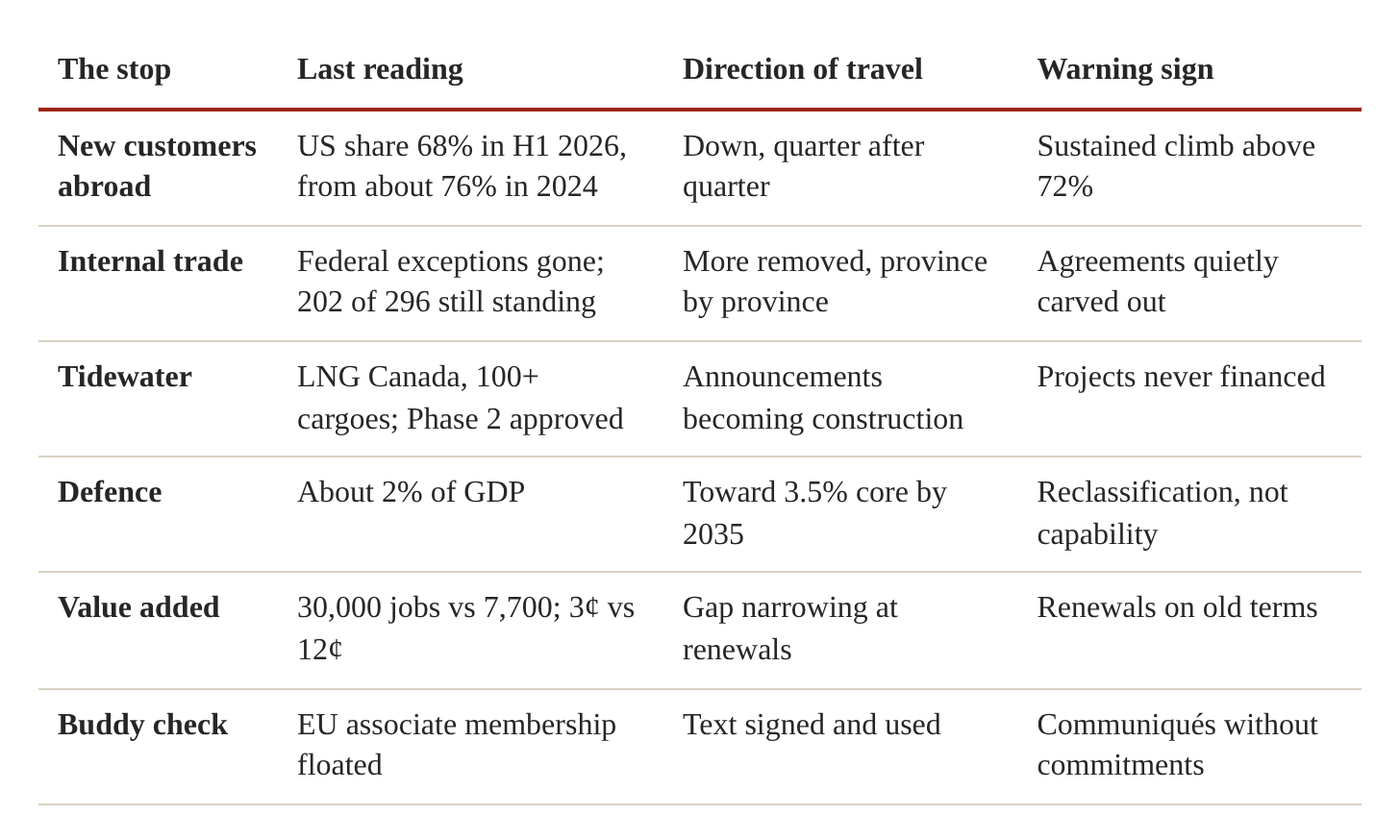
New customers abroad. In the first half of 2026, 68% of Canada’s goods exports went to the United States, down from about 76% in 2024. The share swings month to month: a record low of 66.1% in July, then 69.8% in August, as exporters rushed goods south ahead of the new duties.¹ The direction to watch is steady decline across quarters, not months. The warning sign is a sustained climb back above 72% after a friendly signal from Washington.
Internal trade. Ottawa has removed all 53 of its exceptions to the Canadian Free Trade Agreement, and the federal law lifting its own barriers took effect in January 2026. The provinces are the slower half: 202 of the 296 exceptions that stood in January 2025 are still in place.² Progress here is measured province by province.
Infrastructure to tidewater. LNG Canada has shipped more than 100 cargoes to Asia since June 30, 2025, and in September 2026 its partners approved a second phase that doubles capacity to 28 million tonnes a year.³ A new $5 billion fund targets ports, rail and terminals. The test is whether announcements become construction.
Defence Canada controls. Canada now spends about 2% of its GDP on defence, for the first time since the Cold War, with 3.5% for core defence promised by 2035.⁴ Critics note that part of the gain came from moving the Coast Guard into the defence budget. The warning sign is targets met by reclassification rather than capability.
Value added at home. Quebec’s smelters employ about 7,700 people; the firms that turn aluminium into products employ about 30,000. Smelter power still costs about 3 cents a kilowatt-hour against about 12 for new supply.⁵ Each contract renewal is a chance to narrow that gap, or to lock it in.
The buddy check. The associate membership Brussels floated is still talk, not text.⁶ A buddy system works only once the line is tied.
The dates
A diver chooses her stops. A country does not always choose its own. Some of Canada’s dates are set by elections, some by treaties, and some by power contracts signed long ago.
The first cluster is political. CUSMA now faces a joint review every year, the next on July 1, 2027, because Washington declined to extend it in July 2026.⁷ Americans choose a president on November 7, 2028; Canadians vote on October 15, 2029. Three tests in three years, each a temptation to surface early.
The second cluster is structural, and it is the one that matters. In 2030, Alcoa’s power contracts at Bécancour and Deschambault end. By 2035, Ottawa has promised to double non-US exports, NATO expects 3.5% for core defence, and Hydro-Québec must deliver some 11,000 megawatts of new supply.⁸ Then comes 2036. Alcoa’s Baie-Comeau contract expires, and on July 1 CUSMA itself terminates unless all three countries confirm an extension.
The trade rules of North America and Quebec’s largest remaining smelter contract could end within months of each other, in the same window as Canada’s export and defence deadlines. If one date belongs on every Canadian calendar, it is July 1, 2036. The first cluster tests our patience. The second tests whether the stops were kept.
The odds
Commentary is cheap when it cannot be wrong. The Institute records its forecasts as probabilities, with a date and a source, and scores them when they resolve. These four were set on October 31, 2026, before Americans voted:
1. Exports. The US share of Canada’s goods exports averages below 70% for calendar 2027. Institute’s probability: 60%. Resolves February 2028, against Statistics Canada.
2. CUSMA. All three parties confirm a 16-year extension at or before the July 2027 review. Institute’s probability: 20%. Resolves July 1, 2027.
3. Aluminium. The US tariff on Canadian aluminium stands at 25% or lower on November 1, 2027. Institute’s probability: 35%.
4. Quebec power. The Régie de l’énergie approves a data-centre rate of at least 12 cents a kilowatt-hour by December 31, 2027. Institute’s probability: 65%.
Each forecast will be scored by the Brier method: the square of the gap between the probability given and what happened. A perfect forecaster scores 0; a coin toss scores 0.25. The results will be published in November 2027, good or bad.
The closing turn
Haldane’s tables did not make diving safe by being clever. They made it safe by being kept, stop after stop, by divers who wanted to be on the surface already.
The Dive Table will return each quarter with fresh readings. Some needles will move the right way, some will not. The point is not to be right about every one. It is to know, at every depth, how far we still have to rise.
At a glance
Bonjourhi Institute, Montréal
The Slow Ascent · Part IV of IV
The Tenders
What the ascent looks like to the people holding the lines
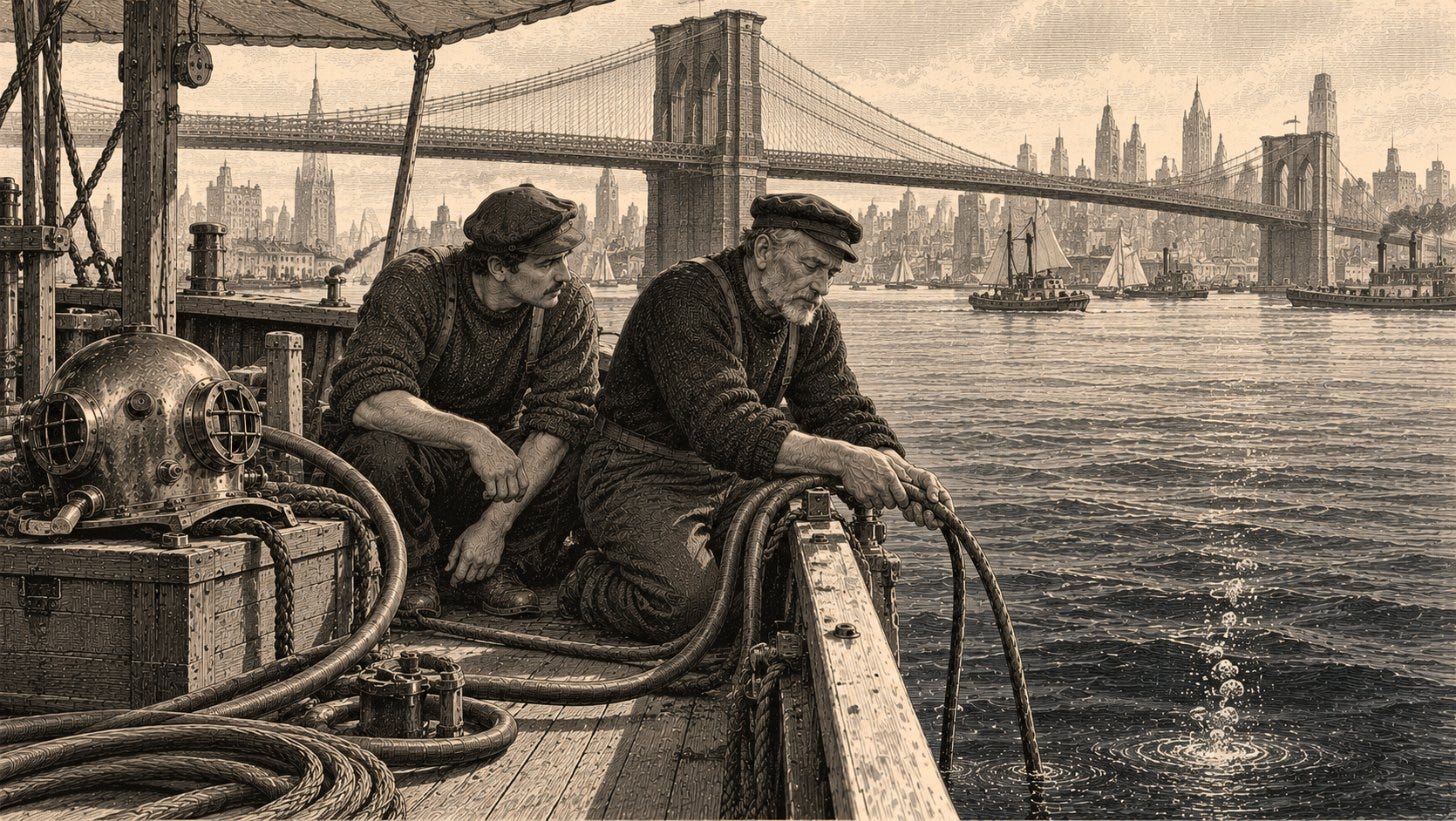
Every helmet diver has a tender. He stands on the deck above, paying out the air hose and the lifeline, and he never sees the dive. He feels it. A single pull means all is well. Several sharp ones mean trouble. Old tenders say they can tell a diver’s mood from the way the rope moves in their hands.
Countries have tenders too. They never sit at the negotiating table, yet they feel every decision through the line: a shift added or cut, an order that arrives late, a paycheque that stretches less far than it used to.
Here are three of them.
They are composites. Their names are invented; their circumstances are drawn from the industries and towns this series describes.
Alma: the potroom
Réjean leaves the house at a quarter to six, before his wife is up, and drives along the lake with the radio off. Twenty-nine years in the potrooms at Alma have taught him to value the quiet before the noise.
Inside, the heat rolls off the pots in waves, and men work in heavy coats in July. His father did the same work at Arvida and came home every night smelling of it. His uncle spent two winters on the Manicouagan in the 1960s, pouring concrete for the dams, and never said much about it except that it was cold.
Réjean has heard the arguments about cheap power and costly new supply. He doesn’t dispute them. “I can count,” he says. “What I want to know is who will be in the room when they decide, and whether anyone there has ever worked a pot.”
He is fifty-four, with a daughter in nursing school in Chicoutimi and a son who wants to stay in the region. “Tell me it ends in five years, and I’ll be ready,” he says. “Tell me nothing, and I’ll spend five years waiting for the phone to ring.”
Stoney Creek: the shop
Karen keeps her father’s coffee mug on the shelf above the bending press. He opened the shop in Stoney Creek in 1983, in the shadow of Hamilton’s steel mills, with two lathes and a loan he worried about for a decade. Today twenty-two people work there, most of them for more than ten years.
Half her customers are across the border, American assembly lines buying brackets, shafts and fittings. The other half are in Ontario, and most of those are parts makers who send what she machines into the United States inside their own products. When the 50% tariff landed on steel, it reached her twice: directly, and through the Canadian plants she supplies. Nobody left at once. They went quiet. Orders came smaller, then later. One buyer she had known for twenty years stopped returning her calls. “That one hurt,” she says. “We sent flowers when his wife was sick.”
So she opened another door. The first order from Germany took eleven months: certifications, metric drawings, prices in euros, and a buyer who flew over twice and asked about everything, including the coffee. The second order took three months. The third came by referral.
Europe will not replace Ohio. It is far away, and the margins are thinner. Most of her work still ends up in American hands, directly or by way of her Ontario customers; it is simply no longer the only place it can go. The night the third order came in, she slept until morning for the first time that year.
Kitimat: the dock
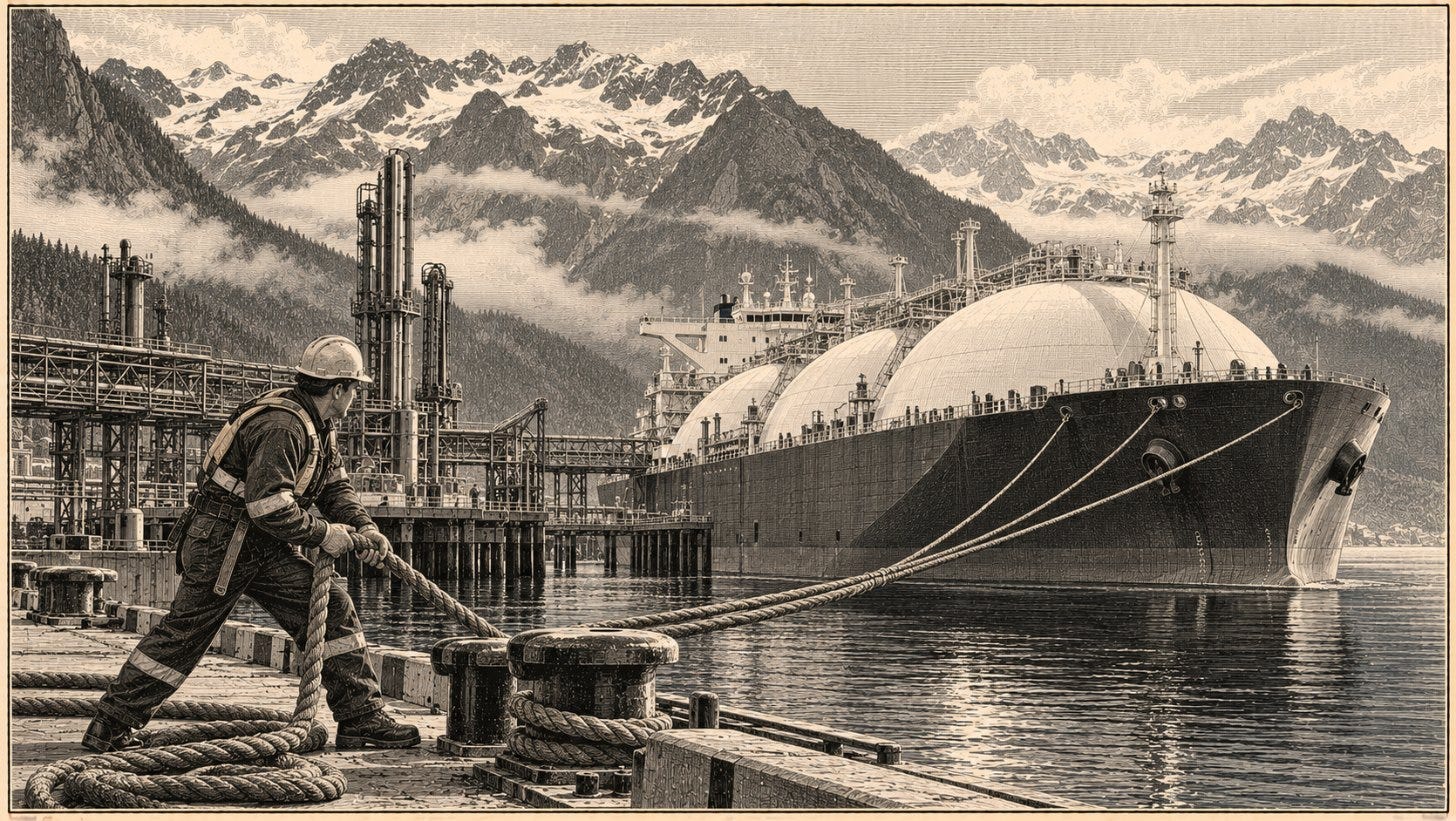
Jordan’s grandfather came to Kitimat in the 1950s with one suitcase and the promise of a job. Alcan had carved a town out of the coastal rainforest and bored a tunnel through a mountain to feed its new smelter. He stayed forty years. The family photographs are full of aluminium: ingots, trucks, a softball team in company shirts.
Jordan left at nineteen for the oil sands, like half his graduating class. He came home at twenty-nine, when LNG Canada began loading ships. Now he helps moor the carriers, standing on the dock in the rain as lines thick as his arm come snaking down from a deck as high as an apartment block.
Each ship is about ten days from Asia. More than a hundred have sailed since the first, in June 2025, and a second phase approved this fall will double the traffic.¹
“My grandfather’s metal went south,” he says. “Ours goes west.” For decades, more than four fifths of the smelter’s aluminium crossed into the United States; now even Rio Tinto says it may send more of it to Asia and Europe.² Jordan doesn’t call any of this diversification. He calls it coming home to work that doesn’t depend on one customer’s mood.
What the tenders know
None of the three wants to rush. Réjean fears a sudden decision more than a slow one. Karen learned that a new customer takes a year to win and a day to lose. Jordan knows a terminal is built over a decade, not an election cycle.
They also know who pays when an ascent goes wrong. It is seldom the people giving the orders.
A tender can hold a line for hours if he knows what the diver is doing. Leave him guessing, and he pulls too hard or lets go. That is why any windfall from repriced power must reach the potroom first, and why the schedule must be one anyone can read.
The first tenders
Quebec’s rivers had tenders long before its smelters did.
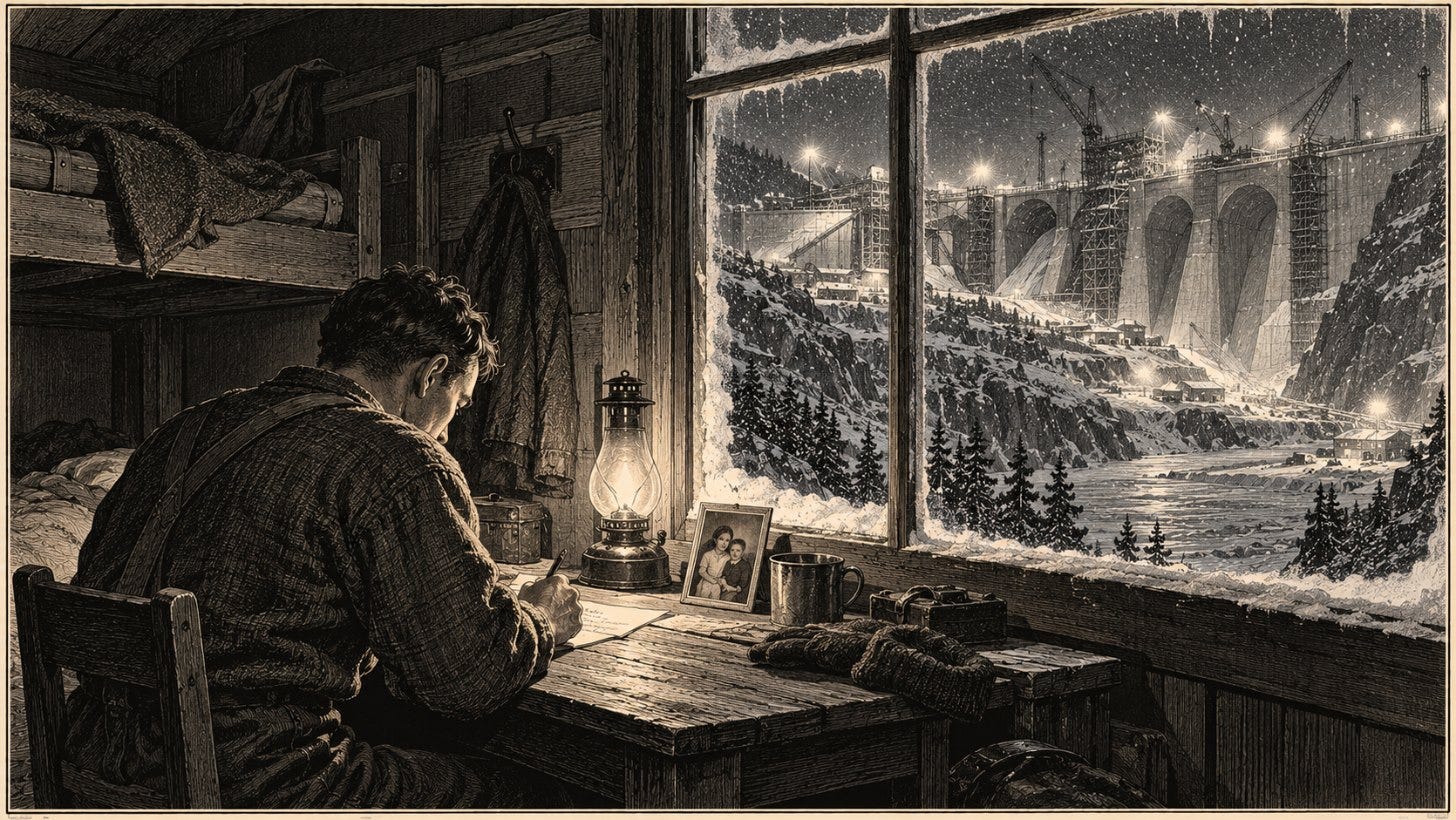
In the 1960s, men spent winters far from home building the great dams of the Manicouagan. Georges Dor’s song La Manic, a worker’s letter to the woman he left behind, still carries their loneliness. Réjean’s uncle knew it by heart and sang it, badly, at every family gathering.
♫ La Manic, performed by Bruno Pelletier (YouTube)
Every ascent is decided by the few who chart it and felt by the many who hold the lines. A country that remembers its tenders rises more slowly, and arrives whole.
Bonjourhi Institute, Montréal
Notes
I. The Bends
1. Rensselaer Polytechnic Institute Archives, Washington A. Roebling papers, biographical note; History.com, “Brooklyn Bridge.” https://guides.archives.rpi.edu/agents/people/146
2. A. E. Boycott, G. C. C. Damant and J. S. Haldane, “The Prevention of Compressed-Air Illness,” Journal of Hygiene, vol. 8, 1908.
3. Prime Minister Mark Carney, address at the University of Ottawa, October 22, 2025, setting the goal of doubling Canada’s non-US exports within a decade.
4. Ryan Dezember, “America Needs Canada’s Aluminum. Trump’s Tariff Exposed Just How Badly,” The Wall Street Journal, October 26, 2026, citing S&P Global Energy data. https://www.wsj.com/business/aluminum-tariff-canada-trump-f2555b38
5. IMF World Economic Outlook, October 2026, nominal GDP projections for 2026: United States about $32.6 trillion; Japan $4.3 trillion, United Kingdom $4.3 trillion and Canada about $2.4 trillion; the European Union, South Korea and Australia together roughly $25 trillion. The combined total is approximate and depends on exchange rates.
6. Mark Carney, address to the World Economic Forum, Davos, January 2026, as reported by the Financial Post.
II. Quebec’s Energy Revolution
1. The United States raised its Section 232 tariff on aluminium to 50% on June 4, 2025, after ending all country exemptions on March 12, 2025. Century Aluminum, Form 10-Q for the quarter ended June 30, 2026, filed with the US Securities and Exchange Commission.
2. Ryan Dezember, “America Needs Canada’s Aluminum. Trump’s Tariff Exposed Just How Badly,” The Wall Street Journal, October 26, 2026. https://www.wsj.com/business/aluminum-tariff-canada-trump-f2555b38
3. Hydro-Québec estimates new supply at roughly 12 cents per kWh. Its Action Plan 2035 calls for about $200 billion in investment and 11,000 MW of new clean energy over the decade, mobilizing about 35,000 workers a year; Desjardins puts the cost of new capacity at about $19,375 per kW, against $3,140 for the James Bay project, in 2023 dollars. Hydro-Québec, Annual Report 2025; Desjardins Economic Studies, May 27, 2026.
4. Guinea produced an estimated 150 million tonnes of bauxite in 2025, against 97 million for Australia. US Geological Survey, Mineral Commodity Summaries 2026: Bauxite and Alumina.
5. Most Quebec smelters buy power under long-term risk-sharing contracts whose rate rises and falls with the aluminium price; Rio Tinto generates much of its own. Alcoa’s 2014 renewal, for example, set its rate at about 3.3 cents per kWh. Because these rates rise with metal prices, today’s record aluminium prices likely put effective rates above 3 cents, so the gaps calculated in this piece are upper-end estimates. CBC News, 2014; Aluminerie Alouette and AMAG disclosures, 2025.
6. Hydro-Québec has proposed a dedicated rate of about 13 cents per kWh for large data centres, and obtained an average of 16.2 cents per kWh on export markets in early 2025, roughly four to five times the smelter rate in note 5. Hydro-Québec filings and quarterly results, 2025 to 2026.
7. Gérard Bélanger and Jean-Thomas Bernard, “Aluminium ou exportation : de l’usage de l’électricité québécoise,” Canadian Public Policy / Analyse de politiques, vol. 17, no. 2, 1991.
8. Gérard Bélanger and Jean-Thomas Bernard, “Aluminium, des subventions annuelles de 336 000 $ par emploi pour 30 ans,” January 2007, and “Les subventions aux alumineries : des bénéfices qui ne sont pas à la hauteur,” Montreal Economic Institute, April 2007.
9. Marcel Boyer, “Raise Electricity Prices in Quebec, and Benefit Everyone,” C.D. Howe Institute e-brief no. 13, March 2005.
10. Alcoa’s preferential contracts were extended in 2014 to 2030 for Bécancour and Deschambault and to 2036 for Baie-Comeau; Aluminerie Alouette extended its supply agreement with Hydro-Québec through 2045 in 2025.
11. Quebec’s Bill 69, adopted in 2025, requires the economy minister’s authorization for any new electricity allocation of 5 MW or more. BLG, “Data Centre Regulation in Quebec,” July 2026. On Rio Tinto’s self-generation, see note 2.
12. Quebec ended its funding for Northvolt’s Saint-Basile-le-Grand project in 2025 after the parent company’s bankruptcy, writing off about $270 million. CBC News, September 2025.
13. Estimates vary by method and scope. Quebec figure: Aluminium Association of Canada, testimony to the House of Commons Standing Committee on International Trade. Global average: industry estimates based on International Aluminium Institute data. The data-centre figure is indicative only.
14. Rio Tinto began commissioning its US$1.5 billion AP60 expansion at Arvida in June 2026 and expects it to cut about 290,000 tonnes of CO2 a year as older potlines close. Rio Tinto announcement, June 2026.
15. Aluminium Association of Canada, Portrait de l’industrie canadienne de l’aluminium, October 2025. Energy per tonne: industry ranges. The 9-cent gap is the difference between the cost of new supply (note 3) and the smelter rate (note 5); the per-tonne figure is illustrative.
16. Aluminium Association of Canada, brief on Bill 69, 2024: the industry used 26 TWh from Hydro-Québec in 2023, plus about 17 TWh of its own generation. The 13-cent figure is Hydro-Québec’s proposed data-centre rate (note 6). Calculations are illustrative.
17. Aluminium Association of Canada, Portrait, October 2025; Gouvernement du Québec, Stratégie québécoise de développement de l’aluminium 2015-2025.
III. The Dive Table
1. Statistics Canada, Canadian international merchandise trade, August 2026 (October 6, 2026); Global Affairs Canada, Monthly trade report, August 2026; first-half 2026 share from Statistics Canada data compiled by Visual Capitalist.
2. Government of Canada, Intergovernmental Affairs, internal trade updates; One Canadian Economy Act, S.C. 2025, c. 2, royal assent June 26, 2025.
3. LNG Canada; gCaptain, September 29, 2026; Government of Canada, Trade Diversification Corridor Fund.
4. NATO defence expenditure report, March 26, 2026; NATO Hague Summit Declaration, June 2025.
5. Aluminium Association of Canada, Portrait, October 2025; Hydro-Québec; see Quebec’s Energy Revolution, notes 5 and 8.
6. Ryan Dezember, The Wall Street Journal, October 26, 2026.
7. Office of the US Trade Representative, Federal Register notice on the 2027 USMCA joint review, October 2026; White & Case, July 2026.
8. Alcoa and Hydro-Québec contract extensions, 2014; Prime Minister Mark Carney, October 22, 2025; Hydro-Québec, Action Plan 2035.
IV. The Tenders
1. LNG Canada; gCaptain, “LNG Canada Greenlights Phase 2, Doubling Export Capacity,” September 29, 2026.
2. Business Examiner, “Amended U.S. metals tariffs keep 50% duty on Canadian steel and aluminum, exposing B.C.’s Kitimat smelter,” July 2026; Rio Tinto, first-quarter 2026 operations review.