

Bonjourhi!
France is quarrelling over its budget again. The Assembly debates, the street answers, and the bond market keeps its own minutes.
Most commentary asks who will win. Which coalition, which tax, which freeze, which candidate in April.
Something has shifted beneath that noise. The bill itself is no longer open for discussion. Only the route by which it will be collected.
There is an old German town that learned this in the year 1284. The story involves rats, a musician, and a contract nobody wanted to honour.
Pierre Somers
Chief Editor, Bonjourhi Institute, Montréal
Public debt stands at €3,596 billion, 119% of output. The ten-year rate nears 5%, the spread over Germany touched 1.76 points in October, and the state's interest charge rises by more than €10 billion next year.
Three routes remain. Chosen: restraint defended before voters. Imposed: conditions written in Brussels and Frankfurt. Silent: savers repaid below inflation.
France has met this fork before. It refused the chosen route in 1787 and paid by revolution, then took the silent one in 1926.
Retirees pay through their savings, the young through rent and inherited debt, and the mobile leave, as the Huguenots did.
The April election will choose the collector, not the fee.
The Piper's Fee
November 2, 2026
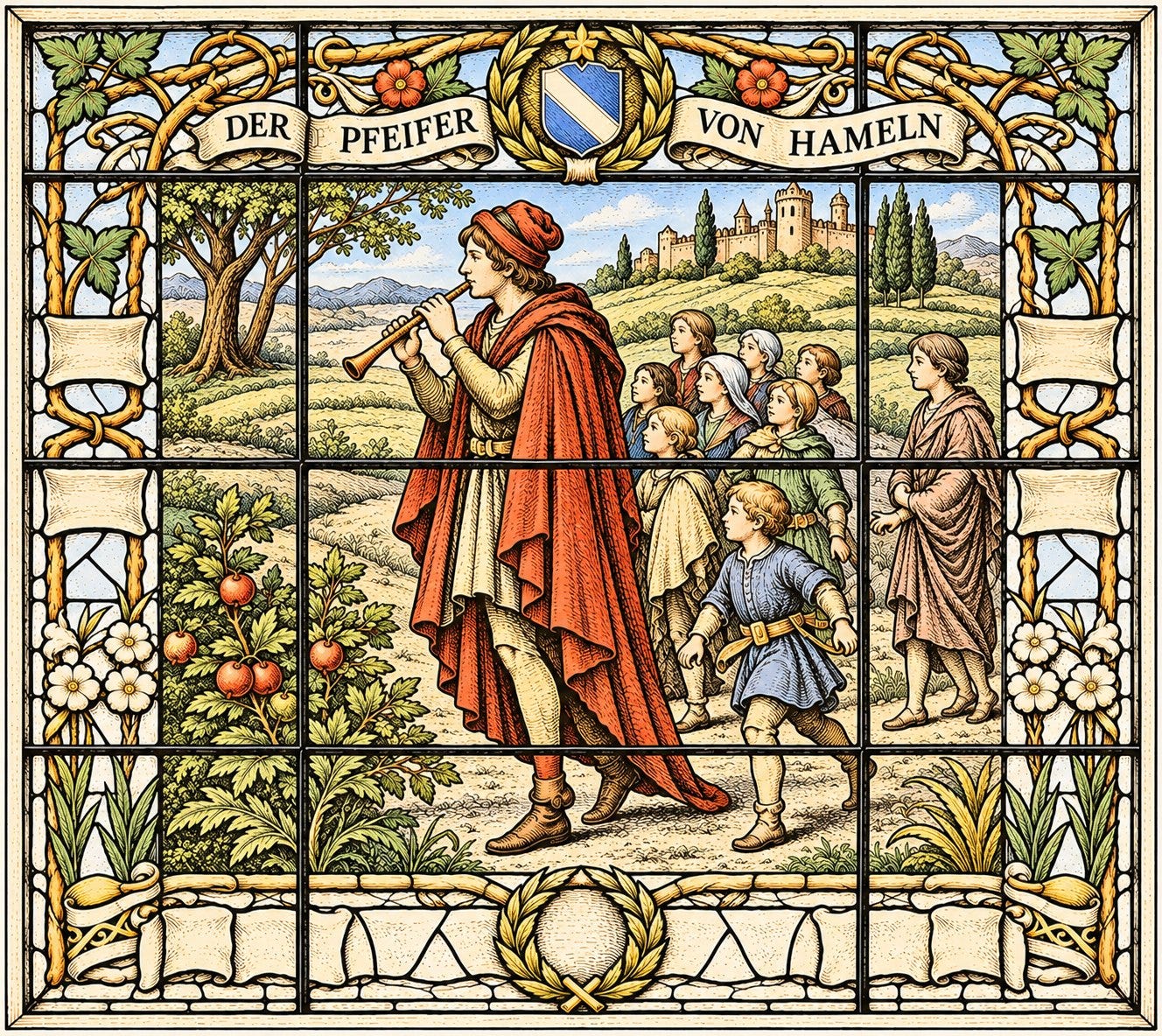
Hamelin, 1284
The legend runs like this. Hamelin, a prosperous market town on the Weser, was overrun by rats. They ate the grain, spoiled the stores, and bit infants in their cradles. The council tried everything, and nothing worked.
A stranger arrived in a coat of many colours. He offered to rid the town of every rat for a thousand guilders. The council, desperate, agreed.
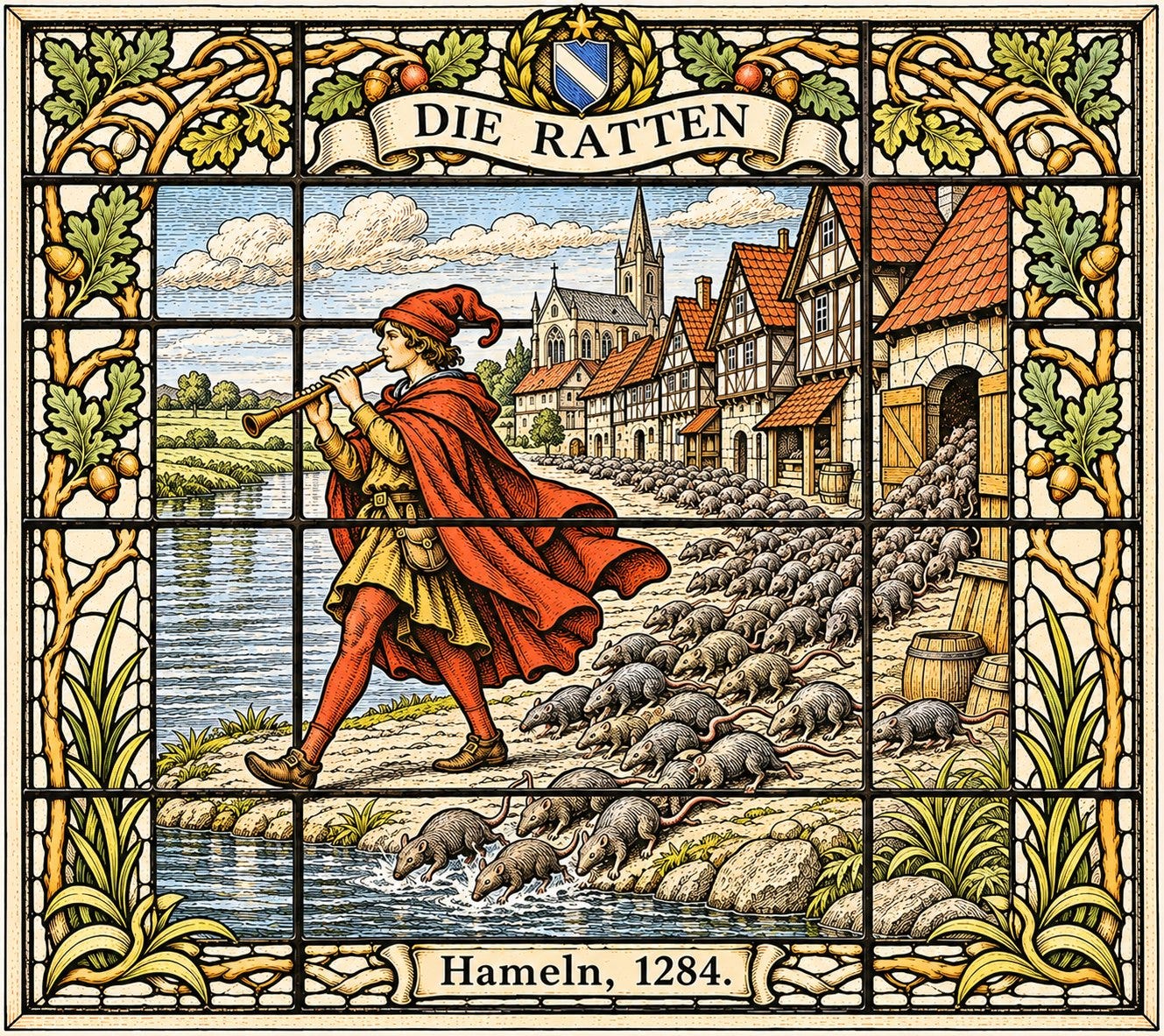
He raised his pipe and played. The rats poured out of cellars and granaries, followed him to the river, and drowned.
With the rats gone, so was the emergency. The councillors looked at the price again and found it excessive. They offered fifty guilders and claimed he had done very little, after all. A few minutes of music.
The piper did not plead. He left, and came back on the 26th of June. This time he played a different tune. The children of Hamelin walked out of their houses, followed him through the town gate and into the hillside beyond, and were never seen again.
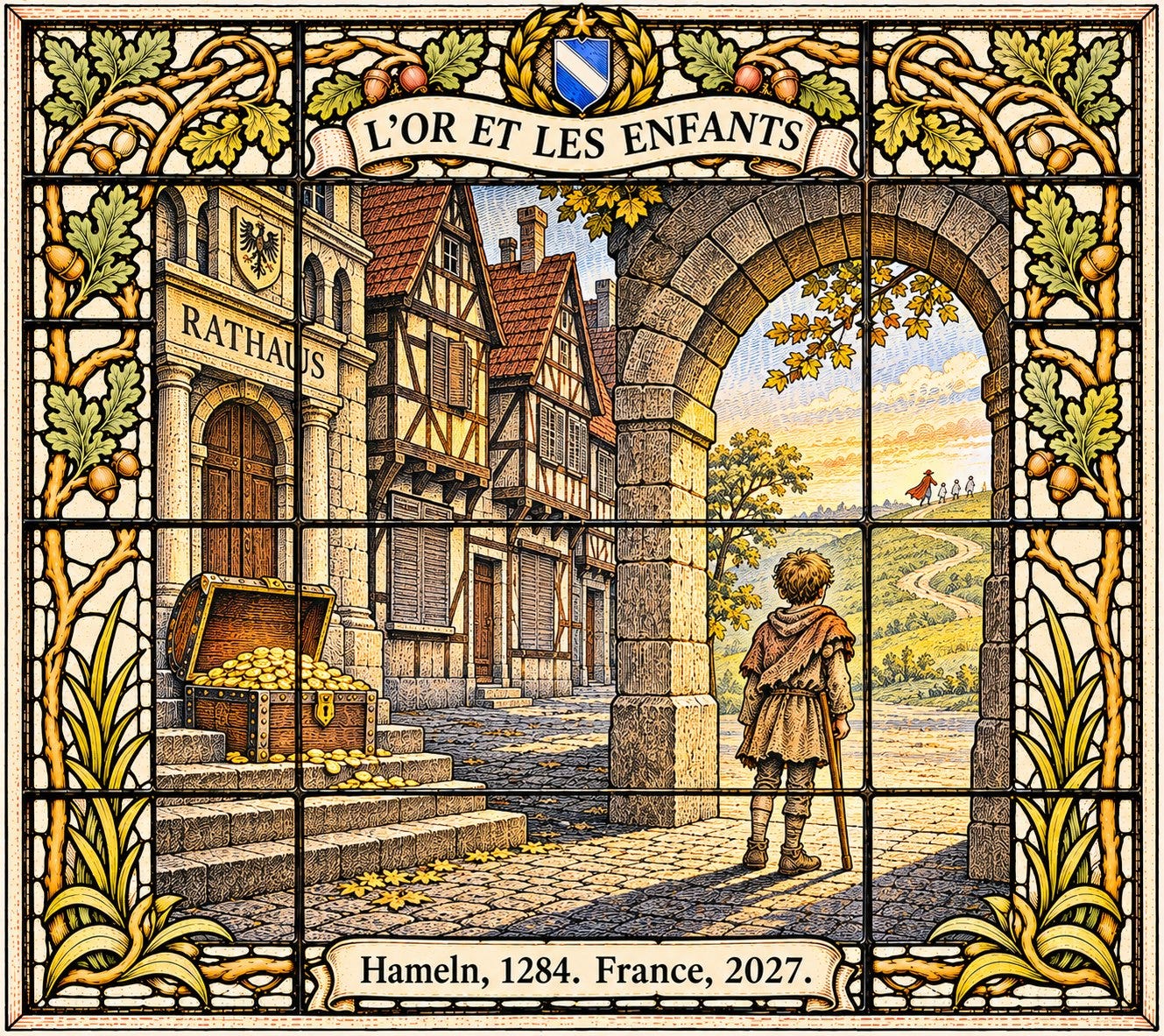
One boy, lame, could not keep up. He alone remained, standing at the gate.
That is the legend. The record is older, and plainer.
A window in Hamelin's Market Church, set around 1300, showed a piper in bright clothes leading children dressed in white. A manuscript from the 1440s supplies a number: 130.¹
The rats
France's rats were real, and they were serious.
In 2008, a financial crisis threatened the banks. In 2020, a pandemic shut the economy. In 2022, an energy shock could have frozen households and factories alike.
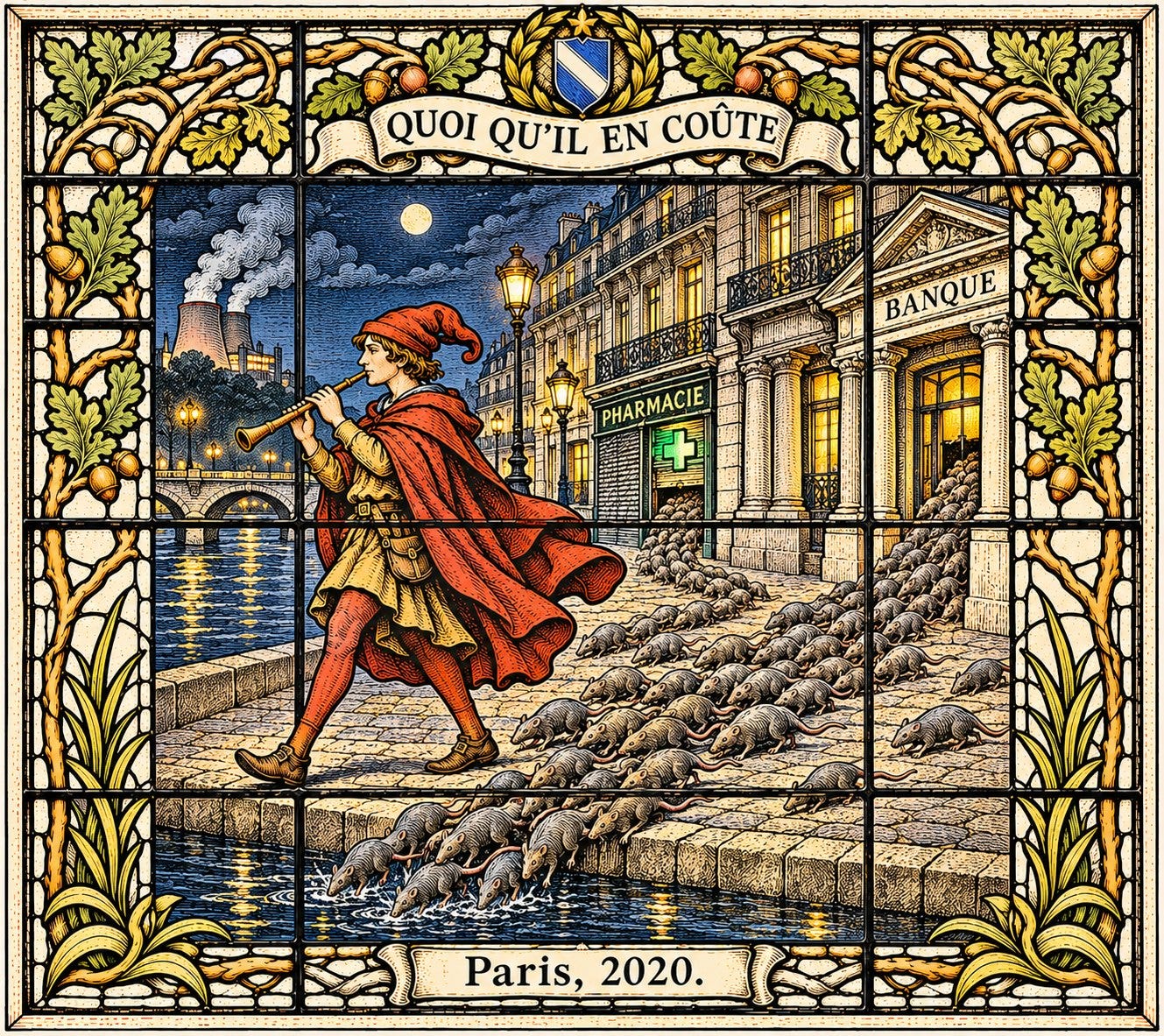
Each time, the state hired the piper. Quoi qu'il en coûte, the president promised in March 2020: whatever it costs. Furlough schemes, guaranteed loans, a shield on energy prices. It worked. The rats went into the river.
For years the fee seemed almost symbolic. Rates sat near zero, sometimes below it, while the European Central Bank bought French bonds by the hundreds of billions. As late as January, France borrowed for ten years at little more than half a point above Germany.²
The service was rendered, and the crisis faded. That is exactly when every council in history begins to reconsider the price.
The piper at the gate
He is back, and he is not negotiating.

At the end of June, French public debt stood near €3,600 billion, 119% of national output.³ The ten-year rate has climbed toward 5%, a level unseen in more than two decades. The gap over Germany touched 1.76 points on October 23.⁴
The state's own interest bill is set to rise from €62.6 billion this year to €72.9 billion in 2027.⁵ That is more than €10 billion added in twelve months. Across all public administrations, the finance minister puts the figure near €91 billion, more than France spends on defence or on education.⁶
Next year the Treasury must raise a record €340 billion on the markets.⁵ Every euro of it at today's rates, not yesterday's.
Meanwhile, the council is still in session. The Social Security budget fell in the Assembly the same day.⁷ The vote on the state's revenues is set for November 3.⁸ On October 17, some 550,000 people marched, and damage to shops approached €1 billion.⁹,¹⁰
Calling the tune
The English proverb has a second half, usually forgotten. He who pays the piper calls the tune.
For half a century France paid with borrowed money, and so it chose its own music: its retirement age, its public payroll, its social model. While creditors were content, the melody belonged to Paris.
Whatever is decided this month, or in April 2027, that arrangement is closing. What remains open is who sets the terms of payment. Three routes exist, and none is free.
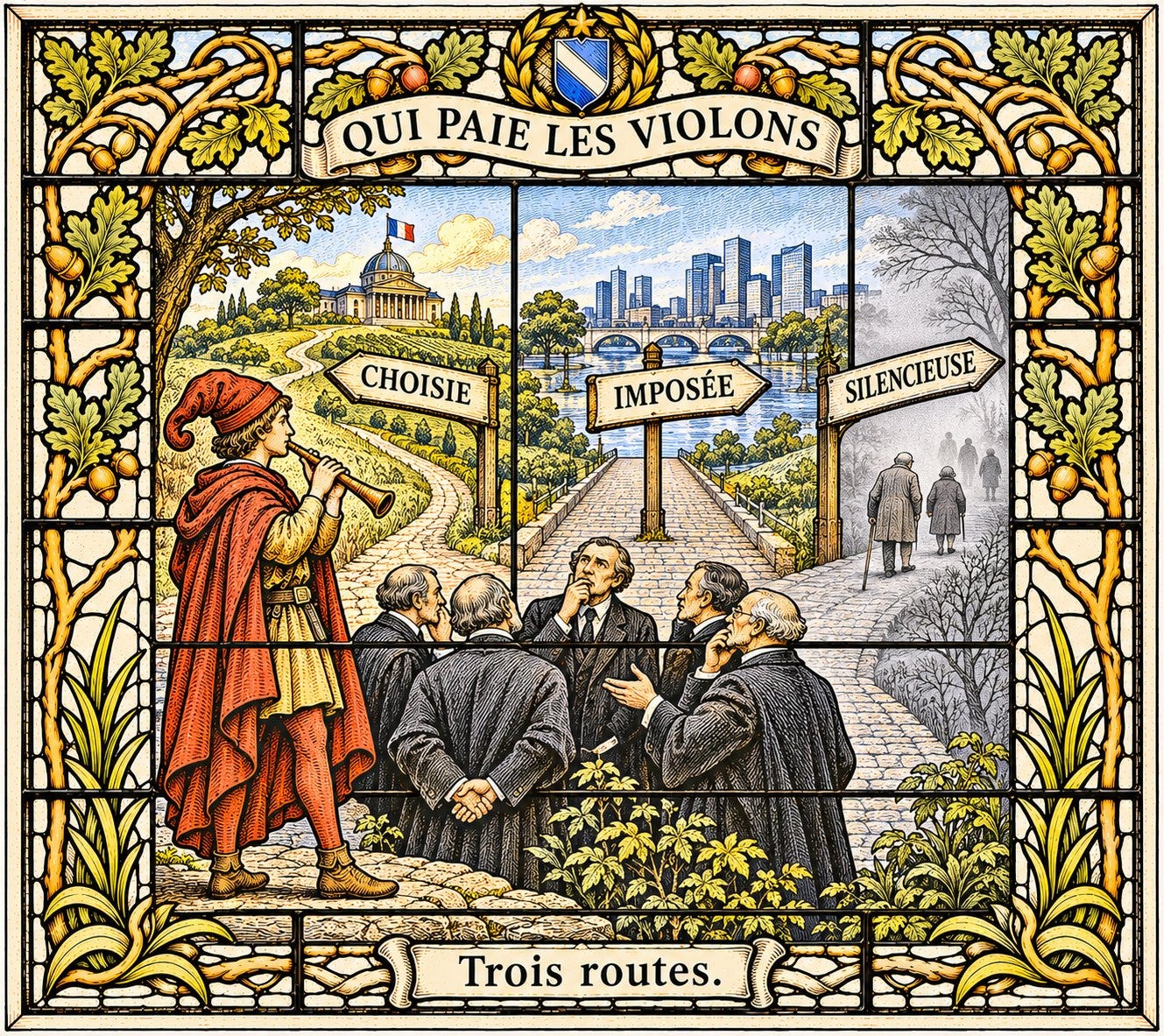
Chosen. A government restrains spending, raises revenue, and defends the plan before voters. It is the cheapest route, and today the least likely, because no majority can carry it.
France has rejected this route before. In 1787, with interest on the debt consuming nearly half the crown's spending, the controller-general Calonne asked the privileged orders to accept a tax on land. They declined.
Two years later, Louis XVI had to summon the Estates-General, and the bill came due as revolution. The nobility and clergy had spared themselves a tax. They lost their privileges, and many their heads.
Imposed. If markets force the matter, help from Frankfurt arrives with conditions attached. The central bank's backstop, its Transmission Protection Instrument, requires compliance with European fiscal rules. Brussels and the ECB would then write part of the budget, as they did for Rome in 2011.
Athens fared worse: eight years of budgets drafted by its creditors, and half a million citizens, mostly young, gone abroad.
Silent. Rates held below inflation, savings steered toward state bonds, capital taxed by increments. Nobody votes for it, which is why it works. The cost lands on savers, who rarely march.
France has walked this one too. After the Great War, governments of the Cartel des gauches fell in turn while capital fled and the franc sank. Poincaré steadied it in 1926, then fixed it at a fifth of its prewar value. Those who had lent the Republic their savings were repaid in fractions.
The children
In Hamelin, the piper was never paid in gold. He collected from those who had no seat on the council.
Among the marchers on October 17 were secondary school pupils and university students. One of their demands was €10 billion more for education.⁹
Over that period, the cost of servicing the debt rises by almost exactly that sum.
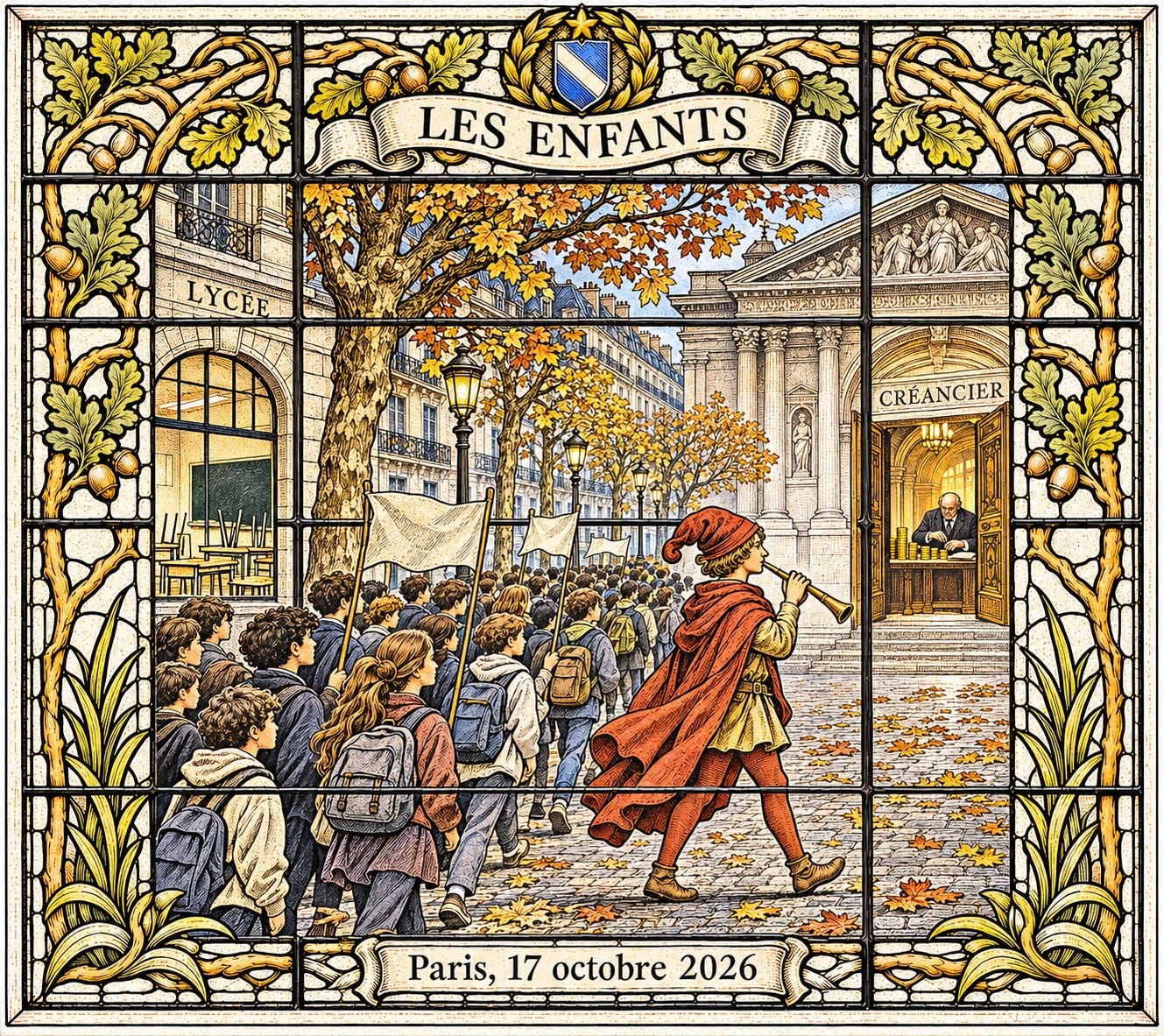
The children are already following the music. Not into a hillside, but into a budget where the creditor is served before the classroom, and where the share left for the future shrinks a little each year.
The whole town
France's piper will be less selective. He will collect from both ends of the town.
The old will pay with their savings. In France, bonds, life insurance contracts and deposits sit largely with retirees, and pensions indexed below inflation finish the work.
For the young, the charge arrives as rent and mortgage, in a country where housing grows dearer as rates climb.
Between them stand those who hold the one asset the others lack: the freedom to leave. An engineer in Lyon can work from Lisbon. A founder in Paris can incorporate in Amsterdam. Capital crosses the Rhine in an afternoon.
Historians now suspect Hamelin's children were never bewitched. In the thirteenth century, recruiters toured German towns signing up sons and daughters to settle the lands to the east.
The proof is the names.
Hamelspringe, a village near Hamelin, has a twin called Hammelspring in the Uckermark, north of Berlin. Beverungen, upriver on the Weser, reappears as Beveringen near Pritzwalk, then as Beweringen near Starogard in today's Poland. Settlers christen new homes after old ones.
Surnames travelled too. Comparing Hamelin's thirteenth-century families against later records, the linguist Jürgen Udolph found them clustered across Brandenburg and Pomerania, and listed to this day in Polish telephone books.¹¹
The piper may have been one of those agents. Hamelin lost a generation to a better offer.
So, once, did France. In 1598, Henri IV's Edict of Nantes granted Protestants the right to worship. In 1685, Louis XIV revoked it: temples were demolished, pastors expelled, and the faithful forbidden to emigrate.
They went anyway. Some 200,000 Huguenots crossed the borders, many of them artisans, merchants and financiers. Prussia, Holland and England absorbed their trades. Berlin keeps its French Cathedral, and its directories still carry their names.
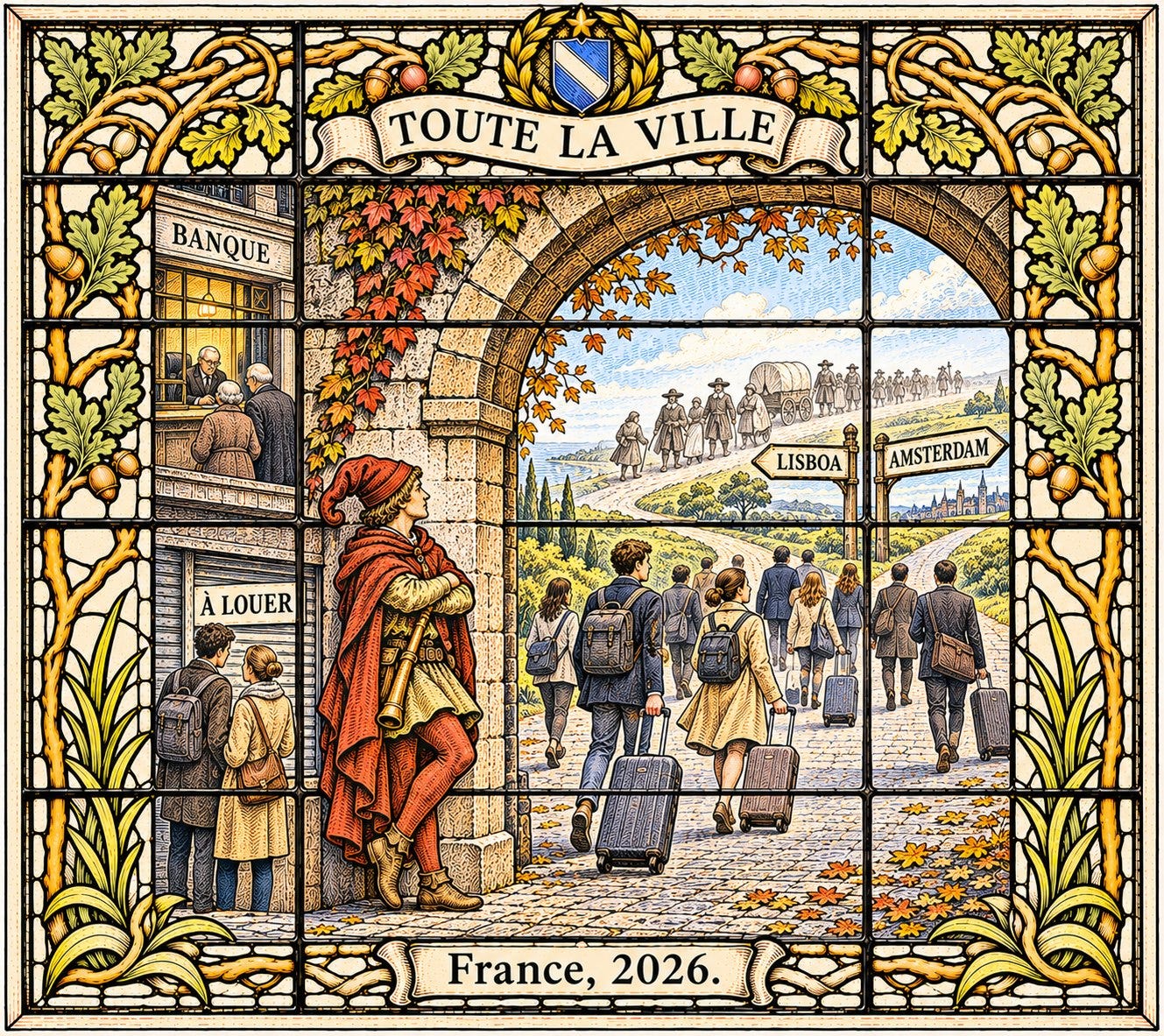
In Hamelin, the only child who stayed was the one who could not walk fast enough. France is sorting its citizens the same way. The most mobile go through the gate on their own, and each departure narrows the tax base, loads more onto those who remain, and makes the next exit more rational.
That is how a bill becomes a spiral. Not through default, but through the slow emptying of the town expected to pay it.
Conclusion
Hamelin's mistake was not the price. It was believing that once the danger had passed, the bill could be argued down.
France will deliberate for some months yet. That is its right, and its tradition. Yet the range of outcomes is narrower than the noise suggests. Whoever governs after April will pay the piper.
Hamelin lost its children and kept its gold. France may pay with both, while its freest citizens settle their accounts elsewhere.
Bonjourhi Institute, Montréal
Notes
1. Museum Hameln, theories on the origin of the Pied Piper story: museumhameln.de/?p=1121
2. BNP Paribas Economic Research, Markets Overview, January 2026 editions, ten-year OAT and Bund yields: economic-research.bnpparibas.com
3. INSEE, Informations Rapides no. 239, 29 September 2026, Maastricht public debt at the end of the second quarter of 2026: insee.fr/fr/statistiques/9053525
4. Admiral Markets, OAT-Bund spread in 2026: admiralmarkets.com/analytics/traders-blog/oat-bund-spread-france-euro. On French ten-year yields reaching 5% for the first time since 2002: SoldiOnline, 21 October 2026, soldionline.it
5. Agence France Trésor, 2027 financing programme and state debt charge, reported by Journal du Net, 29 September 2026: journaldunet.com/business/action-publique/1555599
6. Légifiscal, presentation of the PLF 2027, interest charge of all public administrations: legifiscal.fr/actualites-fiscales/4656-presentation-plf-2027.html
7. Rio Times, French Assembly rejects the Social Security budget: riotimesonline.com/french-assembly-rejects-social-security-budget
8. Arkcity, revised Assembly calendar for the state budget vote: arkcity.net/politique/budget-etat-vote-reporte-assemblee.html
9. Wikipedia, Manifestations du 17 octobre 2026: fr.wikipedia.org/wiki/Manifestations_du_17_octobre_2026
10. CNBC, France protests worst in years, 19 October 2026: cnbc.com/2026/10/19/france-protests-worst-in-years-unrest-macron-.html
11. Jürgen Udolph, “Zogen die Hamelner Aussiedler nach Mähren? Die Rattenfängersage aus namenkundlicher Sicht,” Niedersächsisches Jahrbuch für Landesgeschichte 69 (1997).