

Bonjourhi!
Over the next four weeks we are publishing chapters from The Ice House, the Institute’s new book on who gets paid when intelligence becomes cheap.
Every boom borrows a past, and the AI boom has borrowed more than most: the railways, the dot-com crash, electrification, the gold rush. We tested those comparisons against what is actually happening. Only one survived, and it is the least expected of them all: the nineteenth-century trade in natural ice. This first excerpt, the book’s preface, explains why.
⁂
Why Ice
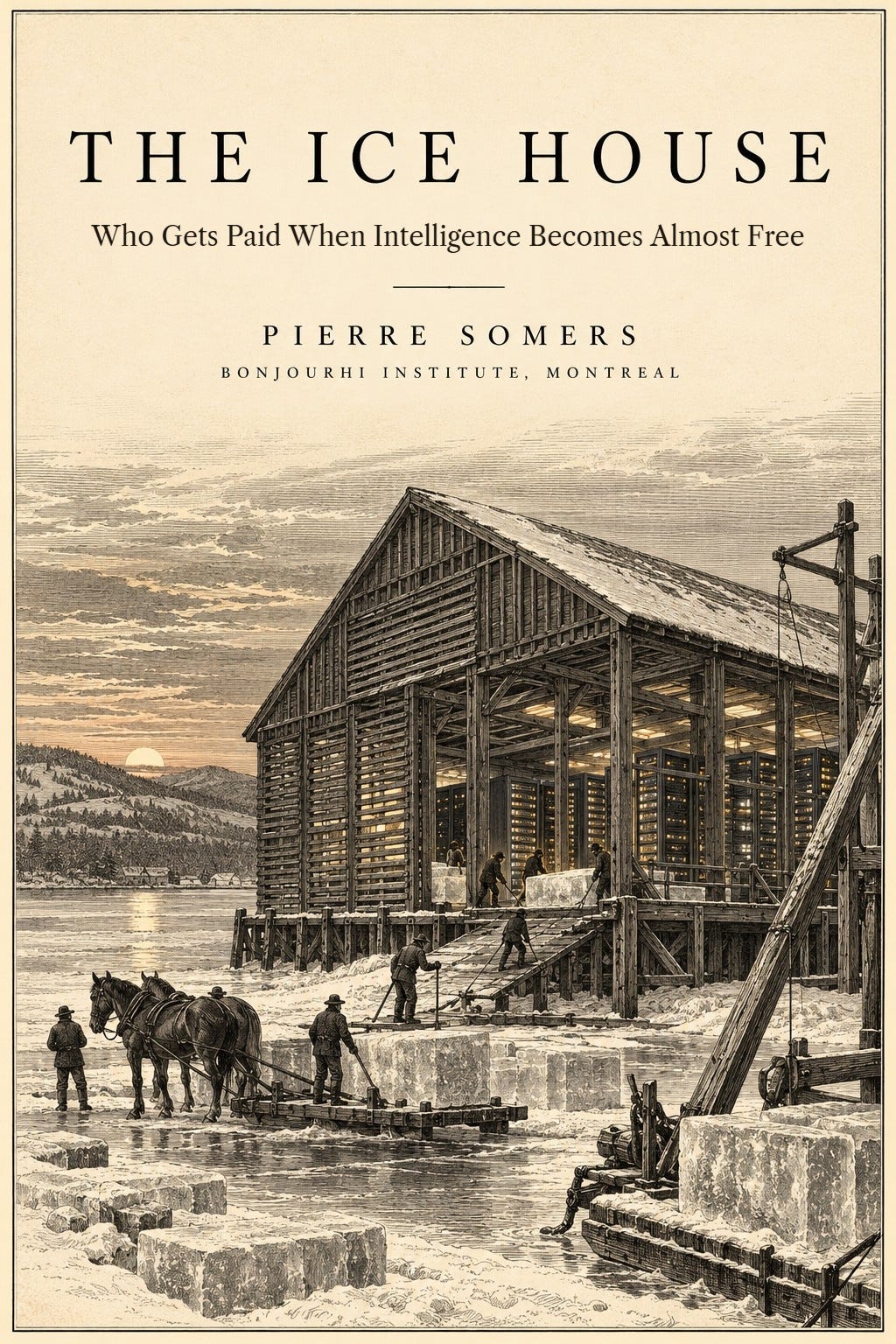
Look again at the cover. The building is an icehouse, of the kind that once lined the Hudson River. The racks glowing inside it are servers.
That picture holds the argument of this book, and it began as a test. Every boom borrows a past, and this one has collected more than most: the railway mania of the 1840s, the dot-com crash, electrification, the gold rush, the Dutch tulips. Repeated often enough, such comparisons acquire what we call narrative debt. They are borrowed faster than anyone checks whether they still fit.
So we checked. We ran each precedent through version 5 of our Translation Machine, which applies the laws of thermodynamics to economic systems. We compared them on the same terms, followed the value to see who captured it once the boom was over, and asked what each one lost to friction and decay, the losses physicists call entropy.
The familiar stories each failed on one point. The railways overbuilt on leverage, yet no invention ever made track obsolete. The fibre glut left bandwidth almost costless, yet the surplus was eventually filled, never replaced. Electrification rewired the world, and its central stations kept earning, the opposite of what befell the icehouses. The gold was genuinely scarce. The tulips produced nothing at all.
The trade in natural ice failed on none. Its raw material came free with the winter. Its worth lay in a costly chain of harvest, storage, and delivery. Its prices fell as the links improved, its owners consolidated and borrowed, and then machines were making cold in kitchens while the world's appetite for it kept growing. Demand multiplied. The owners were ruined. No other precedent we tested comes so close to the predicament of artificial intelligence.
There is a final reason, and it is physical. Every block of ice was a running battle against summer, and any answer a model gives leaves the chip as heat that must be pumped away. Of all the candidates, only one was, like artificial intelligence, a business of moving heat.
Next week: a sultan, a goblet of sherbet, and a block of ice that travelled for months to melt in a few minutes.
Next chapter: Thursday 26 November
Bonjourhi Institute, Montréal