
Bonjourhi!
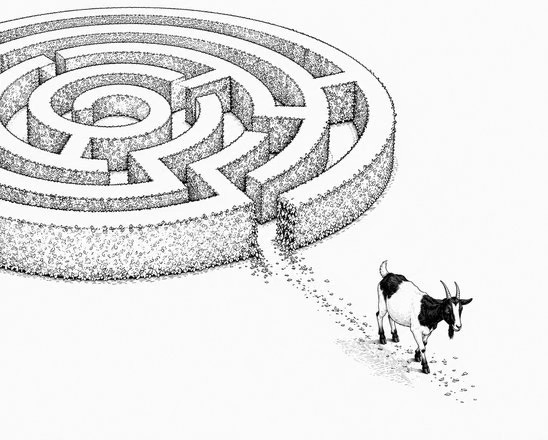
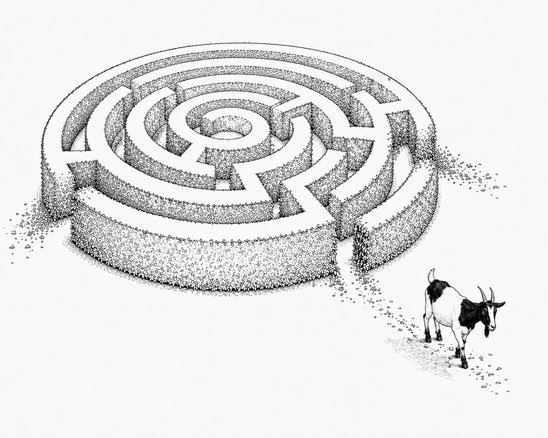
There is a maze, grown slowly over years, built to be walked. And there is a goat, which does not walk it. It eats a hole through the wall and steps through, arriving before anyone who tried to solve the thing honestly.
This week we take that small scene seriously, because it is the Second Law of Coherence Economics in one picture. Extraction is rarely the breaking of a rule. It is the quiet declining of a rule’s unstated terms, the treating of a slow structure as fast food.
We watched it happen in daylight this summer, when an index rewrote its own walls to admit a single enormous newcomer, and the passive savers who were told they had chosen the careful path woke up holding the risk. Then we follow the same shape into three more walls: the corporate balance sheet, the machinery of price discovery, and the promise behind a stablecoin.
Two pieces follow. The first names the law. The second shows it is not an exception.
The goat eats in an afternoon what the hedge took years to grow. The only question worth asking is which one you are becoming.
I. The Second Law of Coherence Economics
The Maze and the Goat
The Morning It Happened
On the seventh of July, millions of people who had chosen the careful option woke up owning something they never agreed to buy.
They held index funds. The safe choice, the passive choice, the one recommended to anyone who did not want to gamble. Overnight, those funds bought a piece of a company that had lost billions the quarter before, priced by a thin sliver of tradable stock. No one asked them. A rule had changed, and the rule did the buying.
This note is about the law that explains that morning. It is the second of the three laws of Coherence Economics, and it is the one worth understanding before your own capital meets it.
The Three Laws, Briefly
Coherence Economics rests on three laws.
The First Law says value compounds when it is reinvested inside a structure built to hold it. A savings account, a family office, a trust, an institution. Time and patience do the work.
The Second Law says extraction happens when an actor treats that structure not as a container to work within, but as raw material to consume for an immediate return.
The Third Law says recoherence happens when extracted value is deliberately reinvested to rebuild what was consumed. It is slower than extraction and rarely gets credit for the damage it repairs.
This note is about the Second Law. It exists to give students, staff, and readers of Bonjourhi a single image sturdy enough to carry the idea without a paragraph of definition every time it comes up.
The Image
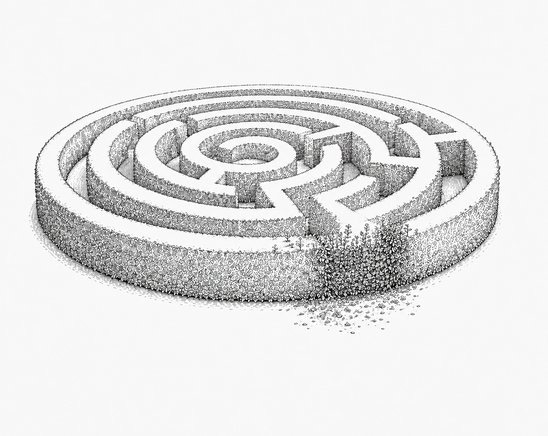
A hedge maze takes years to grow into something that can hold a puzzle. Someone shaped it, trimmed it, let it thicken into walls dense enough to block sightlines. The paths inside are not the point. The walls are the point. They are what make the paths mean anything.
A goat does not experience a wall as a rule. It experiences a wall as food. Faced with the maze, it does not search for the entrance and does not attempt the turns. It eats a hole through the hedge at the corner and walks straight to wherever it wanted to go. It arrives faster than anyone who tried to solve the thing properly.
Nothing about this breaks a written rule. There was no sign that said do not eat the hedge. The maze was built on an assumption that never had to be stated, that whoever engaged with it would engage with the walls as boundaries, not as material. The goat never accepted that assumption. It was never playing the same game.
And once the hedge is eaten, it does not grow back by morning. The maze is compromised for the next person who tries to walk it. The goat’s shortcut cost it nothing. Someone else pays for it, later, in the form of a maze that no longer holds its shape.
One honesty about the image. A goat is hungry, not strategic. It has no intent to harm the next walker. Most extractive actors do know exactly what they are consuming and proceed anyway, which makes the human version colder than the animal one.
The Mapping
The extractive actor rarely breaks a rule. That is what makes it hard to see coming and hard to hold accountable after the fact. It simply declines the implicit compact the structure was built on.
A fund that strips a company’s balance sheet is not breaking the law. A state that mines a trust relationship for one transactional win is not breaking a treaty. An institution treated as a resource to be spent rather than tended has usually had no explicit contract broken at all. In each case, the walls were never designed to survive being eaten. They were designed to be walked.
The mark of the Second Law is always the same. The extractive move looks, for a moment, like superior navigation. It is faster. It looks clever. It is not navigation at all. It is consumption of the thing that made navigation possible for anyone else, including the extractor’s own future self.
A Case In The Open
In the spring of 2026, Nasdaq rewrote the rules for entry into its flagship index, the Nasdaq 100. The old rules were a set of walls built over years. A new company had to trade for roughly three months before it could be considered, a seasoning period meant to let the market find a real price. It had to have a meaningful share of its stock actually available to trade, a float minimum of about ten percent. And it entered, in the normal course, at a single scheduled reconstitution each year. The walls were slow on purpose. They existed to protect the people whose savings track the index.
The new rules removed most of them. A company large enough to rank among the top forty by market value can now enter after fifteen trading days. The float minimum is gone. The index is allowed to hold more than one hundred names for a while so that no existing member has to be dropped to make room. The stated reason was reasonable on its face. A two trillion-dollar company is not a two-hundred-million-dollar company, and a company that large cannot float a large share of itself at once. Some adaptation was defensible. That is worth saying plainly, because the Second Law is not triggered by change. It is triggered by who the change is built to serve.
The first company through the gap was SpaceX. It listed in June 2026 in the largest public offering in history and was added to the index about three weeks later, with only a few percent of its shares actually trading. Reuters reported that rapid inclusion had been a condition of its choice of exchange. Nasdaq changed the rules. SpaceX chose Nasdaq. The exchange collects the listing, the fees, and delivers a wave of buyers who have no say in the matter. Two more offerings of similar scale were expected to follow the same path later in the year, which is the proof that the wall was not moved for one animal. It was moved for the herd behind it.
Those buyers are the point. Funds that track the index do not decide what to own. They own what the index tells them to own. When SpaceX entered, every fund pegged to the Nasdaq 100 had to buy it, funded by trimming a little from everything else it held. The people in those funds are, in large part, ordinary savers who chose an index precisely because they were told it was the safe, passive, sensible option. They now hold a piece of a company that lost billions in its most recent quarter, whose price is set by a thin sliver of tradable stock, at a weight set to grow as more shares are released. They took on that risk through a rule change, not a decision of their own.
This is the bite out of the hedge, in plain daylight. The structure was seasoning and float, walls built to give slow money time and protection. The fast gain, immediate access to a pool of buyers who cannot refuse, went to the issuer and the exchange. The cost, absorbed volatility and a price nobody was given time to discover, was spread across the passive holders who never agreed to any of it and mostly never knew the rule had changed.
The Index That Kept Walking
Here is what keeps this from being a story about villains. Faced with the same pressure, one major index provider declined. S&P Dow Jones weighed the same change and, in June 2026, chose not to make it. Its flagship index still asks for a full year of trading and four straight quarters of real profit before a company can enter. Under those rules SpaceX does not qualify until at least the middle of 2027, and only then if it earns its way in.
Two indexes, the same company, the same pressure, two different answers. One ate the wall. One kept walking the maze. That is the entire choice the Second Law describes, made visible in a single season, by two institutions doing the same job under the same conditions. Nothing forced either outcome. Each was a decision about who the structure is meant to serve, the ones already inside it, or the one impatient to get in.
A Working Diagnostic
Three questions, applied to any actor, deal, or state behavior, help identify Second Law extraction before it is finished.
Is the gain realized faster than the structure could have produced it through its intended paths.
Does the move rely on an unstated assumption that the structure was never designed to defend against.
Does the structure emerge weaker for the next participant, regardless of what happens to the extractor.
A yes to all three is not proof of bad faith. It is proof of extraction. The two are not always the same thing, and Coherence Economics is a framework for seeing structure clearly, not a court for assigning blame.
The AsymmetryThat Decides Everything
Here is the fact that makes the Second Law worth teaching rather than merely observing. Extraction is fast and recoherence is slow. This is not a detail. It is the entire strategic landscape.
In the short run the field always tilts toward the goat. The extractive move shows the better number this quarter, this cycle, this news week. It will keep looking smarter than patience right up until the structure it was feeding on is gone. Then the number reverses, and it reverses fastest for whoever is still standing in the field when the walls come down.
So the contest is never really between the clever and the slow. It is between two clocks. Whoever can hold the longer clock wins, because the longer clock is the only one on which building beats eating. This is why patient capital is not a temperament. It is a structural advantage that compounds precisely because most of the field cannot hold the clock long enough to collect it.
The Edge This Gives You
Read this way, the Second Law is not a description of bad behavior. It is an early warning instrument, and it is priceable.
An actor who is extracting rather than building leaves the same signature every time. The gain arrives too fast for the structure that supposedly produced it. It depends on an assumption the structure was never built to defend. It leaves the field weaker for whoever comes next. Learn to read that signature and you can do two things most allocators cannot.
You can avoid being the maze. Capital that understands the signature does not sit inside structures that are being quietly eaten, and does not become the counterparty who absorbs the cost of someone else’s afternoon.
And you can find the structures worth compounding inside. The mirror image of the signature is just as legible. Gains that arrive at the pace the structure can actually sustain. Assumptions the structure was built to honor. A field left stronger for the next participant. Those are the mazes still worth walking, and they are rarer than they look, which is exactly why walking them pays.
The same signature appears far from markets, in statecraft, in treaties, in any structure old enough to be worth consuming. But you do not need to leave your own field to find it. This summer it priced itself into an index that millions of people were told was the careful choice.
Every structure worth having sits somewhere in this picture, and inside it you are always one of three things. You are the goat, taking the fast way through a wall someone else built. You are the wall, being quietly eaten by someone in a hurry. Or you are the one who plants, slowly, knowing the hedge will outlast you.
The goat eats in an afternoon what the hedge took years to grow.
That sentence is the whole of the Second Law. Read it once more, then ask the only question that matters for your own capital. Not which one is winning this quarter. Which one are you becoming.
II. Other Hedges, Same Goat
Three More Walls Being Eaten
Why A Companion Note
The first note used a single case, the rewriting of an index rule, to show the Second Law at work. One case can look like an exception. The purpose of this note is to show it is not.
The test stays the same throughout. A structure grown slowly. A fast private gain taken by declining the structure’s unstated terms. A cost left for whoever holds the field next. Anything that fails one of the three is ordinary competition, not extraction. All three of the following pass.
First Wall, The Balance Sheet
A company’s borrowing capacity is a hedge grown over decades. It is the room to raise money in a genuine emergency, a plant that burns, a recession, a supplier that fails. It is quiet, it earns nothing in calm years, and its whole value is that it is there when nothing else is.
The debt-funded buyback eats it. The company borrows, not to build a factory or enter a market, but to buy back its own shares. Fewer shares outstanding lifts earnings per share and the stock, without a single new thing having been made. The move breaks no rule. It is legal, common, and often applauded on the day it is announced.
What was consumed is the emergency room. The borrowing that could have met a future shock has been spent on a present share price. When the shock arrives, and it always eventually does, the company meets it with a balance sheet already drawn down. The gain went to whoever sold shares into the buyback and to the quarter’s reported numbers. The cost waits for whoever holds the equity when the room is needed and found empty.
The giveaway is the one from the first note. It looks like superior capital management. It is faster than the patient path of earning the capacity and keeping it. It is not management at all. It is consumption of the thing that made the company able to survive a bad year.
Second Wall. Price Discovery.
Price discovery is the slowest hedge of all. It is the century of accumulated work by people deciding, one judgment at a time, what a thing is actually worth. Every earnings model, every argument between a buyer and a seller, every analyst who was wrong and corrected, has gone into building a market where the price on the screen means something. That meaning is the wall. It is what lets anyone, including the passive investor, trust that the number is real.
Passive investing, in the aggregate, eats it. This is the subtle case, because no single index fund is doing anything wrong. An index fund is cheap, sensible, and for most savers the correct choice. It simply does not do the work of deciding what anything is worth. It buys what the index says to buy, at the price the remaining judgment-makers have set, and pays almost nothing for the privilege.
For a long time this was harmless free-riding on a large and healthy pool of price-setters. It is no longer small. Indexed funds now hold more United States equity fund assets than active funds do, a majority reached in the middle of this decade and still climbing, and so much trading has migrated to the closing auction that the moment of price formation itself has narrowed. The wall is being eaten from within by the very people sheltering behind it.
The SpaceX inclusion was a preview of the end state. A company entered the index at a price almost no one had discovered, on a float of a few percent, and the passive machinery bought it because the rule said to, not because anyone judged the price fair. That is what a market looks like when the buyers have stopped asking what things are worth. The hedge that made indexing safe is the hedge that indexing, at scale, consumes.
Third Wall. The Redemption Promise.
A stablecoin is a promise, and the promise is the wall. The issuer says each coin can be redeemed for one dollar, at any time, in full. That guarantee is what turns a database entry into something people will accept as money. It was built the way all monetary trust is built, slowly, by honoring redemptions until people stopped worrying about them.
The reserve behind the coin is where the goat feeds. The dollars backing the coins sit in the issuer’s reserve, and that reserve earns yield. The holder of the coin gets none of it. The issuer keeps the interest on money that is not its own, which is a fine business as long as the reserve stays whole and liquid. The temptation, and in stressed cases the practice, is to stretch the reserve for a little more yield, a longer maturity, a lower-quality asset, a slice that cannot be sold in a hurry.
Each stretch is a bite out of the redemption promise. Nothing looks wrong while redemptions are calm. The wall still stands. But the guarantee that every coin converts to a dollar on demand has quietly been made thinner than the label claims, and the thinness is invisible until the day everyone asks for their dollar at once. The yield was collected continuously and privately by the issuer. The gap is discovered all at once and publicly by the holders.
This is the oldest banking story wearing new clothes, which is exactly why it belongs here. The hedge is the promise of par. The extraction is earning on the reserve while thinning the thing that makes par credible. The cost lands on whoever is holding the coin on the morning the promise is tested.
The Common Shape
Three walls, one animal. The balance sheet, spent on a share price. Price discovery, hollowed by the people relying on it. The redemption promise, thinned for yield. In each, the extractive move is legal, faster than the patient alternative, and invisible until the structure is needed and found weakened.
Notice what the three share beyond the shape. The gain is always concentrated, private, and now. The cost is always distributed, public, and later. That is not a coincidence of these examples. It is the signature of the Second Law itself, and it is why the law is a diagnostic rather than an accusation. You are not looking for a villain. You are looking for the place where a slow structure is being turned into a fast number, and asking who will be standing there when the bill comes.
The Same Question
The first note ended on a question, and it is the same question here, only now it has three more answers to draw on. In each wall you are one of three things. The one taking the fast way through. The wall being eaten. Or the one who plants, and waits, and keeps the capacity intact for the year it is needed.
The goat eats in an afternoon what the hedge took years to grow.
Read that once more, then look at your own book. Not at which position is winning this quarter. At which walls you are quietly eating, and which ones you are patient enough to keep.
In the News
Ohio City Worker Union Complains That Goats Are Eating Its Lunch
A union in Columbus made a formal complaint after the city farmed out brush-clearing duties at a wastewater plant. The competitors? Goats.
By Sejal Govindarao · The New York Times · Published June 12, 2026 · Updated June 15, 2026
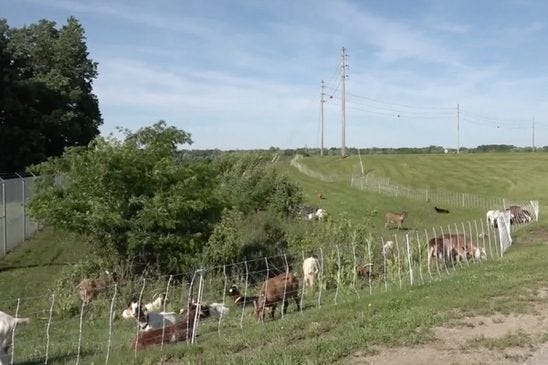
Kevin, Wilson, Marti, and the rest of the crew clearing brush at an Ohio wastewater treatment plant didn’t complain about the hours. They ate lunch on site and were endlessly enthusiastic. But because they weren’t unionized, Local 1632 of the American Federation of State, County & Municipal Employees filed a grievance.
Kevin, Wilson and Marti didn’t have much to say about it. They are goats.
In 2026, anxiety about being replaced by computer superintelligence keeps white-collar workers up at night, sweating it out over a technology that even its creators can’t fully understand. At the wastewater plant though, the threat to employment is less abstract, and it walks on four legs.
The “blatant disregard” of labor through subcontracting is the crux of the issue for Will Harmon, the local’s president, rather than the voracious ruminants clearing vegetation at the facility.
The union filed a complaint with the Columbus Water & Power department this month after the agency promoted its partnership with a goat grazing company on social media. The grievance accuses the management at the facility, the Southerly Water Reclamation Plant outside Columbus, of failing to properly notify the union of its intent to subcontract the work, which, it said, violates their collective bargaining agreement.
“Now it’s animals doing my work,” he said. “Before long, they’ll be having A.I. doing my bargaining unit work.”
Columbus Water & Power said it is reviewing the grievance and declined to comment further because it is the subject of arbitration.
The wastewater plant sits about 13 miles south of downtown Columbus. It encompasses almost 290 acres and can treat up to 330 million gallons per day, serving more than 700,000 residents, George Zonders, a spokesman, said.
But a storm water ditch on the south side of the grounds is teeming with poison hemlock, a weed with clusters of tiny white flowers and purple-spotted stems that the state has declared noxious and invasive. Most equipment cannot be used on the slope, according to an email the department sent to the goat contractor last August.
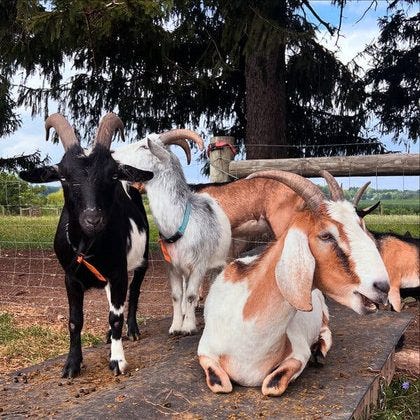
Lauren Cain, the owner of a Goats on the Go affiliate, one of more than 70 nationwide that supply goats for vegetation management, provided about 40 for $2,900 for about 10 days of work. The goats scoured nearly two acres, stripping bark off trees and eating their way through overgrown brush and invasive vegetation.
Goats, with their efficient digestive systems, are useful in dangerous environments, Ms. Cain said. They intuitively know how much poison hemlock their systems can tolerate, she said, and minimize damage to the land and pollutants in the air. They also leave behind fertilizer.
For Kevin, Wilson and Marti, the job is simple: They’re just goats being goats. They exhibited their natural behaviors of climbing and browsing to eat their way through bushes, weeds and small trees. Marti enjoyed rolling down the hill. At times, they were sleeping on the job, which also provided them an opportunity to hang out with dozens of their colleagues, Ms. Cain said.
Unions have long resisted subcontracting, which employers use in two main cases: when work requires a highly specialized skill set or employers are seeking a less expensive option, said Ileen DeVault, professor of labor history at Cornell University.
“Obviously, they’re not providing P.P.E. for the goats,” she said, referring to how personal protective equipment can be costly.
But James Fletcher, who worked as a plant maintenance mechanic at Southerly before becoming vice president of the union, said that the goats’ efficacy is not clear-cut. The goats did not remove all the poison hemlock because it would have been too toxic to ingest in full and some was submerged, Ms. Cain said.
Mr. Fletcher said he did not run into any poison hemlock when he was clearing the brush at the plant four years ago.
“The goats couldn’t do all the job, so, of course, now our employees got to go back in there and do the job,” he said.
Ms. Cain aims for her goats to radiate good. She said she has seen her goats bring bickering neighbors together and is accustomed to hearing that clients set up lawn chairs to cheerfully observe her herd.
“I hate to think that the goats are causing any sort of negativity or strife,” she said.
BONJOURHI! INSTITUTE ANALYTICS · MONTREAL · 2026