
Bonjourhi!
This week’s headlines delivered a familiar verdict: one hundred thousand jobs gone at Volkswagen, the German social model breaking at last. I want to offer a different reading.
What gave way on September 3rd was not an industry. It was a promise, and not one confined to Germany. Beneath the jobs and the plants lies an older understanding, between those who built the postwar order and those now asked to inherit it, and that understanding is the thing coming apart.
Europe received this settlement rather than making it, and has never once had to defend it. Now it must. The demand has arrived from three directions at the same moment, pressed by men who intended anything but to strengthen what they touched.
This week’s issue carries two readings of the same rupture, one industrial, one political. Both say a continent is being asked what it does when every piece on the table has suddenly come loose.
With my regards,
Pierre Somers
Chief Editor, Bonjourhi Institute
Montreal, Quebec – September 2026
Bonjourhi!
Everyone is reading the Volkswagen deal as a wound. On September 3rd, the supervisory board approved a plan that takes the group toward roughly one hundred thousand jobs cut by the end of the decade, the deepest restructuring the global auto industry has ever seen, with four German plants left without a guaranteed future. The model of co-determination is finally cracking, labor and capital no longer holding hands on the board. That is the obituary being written this week.
It reads the right event and draws the wrong lesson. Nothing about German industry is ending. Something about German governance is being forced to grow up.
Notice, first, that Germany never had one industrial model. It had two, running side by side, and only one of them is in trouble.
The first is the Mittelstand1. Tens of thousands of midsize firms, family-owned, specialized, quietly dominant in narrow global niches. Pumps, sensors, machine tools, the parts inside other people’s products. This is the actual backbone of German industry, and it has been adapting for decades. It offshored selectively. It automated early. It moved what had to move and kept what had to stay. It did all of this without drama, firm by firm, because no single such firm carries a nation’s employment policy on its board.
The second model is the automakers. Concentrated, national, politically entangled. And governed in the strong form of co-determination, where labor holds half the supervisory board and the home state holds a veto.
Two models. One adapted continuously. The other could not adapt at all. The difference is not the product. It is the governance.
Consider what a keel does for a ship.
A keel is the long fin beneath a sailing boat. Its job is stability. It resists the wind’s attempt to tip the boat over and push it sideways, and it does this beautifully. Without a keel, a strong wind simply capsizes you. The keel is what lets a boat lean into pressure and hold its line.
But a keel is built for one direction of force. It steadies. It does not steer. When the wind shifts and the boat must come about quickly, the keel does not help you turn. Its whole design is to resist the sudden movement that changing conditions demand. What keeps you upright in a steady wind is what slows you when the wind changes.
A good sailor does not remove the keel. That would be suicide. The sailor keeps it and learns to work with it, trimming the sails, reading the shift, turning in time despite the drag.
Mitbestimmung2 is the keel.
For sixty years the wind blew one way. German exports ruled, the task was to hold the line and preserve employment, and co-determination held that line with a discipline no other country could match. Labor on the board meant jobs were defended structurally, not sentimentally. In a steady wind, the keel is genius.
Then the wind shifted. The electric transition arrived. China stopped buying and started building. The task was no longer to hold. It was to turn, fast, and the keel that had steadied the ship for two generations now resisted the turn with all the strength it once used to keep the boat upright.
That is what September 3rd revealed. Not a broken model. A keel meeting a wind it was never shaped for.
The midsize base had no such problem because it never built that keel. It stayed nimble, adjusting sail by sail, firm by firm. It is the proof that German industry can turn. The automakers are the proof that one governance form cannot.
So the question is not whether Germany keeps making cars. It will. Nor whether co-determination survives. It should. Labor at the table is a genuine strength, and the countries that gave workers no voice at all did not fare better.
The question is whether co-determination can evolve from a keel into a rudder.
A board that could only ever say keep the plant open served the old wind well. The new wind needs a board that can say move this, keep that, retrain here, close there, and do it before the competitor does. That is not the death of co-determination. It is co-determination growing a capability it never needed before, the ability to decide something other than preservation.
But a keel does more than steady a ship. It steadies the crew.
For sixty years co-determination kept the fight between labor and capital inside the boardroom. Workers who might have taken to the street took a seat at the table instead. That was the real genius of the postwar settlement. It did not end the conflict. It housed it. The anger had a room to sit in, and an institution that could still deliver enough to keep it seated.
When the board can no longer deliver, the anger does not vanish. It leaves the room.
And it leaves into a politics already waiting for it. One flank reads the deal as capital finally winning, the veto broken the moment it mattered, and offers a stronger keel, more protection, more veto, the one defense that can no longer turn the ship. The other reads it as betrayal from outside, the transition imposed, the competitor unfair, and offers to wall the country off. Both promise to save the jobs. Neither can. What both actually gather is the loyalty of workers an institution stopped protecting.
Underneath even this sits the deepest arrangement of all, and the most exposed.
Call it the generational contract. The grays were promised permanence, a job for life and a pension funded by the cohort behind them. The greens are asked to fund that pension out of an industrial base they are also being asked, rightly, to shrink for the sake of the climate. The old parties of left and right built their authority on brokering between these groups, and that brokerage is what is now failing in public.
Every party to the arrangement is pulling against the others. The transition the young demand accelerates the losses the old were promised protection from. The security the old were promised falls as a bill on a younger cohort inheriting a leaner industry and a warmer planet. The two parties that once mediated all of this can no longer offer terms any side will accept.
This is the contract that has to evolve, and it is larger than any boardroom. Co-determination was only ever its visible instrument. The real settlement was between generations, and that is the one now being asked to renegotiate itself while the ship is mid-turn.
The cars will be fine. The keel will become a rudder or be worked around. Those are engineering problems, and Germany solves engineering problems.
The contract is the hard part, and Germany would have deferred it for another decade if it could. Every aging democracy defers. The old vote, the young are fewer, and the bill for the past is always easier to postpone than to pay. Left alone, Germany would have postponed.
It has not been left alone.
Three men decided otherwise, none of them meaning to help. Putin pushed to fracture European resolve and remind the continent that its security was never truly its own. Trump treated Europe as a customer to be charged rather than an ally to be kept, and made plain that the American guarantee now carries an invoice. Xi worked to keep Europe open, dependent, and unwilling to choose. Each reached for a different piece, and each reached only for himself.
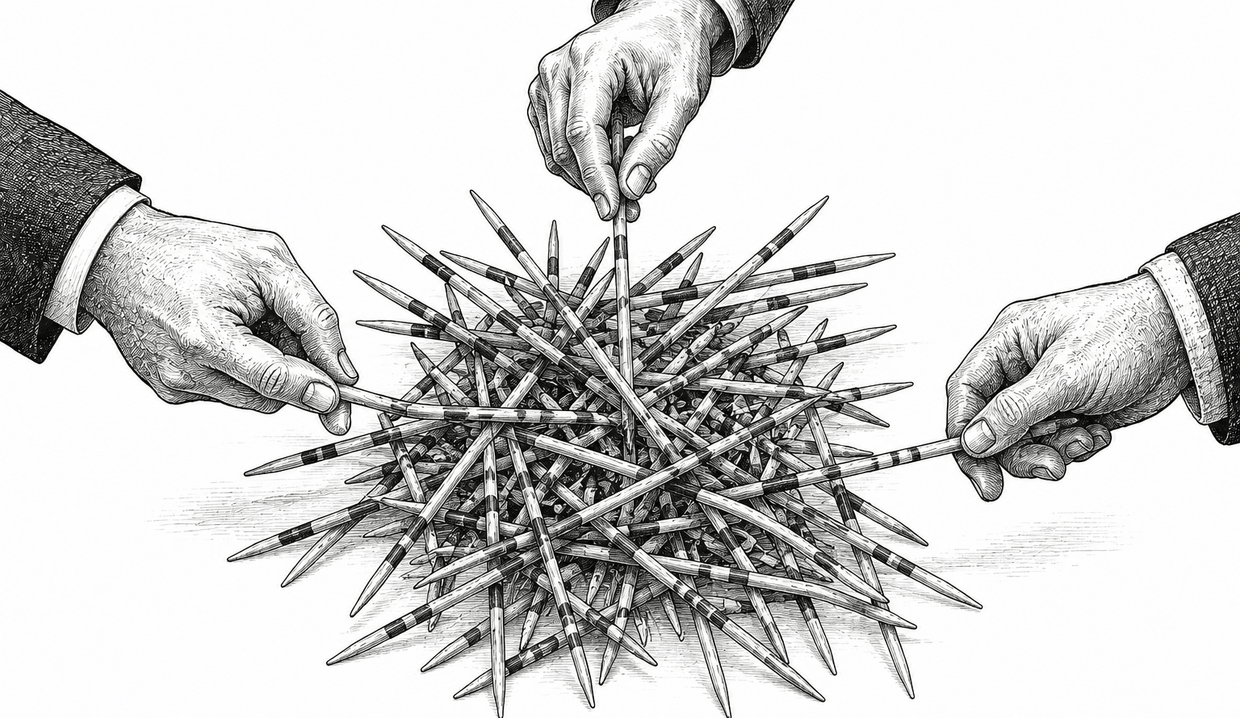
Think of the pile in pick-up sticks, in the first moment, before anyone has taken a turn.
The sticks are dropped in a heap. They land crossed and tangled, each one resting on others, each one pinned by others in turn. The pile is rigid, not because any single stick is strong, but because every stick traps its neighbors. Nothing on the table can move, because everything holds everything else in place. It looks like stillness. It is tension, locked.
That stillness lasts only as long as no one touches it. Reach in and pull a stick hard, and the whole pile answers. Not the one stick. All of them. The pull travels through every point of contact at once, and the heap that sat motionless for the entire game moves in a single instant. The rigidity that kept it still is exactly what makes the reaction total. A loose scatter would absorb the pull and stay much as it was. Only a jammed pile transmits a single tug through its entire body.
That was Europe. Dependent, deferring, each nation’s caution pinned against its neighbor’s, the whole continent held motionless by its own interlock. It looked like peace. It was tension, locked, and everyone had stopped noticing because nothing had moved in so long.
Then three hands reached in at once, each certain it was pulling its own stick free from a pile that would hold for the rest.
The pile moved.
This was not the reaction any of them intended. Each expected a weaker, more divided, more biddable Europe, a continent that would panic separately and bargain alone. Instead the pull ran through every point of contact the continent had, and the posture that had not shifted in decades broke in one motion. The very rigidity they meant to exploit, Europe’s frozen dependence, is what carried the shock into every corner at once.
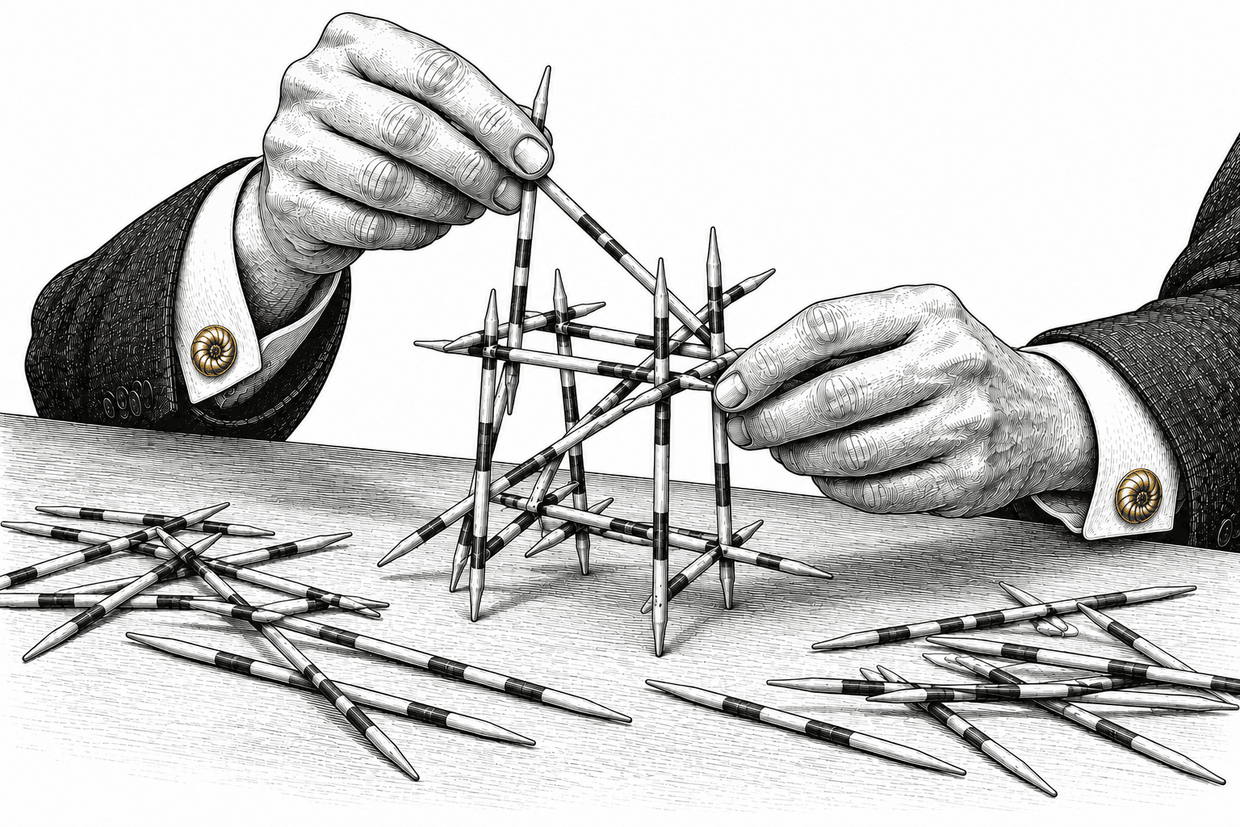
But the game tells the harder truth as well. A pull builds nothing. It scatters. The sticks fly loose, and what was locked is now merely free, lying wherever it fell. Freedom to move is not yet a structure.
That is where Europe now stands. The lock is broken. The pieces are loose for the first time in a generation. The security it outsourced, the markets it assumed, the transition it must now fund without cheap energy from the east or a free shield from the west, all of it is suddenly movable, none of it yet arranged. The shock did what internal politics never could. It ended the stillness. It could not decide what comes after.
And here the German contract stops being German. The pieces now loose on the table are continental. No single country can gather them. The settlement between old and young, worker and owner, present and planet, that Germany was renegotiating alone is now every European nation’s to renegotiate together, because the same pull moved all of their sticks at once.
That is the new ground. Not recovery, which would only drop the sticks back into the old tangle. Recoherence, which gathers loose pieces into a structure that fits the world as it now is, chosen deliberately, by hands that mean to build rather than hands that meant to break.
The three who reached into the pile wanted a scatter they could pick from at leisure. They may instead have given Europe the one thing it could never give itself. A table where everything is finally loose, and a reason that will not let it be left alone.
So it is time to play a new game. And here is the truth hidden inside that line. The game is not new at all.
It is the oldest game there is. The founding game. The one every people plays exactly once, at the beginning, when it has to build what it cannot simply be handed. A defense that is its own. An economy that answers to no one’s permission. A settlement between its generations that it wrote itself. Every nation that has lasted played this game at its start, in blood or in argument or in both.
Europe never did.
Modern Europe was not founded so much as furnished. The structure it lived in was built for it, by the ruin of 1945 and the shield raised over it afterward. Its security came ready-made. Its markets came guaranteed. Its peace was, in the deepest sense, a gift, and a gift is received rather than made. Europe grew rich and old and wise inside a house it did not build and never had to defend.
A people can live a long time in a house it inherited. It cannot live there forever. Sooner or later the roof raised by others has to be held up by the ones inside it, or it comes down on them.
That is the game now on the table. Not a clever new contest to be learned, but the founding one Europe was spared and is now made to play, late, in the open, with the whole world watching to see whether a continent this old can still do the youngest thing a people ever does.
The pieces are loose. That much was done from outside, by three men who meant to take and may have forced a founding instead. What gets built from here is Europe’s alone, the one task no adversary can do for it and no ally can do in its place. You cannot inherit a founding. By definition, you build it yourself.
So the game is the founding game. Europe skipped it once. It does not get to skip it twice.
1. Mittelstand: the network of small and midsize, often family-owned, German firms that forms the country’s industrial core.
2. Mitbestimmung: German co-determination, the system giving employees seats on a company’s supervisory board.
The Center Cannot Claim Calm Anymore
Germany had two warnings in one week. Both said the same thing.
For twenty years, Germany’s political establishment sold itself on a single promise: whatever else was true, the center was the stable option. Vote for the mainstream and you got continuity, competence, a steady hand. The alternative was chaos. That promise did a great deal of work. It held a fractious country together through the euro crisis, the migration wave of 2015, a pandemic, and an energy shock. It was the load-bearing wall of the postwar order.
Within a single week this September, that wall gave way twice. On September 3rd, the supervisory board of Volkswagen, the industrial symbol of the postwar miracle, approved the largest restructuring in the history of the global car industry: one hundred thousand jobs gone by 2030, and for the first time ever, full-scale factories shuttered on German soil. Two days later, in the eastern state of Saxony-Anhalt, the Alternative for Germany, a party parts of which the country’s own domestic intelligence service has classified as right-wing extremist, won 43.9 percent of the vote and finished first by twenty-six points.
The AfD result fell three seats short of an outright majority, and every other party still refuses to govern with it, so there may yet be no AfD-led government. Hold onto that qualifier. It is the last thread the old story has left. But treat the two events as what they are, a companion pair, and the thread looks very thin. One is the country’s flagship company admitting its model no longer holds. The other is a fifth of an electorate saying the same of the state. They are not separate stories. They are one story, read off two different instruments.
I want to suggest a way of reading this that goes beyond the usual vocabulary of protest votes and eastern grievance. I have spent years developing a framework I call Coherence Economics, and its premise is simple. Every durable system, a company, a currency, a country, runs on coherence: the quiet agreement between what a system says about itself and what it actually delivers. Coherence compounds. When an institution keeps its word, trust accrues, and that trust is the cheapest and most powerful asset any order possesses. It lets you borrow patience during hard times. It lets people absorb a bad year because they believe in a good decade.
The opposite process is decoherence, and it does not announce itself with a crash. It extracts, quietly, from the space between the story and the substance. A carmaker still calls itself the guarantor of good industrial jobs while it plans the end of four plants. A government still claims to deliver security while towns lose their trains, their clinics, their young people. Each broken commitment is a small withdrawal from the trust account, and for a long time the balance seems fine, because trust drains slowly. Then it isn’t.
The framework has a master theorem, four words I keep returning to because they have never once failed me: the instruments go first. Before a system fails outright, the tools it uses to measure and steer itself stop reading true. The dials say calm while the engine is coming apart. In a company, the accounting balances right up until the quarter it doesn’t, and by the time a board votes to cut a hundred thousand people, the failure it is responding to is already years old. In a country, the reassuring vote shares and the essays about populism having peaked arrive right until the night an exit poll lands like a blow.
This is what makes Saxony-Anhalt worth more than a regional footnote. Read the dials. In 2021 the AfD took 20.8 percent there. This month it more than doubled that. The Christian Democrats, who won the state as recently as four years ago with 37 percent, collapsed to 17. These are not the numbers of a system under strain that will recover with a better communications strategy. They are the numbers of a system whose gauges have stopped agreeing with reality. The center did not lose an argument. It lost the thing that let it be believed at all.
There is a hard truth here that the center struggles to say aloud, because saying it implicates the center itself. The AfD does not compound anything. It is not an alternative order; it is an extraction machine that runs on the decoherence others created. It offers no coherent account of how it would run a modern export economy, honor Germany’s alliances, or keep the lights on. Its energy comes entirely from the space it did not create, from every citizen who was told the system worked and found, in their own town, that it did not. You cannot beat such a machine by insisting the tank is still full. Denial is the fuel.
And this is where the German case turns genuinely sobering, because this country has decohered before. Twice in a century a German order that looked solid came apart faster than anyone measuring it believed possible, and both times the instruments read reassuring almost to the end. Nobody should reach lightly for that history. But the mechanism does not care about our reluctance to name it. The lesson is not that 2026 is 1933.
It is that stability is not a natural resting state you return to3. It is a balance in an account that has to be refilled, and Germany has been drawing it down for a long time.
So what would refilling look like? The framework calls this third movement recoherence: the deliberate, unglamorous work of closing the distance between story and substance. It does not mean a cleverer slogan or a firmer firewall, though the firewall matters. And it is worth saying plainly that Volkswagen’s board is not the villain of this piece; a company that aligns itself with reality, however brutally, is doing the honest thing its political class has avoided. What the mainstream owes the country is the same honesty turned constructive: delivering something real and visible in exactly the places where the promise broke. A train that runs. A clinic that reopens. A young person who can build a life in the town where they were born rather than leaving it to the party of grievance. Trust is not rebuilt by argument. It is rebuilt by delivery, slowly, at the rate it was lost.
The temptation now will be to treat all of this as an aberration, a bad week in a hard year, something the next quarter or the next election will correct. That is the instruments talking. The honest reading is the harder one. The status quo in Germany is not wobbling. It is slipping, definitively, and the comforting idea that the center is where safety lives has quietly stopped being true. The only question left is whether the mainstream understands that safety is no longer a place it can stand. It is now something it has to earn back.
3. On the historical reference, see Note 8. The allusion is to the mechanism of decoherence, not a claim of equivalence with the 1930s.
NOTES
1. The Volkswagen deal. On September 3rd, 2026, Volkswagen Group’s supervisory board unanimously approved Future Plan 2030. The plan adds roughly 50,000 job reductions to about 50,000 already agreed under a 2024 union pact, bringing the group total toward roughly 100,000 positions by the end of the decade. That is about 15 percent of the group’s global workforce, described as the largest restructuring in the history of the global auto industry. It exceeds the 50,000 cuts General Motors made after its 2009 bankruptcy. The precise location of the new cuts remains subject to talks between management and labor; the CEO has indicated roughly half would fall in Germany.
2. The four German plants. Management and unions agreed that long-term production could not be guaranteed at four German sites, Hannover, Emden, Zwickau, and the Audi plant at Neckarsulm, as current programs wind down across roughly 2031 to 2034. Alternative uses are being assessed. The company has said outright closures would be a last resort but has not ruled them out. Volkswagen has acknowledged European capacity exceeding demand by more than 500,000 units.
3. The financial picture. The plan targets an operating margin of 8 to 10 percent by 2030, up from a first-half margin near 3.8 percent, on projected annual sales of about 9 million vehicles. Group operating profit fell to roughly 8.9 billion euros in 2025 from 19.1 billion the year before. Leadership has cited a cost disadvantage of about 20 percent versus principal competitors, and a 36 percent drop in China sales, VW’s largest market. The plan also calls for cutting the model portfolio by about 50 percent and reducing offering complexity by about 75 percent by 2035.
4. Co-determination and the Volkswagen Act. Under German co-determination, employee representatives hold half the seats on the supervisory board of large firms. At Volkswagen, the state of Lower Saxony holds a roughly 20 percent voting stake and, under the Volkswagen Act of 1960, can veto major decisions. Both labor and the state have historically used this position to defend domestic employment.
5. The Saxony-Anhalt result. The figures cited, the AfD near 44 percent against 20.8 percent in 2021, and the Christian Democrats near 17 percent against 37 percent, describe the companion piece’s argument about the divergence between official confidence and electoral reality. Vote shares should be checked against final certified results. Portions of the AfD have been classified by Germany’s domestic intelligence service as right-wing extremist; the classification has been subject to legal challenge.
6. The two-model distinction. The contrast drawn between the midsize base and the automakers is analytical rather than a claim that midsize firms face no pressure. The point is structural: diversified midsize firms adapt continuously and at the edges, while a concentrated, strongly co-determined automaker stores adjustment pressure until it releases at once.
7. On the external actors. The characterization of Putin, Trump, and Xi describes strategic postures toward Europe, pressure on security guarantees, the pricing of alliance, and the preservation of market dependence, as an analytical frame. It is not a claim of coordinated intent. The argument’s core is that pressure from several directions at once removes Europe’s ability to defer, whatever each actor intended.
8. On the historical reference. The companion piece’s allusion to earlier German ruptures is invoked as a mechanism, how confidence in a system’s own instruments can persist while the system decoheres, not as a claim of equivalence between present events and the 1930s. The explicit point in the text is that the lesson is not that 2026 is 1933.
9. Coherence, decoherence, recoherence. Both pieces draw on the Coherence Economics vocabulary. Coherence denotes the alignment between what a system promises and what it delivers; decoherence, the quiet extraction that occurs as the two diverge; recoherence, the deliberate reconstruction of that alignment, distinct from mere recovery, which restores the prior arrangement.
Sources include Volkswagen Group statements on Future Plan 2030 and contemporaneous reporting from Reuters, Bloomberg, Quartz, and Agence France-Presse, together with reporting on the Saxony-Anhalt state election, September 2026.
BONJOURHI! INSTITUTE ANALYTICS · MONTREAL · 2026