

Bonjourhi!
Everyone can see the trade war. Sixty countries, steel, cars, a number that doubles overnight and takes effect in a year that has not arrived. What is harder to see is the shape of it. This does not look like a war between rich and poor, though the cost falls downward. It does not look like a plan, though it repeats. It looks like a house with old wiring, and a panel full of fuses, and one fuse that keeps being the first to go. The question worth asking is not why the tariffs. It is why Canada, again.
The old logic of trade was a logic of abundance. Goods moved to wherever they were cheapest to make. Capital moved to wherever it earned most. The consumer paid less every year and called it progress. Nobody asked where the jobs went, because the shelves were full and the prices were low, and a full shelf is a very persuasive argument.
For these two countries, the wiring came before the trade. The car industry was fused across the border two decades before free trade existed, and every argument since has been about a circuit no one will switch off. A single part can cross the border four times before it is installed. The line on the map stayed. The current stopped noticing it.
That logic held for a long time. Then it stopped holding for the places that had paid for it.
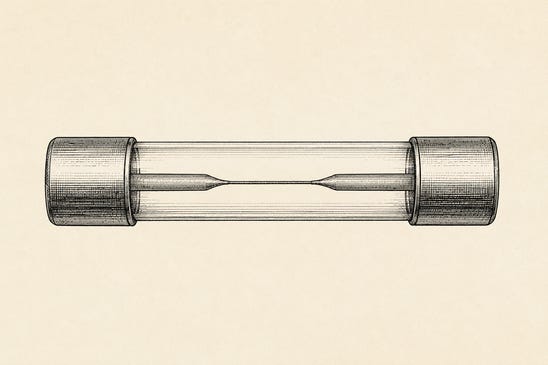
Consider the fuse. In every electrical panel there is a small strip of metal, thinner than the wires around it, chosen on purpose to be the weakest thing in the system. When the current surges, the fuse is engineered to fail first. It melts so the wiring behind the walls does not. This is not a flaw. It is the entire design. The fuse is sacrificed because it is cheap to replace, and its failure is visible, a small controlled break that prevents a large uncontrolled fire. A house without a fuse is not safer. It is a house that burns at the wall instead of at the panel.
A fuse has three qualities that make it the fuse. It is close to the source. It carries real load, so its failure means something. And it is the cheapest thing in the circuit to lose.
Now look at Canada. It sits closest to the source, sharing the longest border and the most integrated supply chain, the one where a part can cross and recross before a car is finished. It carries real load, a large share of the vehicles sold in the country tied to what moves across that border. And in the arithmetic of Washington, it is treated as the cheapest to lose, an ally assumed to absorb the blow and stay in the circuit. Close, load bearing, and considered expendable. That is not an insult. That is a job description. It is what a fuse is.
This is why the number lands on Canada first and returns to Canada often. Not because Canada is the largest problem. Because Canada is the safest place to stage the failure. A break with China risks the whole panel.
A break with an ally who will not walk away is a controlled melt, visible enough to satisfy the room, contained enough to survive. When the impact is defended as a small share of trade and a smaller share of consumption, that is not a defense of the policy. That is the specification sheet for a fuse.
The cost is regressive, a tax paid at the till by the people with the least room to pay it, but the deepest strain is older than any question of who pays. A society that has drawn more than it makes for forty years, settling the difference in a currency the world still accepts, has called that arrangement normal only because it never once had to stop. That is the load the wiring was never sized for. A tariff does not lighten it. It changes the price of carrying it, and insists, one more time, that the problem is anything except the current behind the wall.
Every electrician knows something the panel does not. A fuse only protects the house if it is willing to break. Wire in one thicker than its rating, one that will not melt when it should, and the design inverts. The fuse stops being protection and becomes another stretch of wire, and a circuit with no fuse is only a circuit waiting for the fire it was built to prevent.
So follow the current. When a fuse refuses to melt, the current does not reverse and it does not stop. It keeps pushing down the line, past the part that held, until it reaches the next thing that was never built to take it. Nothing backs up. Everything downstream simply waits its turn.
It finds the American consumer first, the nearest thing not built to take it, and arrives at the till on the car and in the appliance without a label saying where it came from.
It finds the American producer next, the plant in Ohio that waited on the part from Ontario and now waits for nothing, because the machine that crossed the border four times was never two national cars but one shared circuit. Break the circuit on one side and you have not protected the other. You have only decided where it fails.
The fuse was never there to win a fight with the current. It was there to lose one, on purpose, early, so that the loss stayed small. Remove that willingness and you have not removed the surge. You have removed the only thing that ever kept it survivable.
The tariff Canada refuses to absorb does not become someone else’s tariff. It becomes a current with nothing left to stop it, which is the precise thing the panel was designed to prevent.
Canada spent this year learning to be thicker than its rating. Matching the tariff dollar for dollar. Threatening the electricity and the minerals. Refusing the role it was handed in 1965 and every year since. Read one way, that is a country finally standing up. Read another, it is the removal of a fuse from a panel that has not upgraded its wiring in forty years and has no plan for what happens when the current has nowhere to break.
Both readings end in the same room.
When a fuse refuses to melt, the oldest answer in the panel is also the crudest. You jam a coin into the gap to force the circuit shut, and the nearest coin to hand is the one you already decided was worthless. The lights stay on. The panel feels solved. And the heat goes where no one is looking. This is the tariff wielded to override the signal rather than read it, the insistence that the circuit can carry whatever it is asked to carry, as long as nothing is allowed to trip.
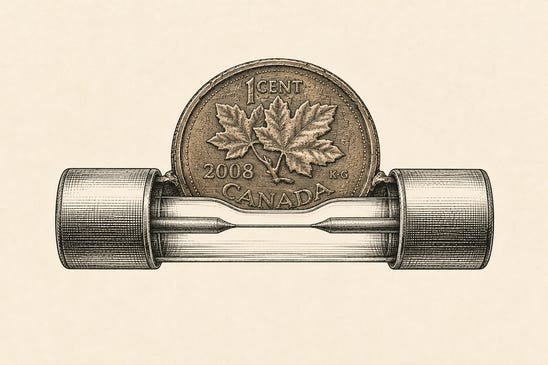
The penny works, for a while. That is the danger of it. It is the fire you cannot see the start of, spreading behind the wall, through wiring shared by everyone who thought the break would happen somewhere else. A blown fuse is the system working. A pennied one is the system pretending its wiring is fine right up until the wall is warm to the touch.
But the penny is not all a stubborn fuse can become. There is a second kind of protection, and it is worth knowing. A fuse dies once, by destroying itself, and its death is the whole of its service.
A breaker does the same job and survives it. It trips, it holds the line, and it waits to be reset, on purpose, by someone who has decided the conditions are safe again. A fuse is sacrificed by the system. A breaker is a decision the system has to live with.
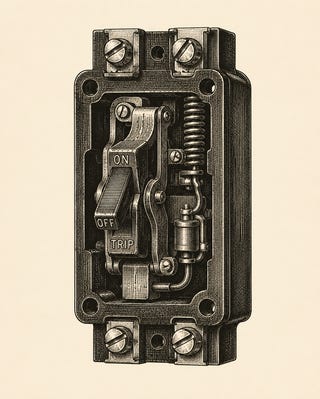
This is what a fuse becomes when it survives its own refusal. The retaliation is the trip. The return to the table is the reset. The symmetry, this much and no further, is a set point, a threshold the component now declares for itself. And you cannot run a breaker the way you ran a fuse. The country that was cheap to lose is trying to become the country that is expensive to ignore.
And if the breaker cannot do the job, there is always the disconnect on the line. It is not in the panel at all. It sits out on the network, upstream of every fuse and breaker in the house, and it does not protect the current or manage it or reroute it. It simply opens the line and lets the current stop. Every device in the panel assumes the circuit should carry what it is asked to carry. The disconnect assumes nothing. It is the hand that walks out past the panel entirely, to the one lever that ends the question.
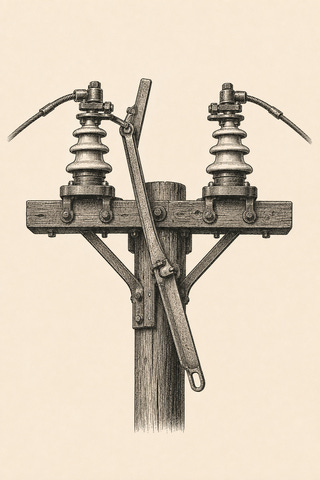
Look at what is being asked, all at once. Give up the industry. Repeal the laws that make the country itself. Keep the power flowing without complaint. And find no other buyers for the goods just taxed.
Each request removes one path. Set together, they do not describe a deal anyone expects to be signed. And you can see that no one expects it, because the one place that cannot afford to be wrong barely moved. When the tariffs landed and the threats doubled, the currency slipped half a cent and the markets went back to their previous level, by the afternoon. That is not complacency. It is the judgment of everyone with money at risk, reading demands built never to be met.
And so the ally cast as the cheapest thing to lose stands, it turns out, next to the master switch.
The electricity. The minerals. The current itself, and the hand on the lever that stops it. It has already thrown a small version. The provincial bans on American liquor were never a matching tariff. They were a shelf cleared, a flow stopped, a refusal to buy at all, and it was that, not the symmetrical tariffs, that the other side could not abide. No one throws that lever willingly. It is the one device that admits defeat, conceding the circuit cannot be saved, only stopped.
You reach for it not because you want to, but because every other device in the panel has already been tried, and overridden, and the only choice left is whether the current stops by decision or by fire.
The fuse was never the risk. The penny is what a panel reaches for when it will not change. The breaker is what the current forces it to become. And upstream of them both, out on the line where the panel has no say, there is a disconnect that simply opens and lets the load fall to nothing.
No one wants to pull that switch. The danger is a house that leaves them nothing else to hold.
NOTES
1. The single car industry referred to is the Canada United States Automotive Products Agreement, the Auto Pact, signed in 1965. It integrated automobile production across the border two decades before the 1988 Free Trade Agreement, which Mexico joined in 1994 and which was renegotiated as recently as 2017 and 2018. The wiring, in other words, predates the trade deals built on top of it.
2. The four crossings are not a figure of speech. A striker plate for a car door, documented in 2025, begins as Michigan steel, is shaped in Windsor, heat treated in Brampton, plated back in Michigan, and returns to Windsor for inspection before final assembly in the United States. A single vehicle contains roughly thirty thousand parts, many with similar itineraries.
3. Roughly one in four vehicles sold in the United States is assembled in Canada or Mexico, and a far larger share contains components that cross a North American border at least once during production.
4. The characterization of the impact as a small share of trade and consumption reflects how the measure has been publicly defended. The point here is not whether the figure is accurate. It is that a deliberately contained effect is the design goal of a fuse, not an argument against calling it one.
5. The Canadian penny was minted from 1858 to 2012 and withdrawn from circulation on 4 February 2013. It remains legal tender but is no longer produced or distributed. The coin in the illustration is dated 2008. The image therefore shows an override performed with currency the country has formally retired, which is the point the caption makes.
BONJOURHI! INSTITUTE ANALYTICS · MONTREAL · 2026