
Bonjourhi!
Everyone asks which giant wins. China, which floods the world with what it cannot sell at home. America, which bolts the door.
Wrong question. Both are the same reflex in different costumes, and both leave the middle powers caught between a flood and a wall.
There is a third choice. It lasted three hundred years. In three parts, below.
Part I. China Is Choosing Deflation
A country that fills its shelves faster than the world can empty them, and forbids its own people to buy the difference.
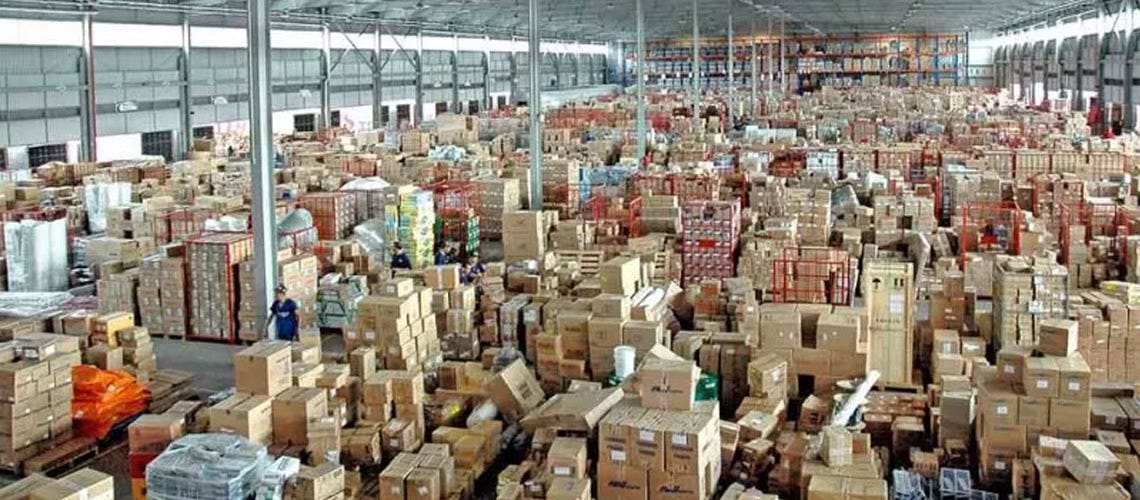
Everyone is waiting for China to recover. The lockdowns ended, the doors opened, and the assumption was that the old engine would roar back. It has not. Growth is missing its own targets, prices are drifting downward, and confidence has thinned. The story being told is one of a stumble, a bad patch, a delayed comeback. But this is not a stumble. It is the sound of a country that keeps ordering stock it cannot sell, run by people who are paid to keep ordering. What follows is the story of a nation falling into deflation, and why it cannot choose otherwise.
The machine that only knows one gear
For four decades, China built. That was the logic, and it worked.
More factories to open.
More capacity to add.
More output to move.
The plans were written this way from the start. The first five-year plan of the reform era ran past a hundred pages, and household consumption received a single one. The most recent plan, forty years later, gives consumption a single paragraph. The emphasis never moved. Build the industrial base, fill the world’s shelves, and let foreign markets absorb whatever the home market cannot.
The party has always seen consumption as a distraction. Spending is individual. Production is collective, and collective things can be directed. Low consumption feeds high savings, high savings feed the state banks, and the state banks feed the factories. The whole arrangement is not an accident of economics. It is a design for control.
The merchant paid to store
Imagine a merchant who is paid not for what he sells but for what he keeps in stock. The larger his inventory, the greater his standing. So he orders, and orders again.
The shelves fill first. Then the aisles. Then the loading dock and the yard behind it.
For a while this works, because there are buyers in the next town, and he ships them what he cannot hold. His storehouse overflows and the surplus becomes someone else’s problem, at a fair price.
Then the next town builds its own storehouse. The buyers stop coming. They put up a gate to keep his goods out.
Now the stock has nowhere to go, and still he orders, because he borrowed to buy it and the lender wants paying. So he sells at any price, below what the goods cost him, because a sale at a loss is still cash and cash holds off the lender one more week. The price of everything in the district falls with his. And the inventory that was supposed to be his wealth becomes the weight that pulls him under.
This is overcapacity. This is how it turns into deflation.
Where the shelves are already overflowing
Look at what China now makes. It produces twice as many solar panels each year as the world can install. Its battery output in a single year matched total global demand. More than a quarter of its carmakers lost money last month. The utilization rate in its solar industry fell to twenty-three percent, and the factories run anyway, because idle factories cannot service debt.
Every province was told to build the same priority industries. Xinjiang and Shanghai, Heilongjiang and Hainan, all racing into the same sectors with almost no coordination between them. They call the result nei juan. Involution. Everyone stocks more, no one differentiates, and the only competition left is who can cut the price further.
The prices fall. Inflation sits near zero. Debt climbs. Confidence erodes, so people buy less, so prices fall again. The loop tightens with each pass, and every pass is harder to reverse than the one before.
The warehouse that held the surplus for a while
For a long time, the merchant had an answer to his overflowing stock, and it was a clever one. If he could not sell the goods, he would build somewhere to put them. So he built warehouses. Then more warehouses. The building itself consumed the surplus, because a warehouse is made of the very bricks and steel piling up in his yard. The problem solved the problem. For years it worked.
This was China’s property boom. The steel, the cement, the glass, the aluminum, all of it had somewhere to go: into apartment towers, ring roads, high-speed rail, whole new districts raised from empty ground. Construction became the customer that the export markets could no longer fully be. At its peak, real estate and building reached close to a third of the entire economy.
And it worked, the way the merchant’s warehouses worked, as long as one thing held true. As long as people believed the buildings were worth something.
But a warehouse is only worth what goes inside it. In the end the merchant was building warehouses to store the bricks he was making to build the next warehouse. The towers went up faster than anyone moved in. By recent estimates China holds somewhere between sixty-five and eighty million empty homes, enough to house a large country. Entire districts stand finished and unlived in, the ghost cities.
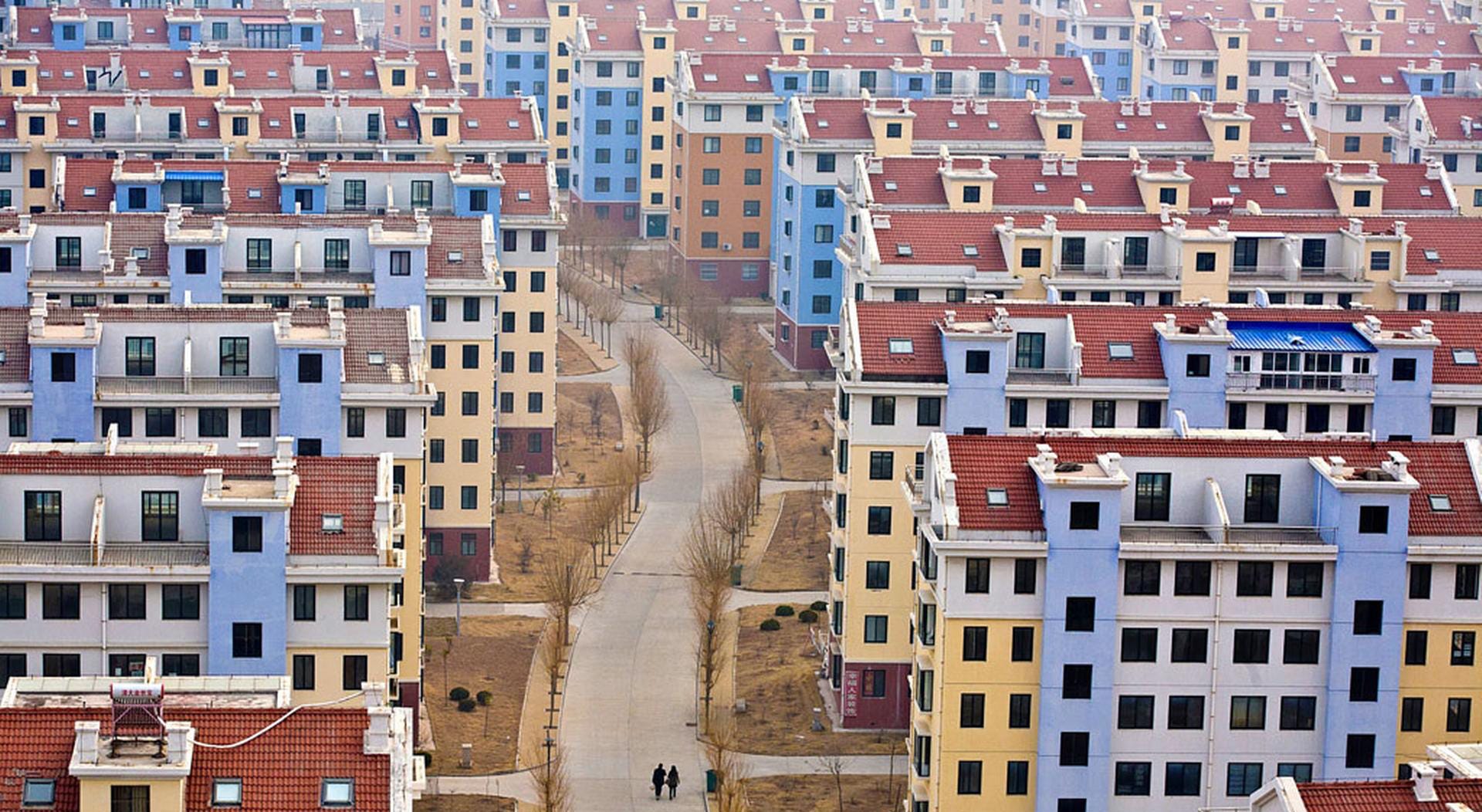
Then the belief broke. In 2021 the largest developer, Evergrande, defaulted on more than three hundred billion dollars, leaving hundreds of thousands of paid-for homes unbuilt. The circle that had absorbed the surplus for twenty years stopped turning. And the surplus, with nowhere left to go, turned back toward the only exit remaining, the one that pushes prices down.
The merchant had not solved his problem. He had borrowed against it, and postponed it, and made it larger.
This has happened before, twice.
Japan is the comparison everyone reaches for, and it is worth reaching for once, then setting down.
When Japan’s bubble burst in 1990, its companies stopped borrowing and started paying down what they owed. They spent more than a decade emptying their own storehouses and buying nothing new. Prices fell slowly, only a few percent across many years, but they never quite stopped falling. Japan called it the lost decade, then had to call it two.
But Japan’s storehouse emptied because the merchant stopped ordering. The buyers were there. The seller had lost his nerve.
China’s storehouse overflows because the merchant cannot stop ordering. The buyers are the ones who left. Same falling prices, opposite cause, and a cause that is harder to cure, because you cannot wait for a merchant’s confidence to return when the problem is that he is compelled to keep buying.
The older lesson runs deeper. In 1933, an American named Irving Fisher watched the Great Depression and named the trap inside the storehouse. Falling prices, he wrote, make debts heavier. So the merchant who discounts his stock to raise cash finds that each markdown raises the real weight of what he owes. The faster he sells to escape the debt, the larger the debt becomes.
Fisher called it debt deflation. It is the merchant’s whole predicament, described ninety years ago, in the country now watching China with such concern.
Why the exit stays locked
The obvious answer is to rebalance. Order less stock, put money in the hands of ordinary people, let them buy. Beijing knows this. Its own economists have said it for twenty years, since 2005 at the latest.
It will not do it.
To hand purchasing power to households is to loosen the leash. A buyer who spends as he chooses is a citizen who no longer depends on the state to tell him what to want. A business elite with access to private capital is an elite that no longer needs the party’s banks. The overflowing storehouse is not a flaw in the plan. It is the price of the control the plan exists to protect.
So instead of rebalancing, it tightens. Instead of selling down the stock, it orders more. Xi has doubled down on self-sufficiency, mobilizing the entire banking system to fund the same crowded sectors. The remedy is another delivery of the thing already spoiling on the shelf.
The closing turn
The West keeps asking whether China will overtake it. That is the wrong question.
There is one more precedent, and it is not an economic one. Another great power once decided that what mattered was how much it produced, not what its people could buy. It counted its strength in tonnage and left its shelves empty. It did this not by miscalculation but by design, because a directed economy kept the citizens dependent and the leadership secure. That country was the Soviet Union, and the design outlived the economy that ran on it.
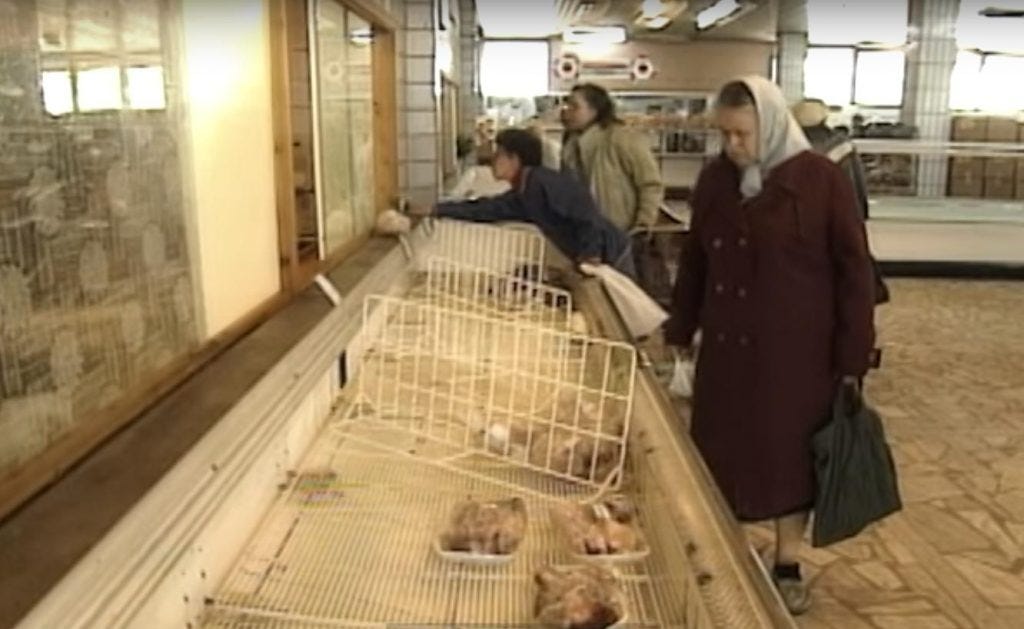
China is not the Soviet Union. Its factories are efficient, its exports are real, its engineers are among the best in the world. But the instinct is the same one. Produce, do not let them buy, and hold the control that producing provides.
A merchant who fills his storehouse faster than the world can empty it, and who is forbidden to let his own neighbors buy the difference, has only one direction left for his prices. Not a recession, which passes. A deflation, which settles in and compounds.
China’s problem was never that it could not build. It is that it never learned how to want.
Part II - The Chinese Are Not Stupid
The Party has a choice. It has simply decided that its own primacy matters more than the exit.
Bonjourhi!
The easy explanation for China’s troubles is that its leaders miscalculated. That they built too much because they did not see the wall coming. This is comforting and it is wrong.
The people running China’s economy are among the most capable technocrats any state has ever assembled. They can read a utilization rate. They know what a deflationary spiral looks like, because their own economists have described it for twenty years.
So the puzzle is not why smart people made a mistake. It is why smart people keep choosing the mistake, and whether they truly have no other choice. They say they do not. The record says otherwise.
The customers who stopped coming
Start with a limit the merchant keeps forgetting. He can order his suppliers to keep delivering. He cannot order anyone to buy.
The customers he needs most are the young. They are the ones who would fill the empty towers, start the households, buy the appliances the factories keep making. For decades the arrangement asked them to work brutal hours, the nine to nine, six days a week, and promised an apartment and a family at the end of it. The bargain held as long as the apartment was reachable.
It stopped being reachable. So the young stopped reaching.
They gave it a name. Tang ping, lying flat. It began in 2021 with a single post, titled Lying Flat Is Justice, written by a former factory worker who had decided that endless striving was not worth it.
The idea spread because it named what millions already felt. Work less. Want less. Delay the marriage. Skip the mortgage. Do the minimum the system requires and no more.
A harsher version followed, bai lan, let it rot, for those who had stopped believing the game could be won at all.
This is not a protest the state knows how to answer. It has admonished the lying-flat, named and shamed officials who embraced it, pushed back through its media. None of it works, because there is nothing to arrest.
A person who simply declines to want is breaking no law. In 2024 marriage registrations fell to their lowest level since 1980. The customers are not rioting. They are just not coming.
And here is the trap closing on itself. The overproduction built the towers that had to be filled. Filling them required a generation willing to spend a lifetime paying for them. But the same system that overproduced also made the hours long, the jobs scarce, and the apartment a debt rather than a home.
So the generation lay down. The factories make what no one will buy, the towers wait for buyers who have quietly opted out, and the prices fall, because there is no forcing a customer through a door he has decided not to enter.
What the merchant knows
Recall the merchant from the first reading, the one paid to keep his storehouse full rather than to sell. He is not a fool. He can see the stock spilling into the yard, and he knows, better than anyone, that every crate he adds is worth less than the last.
None of this is hidden from him. That is the part worth sitting with. He understands his situation completely, and he keeps ordering anyway.
So the question changes. It is no longer whether the merchant sees the problem. It is why a man who sees it so clearly cannot bring himself to stop.
The choice dressed as a constraint
Beijing’s answer is that it has no choice. That China is too large, too complex, too dependent on its industrial base to turn toward its own consumers without inviting chaos. Rebalancing, in this telling, is a luxury China cannot afford.
This is a decision wearing the costume of a constraint.
We know it is a decision because the same choice has been offered to others in the same position, and some of them chose the other way.
The merchant next door
Consider the merchant next door. Same kind of shop, same single owner who tolerates no rivals, same instinct to control the street.
His name is Vietnam.
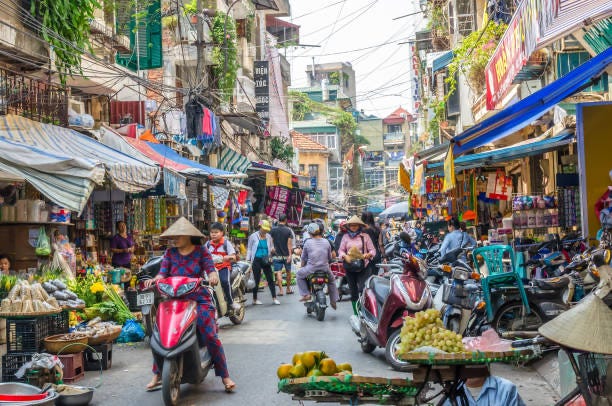
Vietnam is a one-party state. Its Communist Party guards its monopoly on power as jealously as China’s does. And yet Vietnam let its customers buy. Household consumption there runs above half of the economy, near fifty-four percent. In China it sits closer to thirty-eight, and it fell as the country grew richer, dropping from more than half in the early 1980s to roughly a third by 2008.
Same political shop. Opposite decision about the customers.
Vietnam did not collapse into disorder when its people started spending. The party did not lose its grip. The customers bought more, the shop stayed under one owner, and the storehouse never had to overflow, because there was somewhere for the goods to go. The thing Beijing calls impossible is operating next door, run by a party built on the same blueprint.
The merchant China used to be
There is a second witness, and it is the most damaging one, because it is China itself.
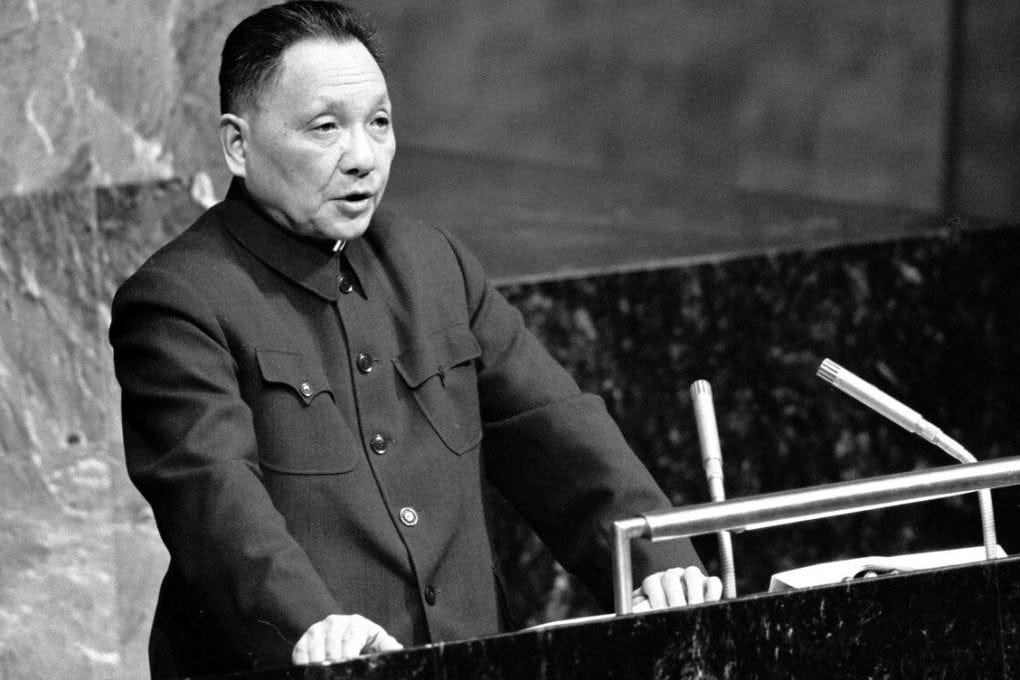
The merchant who opened the doors in 1978 was Chinese. Deng Xiaoping looked at a storehouse that decades of central planning had left both overstuffed and empty at once, and he made a choice that the orthodoxy of his day also called impossible. He let the market in. He let people want things, and earn things, and buy things. The doors opened, and the country woke up.
That merchant existed. He was not a foreigner. He was the founder of the very shop now insisting the doors must stay shut.
So when today’s owner says he has no choice, he is contradicted by his own predecessor. The choice was made once, in this shop, by this party, and it produced the greatest expansion of prosperity in human history.
Why the door stays shut anyway
If the choice exists, and the neighbor took it, and the founder took it, why does today’s merchant refuse?
Because Deng’s choice bought growth at the price of control, and the current owner has decided the price is too high.
A customer who buys what he wants is a customer who no longer asks permission. A shopkeeper down the block with his own money is a rival who no longer needs the owner’s credit. Deng accepted that risk because the shop was poor and had everything to gain. Today’s owner runs a rich shop with a great deal to protect, and he has concluded that a dependent people is safer than a prosperous one.
That is the real answer to the question in the title. The CCP has a choice. It has simply decided that its own primacy matters more than the exit.
The closing turn
So the Chinese are not stupid. This was never the right frame.
The tragedy is the opposite of stupidity. It is intelligence in full possession of the facts, choosing the worse outcome on purpose, because the better one would loosen a grip the leadership will not loosen.
The merchant next door proved the doors can open. The merchant this shop used to be proved it too. The only thing standing in the doorway is a man who would rather own a shrinking shop outright than share a growing one.
The question was never whether China can change course. It is whether the Party can survive doing so. And Beijing has already told us, through every crate it keeps ordering, what it believes the answer to be.
Part III - The Rest of the World Is Not Stupid Either
Two giants chose to flood and to wall. The many have a third choice, and it already lasted three hundred years.
Bonjourhi!
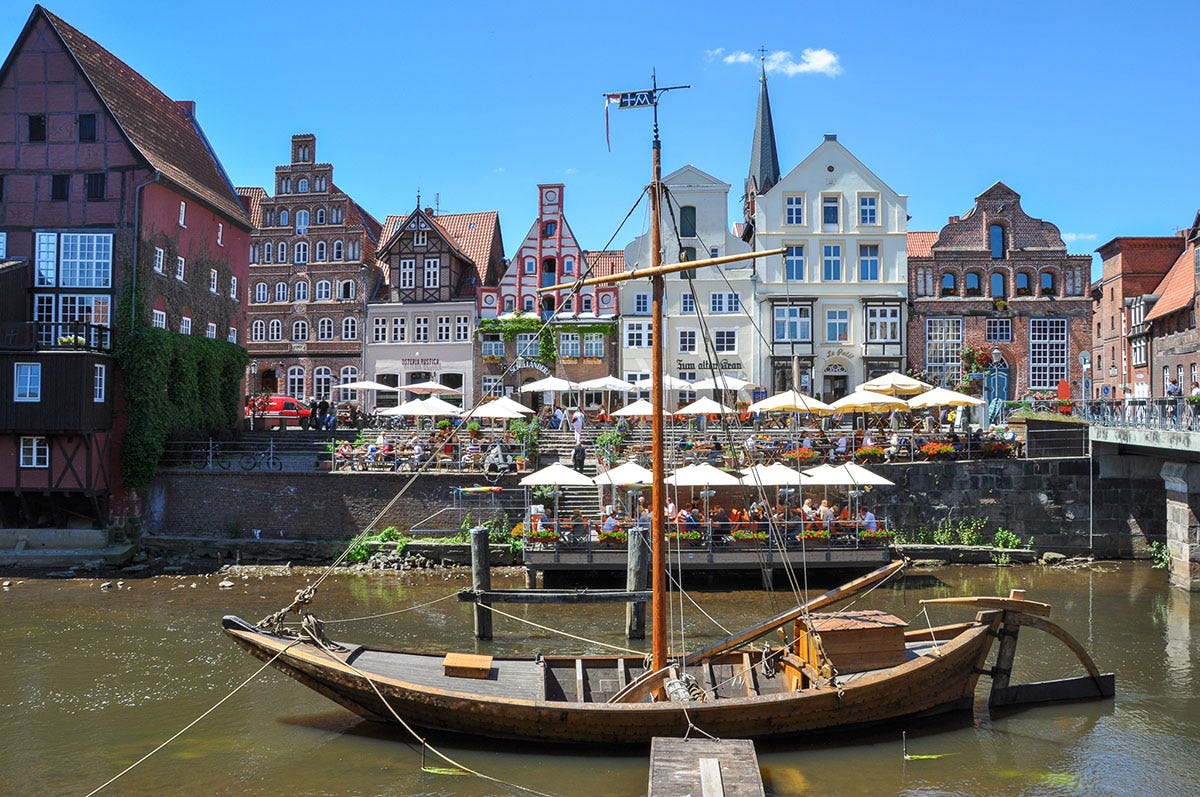
Two giants have made their choices. China chose to flood, producing more than the world can absorb and selling the surplus below cost. The United States chose to wall, raising gates against friend and rival alike. Both are the same reflex wearing different clothes. Both try to control the current rather than learn to live with it. And both leave everyone else, the middle powers who are neither giant, standing between a flood and a wall, wondering which way to run. The answer is neither. The answer was worked out eight hundred years ago, by merchants who faced the same problem and found something that lasted three centuries.
The shopkeeper between two giants
Return one last time to the street. There is the merchant who floods it with goods sold at a loss. There is the merchant who bars his door and lets no one in. And there is a third figure we have not yet looked at closely.
The small shopkeeper across the way.
He has no flood to loose and no gate worth barring. When the first giant dumps, his goods are undercut. When the second giant walls, his best customer vanishes behind it. He is not a giant, and he cannot become one. So his instinct is to pick a side, to shelter behind one giant against the other.
This is the trap. To pick a side is to accept that a giant controls your current. The shopkeeper who shelters behind the wall is still at the mercy of whoever built it. The one who takes the flood is drowned slowly by cheap goods. Neither choice is his own. Both are someone else’s leash.
For Canada this is not an abstraction. One enormous customer sits across the border, and has just shown he will close the door when it suits him. One enormous supplier sits across the ocean, and floods. Canada spent decades treating the first relationship as permanent. It was never permanent. It was a choice someone else could revoke, and now has.
What the free cities did
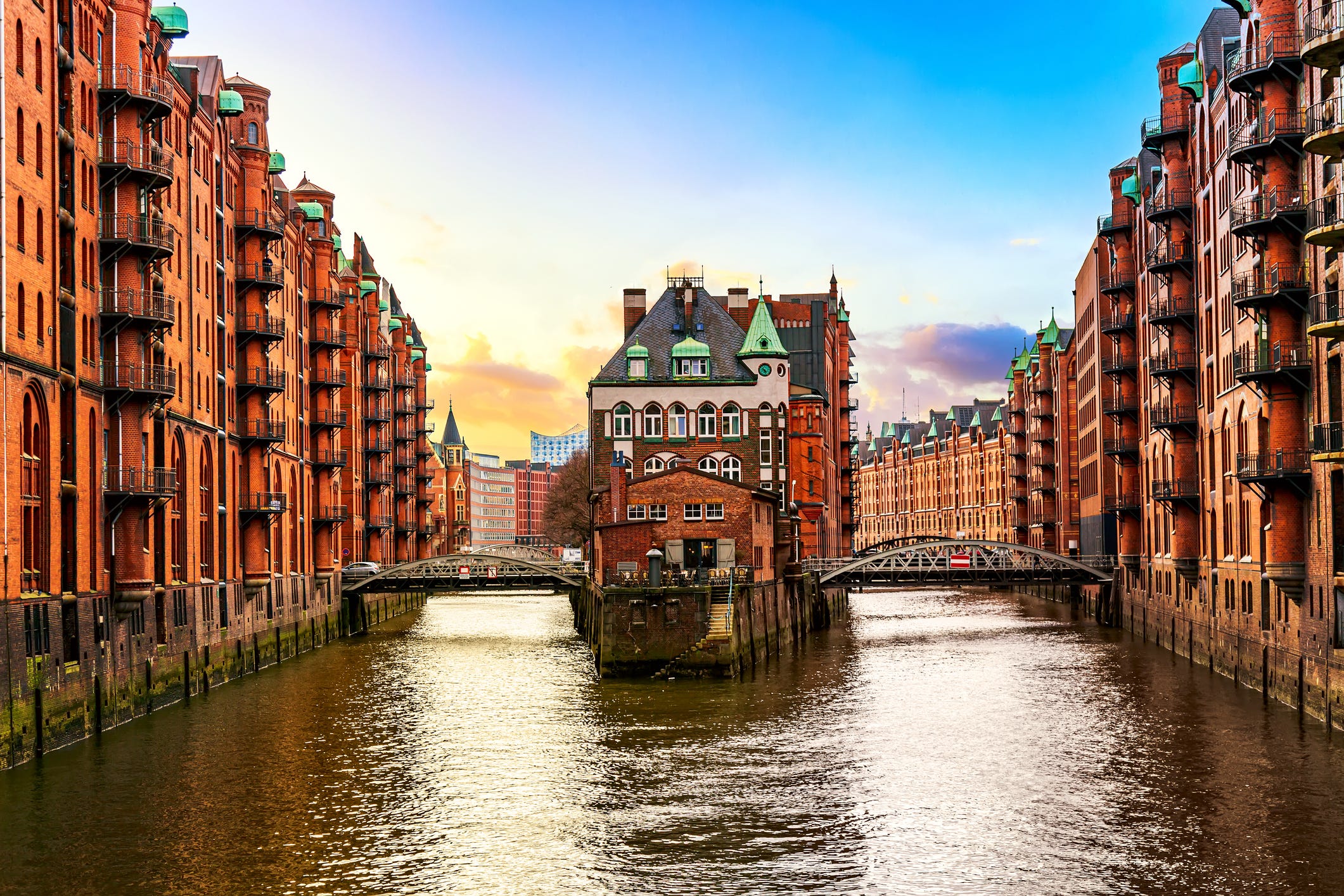
There was a time when the map of northern Europe was crowded with small shopkeepers in exactly this position. Free cities, Hamburg and Lubeck and Bremen and two hundred more, each too small to face the kings and warlords who surrounded them, each able to be squeezed alone.
They did not pick a side. They did something stranger and more durable. They pooled.
Beginning in the twelfth century, these cities formed what came to be called the Hanseatic League. It was not an empire. It had no king, no capital, no standing army worth the name. It was a voluntary confederation of traders who agreed on common things: common weights, common measures, common rules for settling a dispute, common protection on the roads and the seas. They met when they needed to and went home when they were done.
Their power was not force. It was the market they made together, and the threat of being shut out of it. A king who leaned too hard on one city found his merchants barred from all of them. The combined market was too valuable to bully and too large to flood. And so cities that were nothing alone became something no giant could dictate to.
The League stayed open. It traded with everyone, members and outsiders alike, through trading posts it kept in London and Bruges and Novgorod. It did not wall off, because the walling was never the point. The point was that no single power set the terms. The terms were set among the many.
It lasted about three hundred years.
The modern Hansa: a Hansada
The lesson for the middle powers is not to build a bloc against China, or a bloc against America. Blocs against are just walls by another name.
The lesson is to build a bloc among. A confederation of the open. Give it a name, so it can be argued for and built toward rather than merely wished. Call it a Hansada, the old Hansa anchored in Canada, a league of the open with a Canadian keel.
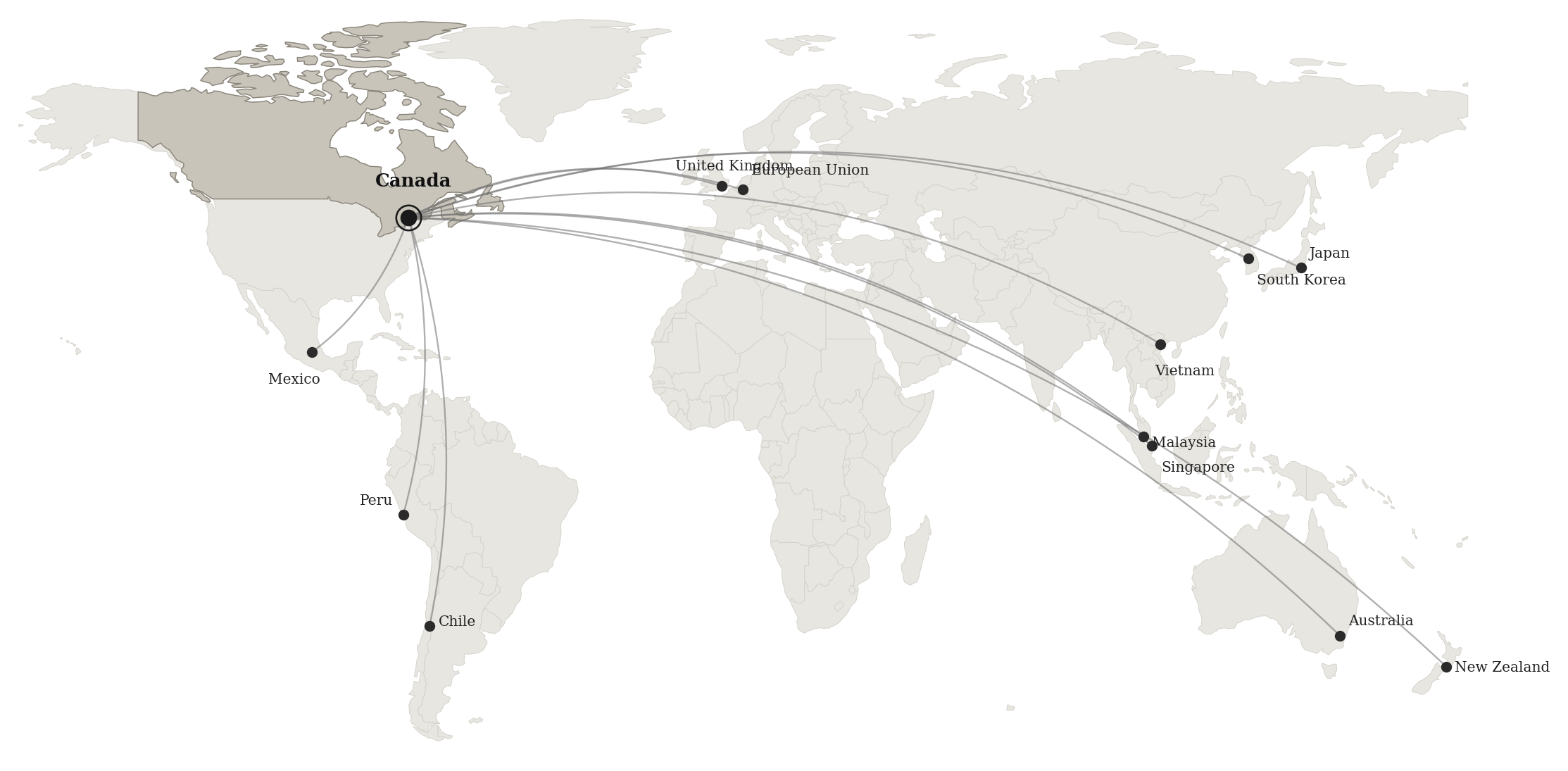
For Canada the pieces already exist, waiting to be treated as a strategy rather than a hedge. The trans-Pacific partnership that reaches Japan, Vietnam, Australia, and a dozen others. The trade agreement with the European Union. The ties to Korea, to Mexico, to the democracies of the Pacific rim. These are not consolation prizes for a relationship gone cold. They are the beginnings of a market too large for any one giant to flood and too valuable for any one giant to lock out.
The single currency such a confederation would trade in is not gold. It is access. Access to a combined market, offered on common terms, to anyone who meets the standards and withheld from anyone who will not. That was the Hansa’s real instrument, and it disciplined kings.
The warning inside the precedent
Honesty requires the rest of the story. The Hanseatic League fell.
It did not fall to a stronger giant. It fell to itself. As nation states rose and grew rich, the member cities began to quarrel, to pursue private advantage, to put the near-term gain of one city above the common terms that held them all. The confederation held only as long as its members chose to hold together. When they broke ranks to cut their own deals, the market that had protected them dissolved, and each city stood alone again before powers now far larger than any single town.
This is the exact risk the middle powers face. A modern Hansa works only if its members resist the temptation each giant will dangle: a private bargain, a favored exemption, a separate peace. The flood and the wall will both offer side deals. Every side deal is a crack in the common terms. The precedent lasted three centuries because the cities held. It ended when they stopped.
The closing turn
So weigh the choices honestly, by how long each can last.
China’s flood is a machine that cannot stop until it breaks, and its own economists have been forecasting the break for twenty years. America’s wall turns allies into supplicants and rivals into enemies, and a wall invites the very siege it was built to prevent. Neither is built to last. Both are reflexes dressed as strategy.
Against them stands a plainer idea. Stay open, but not alone. Set common terms among the many, and make the market you share too large to bully. It is not a new idea. It kept a crowd of small cities safe for three hundred years, in a Europe far more dangerous than our world, and it fell only when they forgot to trust each other.
Three centuries of holding together, against a few decades of flooding or walling. The sustainable choice is not the one that sounds the toughest. It is the one that has already outlasted every giant who was certain he did not need it. The Hansa was that choice once, for three hundred years. A Hansada could be it again.
BONJOURHI! INSTITUTE ANALYTICS · MONTREAL · 2026