
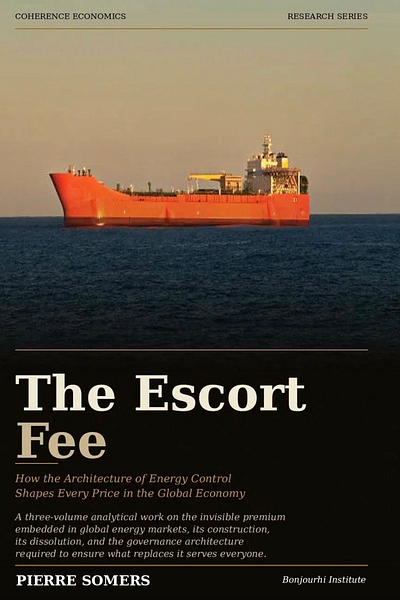
BONJOURHI : Let us start where most readers will start, with the title. Why The Escort Fee?
PIERRE
Because I wanted a name people could feel, not just understand. An escort fee is the oldest arrangement in the world. If everything has to pass through one narrow place, and you control that place, you get to charge for the passage. The Venetians did it. The British did it at Suez. I did not invent anything. I just put a plain name on something we have stopped noticing.
BONJOURHI : And you say energy is priced this way today.
PIERRE
Quietly, yes. We think the price of energy is the price of the molecule. The barrel, the cubic meter, the kilowatt. But more and more, the price is the price of the road it travels on. The United States is now the biggest energy exporter in the world, and at the same time it runs the navy, the currency, and the financial plumbing that everyone else’s energy depends on. So part of what you pay has nothing to do with geology. It is rent for moving through a system somebody else holds. Once you see that, the whole map looks different.
BONJOURHI : Was there a single moment where this clicked for you?
PIERRE
It built up slowly, the way these things do. I have a farm, and farms teach you something about flow. Water finds the low ground. Animals find the gate. Nothing moves randomly, everything moves through the easy path. And whoever owns the easy path owns more than they let on. I started seeing straits and sea lanes the same way I see the gate in a fence. The whole system runs through a few narrow points, and the people standing at those points are quietly charging everyone else.
BONJOURHI : The book is unusually calm for a subject this charged. That seems deliberate.
PIERRE
It is. There is a temptation to write about this with alarm, to make it a story about villains. But there are no villains here, or very few. The escort fee is not a plot. It is just what incentives build when nobody is watching. A system does not need to be designed to be unfair. It only needs to be left alone long enough. I think the calm tone is closer to the truth than outrage would be.
BONJOURHI : The book comes in three parts. Can you say where it leads?
PIERRE
The first part describes the system as it is. The second part, The Bypass, is about how these things always end. No toll booth lasts forever. Somebody always finds another road. The railway made the caravan route pointless. Cheaper solar, satellites, money that moves without permission, eventually sunlight gathered in orbit, all of that is a road around the booth. And the third part, The Commons, asks the hard question. If the new road has no rules, the booth just gets rebuilt somewhere higher up. So who makes sure the new world belongs to everyone? The three parts are one argument, not three books. You cannot really stop after the first.
BONJOURHI : Let us stay with the third part, because you have said elsewhere it is the one that matters most to you. Why?
PIERRE
Because it is the only part of the book about something that has not happened yet. The first part is a description. The second part is a forecast. I am fairly confident about both, the way you can be confident about a tide coming in. But the third part is about a choice, and a choice is the one thing that is still genuinely open. The escort fee is already built. The bypass is already on its way. The rules of the bypass are not written. That is the small window the whole book is pointing at. Once the new roads are paved, the rules harden fast, and then they are just as permanent as the old ones felt. I wanted to get there before the concrete set.
BONJOURHI : When you say the toll booth gets rebuilt higher up, what does that actually look like?
PIERRE
It stops being a place you can see. The old toll booth sat on a strait. You could photograph it. The new one sits on a standard, or a network, or an orbit, or the data a machine learns from. Nobody charges you at a gate. They charge you by owning the thing everyone has to build on top of. It is a much better toll booth, from the owner’s point of view, because most people never notice they are paying. The Commons is the part of the book that drags those new narrow places into the daylight while they can still be argued over. That is the whole reason the Institute went as deep as it did. We did not want to just warn people. We wanted to hand them the actual instruments.
BONJOURHI : Say more about the instruments. That word does a lot of work in the third part.
PIERRE
It does, and I chose it carefully. A warning is easy. Everyone can write a warning. What is hard, and what I think the Institute’s work in this part is genuinely good at, is describing the machinery you would actually use to keep a shared thing shared. How do you govern a resource that belongs to everyone without one party quietly capturing it? How do you make sure the value created on common ground flows back to the common, instead of pooling with whoever arrived first? How do you write the rules of a road so they cannot be bought once the traffic shows up? Those are not slogans. They are designs. They have shapes. You can hold them up and find the flaws. The third part gives them names so that people can fight about them properly, which is the only way anything like this ever gets built.
BONJOURHI : That sounds more hopeful than the rest of the book.
PIERRE
It is, but it is an earned hope, not a soft one. The gravity of the whole system pulls toward enclosure. Left alone, a commons does not stay a commons. Someone fences it. So the hope is not that fairness happens on its own. The first two parts are precisely the argument that it does not. The hope is that, for once, we can see the enclosure coming, and we have a short stretch of time to build the road differently. A commons that survives is never an accident. It is built on purpose, against the current. The third part is the blueprint for building against the current. That is why it kept us up at night, and that is why it is the part I would want a reader to carry out of the book.
BONJOURHI : But that comes later in the book. From the opening part alone, what do you want a reader to walk away with?
PIERRE
I want them to read the news differently for a while. To notice that behind every price there is a route, and behind every route there is sometimes a hand quietly collecting. I am not asking anyone to be angry about it. I am asking them to see it clearly. Seeing it clearly is the whole beginning of everything that follows.
BONJOURHI : Last question. Why publish this now?
PIERRE
Because the system is starting to move. For a long time the escort fee felt permanent, and when something feels permanent, you do not bother to understand it. Now the ground is shifting under it, and there is a short window where understanding the old system actually helps you see the new one arriving. I wanted the description on the table before the change makes it urgent. Describe the thing while it is still standing still. The rest of the book is about what happens when it starts to move. And the last part is about making sure that when it moves, it moves somewhere worth going.
BONJOURHI! INSTITUTE ANALYTICS · MONTREAL · 2026