

Bonjourhi!
Today the Bonjourhi Institute releases The Closing Machine: China’s Decoherent State, a series in four issues.
China is usually measured by what it can build. This series asks a different question: why a state with so much power appears unable to use it on the problems that matter most. Its population is shrinking, its pension system is running down, its succession is unresolved, and the instruments that once allowed it to change course have been moved, muted or switched off.
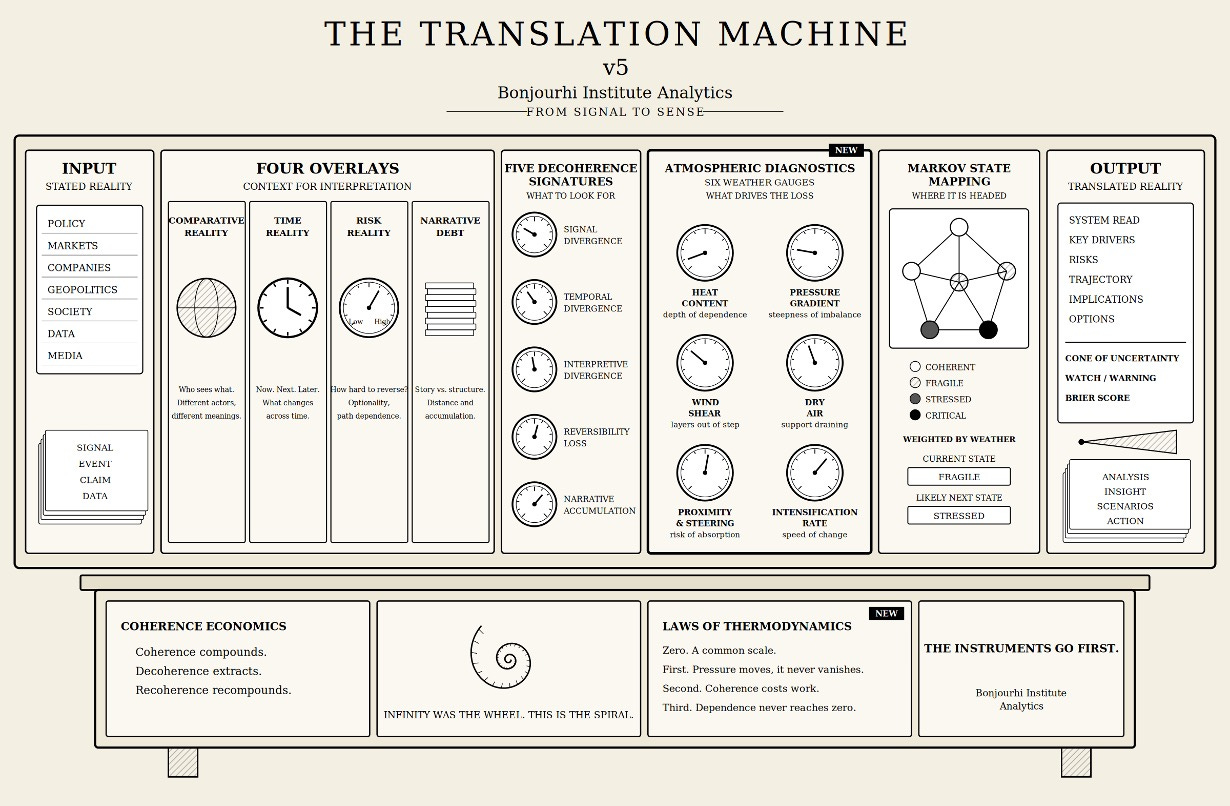
The Closing Machine is the first of several planned series built on the fifth version of our Translation Machine, the analytical engine behind Coherence Economics. Version 5 reads a system the way a meteorologist reads a storm, through six gauges that range from heat content and pressure gradient to wind shear and intensification rate. It produces a cone of uncertainty rather than a single forecast, and it distinguishes a watch, when conditions favour a transition, from a warning, when one is likely soon.
With my regards,
Pierre Somers
Chief Editor, Bonjourhi Institute, Montreal
Introduction
This series looks past China’s factories, its navy and its share of world manufacturing, to something less visible and more consequential: the machinery a state uses to correct itself.
The lens is decoherence: the condition of a system that can no longer hear itself, and so locks into doctrine just as the pressure on it rises.
Each issue examines one part of that machine through a single image. Issue 001 finds a thermostat moved beside the furnace, reading the warmth of the center instead of the cold of the house. The second follows a braided river paved into a concrete canal. The third watches a team play a defensive trap while trailing on the scoreboard. The last tells the story of a dismissed courier who brought down the Ming.
Each issue stands alone. Read together, they describe a state that knows what it must do and cannot do it, facing succession, fiscal exhaustion and demographic contraction within a single decade.
A counterpoint then states the strongest case against the series, and a closing coda asks what it would take for the machine to reopen.
The Ming dynasty runs through all four. It is offered not as prophecy but as structure: the same mechanism, operating again, in a far larger machine.
Bonjourhi Institute Analytics, Montreal | October 2026
The instrument behind this series
Issue 001: The Architecture of Collapse
The thermostat beside the furnace
Everyone knows China is getting older. The charts have circulated for a decade, and the numbers no longer surprise anyone.
But aging is not the story. Japan aged, and so did Italy. Neither lost the ability to govern itself.
What has shifted in China is quieter. The country is losing its demographic engine at the precise moment it has dismantled the instruments that once let it change course. To see why that matters, start with a small device on the wall of every house in Montreal.
The engine in reverse
In 1978, working-age Chinese made up 57 percent of the population. By 2010 they reached 75 percent. That swelling cohort powered three decades of growth near ten percent a year. It poured the concrete, staffed the assembly lines and filled the apartment towers.
Now it runs backward. The population peaked in 2021 and has fallen every year since. In 2025 alone it shrank by 3.4 million, the steepest drop since the famine of the early 1960s. By the 2040s the annual loss approaches ten million, more than the population of New York City, gone every year.
The age structure tilts with it. Citizens aged 65 and older are 15 percent of the population today. They will be 30 percent by the 2040s and above 40 percent before the century closes. The United States, over the same span, moves from 19 to 23 percent.
None of this is fate. Demography sets the problem. Politics decides whether it gets solved.
The thermostat
Take that thermostat in January.
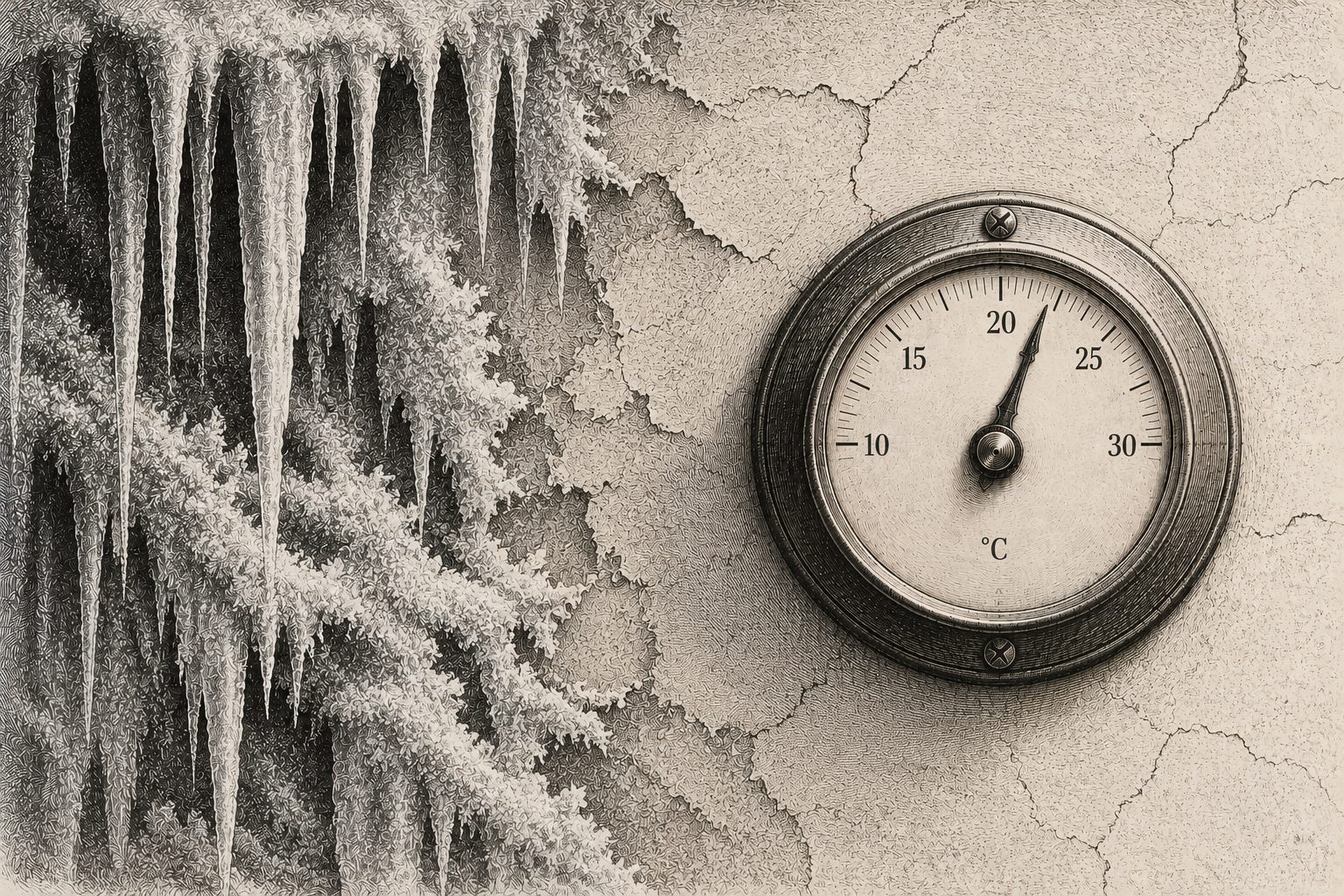
It does one thing well. A sensor reads the temperature of the room. When the reading drops below the setting, the furnace fires, and when the room warms, the furnace rests. The house stays livable because the thermostat hangs where the family lives.
Now imagine someone moves it. Not far, only down the stairs, onto the wall beside the furnace. The sensor still works perfectly. It reads the true temperature of the spot where it hangs, and there it is always warm. Twenty-one degrees, at least. So no heat is sent down the long ducts, and the bedrooms at the far end of the house begin to freeze.
Nothing has been falsified. The thermostat tells the truth about the room it is in. It is simply in the wrong room. The house is no longer regulated by the people who live in it, but by the corner closest to the heat.
Decoherence
This is decoherence. A coherent system reads its own conditions and responds. Signals travel from the edges to the center, and the center acts on them.
A decoherent system has moved its sensor to the center. It hears only what is true near the furnace, and the periphery freezes out of sight.
Reform-era China kept its sensor out in the house. Under Xi Jinping the thermostat has been moved. How that happened belongs to the next issue. Here it is enough to walk through the house as it stands.
The furnace room
Begin near the furnace, with the urban pension fund that covers 500 million people. Its reserves run out in the mid-2030s, a date Chinese economists have published for over a decade. The retirement ages that drain it are among the lowest in the world: 60 for men, 55 for white-collar women, 50 for women in blue-collar work.
Beijing announced a phased increase in 2024. It will not be complete until 2040, and even then China will sit near the bottom of global rankings. Ten years of knowing, fifteen years of phasing, and an outcome that still falls short.
That is not caution. It is paralysis with a timetable.
The far rooms
Now walk to the other end of the house. China runs two pension worlds. In 2024 the average urban retiree drew 3,825 yuan a month. The average rural resident drew 246 yuan, about one fifteenth as much.
Health insurance follows the same gradient. The individual premium for the residents’ scheme rose from 10 yuan in 2003 to 400 yuan in 2024, close to 20 percent a year. At some point the premium line crossed the wage line, and tens of millions let their coverage lapse, 25 million in 2022 alone. They did not give up a luxury. They stepped out of the only protection they had.
The gap persists because the people near the furnace have voice. Civil servants, state employees and party members can make their displeasure felt. Farmers and migrants cannot, so every adjustment is pushed toward the cold rooms, where complaint never reaches the controller.
Heat out the window
The second failure sits in the furnace itself. Beijing has known for two decades that its growth leans too hard on factories and exports. In 2007, Premier Wen Jiabao called the economy unstable, unbalanced, uncoordinated and unsustainable. The prescription has not changed since: put more income in the hands of households and let their spending absorb what the factories make.
Almost nothing has moved. Household consumption still accounts for roughly 40 percent of GDP, against an average of about 54 percent in OECD economies. Social transfers, from pensions to health care, come to about 13 percent of GDP, compared with about 30 percent in the European Union.
The 15th Five-Year Plan, adopted in March 2026, names consumption a top priority for the second plan in a row. It also sets out to enlarge China’s role as the world’s factory.
So the furnace burns hotter and the surplus heat escapes through the windows. In 2025 China ran a trade surplus of $1.19 trillion, the largest any country has recorded. Factories produce more than their own country can buy, prices sag at home, and trading partners answer with tariffs.
These are not two failures but one. A rural household drawing 246 yuan a month saves everything it can, because no one else will pay for its old age or its hospital bills. A state that will not heat the far rooms cannot expect them to buy what the furnace makes.
What a working house would do
A coherent state facing this arithmetic would raise retirement ages quickly, move resources toward the periphery and ask the privileged to fund it. Its own households, not foreign markets, would become the buyers of last resort. Each step requires the center to accept unwelcome readings and act against its own core constituencies.
Beijing can still build aircraft carriers, high-speed lines and entire cities. What it can no longer do is read the room.
The cold is not the real danger. Cold can be fixed.
What resists fixing is a controller that will be the last to know.
Issue 002: The Sclerosis Pattern
How a braided river became a concrete canal

There is a common belief that authoritarian systems are good at hard decisions. No elections to lose, no opposition to placate, only the will to act.
For three decades China seemed to prove it. Beijing absorbed painful reforms that democracies would have debated for years.
That capacity has quietly disappeared. It was never a property of authoritarianism as such. It belonged to a particular shape of channel, and the channel has since been poured in concrete.
The braided river
Picture a river crossing a wide gravel plain. It does not run in a single bed. It splits into dozens of channels that wander, merge and separate, and each spring the flood finds new paths. Some channels silt up and die. Others deepen and carry more of the flow.
Geographers call this a braided river, and it looks wasteful. Water spreads across kilometres and nothing runs straight. Yet the system has a remarkable property. It is always testing alternatives, so when one route blocks, water is already moving through another.
Now drain the plain and confine the river to a single concrete canal. It is straight, fast and orderly, and in a normal season it moves more water with less loss. Then a flood arrives that the canal was never designed to carry. There are no side channels to take the surge. When the one path overtops, it breaks along its whole length at once.
The river years
Reform-era China was a braided river. In the late 1970s, farmers in Anhui quietly divided collective land among households, in open breach of doctrine. Deng Xiaoping let the experiment run. Output rose, and the practice spread across the country. Policy was discovered at the edges before it was announced at the center.
The same tolerance held in harder seasons. In the 1990s Jiang Zemin gave Zhu Rongji the authority to rebuild the tax system and restructure state enterprises that existed for loyalty rather than output. Tens of millions lost their jobs, and labor unrest followed. The party carried that pain because the gain was legible, and because a capable official had been given room to act.
That room was not democracy. It was space. Officials could take a risk without the risk destroying them, and information moved sideways between provinces as well as upward to Beijing.
Pouring the concrete
The paving began before Xi. The color revolutions in the former Soviet states and the Arab Spring frightened party elites, who tightened their grip on media, courts and civil society.
Xi finished the work. He removed presidential term limits in 2018. He cleared the top ranks at the 2022 Party Congress and filled them with loyalists. In January 2026 he placed Zhang Youxia, his most senior general and long his closest military ally, under investigation, leaving only Xi and one vice chairman at the top of the Central Military Commission.
There is no Zhu Rongji in this system. There is one channel, and it runs through one man.
The first flood
Shanghai in 2022 showed what happens when high water comes. The city’s health officials had tried targeted, lighter controls against Omicron, a test of whether the virus could be managed rather than eliminated. Then it became clear that zero COVID was not a health policy but Xi’s personal signature.
The city’s party secretary, Li Qiang, set the evidence aside and imposed a two-month lockdown. Families were separated. Residents struggled to obtain food and medicine.
Li was not censured. In 2023 he became premier, and he now carries out Xi’s industrial priorities with the same loyalty.
The lesson learned below
Every official in China watched that promotion and absorbed its meaning. Results are secondary. Alignment is everything.
So provincial leaders stop piloting what Beijing has not blessed. Bad news travels upward only after it has been softened. Household registration reform stalls. Local fixes for the property slump wait for a signal that never comes. One by one, the side channels silt up.
The canal still moves water. Factories run, exports climb, plans are met. In an ordinary season that looks like strength.
China’s demographic contraction is not an ordinary season. It is the flood the canal was never built to carry, arriving on a plain that has been paved over.
Issue 003: The Backward Engine
Playing the trap while trailing on the scoreboard
When a country faces a problem it cannot solve, it often reaches for one it knows how to solve. The substitution feels like action. It can even feel like strength.
Beijing has made that substitution. Confronted with a shrinking, aging and unmarrying population, it has chosen to fight a cultural campaign against foreign influence.
To see why that choice deepens the real problem, it helps to go to the rink.
The trap
Picture a hockey team in the last period of a game. Its players crowd the middle of the ice and hold their positions, waiting rather than chasing. Every opposing attack runs into a wall before it can reach the goal. Coaches call this the trap. It is disciplined, suffocating and very effective.
The trap exists for one purpose: protecting a lead. It slows the game, burns the clock and denies the other side chances. It also denies your own. A trapping team rarely scores, and does not need to, because the scoreboard already favours it.
Now imagine a team down two goals with eight minutes left that falls back into the trap. The players are working hard and the structure is tight. Yet every disciplined minute brings defeat closer, because what the moment demands, open ice and real risk, is exactly what the system forbids.
A team in that position does the opposite. In the final minutes it pulls its goalie, leaving its own net empty so an extra attacker can join the play. The gamble may cost another goal, but it is the only move that gives the team a chance to win. A trailing team opens up. It does not build a wall.
The Ming system
The Ming dynasty, founded in 1368 after a century of Mongol rule, built a wall in more than one sense. Its rulers treated the Mongol era as a humiliation and set out to restore an authentic Chinese order. They restricted foreign practices, enforced neo-Confucian hierarchy at home, including rigid gender roles, and, after the great maritime voyages of the early fifteenth century, turned away from the sea.
It was a trap designed to protect a civilization that believed itself under siege.
Beijing, 2026
Beijing has adopted the same structure. Xi warns cadres against foreign cultural infiltration and directs them toward China’s excellent traditional culture. He speaks of women’s special role as virtuous wives and good mothers.
The 2026 Law on Promoting Ethnic Unity and Progress codifies assimilation. Christianity and Islam are being recast in the Party’s image of Chinese culture. Each April 15, National Security Day propaganda reminds citizens that foreign spies are among them.
The message is consistent. Trust what is Chinese, suspect what is not.
The scoreboard
The difficulty is the score, or rather which score Beijing is watching. On industry, China leads, and a system built to protect that lead makes sense. On people, it is behind and losing ground. Its population is shrinking, its workforce contracting, and its families are not forming.
In 2013 the country registered 13 million new marriages. By 2024 it registered 6 million, a fall of 55 percent in eleven years. A rebound to 6.76 million in 2025, helped by simpler registration rules and an auspicious calendar year, barely dents that line.
A trailing team needs open ice. For China that means immigration, genuine economic autonomy for women and openness to foreign talent. Beijing is offering patriarchal order, ethnic conformity and suspicion of outsiders. It has fallen back into the trap with the clock running.
The women who opt out
Young women have read the situation correctly. They see a state that wants their fertility while restricting divorce and tightening access to abortion, and that offers a childcare subsidy of 3,600 yuan a year per child under three, set against the cost of raising one to adulthood. Many have concluded that the safest move is not to enter the arrangement at all, and each new restriction confirms that judgment.
Beijing is reaching for a remedy from the 1950s, when one wage could support a family. In rich countries today the pattern runs the other way. France, where most mothers work, has more children per woman than Italy or Japan, where many must choose between a career and a family. Births follow the freedom to have both.
Consider a graduate in Shanghai today. She cannot find stable work and cannot afford a wedding or an apartment. She watches older urban workers keep their benefits while her own prospects narrow. The state asks her to raise children and stay home, to compete globally and to fear the globe, and since those instructions cannot all be followed, she eventually stops following any of them.
The visa
In August 2025, Beijing announced a small opening: the K visa, for young foreign workers in science and technology. The economy needs exactly that talent, and the announcement passed almost unnoticed.
The backlash arrived with the launch on October 1. Youth unemployment had just reached a record 18.9 percent, and social media filled with fury at a state importing foreigners while its own graduates went without work. Users who defended the policy were branded traitors. A year on, public evidence that the visa is being issued in any number remains thin.
Beijing had spent years teaching its population to fear outsiders. When it finally needed foreign talent, the people it had trained rejected it.
Beijing has imported talent before, but only for show. For its 2022 Winter Olympics, it assembled a men’s hockey team in a hurry. Of the 25 players on the roster, 18 were born or raised in North America, several with no Chinese ancestry at all. The team did not win a game. Talent was imported for a fortnight of television, not for the decades a shrinking country now faces.
The teams that pulled the goalie
South Korea and Taiwan face the same demographic arithmetic, and both chose to open up. Foreign residents, once almost absent, are now a meaningful share of each population, about 5 percent in South Korea. Neither has solved its fertility problem. Both accepted the risk that the score required.
China has fewer than one million foreign residents, under 0.1 percent of its population.
The trap is working exactly as designed. It smothers every rush, its own included.
Beijing is defending the lead it holds on the scoreboard it watches. The game will be decided on the other one.
Issue 004: The Inheritance Problem
The courier who lost his post

Great powers rarely fall to the threat they are watching. They fall to something that looked, for years, too small to matter.
In the case of the Ming dynasty, it was a line in a budget.
The saving
By 1629 the Ming treasury was running dry. Armies on the northern frontier were holding off the Manchus, and they had to be paid in silver. The young Chongzhen emperor, barely two years on the throne, went looking for savings and found them in the imperial postal relay system, a vast network of stations, horses and couriers that carried official dispatches across the empire.
He ordered deep cuts. Stations closed, and thousands of couriers and station hands were dismissed. In the ledgers it looked like sound administration: a bloated service trimmed so the soldiers could be paid.
The courier
One of the men let go was a courier in Shaanxi named Li Zicheng. The province was already starving. Drought had ruined the harvests for several years running, peasants were stripping bark from the trees to eat, and bands of rebels were forming in the hills.
With no wages and debts he could not repay, Li joined them. He was not a general, a scholar or a nobleman. He was a laid-off servant of the state in a hungry province.
The vacuum above
The court that dismissed him had been hollowing out for decades. Chongzhen’s grandfather, the Wanli emperor, had spent some fifteen years in standoff with his officials over the choice of an heir. Memorials went unanswered, posts sat empty, and factions turned the bureaucracy against itself.
By the time Chongzhen inherited the throne, the state could still collect taxes and trim budgets. What it could no longer do was see what its own decisions were doing in the provinces.
China’s succession now has a date. Xi Jinping is poised for a fourth term in 2027. In 2032, when that term would close, he will be 79, with no successor named.
A leader who has removed every rival and declines to designate an heir is saying something plain. Power will be held until it is taken.
Today’s ledger
Beijing is making savings of its own. Local governments run deficits and fall behind on salaries for teachers and civil servants, and each adjustment lands on those with the least voice.
The budget for watching has not been cut. In 2023 Beijing created the Central Social Work Department, a party agency that pairs welfare outreach with the monitoring of discontented citizens. After a driver killed 35 people in Zhuhai in November 2024, neighbourhood committees began screening for the four withouts: no spouse or children, no job or steady income, no ability to communicate normally, no home or other assets. Many also screened for the five losses: failed investments, setbacks in life, broken relationships, psychological imbalance and mental disorder.
The pattern is Chongzhen’s. The state economises on the people who serve it and spends on the forces that watch them. In its screening lists, it is already drawing the profile of its own Li Zicheng: no job, no assets, no family, a setback in life.
The rise
Li proved a gifted organiser. Promising land to the landless and an end to grain taxes, he gathered starving peasants, deserting soldiers and other dismissed men into an army. In 1643 he took Xi’an. Early in 1644 he proclaimed a dynasty of his own and marched on the capital.
Beijing fell with barely a fight. As the rebels entered the city, the Chongzhen emperor climbed the hill behind the palace and hanged himself from a tree. After 276 years, the Ming ended at the hands of a courier whose post it had cut to save money.
Li held Beijing for about six weeks. Then a Ming general opened the Great Wall at Shanhai Pass to the Manchu armies, who drove him out and founded the Qing. The rebellion built nothing. It only finished what decades of neglect had already emptied.
The dry decade
The 2030s will bring dry years of their own. The succession question arrives first. The urban pension fund runs out a few years later. After 2035, the population decline steepens sharply.
Northern China faces deepening water scarcity, sharpened by climate change. A distorted gender ratio leaves many young men with no prospect of a family.
These pressures do not arrive in sequence. They stack within a single decade, landing on a state whose thermostat hangs beside the furnace, whose side channels have been paved and whose gates are closing.
Two paths
The most likely path is not collapse. It is stasis under surveillance: an aging leadership in Zhongnanhai, grievances screened and suppressed one at a time, succession settled by bargaining or force rather than rules. That path can last a long while.
Each year of it, however, leaves the ground drier. Factional rupture at the top, salary and pension cuts that bring state employees into the street, or a water crisis that sets rural populations moving could each supply the spark.
The Ming did not fall first to the Manchus it spent its silver fighting. It fell to a man it laid off to pay for them.
The forces that consume great powers seldom look dangerous from the capital. They look like one man who lost his job, in a dry year, far from anyone paying attention.
Counterpoint: The Case Against This Series
The strongest argument for the canal
Every argument in this series can be answered. The answers deserve to be heard at full strength.
Start with what China builds. In 2025, BYD sold more than 2.25 million fully electric cars and overtook Tesla as the world’s largest maker. In 2024, China installed 295,000 industrial robots, 54 percent of all those installed worldwide, and its working stock passed two million, nearly half the global total. Chinese firms dominate the supply chains for solar panels and batteries. Chinese laboratories have shown they can build AI models close to the frontier at a fraction of the expected cost.
These are not the achievements of a system that has stopped working. They belong to a state that can still choose a target, pour capital and talent into it, and hit it faster than anyone else.
The demographic answer
The critics have an answer to demography as well. A shrinking workforce matters less in an economy that automates this quickly. Robots do not retire, draw pensions or need marriage subsidies.
Japan has aged for three decades without collapse. It remains rich, orderly and stable.
The record of the pessimists
In 2001, a widely read book announced the coming collapse of China. The collapse did not come. For a quarter century, forecasts of Chinese breakdown have been wrong, while the economy grew several times over.
Any series that describes a closing machine should admit how many people have misread this one.
Why the argument holds
All of this is true. On the scoreboard of things a state can build, China leads, and this series does not dispute it. None of it touches the argument.
Look at what the strengths have in common. Each is a target the center chose and could command: build the cars, install the robots, flood the market with panels. That is the canal at its best, moving vast volumes down one straight channel.
This series never claimed China cannot execute. It claims China cannot correct, and the problems that now matter most are problems of correction. No ministry can order a young woman to marry, a household to spend rather than save, or a pension fund to refill itself. Each of those outcomes depends on the center hearing unwelcome readings and acting against its own constituencies, which is the capacity that has been removed.
The strengths also feed the weakness. The factories that make the world’s cheapest electric cars make more than China can buy. Even as BYD took the global crown, its sales at home were weakening, cushioned by more than a million cars sold abroad. The furnace is impressive. The heat still goes out the window.
Robots solve the factory’s problem, not the country’s. A robot can replace a worker. It cannot replace a consumer, a taxpayer or a contributor to the pension fund.
Japan is the right comparison, and it cuts the other way. Japan aged after it became rich, with independent courts, a free press, honest statistics and governments that could be voted out when they failed. Its decline was gentle because its instruments kept working.
China is aging at a far lower income, and its instruments are being switched off. When youth unemployment hit a record in 2023, the statistics bureau stopped publishing the figure for five months. It returned with a new method that left students out.
As for the pessimists, they were wrong because they predicted collapse. This series does not. Its base case is a long stasis, a system that endures for years while losing the ability to repair itself. The Ming survived another half century after its troubles became visible.
The strongest case against this series is a list of things the center can command. The series is about everything it cannot.
Coda: Recoherence
How a closed system reopens
A diagnosis without a way out is only half an argument. If decoherence describes a system that can no longer hear itself, the question that follows is whether it can learn to hear again.
The third law
Coherence compounds. Decoherence extracts. Recoherence recompounds. A system that restores its feedback loops does not simply return to where it was. It retires the structures it has outgrown, keeps what still carries weight, and grows again from a stronger base.
Recoherence is rare, and it is never comfortable. China has done it before, which is why the question is worth asking.
The last time
Mao died in 1976, leaving a country exhausted by a decade of Cultural Revolution. Within two years the system had reopened.
What came first was not a growth plan. It was the instruments. In 1977 the national university entrance examination, abolished during the Cultural Revolution, was restored, so talent could once again be measured. In 1978 the party embraced the slogan “seek truth from facts,” making evidence rather than doctrine the test of policy. That same year Deng Xiaoping travelled to Japan and Singapore and came home openly admitting how far China had fallen behind.
Only then did the reforms follow. In 1981 the party passed a formal judgement on Mao: great in his achievements, gravely wrong in his final decades. The resolution settled the past without breaking the party. Mao’s portrait stayed above Tiananmen, but it no longer guided policy. It became ballast for legitimacy while the country grew in a new direction.
Japan offers a second case. In 1853 American warships forced open a country that had been closed to most of the world for over two centuries. Within fifteen years the Tokugawa order had fallen. In 1871, a large share of the new Meiji government’s leaders set off on a voyage of almost two years through America and Europe to study the world Japan had shut out. They came home and rebuilt the state on what they had seen.
The pattern
The two cases share three features. A shock made denial impossible. A change at the top opened room for people able to act. And the instruments were restored before the reforms began: an examination, a slogan about facts, a voyage to look.
The instruments go first, in decline and in recovery alike.
The window
For China, the shock is likely to be the dry decade itself. The change at the top is the one the system fears most, the succession.
In 1976, a death at the top opened the door to Deng. In the 2030s, the same uncertainty that makes the succession dangerous is also the widest opening the system will have. The date that frightens Beijing is the date that could save it.
What to watch
Recoherence would not announce itself. It would appear first in the instruments, and five signals would show the machine beginning to reopen.
A successor named with a standing of his or her own, rather than a loyalist without a base.
Statistics restored: youth unemployment, local government debt and pension balances published in full and on time.
Household registration opened in the largest cities, and rural pensions raised to a level that lets families stop saving out of fear.
Household consumption climbing toward half of GDP.
Foreign residents, including holders of the K visa, increasing year after year instead of quietly disappearing.
If these signals move, this series will have been wrong in the best possible way. If they do not, the canal will meet the flood it was never built to carry.
In the language of the first issue, recoherence begins when someone carries the thermostat back up the stairs and hangs it where the family lives. Until then, the house will go on reporting that it is warm.
Notes
General
Demographic, fiscal and political data. Unless noted otherwise, projections and figures in this series draw on Carl Minzner, “China’s Long Twilight,” Foreign Affairs, October 2026, (upcoming book As China Ages The Politics of Demographic Decline in the Counter-Reform Era) and on United Nations, World Population Prospects.
Issue 001: The Architecture of Collapse
Working-age share of 57 and 75 percent; population aged 65 and over. Minzner, “China’s Long Twilight”; United Nations, World Population Prospects.
Shrank by 3.4 million in 2025. National Bureau of Statistics of China, annual population data, released January 2026. The population fell to 1.40489 billion at the end of 2025, the fourth consecutive annual decline.
Retirement ages and the 2024 reform. Standing Committee of the National People’s Congress, decision of September 13, 2024. The increase is phased in over fifteen years from January 2025: men from 60 to 63, women from 50 and 55 to 55 and 58.
Pension fund reserves run out in the mid-2030s. Chinese Academy of Social Sciences, China Pension Actuarial Report 2019 to 2050, April 2019, which projected exhaustion of the urban employee fund around 2035.
3,825 yuan and 246 yuan a month. Caixin Global, July 11, 2025; Ministry of Human Resources and Social Security, China Labour Statistical Yearbook 2025, as reported by The New York Times, March 2026.
Premium of 10 yuan in 2003 and 400 yuan in 2024; 25 million left Health Care in 2022. National Healthcare Security Administration data, reported by the South China Morning Post, 2024, and China Daily, March 26, 2024.
Wen Jiabao in 2007. Press conference at the close of the National People’s Congress, March 16, 2007.
Household consumption of roughly 40 percent of GDP; OECD average of 54 percent. National Development and Reform Commission, Qiushi, reported by Caixin Global, December 16, 2025: household consumption was 39.9 percent of GDP in 2024. Rhodium Group, “No Quick Fixes: China’s Long-Term Consumption Growth,” for the OECD comparison.
Social transfers of 13 percent of GDP; the 15th Five-Year Plan. Mercator Institute for China Studies (MERICS), commentary on the 15th Five-Year Plan, 2026.
Trade surplus of $1.19 trillion. General Administration of Customs of China, January 2026; Econofact, 2026.
Issue 002: The Sclerosis Pattern
Farmers in Anhui. The household contract agreement at Xiaogang village, 1978. See Ezra F. Vogel, Deng Xiaoping and the Transformation of China, 2011.
Zhu Rongji’s tax and enterprise reforms. The tax-sharing reform of 1994 and the state enterprise restructuring of the late 1990s. See Barry Naughton, The Chinese Economy: Adaptation and Growth, second edition, 2018.
Presidential term limits removed. Constitutional amendment adopted by the National People’s Congress, March 11, 2018.
Zhang Youxia placed under investigation. Ministry of National Defense statement, January 24, 2026, announcing investigations into Zhang Youxia and Liu Zhenli, chief of the Joint Staff Department, for “suspected serious violations of discipline and law.”
Shanghai lockdown; Li Qiang as premier. The citywide lockdown ran from late March to June 1, 2022. Li Qiang was confirmed as premier on March 11, 2023.
Issue 003: The Backward Engine
The Ming dynasty and its turn inward. Timothy Brook, The Troubled Empire: China in the Yuan and Ming Dynasties, 2010. The maritime expeditions of Zheng He ran from 1405 to 1433.
Xi’s remarks on traditional culture and women’s role. Minzner, “China’s Long Twilight.”
Law on Promoting Ethnic Unity and Progress. Adopted by the National People’s Congress on March 12, 2026, effective July 1, 2026.
National Security Day. Established under the National Security Law of 2015 and first observed on April 15, 2016.
13 million, 6 million and 6.76 million marriages. Ministry of Civil Affairs, annual statistics for 2013 and 2024, and data for 2025 released in February 2026.
Divorce and abortion restrictions. The 30-day divorce cooling-off period took effect with the Civil Code on January 1, 2021. The State Council’s guidelines on women’s development of September 2021 called for reducing abortions deemed medically unnecessary.
France, Italy and Japan. Total fertility rates of about 1.6 in France and about 1.2 in Italy and Japan in 2024, from national statistics offices (INSEE, ISTAT and Japan’s Ministry of Health, Labour and Welfare).
Childcare subsidy of 3,600 yuan. National childcare subsidy announced by the State Council in July 2025, paid annually for each child under three.
The K visa. Announced by the State Council in August 2025 and effective October 1, 2025.
Youth unemployment of 18.9 percent. National Bureau of Statistics, August 2025, for urban residents aged 16 to 24 excluding students.
Foreign residents in South Korea and China. South Korea, Ministry of the Interior and Safety, 2024. China’s Seventh National Population Census of 2020 counted about 845,000 foreign residents.
Beijing 2022 men’s hockey team. Associated Press, February 2022, reporting the 25-player roster of whom 18 were born in or grew up in North America.
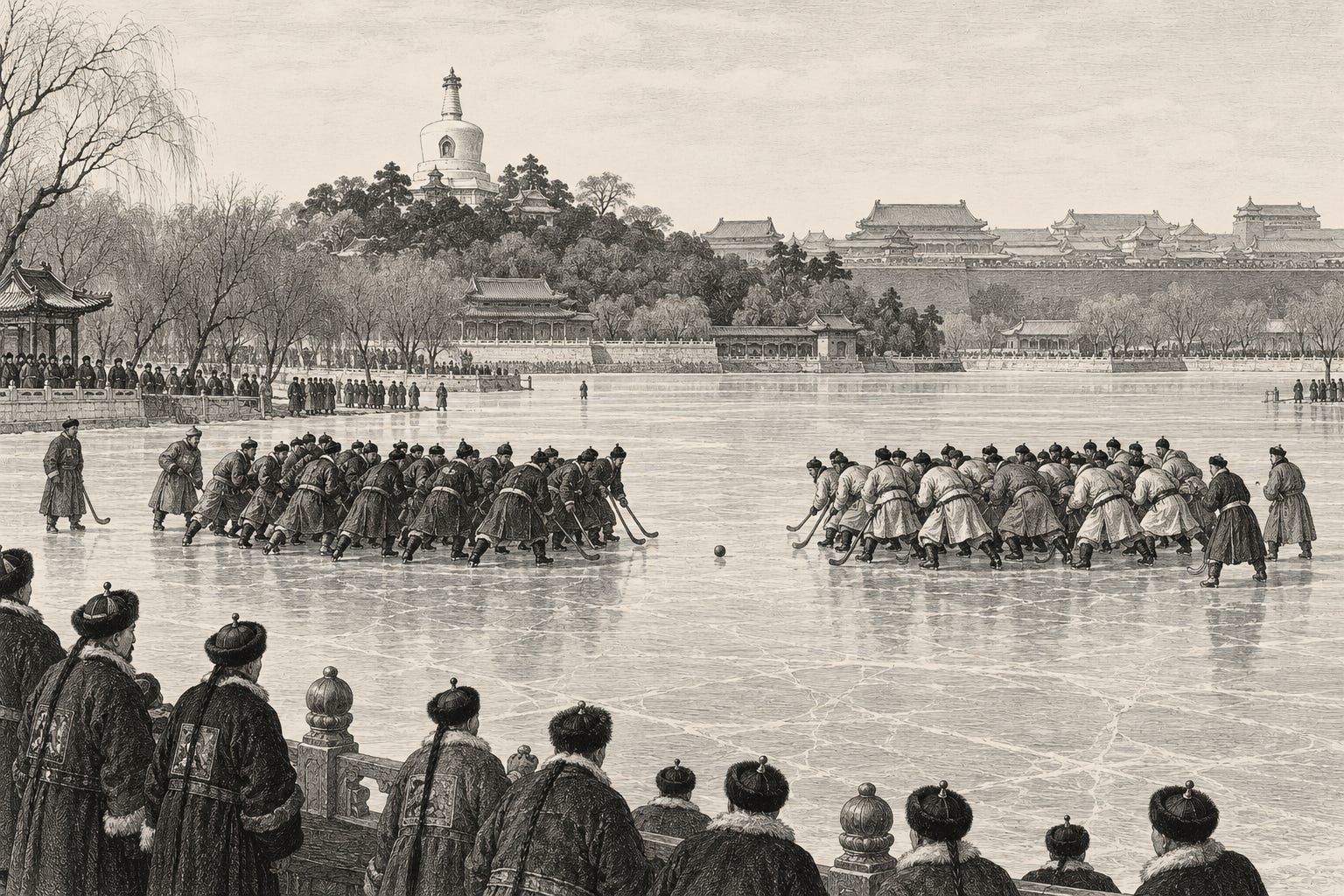
Image caption: bingxi, buda and beikou. Bingxi, the Qing imperial ice games, were recorded in court scrolls of the eighteenth century. Buda was a Tang dynasty stick and ball game played on foot. Beikou is the traditional stick game of the Daur people of Inner Mongolia and Heilongjiang.
Issue 004: The Inheritance Problem
The postal cuts of 1629, Li Zicheng and the fall of Beijing. Frederic Wakeman Jr., The Great Enterprise: The Manchu Reconstruction of Imperial Order in Seventeenth-Century China, 1985; Jonathan D. Spence, The Search for Modern China, 1990. Beijing fell on April 25, 1644.
The Wanli succession standoff. The dispute over the designation of the heir ran from 1586 to 1601. See Ray Huang, 1587, A Year of No Significance, 1981.
Xi at 79 in 2032. Xi Jinping was born in June 1953.
Salary arrears in local government; water scarcity in the north. Minzner, “China’s Long Twilight.”
Central Social Work Department. Created under the party and state institutional reform plan of March 2023. Caixin Global, March 17, 2023, on its role in handling public complaints; Bill Bishop, Sinocism, March 2023, on its reach into the grassroots outside the existing security ministries; National University of Singapore, East Asian Institute, Background Brief No. 1778, 2024.
Zhuhai attack; the four withouts and five losses. The attack at the Zhuhai sports centre on November 11, 2024 killed 35 people. Local screening lists were documented by China Digital Times, November 2024.
Counterpoint: The Case Against This Series
BYD sales in 2025. BYD annual sales disclosure, January 2026: 2,254,714 battery electric vehicles, against 1,636,129 Tesla deliveries. BYD sold more than one million vehicles outside China in 2025.
295,000 industrial robots. International Federation of Robotics, World Robotics 2025.
Solar panels, batteries and AI. International Energy Agency reporting on solar and battery supply chains; DeepSeek released its R1 model in January 2025.
The coming collapse of China. Gordon G. Chang, The Coming Collapse of China, 2001.
Youth unemployment figure suspended. The National Bureau of Statistics halted publication in August 2023 and resumed in January 2024 with a measure excluding students.
Coda: Recoherence
University entrance examination; seek truth from facts. The gaokao was restored in 1977. The Third Plenum of the Eleventh Central Committee, December 1978, endorsed seeking truth from facts as the party line. Deng visited Japan in October 1978 and Singapore in November 1978.
The 1981 judgement on Mao. Resolution on Certain Questions in the History of Our Party since the Founding of the People’s Republic of China, June 1981.
Japan, 1853 and 1871. Commodore Perry’s squadron arrived in 1853. The Iwakura Mission travelled from December 1871 to September 1873.