

Bonjourhi!
Last month the French state paid more to borrow than at any time since euro coins arrived in our pockets. Its 10-year yield touched 5 percent, and today large French companies borrow more cheaply than their own government.
Most commentary reaches for spreadsheets. We reached for a cathedral.
Ninety minutes north of Paris stands Saint-Pierre de Beauvais, the tallest Gothic choir ever raised. Its vault fell in 1284. Its spire came down in 1573. Its nave was never built. For three decades, timber struts held it upright, until engineers finally let part of it stand on its own again last year.
The Choir at Beauvais, Part One of this issue, reads France's predicament through that building: an ambitious state, a margin spent on height, buttresses borrowed from the bond market, and a euro that now serves as rented scaffolding. It is a short read, and I believe it will change how you see the headlines from Paris.
For those who want to go further, Part Two presents a companion paper, The Long Repair. It is the first study in the Institute's Sequence Methodology, published by the Bonjourhi Institute Analytics Team as part of a larger research effort now under way.
Our aim is to hold the tools of Coherence Economics to the same discipline we apply to everyone else. The paper turns Beauvais into five testable hypotheses, defines measurable indicators for the latest version of the Translation Machine, tests them against Canada in 1995, Greece in 2009, Italy in 2011 and Britain in 2022, and enters dated forecasts for France in a public ledger we will score as events unfold.
The early evidence supports our central claim: systems recover when they restore honest measurement first. The instruments go first.
We would value your challenge as much as your agreement. If you see a flaw, a counterexample or a better data source, simply reply to the email that brought you this issue. Tools become strong only when sceptical readers have tested them.
Until next week,
Pierre Somers
Chief Editor, Bonjourhi Institute, Montréal
The Choir at Beauvais
France, cheap money, and the price of building higher than the stone allows

Bonjourhi!
France has lived with heavy debt for decades. Nobody is surprised by that.
What has changed is the mood of the lender. As global yields climbed, investors began walking the street looking for the building with the least margin, and they paused in Paris. On October 21, the French 10-year yield touched 5.002 percent, a 24-year high.¹
The usual explanation is fiscal. A better one is architectural. Ninety minutes north of Paris stands a cathedral that tells the whole story in stone.
A Bishop and a Fire
In 1225, fire struck the old cathedral of Beauvais. Bishop Milon de Nanteuil saw an opening rather than a loss.
Milon was a count-bishop, lord of the town as well as shepherd of its souls, holding the keys to both the temporal and the spiritual treasury. He could not look on with indifference while great cathedrals rose in Paris, Amiens and Reims. His ambition was to outbuild them all.²

Milon de Nanteuil, far right, holding the royal mantle at the coronation of Louis VIII and Blanche of Castile, Reims, 1223. Nine years later, Blanche would be ruling for her young son when the crown stopped his cathedral.³
He began the work with funding from his own family. When private wealth ran short, he leaned on his authority to raise more, and collided with the young Louis IX. Work halted from 1232 to 1238.⁴ Within seven years, ambition had met its first fiscal limit.
Milon's heirs in the Nanteuil family pressed on, but when their line ended the works fell silent, and every effort turned to consolidating what had already been built. The choir was completed on October 3, 1272, and services began immediately.⁵
One detail says the rest. The small church the cathedral was meant to replace, Notre-Dame de la Basse-Œuvre, still occupies the site set aside for the nave.⁶ The new structure rose beside the old one and never displaced it.
An Evening in 1284
By then the choir vault stood about 48 metres from floor to keystone, well above Amiens and beyond anything Gothic builders had dared.⁷
It stood for twelve years. Then, one evening in 1284, part of it came down.
Nobody had been careless. The design simply had no room left in it.
The Long Calm
For most of the past fifteen years, money cost almost nothing.
Debt grew, yet the interest bill shrank, because old loans rolled into cheaper ones. Each government could promise without choosing. France has run a budget deficit every year since 1975, and for a long stretch that habit carried no visible penalty.⁸
The arrangement worked, and for years it went unquestioned.
The Wind Changes
A strong American economy pushed inflation and rates higher, and bond investors suddenly had reason to be selective.
France was the obvious candidate. The French-German 10-year spread passed 170 basis points in late October, the widest since the euro crisis.⁹ Spain, which paid far more than France at the height of that crisis, has borrowed more cheaply since 2024.¹⁰
Another figure says even more. About €215 billion of French corporate bonds now yield less than the government's own debt.¹¹ Lenders trust French companies more than the French state. The side chapels, it seems, are sounder than the vault.
How a Gothic Vault Stands
A stone vault does not just press down. It pushes sideways, trying to split the walls apart.
Gothic builders solved this with a beautiful trick. They thinned the walls to let in light, then carried the sideways thrust outside the building through flying buttresses, arms of stone reaching out to heavy piers standing in the open air.
Height is where the trouble begins. Every additional metre adds thrust. The buttresses must reach farther, the piers must weigh more, and the margin between standing and falling narrows with each course of stone laid.
At Beauvais, the piers were slender and widely spaced. Under normal conditions, that was enough.
After the collapse, the masons did the only honest thing available. They inserted new piers between the old ones, halving every span.¹² The choir rose again, heavier and crowded with stone. Less light. Less glory. Still standing.

Two and a half centuries later, a new generation repeated the error in a different form. They raised an enormous crossing tower before building a nave to brace it. The tower briefly made Beauvais the tallest building in the world. In 1573, with nothing beside it to lean on, it fell.¹³
The nave was never built.
Reading France in Stone
The vault is the French state, among the most ambitious in the developed world, with public spending near 57 percent of national output.¹⁴
The stone has a limit. France already taxes at the point where higher rates begin to shrink revenue rather than raise it. Adding weight to the walls no longer adds strength.
The buttresses were cheap borrowing. They shifted the outward thrust of spending away from the taxpayer and into the open air of the bond market, where for years it cost nothing to hold up.
The wind is the global rise in yields. Gross debt reached a record €3.6 trillion in the second quarter, or 119 percent of GDP. Net of the state's financial assets, the IMF still puts the burden above 110 percent.¹⁵ Each refinancing now lands on a higher pier. Agence France Trésor plans to borrow a record €340 billion next year.¹⁶
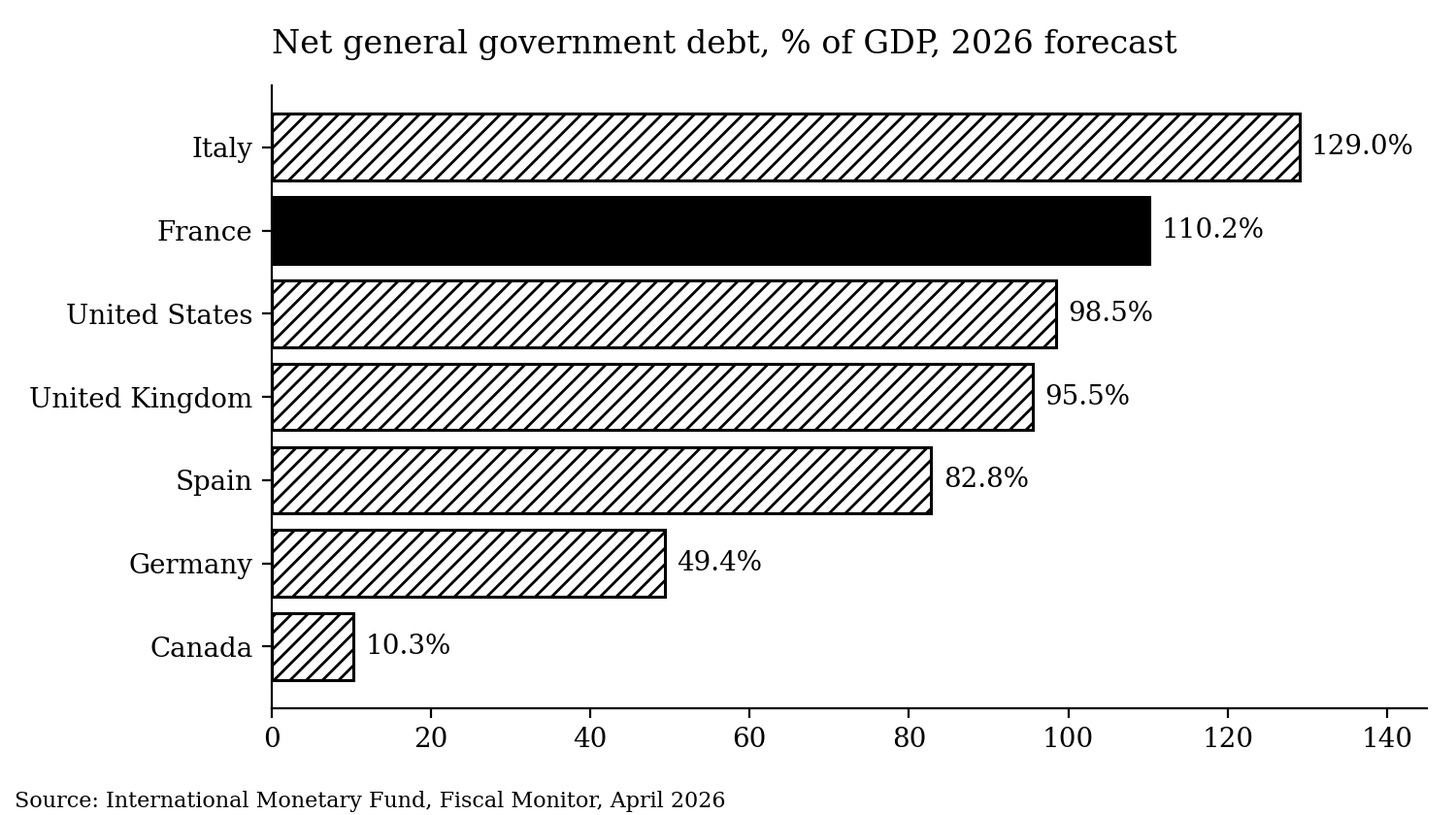
And this is the part nobody will accept. Inserting new piers means less of everything the vault was built to hold: fewer transfers, later retirements, tighter services. Parliament ousted François Bayrou over a 44 billion euro budget squeeze, and national protests on October 17 later descended into riots.¹⁷
Many of those in the streets were teenagers and university students, protesting crumbling schools. Interest on the debt is on course to become the largest single item of state spending.¹⁸ The girl holding a banner outside her lycée is not protesting the debt. She is protesting what it has already eaten.
Milon found this out in 1232, and every French government since has relearned it: ambition financed by authority eventually meets someone who refuses to pay.
The stone will bear no more. The congregation will accept no less. That is the predicament, stated plainly.
The Rented Scaffolding
Look again at the timber that braced the Beauvais transept for thirty years.¹⁹ It was the only part of the building not cut from local stone.
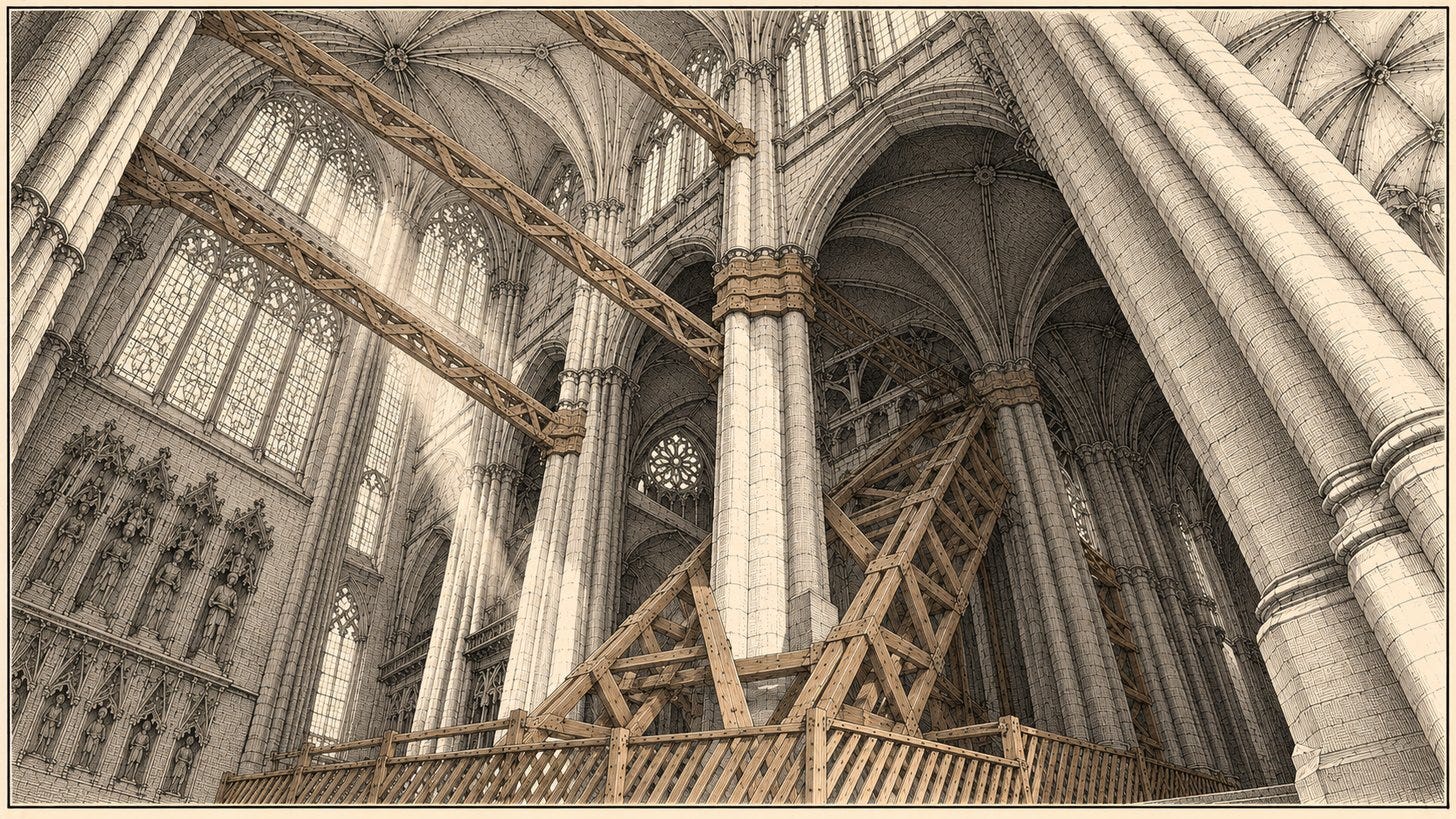
The euro plays the same role in France. For two decades it let Paris borrow at rates close to Berlin's, support that France never had to quarry or pay for. The price was flexibility. A country with its own currency can let it fall, and the whole structure gives a little. Inside the monetary union, that joint is gone.
The bracing is also conditional. The European Central Bank holds an emergency instrument designed to buy a member's bonds when markets turn disorderly. It has never been used, and France, under an excessive deficit procedure, may not qualify. Christine Lagarde has said the remedy lies in Paris, in its fiscal choices.²⁰
So the struts stand in plain view, reassuring the faithful. Whether they will take weight when the stone shifts is decided in Frankfurt.
France has not lost its sovereignty. It has rented its scaffolding.
A Choir We Have Stood In
Montreal knows this choir well.
In January 1995, the Wall Street Journal called Canada an honorary member of the Third World. Federal debt was climbing, the dollar was sliding, and lenders had begun to ask the question they now ask of Paris.²¹
That spring, Jean Chrétien and Paul Martin delivered a budget that cut program spending deeper than any in a generation. Transfers to the provinces shrank. Hospitals and universities felt it, and Quebec felt it as much as anyone.
It hurt. It held. Before the decade was out, Ottawa was running surpluses, and today Canada's net debt sits near 10 percent of GDP, the lowest in the G7.²²
Recovery is possible. It is never painless, and rarely popular while under way.
Who Keeps Margin
Spain rebuilt after 2012 the way the masons rebuilt after 1284. It added piers and accepted the sacrifice. The reversal in borrowing costs is its reward.
France is not the only tall vault on the street. It is simply the first one the wind found.
Italy watches from the next pew, aware it would be next in line.
For investors, the rule is plain. Markets do not price ambition. They price margin, and they reprice it all at once.
What the Masons Do Next
The coming months will show which way the work leans.
Adding piers would look like a 2027 budget that passes intact, a deficit path the markets believe, and a presidential campaign that argues over how to share the cost rather than whether to bear it.
Removing struts would look different: a government that falls on its budget, promises to unwind past reforms with no word on who pays, or a quarrel with Brussels that puts the European bracing in doubt.
The bond market will not wait for the May election to decide which story it believes.
The Closing Turn
France also built its tower before its nave. Pensions, transfers, and protections went up first. The productive base meant to brace them, faster growth and broader employment, was left for later.
Beauvais also never cleared its ground. The Basse-Œuvre sits where the nave should rise, and France has its own version: statutes, privileges and habits that each reform was meant to replace and none removed. No one finishes a new structure on ground the old one refuses to yield.
France can still add piers. What it cannot do is keep the light and the height and the cheap buttresses all at once.
Visitors to Beauvais crane their necks at the vault. Few ever noticed the struts. Citizens treat the state the same way. They see the services and never the bracing, until someone proposes taking it down.
Bonjourhi Institute, Montréal
Bonjourhi Institute Working Papers, Sequence Methodology Series, No. 1
The Long Repair
Sequence, Measurement and Fiscal Recovery: Beauvais Cathedral, France and Four Test Cases
Bonjourhi Institute Analytics Team, Montréal
October 2026. Draft for discussion.
Abstract
This paper argues that the order in which a strained system repairs itself matters as much as the size of the repair. It states five hypotheses drawn from eight centuries of structural repair at Beauvais Cathedral, the most important being that recovery requires restoring credible measurement before consolidation begins. It relates each hypothesis to existing research on fiscal councils, the composition of fiscal adjustments, financial instability and institutional lock-in. It then defines measurable indicators for the Institute's diagnostic instrument, applies the framework retrospectively to Canada (1995), Greece (2009), Italy (2011) and the United Kingdom (2022), and reads France as of October 2026. The cases are consistent with the measurement hypothesis, and the United Kingdom offers a near natural experiment. The paper closes with the strongest counterarguments, the evidence that would falsify the framework and a research agenda for testing it.
Keywords: fiscal consolidation, fiscal councils, sovereign spreads, sequencing, institutional lock-in, France.
1. Introduction
Debate about public debt usually concerns levels: how high, how fast, how sustainable. This paper concerns order. Two governments can attempt the same consolidation and reach opposite outcomes because they act in a different sequence.
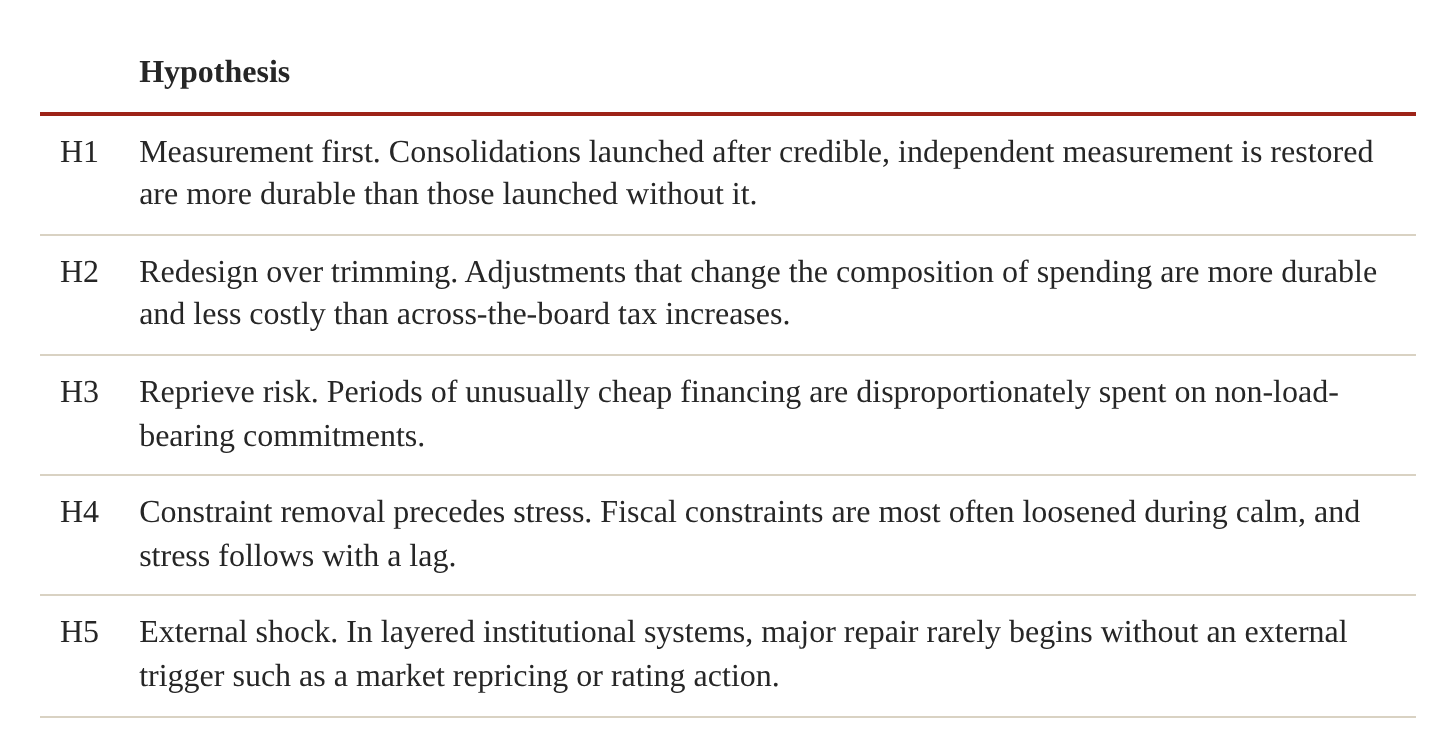
The intuition comes from an unusual source. Beauvais Cathedral, begun in 1225, carried the highest Gothic vault ever built. It partly collapsed in 1284, was reinforced, lost a 150-metre tower in 1573, was abandoned unfinished in 1604, was weakened by a twentieth-century modernisation and is now being released from three decades of emergency shoring through an instrumented, step-by-step programme (Murray 1989; Wolfe and Mark 1976). Its record suggests that repairs succeeded when they changed the design and when measurement preceded intervention, and failed when reprieves were spent on prestige or constraints were removed during calm.
The paper is the first study in the Institute's Sequence Methodology, which reads the full life cycle of long-lived structures, whether buildings, institutions or states, to identify the order in which coherence is built, lost and restored, and admits the resulting patterns into the Coherence Economics toolkit only after testing them against economic evidence. Analogy cannot prove an economic claim, and this paper does not ask it to. Beauvais is used to generate hypotheses. The evidence for or against them comes from the economics literature and from four modern fiscal episodes.
Hypotheses
2. Related Literature
H1 connects to research on independent fiscal councils. IMF studies of a cross-country dataset find that only well-designed councils are associated with stronger fiscal performance and with more accurate, less biased forecasts (Debrun and Kinda 2014). Later work finds tentative evidence that a council's presence is associated with more accurate and possibly less optimistic forecasts and with greater compliance with fiscal rules (Beetsma et al. 2019). The evidence is suggestive rather than conclusive, and the authors stress that design quality matters.
H2 connects to the literature on the composition of austerity. Alesina, Favero and Giavazzi (2019) find that spending-based plans have on average close to zero output costs, while tax-based plans are associated with large and lasting recessions. This finding remains contested, notably by research showing that fiscal multipliers were underestimated during the euro crisis (Blanchard and Leigh 2013).
H3 and H4 echo Minsky's (1986) argument that stability encourages the risk-taking and loosening that produce instability, and the record compiled by Reinhart and Rogoff (2009) of credit booms preceding debt crises. H5 draws on historical institutionalism, particularly path dependence and critical junctures (Pierson 2004), and on Olson's (1982) account of distributional coalitions that lock economies into protective arrangements.
The principal counterweight is Blanchard (2019, 2023), who argues that when interest rates sit below growth rates, public debt may carry lower fiscal costs than conventionally assumed. Section 7 takes this seriously, because France's 2026 situation is precisely a test of whether that condition still holds.
3. Method and Measurement
The Institute's diagnostic instrument, Translation Machine v5, previously relied on analyst judgment. To make readings reproducible, this paper assigns each of its six gauges an observable indicator, a public data source and provisional thresholds. The thresholds are a first calibration, to be revised against back-test results.
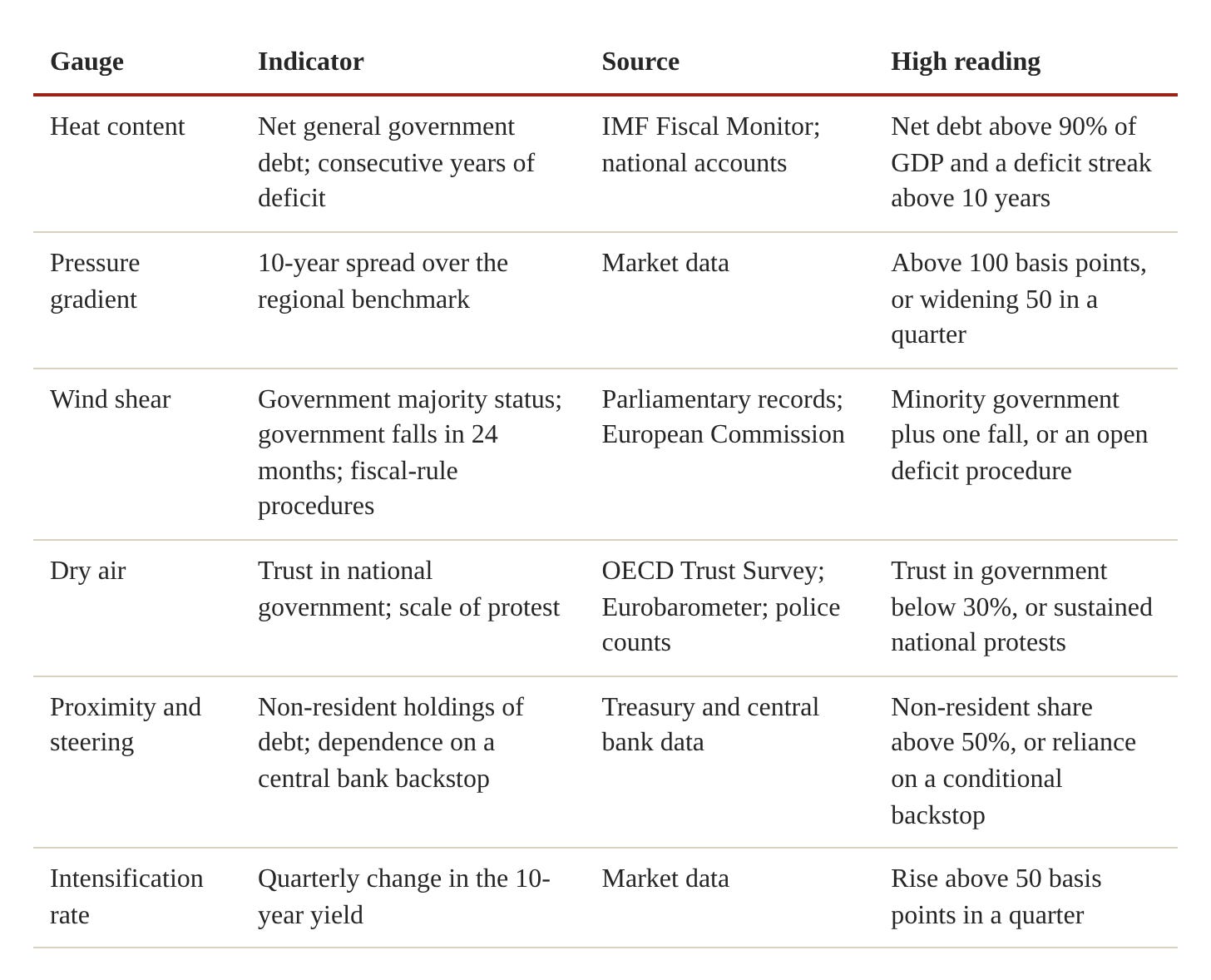
Measurement status is recorded separately because H1 makes it the decisive variable. It is scored as restored when an independent fiscal institution publicly endorses the government's forecasts, and as blinded when forecasts are bypassed, disputed or revised sharply after the fact.
State rules are provisional. Stressed: three or more gauges high. Watch for Critical: four or more high, including intensification. Warning: any two trigger events within a quarter, such as a government falling on a budget, a poorly covered auction, a sovereign downgrade, or a spread sustained above twice its high threshold. Forecasts are entered with probabilities and scored with the Brier score, the mean squared error between forecast probability and outcome.
4. The Generating Case: Beauvais
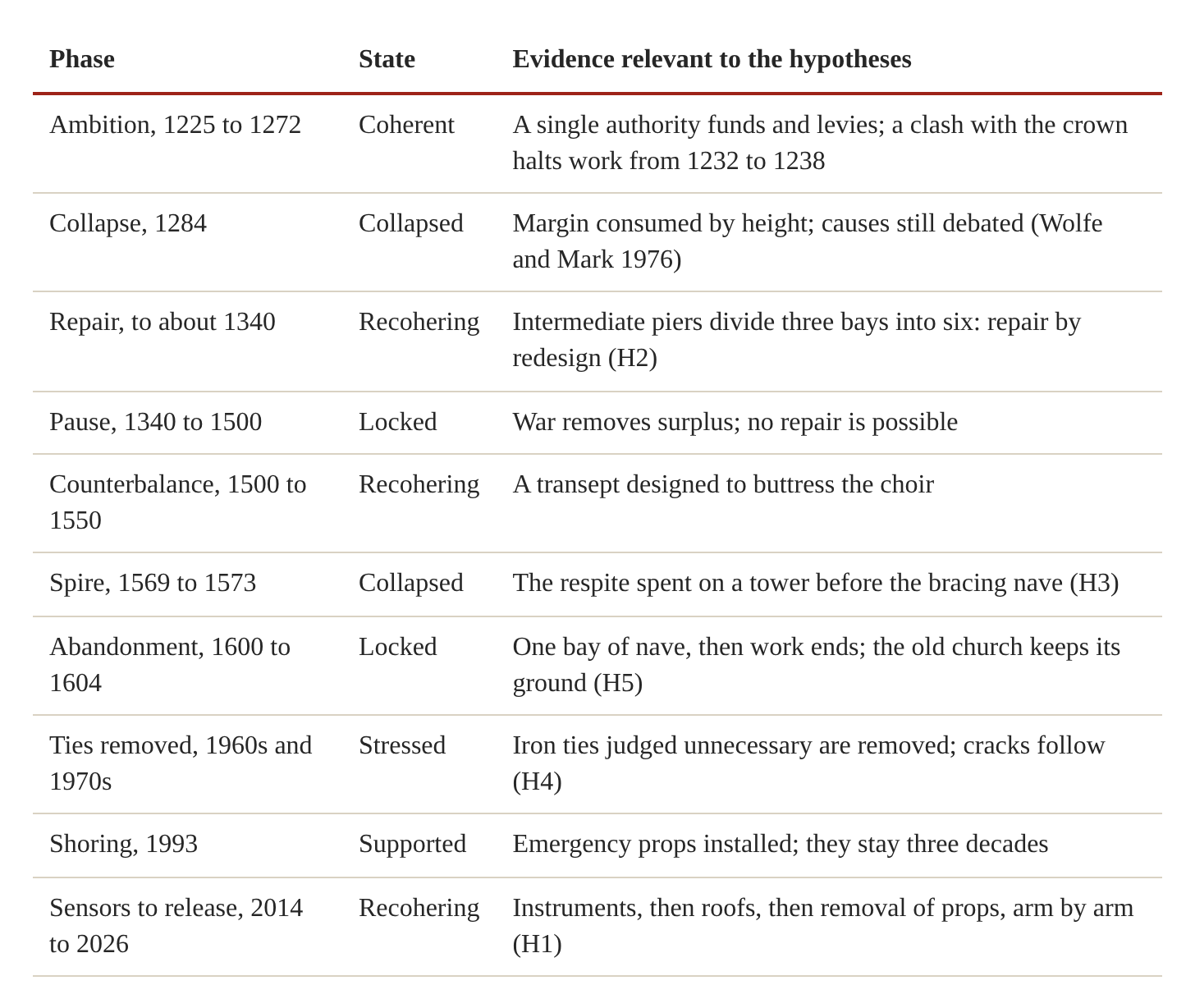
The building illustrates all five hypotheses, but it is a single case chosen because it fits. Its value is heuristic. The tests follow.
5. Four Test Cases
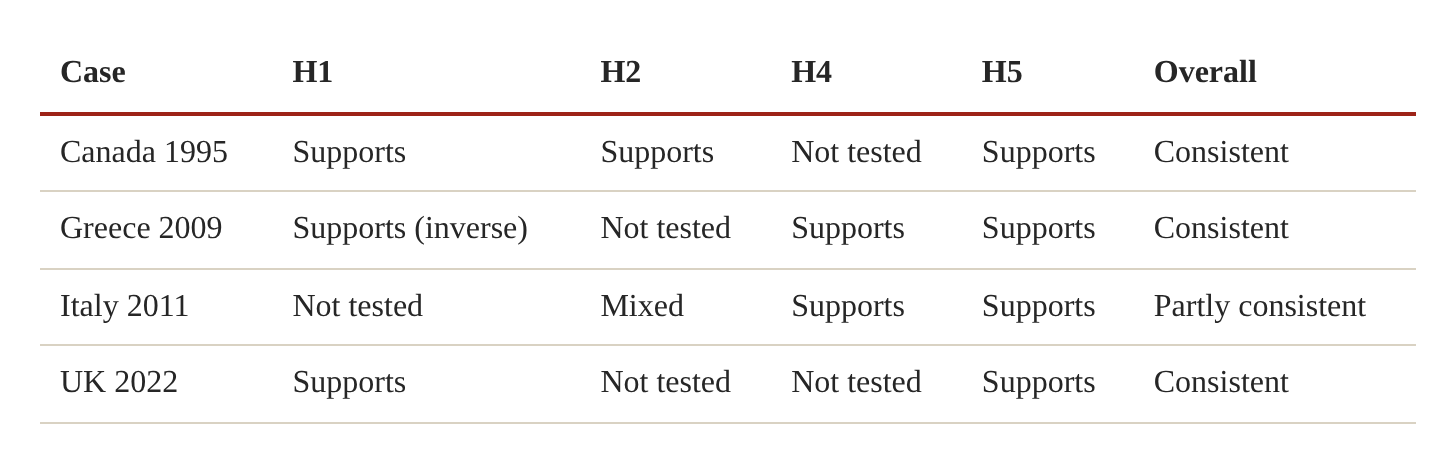
Each case is read retrospectively for consistency with the hypotheses. This is not yet a formal back-test, which requires the gauges to be computed from data available at the time; Section 8 sets out that protocol.
Canada, 1994 to 1998
Canada's credit was downgraded by S&P in 1992 and by Moody's in 1994 and again in 1995, and in January 1995 the Wall Street Journal called it an honorary member of the Third World. Moody's placed the debt under review on February 16, 1995, weeks before the budget.²³ The budget that followed relied on spending cuts and tax increases in a ratio of roughly seven to one and produced a balanced budget by 1998.²⁴ From 1994 the government deliberately set its economic assumptions below the private-sector average, explaining that earlier over-optimistic forecasts had sent fiscal plans off track, and it backed them with contingency reserves of $2.5 billion and $3 billion.²⁵
Assessment. Consistent with H1, H2 and H5. Credible measurement was restored through conservative forecasting a year before the main consolidation, even though Canada created an independent budget office only in 2008.
Greece, 2009
In October 2009 a new government revealed that the 2009 deficit would be about twice the previous government's estimate. Eurostat later put it at 13.6 percent of GDP, then 15.4 percent, and a European Commission report found severe irregularities in the Greek fiscal notifications.²⁶ The crisis that followed required external programmes and a debt restructuring.
Assessment. The clearest inverse case for H1. Measurement had been blinded, so decay proceeded unseen until revision exposed it all at once.
Italy, 2011
Italian spreads over Germany reached a euro-era record of about 575 basis points on November 9, 2011, with the 10-year yield near 7.5 percent. Silvio Berlusconi, who had promised the day before to step down once the budget law passed, resigned on November 12, and Mario Monti took office on November 16. That summer, the European Central Bank had begun buying Italian bonds days after a confidential letter from its outgoing president, Jean-Claude Trichet, and his successor, Mario Draghi, then governor of the Bank of Italy, requested specific budget measures, including a balanced budget by 2013.²⁷
Assessment. Consistent with H5: the market moved before the government did, and European support followed explicit policy requests. Durability was mixed, which cautions against reading any single consolidation as permanent.
United Kingdom, 2022
On September 23, 2022, the government announced about £45 billion of unfunded tax cuts without the independent forecasts the Office for Budget Responsibility normally provides. The 30-year gilt yield, about 3.7 percent that day, crossed 5 percent within days. On September 28 the Bank of England announced temporary purchases of up to £65 billion of long-dated gilts. The government then pledged to involve the OBR in the budget process, and a revised fiscal plan was presented with full OBR forecasts in November.²⁸
Assessment. A near natural experiment for H1. Bypassing the fiscal watchdog coincided with a disorderly repricing, and restoring it formed part of the stabilisation. Leveraged pension-fund strategies amplified the move, so measurement was not the only cause.
6. France, October 2026
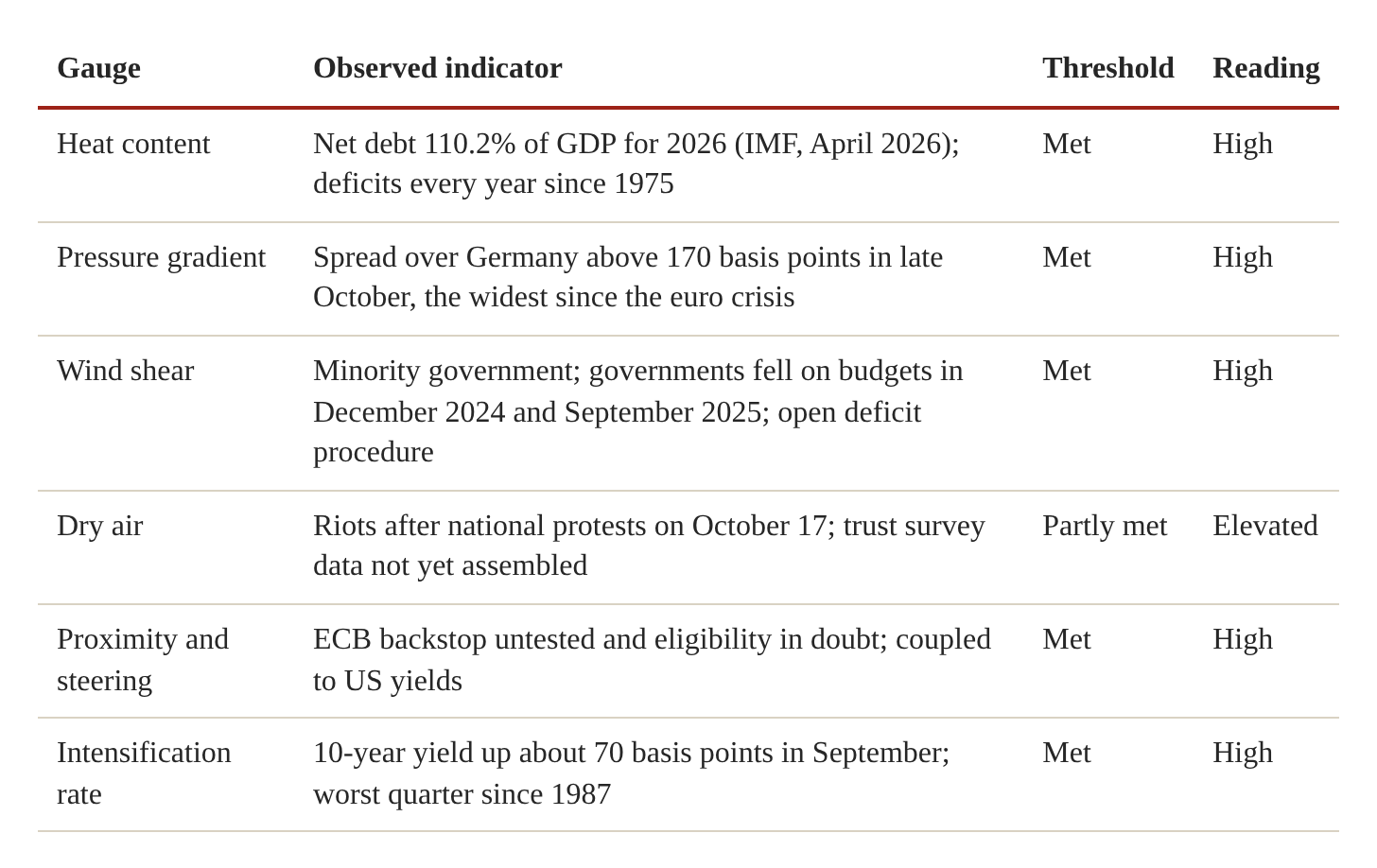
Measurement status: contested. The Haut Conseil des finances publiques judged the government's 1.0 percent growth forecast for 2027 optimistic.²⁹ Under H1, this is the variable to watch most closely.
Reading: five gauges high and one elevated, including intensification. State: Stressed, with a Watch for Critical.
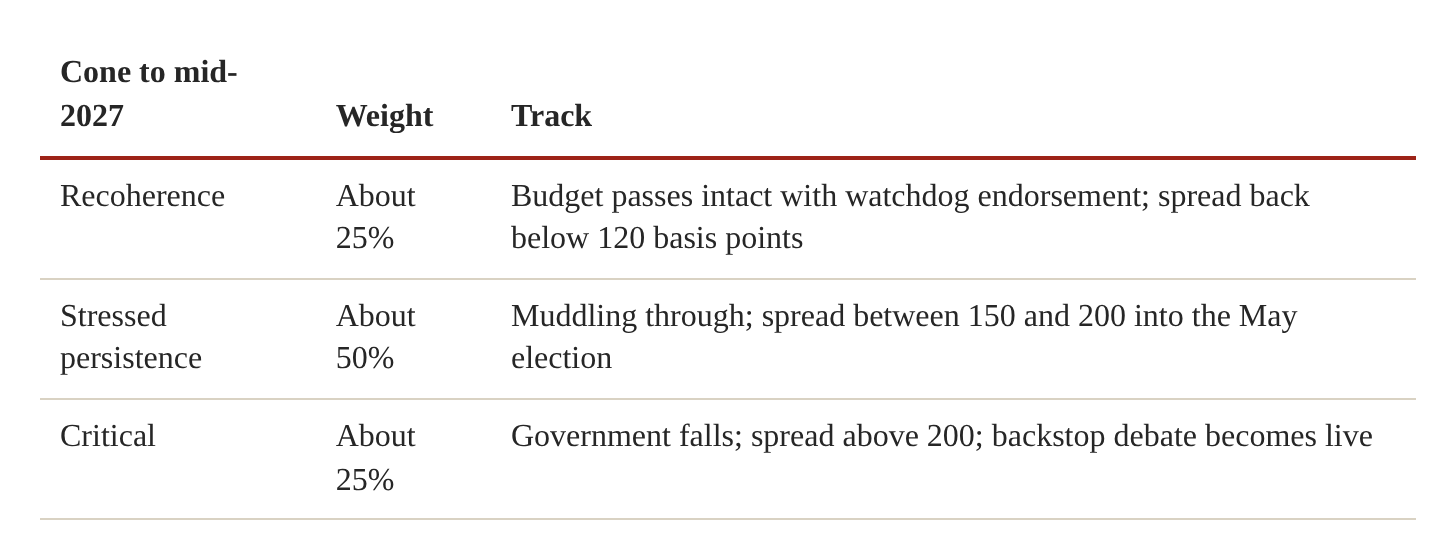
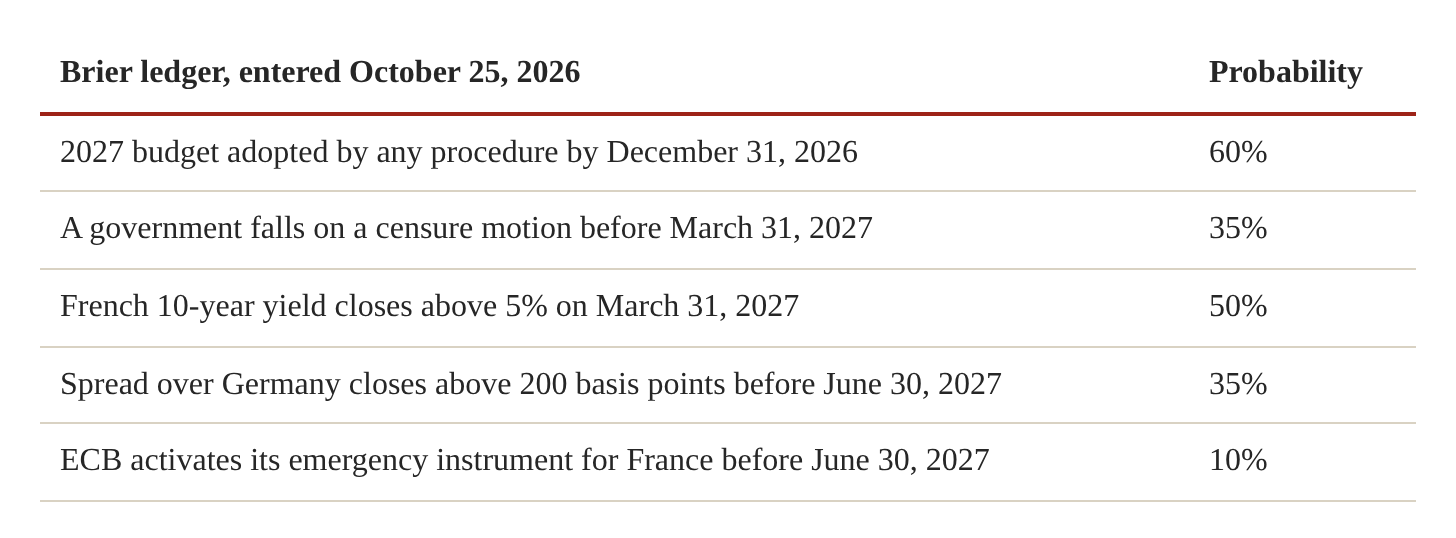
The weights and probabilities are calibrated judgments, not model outputs. Their value lies in being scored.
7. Counterarguments
Debt may be affordable. If interest rates stay below nominal growth, debt ratios can stabilise without large surpluses (Blanchard 2019, 2023). The French repricing of 2026 suggests that condition is weakening, but if rates fall back, the urgency the framework implies would diminish. The framework claims nothing about the optimal debt level, only about the order of repair.
Consolidation can be self-defeating. Multipliers may be larger in downturns than earlier estimates assumed (Blanchard and Leigh 2013), so tightening into weakness can raise debt ratios. H1 is compatible with this concern: credible measurement allows a slower, better-sequenced adjustment rather than demanding a faster one.
Composition findings are disputed. The advantage of spending-based adjustment (Alesina, Favero and Giavazzi 2019) is not universally accepted, and its distributional consequences are real. H2 is stated in terms of redesign, not of cutting for its own sake.
The analogy is selective. Beauvais was chosen because it fits. That is why the paper treats it as a source of hypotheses and seeks its evidence elsewhere.
8. Falsification and Research Agenda
The framework would be weakened by any of the following: consolidations without credible independent measurement proving as durable as those with it; the provisional gauges failing to flag the Greek, Italian or British episodes when computed from contemporaneous data; or the Brier ledger scoring no better than a naive baseline over twenty or more entries.
The Institute intends four tests. First, combine the IMF Fiscal Council Dataset with an established narrative dataset of consolidation episodes to compare durability with and without independent measurement. Second, compute the six gauges quarterly from contemporaneous data for the four test cases and for control countries that did not experience crises, and report hit and false-alarm rates. Third, recalibrate thresholds on the results and publish the revisions. Fourth, score the ledger publicly at each resolution date.
9. Implications
For France, the evidence supports a specific sequence: restore measurement, with forecasts the watchdog can endorse; seal the roof, with a budget process that no longer runs from crisis to crisis; add piers through redesign of spending composition; and only then reduce dependence on external bracing by exiting the deficit procedure.
For capital allocators, the framework shifts attention from levels to transitions. Spreads in a Stressed system reprice structure rather than sentiment. Exposure that relies on a conditional backstop carries the politics of whoever provides it. And measurement status may be the earliest signal available: in both Greece and the United Kingdom, the instrument failed before the market did. This paper informs judgment and is not investment advice.
10. Conclusion
The ideas in this paper began as an essay about a cathedral. They now stand as five testable hypotheses, a reproducible diagnostic with stated thresholds, four test cases and a public forecast record. The cases so far are consistent with the central claim that measurement must come first. Whether that claim survives systematic testing is the question the Institute's next papers will answer.
References
Alesina, A., C. Favero and F. Giavazzi (2019). Austerity: When It Works and When It Doesn't. Princeton University Press.
Alesina, A., C. Favero and F. Giavazzi (2019). Effects of Austerity: Expenditure- and Tax-Based Approaches. Journal of Economic Perspectives 33(2): 141 to 162.
Beetsma, R., X. Debrun, X. Fang, Y. Kim, V. Lledó, S. Mbaye and X. Zhang (2019). Independent Fiscal Councils: Recent Trends and Performance. European Journal of Political Economy 57: 53 to 69.
Blanchard, O. (2019). Public Debt and Low Interest Rates. American Economic Review 109(4): 1197 to 1229.
Blanchard, O. (2023). Fiscal Policy under Low Interest Rates. MIT Press.
Blanchard, O. and D. Leigh (2013). Growth Forecast Errors and Fiscal Multipliers. American Economic Review 103(3): 117 to 120.
Debrun, X. and T. Kinda (2014). Strengthening Post-Crisis Fiscal Credibility: Fiscal Councils on the Rise. A New Dataset. IMF Working Paper 14/58.
International Monetary Fund (2026). Fiscal Monitor, April 2026.
Minsky, H. (1986). Stabilizing an Unstable Economy. Yale University Press.
Murray, S. (1989). Beauvais Cathedral: Architecture of Transcendence. Princeton University Press.
Olson, M. (1982). The Rise and Decline of Nations. Yale University Press.
Pierson, P. (2004). Politics in Time: History, Institutions, and Social Analysis. Princeton University Press.
Reinhart, C. and K. Rogoff (2009). This Time Is Different: Eight Centuries of Financial Folly. Princeton University Press.
Wolfe, M. and R. Mark (1976). The Collapse of the Vaults of Beauvais Cathedral in 1284. Speculum 51(3): 462 to 476.
Market, budget and event data for 2022 to 2026 are drawn from contemporaneous reporting by Reuters, Trading Economics, the Office for Budget Responsibility, the Bank of England, the French Ministry of Culture and the cathedral's own published history. A full data appendix with dated sources accompanies the final version.
Bonjourhi Institute Analytics Team, Montréal
Notes
Part One. The Choir at Beauvais
1. Reuters, via The Standard (Hong Kong), French 10-Year Bond Yields Hit 5pc, Highest since July 2002, October 21, 2026. https://www.thestandard.com.hk/finance/article/346096/French-10-year-bond-yields-hit-5pc-highest-since-July-2002
2. Cathédrale Saint-Pierre de Beauvais, History of Beauvais Cathedral. https://cathedrale-beauvais.fr/en/history-of-beauvais-cathedral/ ; Ville de Beauvais, 800 Years of Beauty and History. https://800anscathedrale.beauvais.fr/en/
3. On the regency: Blanche of Castile, Wikipedia (regent 1226 to 1234). https://en.wikipedia.org/wiki/Blanche_of_Castile ; Larousse, Louis IX ou Saint Louis. https://www.larousse.fr/encyclopedie/personnage/wd/130421 . On the bishop's role at the coronation and his conflict with the crown: Milo of Nanteuil, Wikipedia. https://en.wikipedia.org/wiki/Milo_of_Nanteuil
4. Beauvais Cathedral, Wikipedia, on the funding crisis provoked by the struggle with Louis IX. https://en.wikipedia.org/wiki/Beauvais_Cathedral
5. The Connexion, Ups and Downs of Historic Gothic Giant in Beauvais. https://connexionfrance.com/magazine/ups-and-downs-of-historic-gothic-giant-in-beauvais/508653
6. French Moments, Beauvais Cathedral. https://frenchmoments.eu/beauvais-cathedral/
7. Beauvais Cathedral, Wikipedia (choir height 47.5 metres; Amiens nave 42 metres). https://en.wikipedia.org/wiki/Beauvais_Cathedral
8. Sénat, Proposition de loi n° 81 (2010 to 2011), exposé des motifs: no budget voted in balance since 1975. https://conferenceconsensuslogement.senat.fr/leg/ppl10-081.pdf ; Fondation iFRAP, Retour sur 50 ans de déficit public (last surplus in 1974). https://www.ifrap.org/data/retour-sur-50-ans-de-deficit-public
9. Banque de France and Deutsche Bundesbank yield data, compiled by Idéal Investisseur, OAT/Bund spread, October 22 and 23, 2026. https://www.ideal-investisseur.fr/en/markets/oat-bund-spread.html ; EFG International, French Debt Crisis: Causes, Repercussions, and Risks, October 2026. https://www.efginternational.com/us/insights/2026/french_debt_crisis_causes_repercussions_and_risks.html
10. Euronews, French Bond Yield Surpasses Spain's as Investors Mull Budget Woes, September 26, 2024, citing LSEG data. https://www.euronews.com/2024/09/26/bond-investors-see-french-debt-as-more-risky-than-spanish-according-to-the-price
11. Bloomberg, France’s Debt Is Riskier Than 38% of Nation’s Company Bonds, October 8, 2026 (nearly €215 billion of French high-grade corporate bonds trading at lower yields than comparable government securities, up from €12 billion at the start of 2026). https://www.bloomberg.com/news/articles/2026-10-08/france-s-debt-is-now-riskier-than-38-of-nation-s-company-bonds
12. Cathédrale Saint-Pierre de Beauvais, History of Beauvais Cathedral (intermediate piers dividing three bays into six). https://cathedrale-beauvais.fr/?p=3373
13. Cathédrale Saint-Pierre de Beauvais, Historical Overview. https://cathedrale-beauvais.fr/en/historical-overview-of-beauvais-cathedral/ ; Ville de Beauvais, A Setting of Stone and Glass (chronology). https://800anscathedrale.beauvais.fr/en/la-cathedrale-saint-pierre/800-ans-de-splendeur/
14. INSEE, Insee Première n° 2106, Le compte des administrations publiques en 2025, May 2026 (public spending 57.3% of GDP). https://www.insee.fr/fr/statistiques/8997691 ; INSEE, Dépenses des administrations publiques dans l'Union européenne (France 57.2% against an EU average of 49.5%, Eurostat). https://www.insee.fr/fr/statistiques/2381406
15. International Monetary Fund, Fiscal Monitor, April 2026, Chapter 1 (net debt 110.2% of GDP for 2026). https://www.elibrary.imf.org/display/book/9798229042512/CH001.xml ; INSEE, Informations Rapides n° 239, September 29, 2026 (net debt 111.4% of GDP at end of second quarter 2026). https://www.insee.fr/fr/statistiques/9053525
16. INSEE, Informations Rapides n° 239, September 29, 2026 (Maastricht debt €3,595.5 billion, 119.0% of GDP). https://www.insee.fr/fr/statistiques/9053525 ; Trading Economics, French 10-Year Bond Yield Briefly Tops 5%, October 2, 2026 (Agence France Trésor borrowing programme). https://tradingeconomics.com/france/government-bond-yield/news/589189
17. Reuters, France in Turmoil: What Might Follow a Weekend of Riots?, October 20, 2026, via bdnews24. https://bdnews24.com/world/europe/france-unrest-riots-protest-europe-politics-cost-of-living ; on the fall of the Bayrou government: Dubai Eye 103.8, France Gears Up for Protests, Strikes over Budget Cuts. https://www.dubaieye1038.com/news/international/france-gears-up-for-protests-strikes-over-budget-cuts/
18. Banque de France, Prix du meilleur article financier 2024, published April 2026 (debt service projected to become the state's largest expenditure item by 2027). https://www.banque-france.fr/system/files/2026-04/Prix_du_meilleur_article_financier_2024.pdf
19. Ministère de la Culture, Restauration de la cathédrale Saint-Pierre de Beauvais (shoring installed in 1993). https://www.culture.gouv.fr/regions/drac-hauts-de-france/actualites/grands-projets/france-relance/Restauration-de-la-cathedrale-Saint-Pierre-de-Beauvais
20. Reuters, Explainer: Why the ECB Is Unlikely to Step In for France, October 1, 2026, via Global Banking & Finance Review. https://www.globalbankingandfinance.com/explainer-why-ecb-unlikely-step-france/ ; Trading Economics, France 10-Year Bond Yield Tracks Peers Lower, October 15, 2026. https://tradingeconomics.com/france/government-bond-yield/news/592291
21. CBC News, Will Jim Flaherty Cut as Deeply as Paul Martin? https://amp.cbc.ca/news/politics/will-jim-flaherty-cut-as-deeply-as-paul-martin-1.1174139 ; The Globe and Mail, We've Come a Long Way. https://www.theglobeandmail.com/news/national/weve-come-a-long-way/article20447795
22. International Monetary Fund, Fiscal Monitor, April 2026, Chapter 1 (Canada net debt 10.3% of GDP for 2026).
Part Two. The Long Repair
23. Department of Finance Canada, Canada's Minister of Finance Surprised at Moody's Action before Budget, February 16, 1995 (archived). https://bac-lac.wayback.archive-it.org/web/20061129181233/http://www.fin.gc.ca/news95/95-015e.html ; Christian Science Monitor, Canadian Budget Cuts Deeply But Proves Popular, March 1, 1995. https://m.csmonitor.com/1995/0301/01081.html
24. Investing Daily, When Canada Got Downgraded. https://www.investingdaily.com/11339/when-canada-got-downgraded/
25. Department of Finance Canada, The Budget Plan, February 1994, Chapter II (assumptions below the private-sector average). https://budget.canada.ca/archives/1994-plan-eng.pdf ; Budget 1995, Budget Speech, February 27, 1995, and Budget in Brief. https://budget.canada.ca/archives/budget95/speech/speech.pdf
26. European Commission, Report on Greek Government Deficit and Debt Statistics, COM(2010) 1 final, January 8, 2010. https://reporter.gr/images/stories/alex/COM_2010_REPORT_GREEK-EN2.pdf ; MNI, Greece '09 Public Deficit Revised Up to 13.6% of GDP, April 22, 2010. https://investinglive.com/news/!/update-greece-09-public-deficit-revised-up-to-13-6-of-gdp-20100422/ ; Yorkshire Post, Greece's Debts Much Worse Than Thought (15.4%). https://www.yorkshirepost.co.uk/news/greeces-debts-much-worse-thought-1950417
27. AGI, Draghi e lo spread sulle montagne russe, February 4, 2021 (record of 575 basis points and 7.47% yield on November 9, 2011; Monti's appointment on November 16). https://www.agi.it/economia/news/2021-02-04/draghi-spread-montagne-russe-11286301/ ; FinanzaOnline, Berlusconi si dimetterà dopo la legge di stabilità, November 2011. https://www.finanzaonline.com/notizie/berlusconi-si-dimettera-dopo-legge-di-stabilita-spread-btp-bund-ancora-elevato-209577
28. Western Asset, The UK Gilt Market: Making Sense of the Turmoil, November 3, 2022. https://www.westernasset.com/us/en/research/blog/the-uk-gilt-market-making-sense-of-the-turmoil-2022-11-03.cfm ; Central Banking, BoE Becomes Reluctant Market-Maker of Last Resort. https://www.centralbanking.com/node/7953253 ; Robeco, Volatility Strikes in the UK Bond Market, October 11, 2022.
29. Public Sénat, Budget 2027: le Haut Conseil des finances publiques pointe des prévisions optimistes du gouvernement, October 2026. https://www.publicsenat.fr/actualites/economie/budget-2027-le-haut-conseil-des-finances-publiques-pointe-des-previsions-optimistes-du-gouvernement ; Euronews, Le gouvernement français prévoit 1% de croissance en 2027, October 2, 2026. https://fr.euronews.com/2026/10/02/le-gouvernement-francais-prevoit-1-de-croissance-en-2027-quen-pensent-les-experts