

Bonjourhi!
Recently we had the privilege of hosting Professor Ranjay Gulati of Harvard Business School for a workshop at HEC Montréal. The theme was leading in turbulent times, and he opened with a case on Ernest Shackleton.
The Shackleton most of us know is the one of the Endurance: the ship crushed by pack ice, the open boat, every man brought home alive. What stayed with me after the workshop was a smaller episode from an earlier expedition, a biscuit handed over in the snow.
It came back to me while reading “The Backlash to Corruption Is Going Global,” Isaac Stanley-Becker’s piece in The Atlantic, which follows public anger from Budapest to Pennsylvania. Voters everywhere seem to be asking their leaders what Frank Wild answered in his diary that night: when rations run short, who is eating what?
What follows is my attempt to explain why that may matter more than character.
Pierre Somers
Chief Editor, Bonjourhi Institute, Montréal
For ten years, Americans argued about Donald Trump’s character. The insults, the indictments, the lawsuits, the boasting. His critics said it should disqualify him. His supporters had heard it all before and voted for him anyway. Most people, quietly, stopped listening.
This autumn, the subject changed. Ask voters what worries them most and many now answer with a word they used to reserve for other countries: corruption. In April, Hungarians delivered that verdict and ended Viktor Orbán’s sixteen years in power.
So is this finally a judgment on morals? It is, I suspect. Just not on the morals we spent a decade debating.
The clearest explanation I know comes from a diary written on the Antarctic ice in 1909, and it concerns a single biscuit.
Survivors of the London Blitz liked to tell a small story. In September 1940, German bombs hit Buckingham Palace, and the Queen said she was almost glad, because now she could look the East End in the face. Londoners had lost far more than palace windows. What moved them was not her loss. It was the sense that she understood theirs at last.
The Atlantic recently met a woman in Pennsylvania who has voted reliably for years, and whose ballot normally helps her Republican congressman. This year she is staying home. Picture someone like her at the kitchen table, receipts in one hand, phone in the other. She has not switched parties. She simply cannot bring herself to show up.

For most of our lives, we kept a leader’s private conduct and our own fortunes in separate drawers. Character was for preachers, columnists and biographers. Ordinary citizens asked a simpler question: am I better off?
A president could be vain, unfaithful, rich or rude, and if the paycheque stretched a little further each year, the country let it go. Many who disliked Trump hired him again in 2024 for exactly that reason. They wanted prices down. They could forgive the noise.
Prices did not come down.
Over the months that the grocery bill went on climbing, the president’s estimated fortune grew by roughly $2.7 billion, to about $7 billion. His youngest son, a twenty-year-old college student, is reported to be worth some $150 million, most of it from the family’s crypto company. In Georgia, Senator Jon Ossoff found the sentence that sticks: “Prices soar while the president rakes in billions.”
The money was not new. The timing was.
Then there was the ration itself. The 2025 tax law was most generous at the top; tariffs, meanwhile, raised the cost of most things a family puts in its cart. When Yale’s Budget Lab added the two together, only the richest tenth of households came out ahead on average. Every other group lost ground.
The rich got lower taxes. The rest got tariffs.
In the southern summer of 1908, Ernest Shackleton set out for the South Pole with three companions: Frank Wild, Eric Marshall and Jameson Adams. Their ponies died or were shot along the way, and from the foot of the Beardmore Glacier the four men hauled the sledges themselves, in harness, like draught animals.
Anyone who has read their diaries knows how small their world became. Every conversation drifted toward food. They dreamed of puddings and woke hungry. Each man’s daily ration was weighed to the ounce, in full view of the others. Hunger they could bear. It was shared, and that was the bargain they had signed.
What they could not have borne was the suspicion that someone was eating more. On a sledge journey you watch your companions’ hands at mealtime more carefully than you watch the weather. A man will pull through frostbite and blistered feet. He will not pull for long beside someone he believes is taking his share.
On January 9, 1909, ninety-seven miles from the Pole, Shackleton turned them around. He chose living men over a flag.
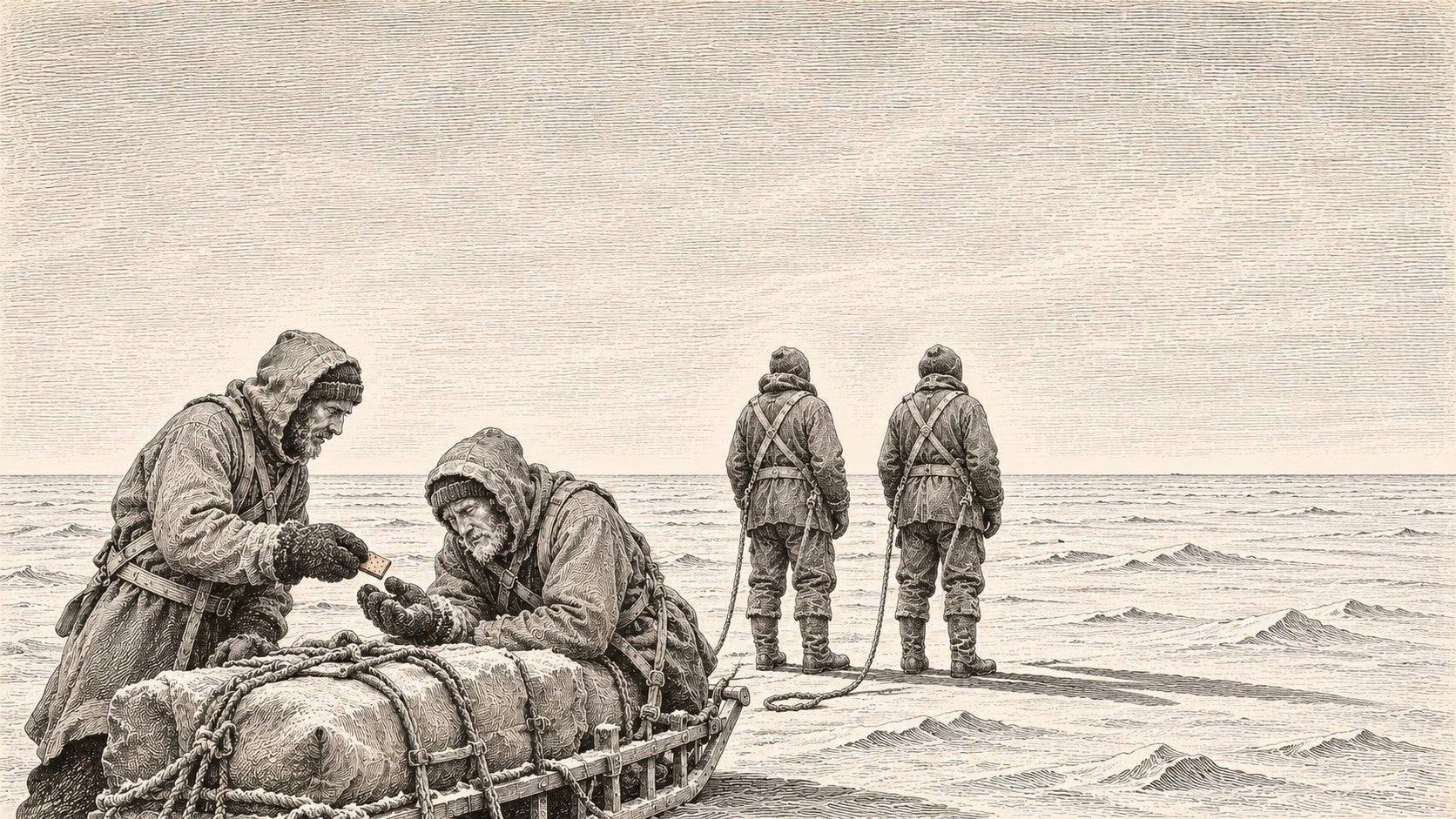
On the long march back, Wild fell sick with dysentery and could barely keep pace. One morning Shackleton pressed his own breakfast biscuit into Wild’s hand and would not take no for an answer. That night Wild wrote in his diary: “Thousands of pounds would not have bought that one biscuit.”
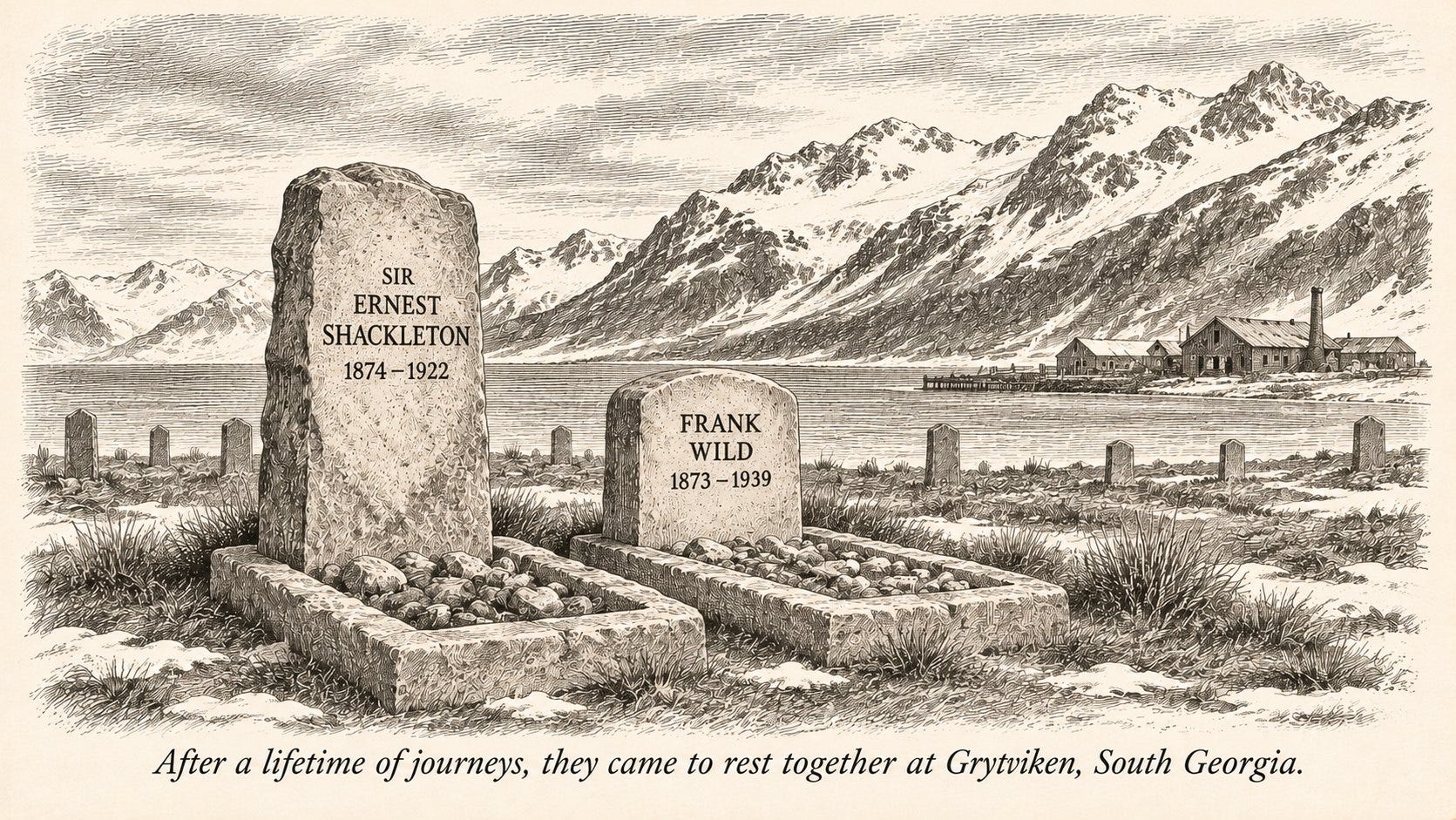
It cost Shackleton a few mouthfuls. It earned him a friend who followed him south twice more, and whose ashes, a century after that march, were laid to rest beside him on South Georgia.
This is how a household feels in a squeeze. Rent, groceries, insurance, gas: everyone is pulling. Few expect easy years, and few demand that their leaders be saints. What they keep an eye on, often without saying so, is what the person at the front of the sledge is eating.
When times are good, a president’s fortune hardly registers. In hard times the identical figure weighs differently. It looks like a portion taken from a shared ration. And when the scales are reset, more for the front of the sledge and less for the back, suspicion hardens into certainty. Nothing about the money has changed. Everything about how it feels has.
That is why the old quarrel about character achieved so little, and why corruption is landing now. Voters were told the man was coarse, and they shrugged. Now they see him at the table as they go without, and that touches something older than politics.
Notice, too, that nearly half of Republicans told Fox News pollsters they were extremely concerned about corruption. This is not one tribe scolding another. It is a rule anyone who has ever sat down to a family dinner already knows.
In Coherence Economics, we would say decoherence extracts. A growing economy can hide a great deal of extraction; there is enough to go around, and nobody looks closely. A squeezed one hides nothing.
And the instruments go first. When inspectors general are dismissed and ethics offices fall silent, the formal gauges stop reading. The public then becomes the gauge, and its reading shows up at the ballot box, or in the quiet decision to stay home.
Similar readings are arriving from very different places. In Nepal last year, young people scrolled past photos of politicians’ children on foreign holidays as they lined up for work permits abroad, and within days of the protests the government fell. In Indonesia, a housing allowance for members of parliament filled the streets. In Hungary, Péter Magyar, himself a former Orbán loyalist, won by talking about cronyism and hospitals that no longer worked, on a turnout of 79 percent.
Left or right, east or west, one test is being applied.
That test rewards the visibly frugal more than the virtuous. Hungarians did not ask Magyar to be a saint. They asked him to be seen pulling the same weight they were.
Nor does it stop with those it removes. Whoever wins on a promise to clean things up has just volunteered for that scrutiny. The march carries on after election night.
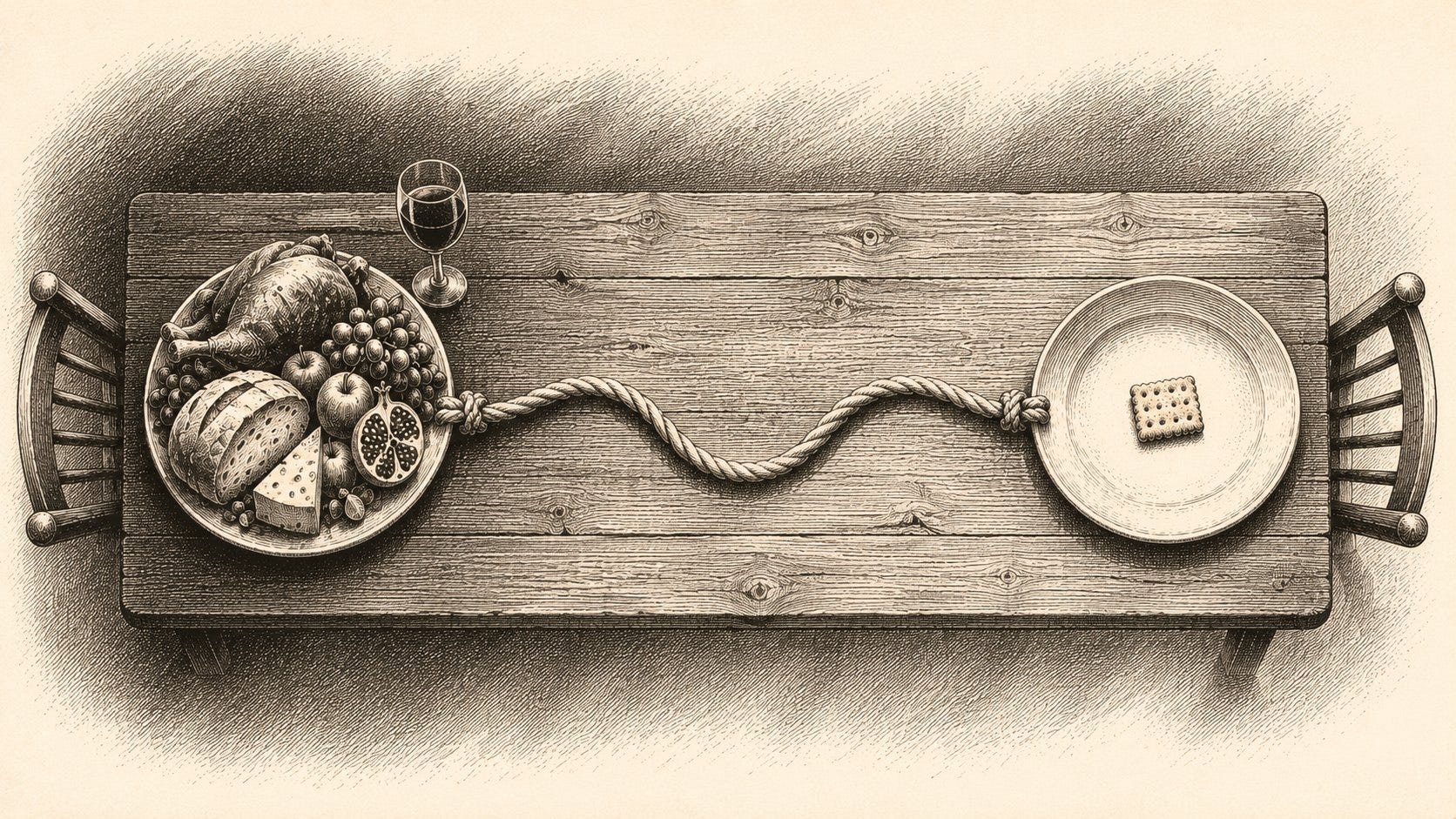
So yes, I think this is a vote on morals. But on one narrow and ancient question. Not whether the leader is a good man. Whether he is eating while we are hungry.
All those arguments shifted few minds. One biscuit, seen from the other side of the sledge, can move a whole country.
Bonjourhi Institute, Montréal
Notes
I. On the wealth figures
Estimates of the Trump family’s fortune rest largely on valuations of private companies and cryptocurrency holdings, which move quickly and are difficult to verify. The essay’s argument does not depend on the precise figure. It depends on the direction of travel, and on the public’s perception of it, during a period when household budgets were under strain. The president and his supporters maintain that the family’s wealth comes from lawful private business and that corruption charges are political attacks.
II. On the line “The rich got lower taxes. The rest got tariffs.”
Taken alone, the 2025 tax law raises after-tax income for most groups, with the largest gains at the top; lower-income households lose mainly through cuts to programs such as Medicaid and food assistance. The broad losses appear when tariffs are added, because tariffs act as a consumption tax that weighs most heavily on households spending a large share of their income. Tariff policy has also been subject to legal challenge and revision, so these estimates may shift. The line compresses a combined effect into a single sentence; readers who prefer precision should read it as a statement about the package, not about either policy alone.
III. On reading the polls
Concern about corruption is not evenly spread: Democrats report it far more intensely than Republicans. A president’s party has also tended to lose ground in midterm elections whatever the issues of the day, which makes any single cause hard to isolate. The essay claims a shift in what voters notice, not a proof of why any particular race was won or lost.
IV. On Coherence Economics
The framework developed by the Bonjourhi Institute rests on three laws: coherence compounds, decoherence extracts, recoherence recompounds. Its master theorem holds that the instruments go first: a system can only correct what it can still measure. When formal oversight is weakened, the measurement does not disappear; it migrates, often to the electorate, where it is cruder, slower and harder to ignore.
V. On the Shackleton account
The southern party’s rations had been cut repeatedly on the return march, and Wild’s illness is generally attributed to tainted pony meat. Shackleton’s gesture survives because Wild recorded it the same night, writing that he did not suppose anyone else in the world could realise the generosity it showed.
VI. Sources
Isaac Stanley-Becker, “The Backlash to Corruption Is Going Global,” The Atlantic, November 2026, for the Pennsylvania voter, the Trump family wealth estimates and the Ossoff quote (https://apple.news/ARWujlpUKS8KP5oZm-wI3hg); the kitchen table scene is a composite. Fox News poll of registered voters, October 9 to 12, 2026. Hungarian national election committee results, April 2026. The Budget Lab at Yale, “Combined Distributional Effects of the One Big Beautiful Bill Act and of Tariffs,” August 2025, data updated December 2025. Ernest Shackleton, The Heart of the Antarctic (1909), and Frank Wild’s expedition diary, entry for January 31, 1909. The farthest south was reached on January 9, 1909, at 88°23′ South, about 97 geographical miles from the Pole. Wild’s ashes were interred beside Shackleton’s grave at Grytviken, South Georgia, in November 2011.