

Tuesday’s rout was not a referendum on Donald Trump’s character. Americans were judging something older.
Bonjourhi!
On the eve of the vote, in The Biscuit, I argued that Americans on short rations would judge a leader by his portion rather than his character. On Tuesday, they did.
Smong is the follow-up. The word comes from Simeulue, a small island off Sumatra. A tsunami in 1907 taught its people that when the sea withdraws, you climb. In 2004 they remembered, and nearly all of them lived.
The essay reads Tuesday’s blue wave through that word: the anger that crossed open water unnoticed, the quiet before it reached shore, and a second retreat now under way, as savers abandon stocks for Treasury bills and ask to be paid more for holding them. FOMO is giving way to FOLO, and Washington will feel it in the price of its debt.
The full essay follows, with notes and sources.
Warmly,
Pierre Somers
Chief Editor, Bonjourhi Institute, Montréal
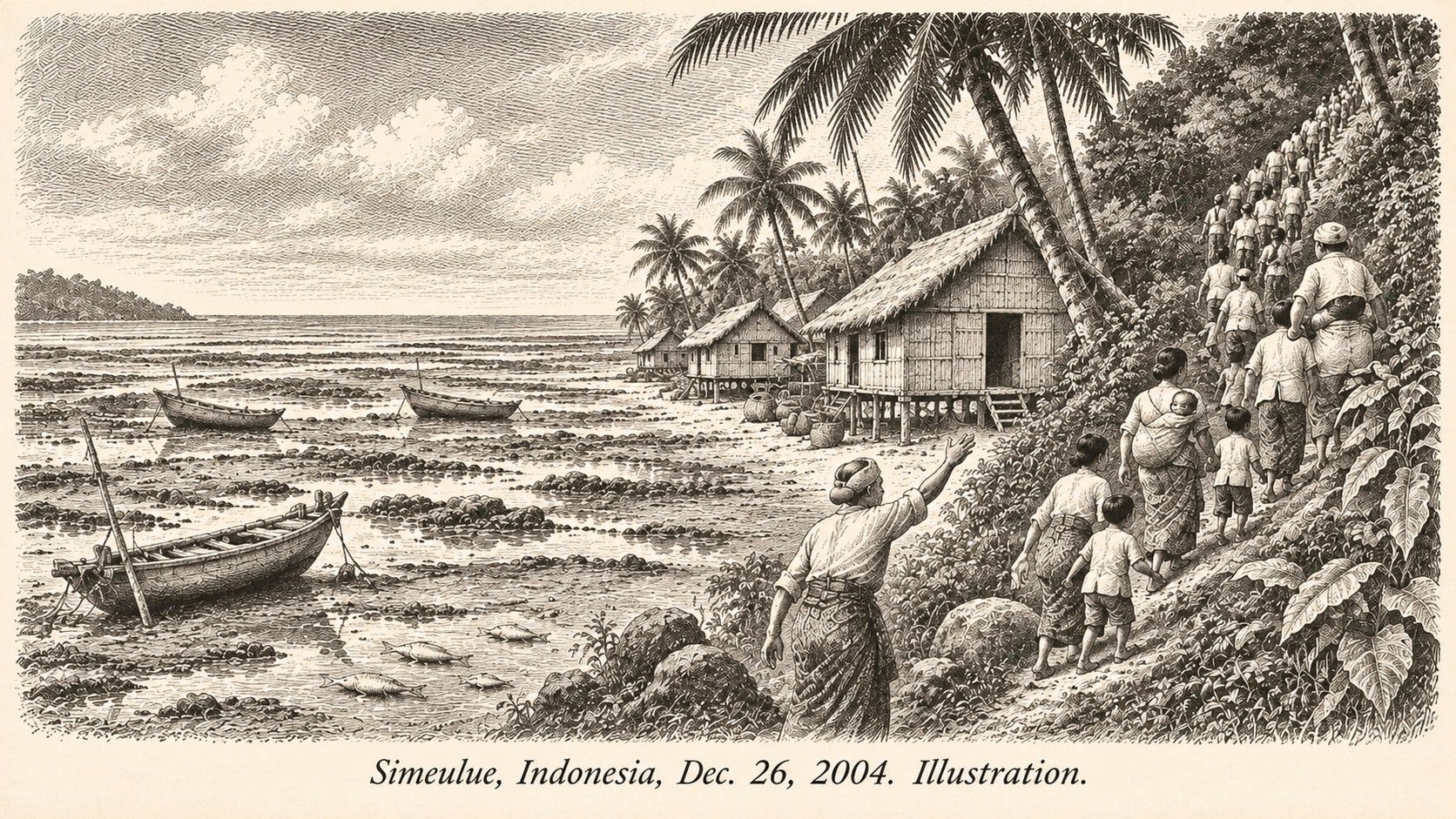
On the morning of Dec. 26, 2004, the sea off Simeulue, a small island west of Sumatra, slid away from the coast. Fish flapped on the bare sand. Elsewhere that morning, curious crowds walked out to gather them.
On Simeulue, the islanders ran for the hills. Their grandparents had survived a tsunami in 1907 and handed down one word for what follows when the ocean retreats: smong. Children absorbed it through stories and songs. When the wave struck, the island lost seven lives. Around the Indian Ocean, more than 200,000 died.
That word came back to me on Tuesday night, as commentators began calling the Democratic sweep a blue tsunami. Democrats took the House and flipped seven Republican Senate seats, in Iowa, Kansas, Maine, North Carolina, Ohio, South Carolina and Texas. Exit polls showed Mr. Trump on course for the lowest midterm approval rating on record, 38 percent.
The temptation now is to call this the long-awaited verdict on his character. That would misread the sea.
In an essay for the Bonjourhi Institute on the eve of the vote, I argued that voters on short rations judge a leader less by his virtues than by his portion. Its central figure was Ernest Shackleton, pressing his own biscuit on a starving companion on the Antarctic plateau in 1909. A decade of arguments about Mr. Trump’s conduct had shifted few ballots. A presidential fortune swelling during a household squeeze, I suggested, would shift many.
The returns bear that out. Roughly nine in 10 voters told exit pollsters that government corruption was a major factor in their choice, matching the share who cited prices. About half called corruption and the cost of living “crucial,” ahead of immigration enforcement, the war in Iran or AI data centers.
Strategists in both parties saw it coming. James Carville, author of “It’s the economy, stupid,” told The Wall Street Journal that inequality and corruption now outweigh everything else, and that Americans on the losing side understand that “the corruption is driving the inequality.” From the other bench, Sarah Chamberlain of the Republican Main Street Partnership had warned: “If the economy were healthier, no one would pay attention to the corruption.” A full sack goes unnoticed in a fat year. When rations shrink, it is all anyone sees.
Consider how a tsunami behaves.
Far from shore it is nearly invisible. It travels at the speed of a jetliner, yet its crest may stand less than a meter tall, stretched across a wavelength of a hundred miles or more. Ships pass over it unaware. The energy is immense. The surface looks still.
Only in the shallows does the wave slow, compress and rise. The ocean floor forces it upward. What crossed open water as a ripple reaches land as a wall.
Before it arrives, the sea often withdraws. That is the most dangerous moment, because it resembles an opportunity.
American politics spent this year in deep water. The rupture came long ago: prices that refused to fall, and a presidential fortune that kept climbing, by roughly $2.7 billion this term, according to estimates cited by The Atlantic. Polls registered the swell. In October, a Fox News survey found 60 percent of registered voters “extremely concerned” about government corruption, edging out inflation at 58 percent. Washington sailed over it.
Then the beach went quiet. The Atlantic introduced readers to Nicole Irvin, a Pennsylvania voter whose past ballots had favored her Republican congressman and who planned to skip Tuesday altogether. Citizens like her do not appear in rally crowds or on cable panels. To a campaign, a receding electorate can look like a contented one. It was a gathering one.
Tuesday was the shallows. A ballot is where diffuse grievance meets hard ground and stands up.
Elon Musk, in his first public comment after the results, wrote: “Data centers in space looking pretty appealing right now.” It captured the instinct of those stranded on the exposed seabed: look for higher ground rather than ask why the ocean moved.
Ms. Irvin has no rocket. Her refuge sits much closer to earth.
Over a generation, risk has migrated off the books of employers and governments and onto households: pensions replaced by 401(k)s, guaranteed benefits by market exposure, fixed costs by variable ones. Those asked to carry the most risk have the thinnest cushion to absorb it.
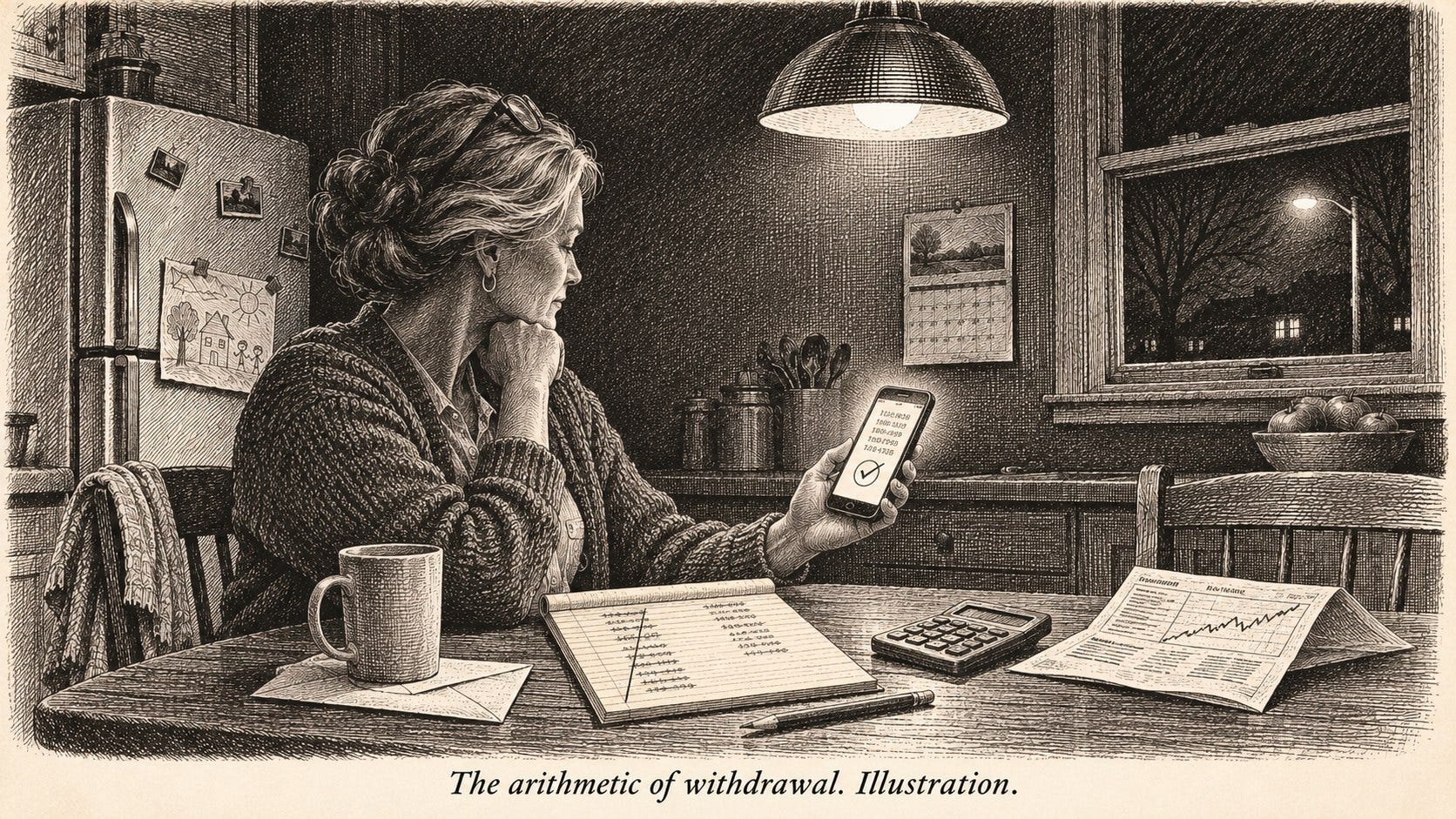
A voter who decides her ballot buys nothing may, in time, run the same arithmetic on her savings. Her next exit is from the stock market. Not toward gold or crypto, which offer more of what she is fleeing, but toward the plainest shelter available, the Treasury bill. And she will ask to be paid more for holding it. For a decade, Wall Street sold her FOMO, the fear of missing out. Brokers now have a name for what replaces it: FOLO, the fear of losing out. In one survey by the trading platform eToro, retail investors driven by that fear outnumbered the FOMO crowd two to one.
That migration is already underway. Money market funds, which invest largely in Treasury bills, held $7.98 trillion in early September, $3.11 trillion of it from retail savers. Bills that paid almost nothing five years ago now yield more than 4 percent, and the Federal Reserve, after its first increase since 2023 in September, is expected to tighten again. The Treasury, meanwhile, expects to sell some $800 billion of bills in the second half of the year to cover the deficit. Washington relies on household savings to finance its borrowing. It is about to learn that a citizen who has stopped trusting it is also a creditor who names her terms.
Staying home on Election Day is a protest. Walking away from risk is a repricing, and it lands on every dollar of federal debt.
Other explanations deserve a hearing. The president’s party almost always loses seats in a midterm. Gas prices pushed up by the Iran war did damage that needs no theory of corruption to explain. Concern about self-dealing also ran hotter among Democrats than among Republicans. All true. None of it explains why voters placed corruption beside groceries, or why a Democratic veteran and a Republican operative drew the same link.
Smong did not stop the 2004 wave. It told people what an empty beach meant.
For the winners, the lesson is less comfortable. Along many coasts in 2004, the first surge was not the largest. Water that rushed inland drained back, and later waves did more harm. The new majority has signed the ration sheet it campaigned on: in the final week, nearly 50 Democratic candidates pledged in a letter to make anti-corruption legislation their top priority. Every stock trade, family appointment and donor dinner in the coming Congress will be read against the price of eggs.
James Talarico, the Texan who told voters the affordability crisis was a corruption crisis, chose an unusual setting for his victory. He and Governor-elect Gina Hinojosa toasted with fountain drinks at a Whataburger in Austin. It may have been choreographed. It was also correct. In a lean year, the most persuasive thing a winner can do is be seen eating where everyone eats.
The flood has come in. Washington’s task now is to remember what the shoreline looked like when it went out.
Pierre Somers is chairman and chief executive of Walter Capital Management. He writes for the Bonjourhi Institute, Montréal.
Bonjourhi Institute, Montréal
Notes
I. On the election results
Democrats flipped Republican-held Senate seats in Iowa, Kansas, Maine, North Carolina, Ohio, South Carolina and Texas, according to projections by CNN and NBC News. Races in Alaska and Mississippi were still uncalled when this was written, so the essay gives no final seat count. The 38 percent approval figure comes from early CBS News exit polling and may shift as final weights are applied. The share of voters calling corruption a major factor is from CBS News exit polls; the “crucial” figures are from AP VoteCast, a survey of about 80,000 voters. The Fox News poll was conducted in October.
II. On rates and Treasury bills
Bill yields are as of early November 2026. The 3-month bill traded near 4.03 percent on Nov. 2, according to Federal Reserve data, and recent auctions priced the 26-week bill near 4.35 percent and the 52-week near 4.62 percent. Yields above 5 percent appear only at the long end of the curve, where the 30-year bond reached about 5.33 percent on Election Day. The Fed raised its target range to 3.75 to 4.00 percent in September. As of Nov. 3, market pricing implied a 77 percent chance of a quarter-point increase on Dec. 9 and a little over two increases across the following twelve months. Views differ: New York Fed President John Williams sees one more increase this year and none in 2027. Money market fund assets are from the Investment Company Institute’s weekly report for the week ended Sept. 2; the bill issuance estimate is from Crane Data.
III. On FOLO
eToro’s December 2023 “Rethinking Risk” research found that 61 percent of U.S. retail investors said the fear of losing money through excessive risk shaped their approach, against 31 percent guided by the fear of missing out. The term is a coinage of brokers and market commentators, not yet common usage. In crypto trading it often describes panic selling during a crash; the essay uses it for a slower, deliberate move toward safety.
IV. On smong
The word entered Simeulue’s memory after a tsunami struck the island in 1907 and was passed down in stories, verse and lullabies. In 2004 the island lay close to the earthquake’s epicenter, yet only seven of its roughly 78,000 residents died, a figure widely cited by disaster researchers. Both images in this essay are illustrations, not photographs.
V. On the kitchen table
The woman in the second illustration is a composite. She does not depict Nicole Irvin, whose decision not to vote was reported by The Atlantic, and the move into Treasury bills is the essay’s argument about voters like her, not a claim about Ms. Irvin.
VI. Sources
Isaac Stanley-Becker, “The Backlash to Corruption Is Going Global,” The Atlantic; Rachel Wolfe, “James Carville on Why It’s Not Just the Economy, Stupid,” The Wall Street Journal. Election results and exit polls: CNN, NBC News, CBS News, AP VoteCast via PBS NewsHour, Yahoo News, Al Jazeera. Corruption polling: Fox News, CNBC, The Christian Science Monitor. The Chamberlain quote: Daily Caller News Foundation. Rates: Federal Reserve H.15 via FRED, Treasury auction results, CNBC, U.S. Bank, CME FedWatch. Money market funds: Investment Company Institute, Crane Data. FOLO: eToro, Swissquote.