

Bonjourhi!
This is what the sky looks like after.
Empty. Snow on the pilings, ice on the water, one bird left on a post. A few weeks ago it was full of starlings, thousands of them, folding and turning as one great shape at dusk. Then the season changed and they scattered. Hold that empty sky in mind, because the market is about to fill it, and it will look like a miracle right up until it looks like this again.
The Ragdolls
It is odd to watch the largest companies ever built get tossed around like ragdolls.
Apple just had its worst post-earnings drop in twelve years. Amazon had its best day in fourteen. Microsoft added four hundred and fifty billion dollars in a single session, which Shufelt notes as the largest one-day gain any American company has ever posted. Meta fell eight per cent when a quarter of free cash flow nearly vanished. That was two trading days.
These are moves you expect from penny stocks, not from the trillion-dollar concerns supposedly leading the species into the age of artificial intelligence. It looks like a glitch in something advanced. It is the opposite, one of the oldest things in the market, running faster than it ever has before.
And it is not small. A handful of these companies now make up about a third of the entire S&P 500, up from a twelfth ten years ago. The ten largest carry roughly forty per cent of the index, a heavier concentration than at the peak of the dot-com bubble in 2000. When people say they own the whole market, this is mostly what they own.
The Flock
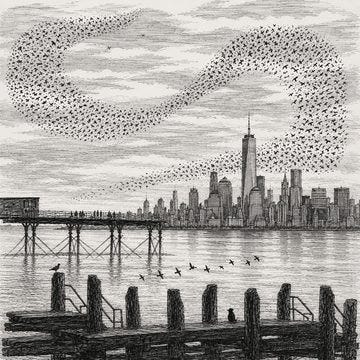
A murmuration has no leader. No starling can see the whole, and none knows where it is going. Each tracks only its six or seven nearest neighbors, matching their speed, turning when they turn. From that one small rule, repeated ten thousand times, the great coordinated shape emerges on its own. It has always been the picture of a market: millions of participants, no one in charge, and out of the scatter a price wiser than any single mind.
The grace depends on a gap. When one edge turns, the turn travels inward slowly, arriving a fraction of a second later at the far side. That delay is what makes the shape roll instead of snap. At any moment some are still going the old way while others have already turned, and that small disagreement is what keeps the whole thing aloft. The flock is safe not because it agrees, but because it does not agree all at once.
Two Ropes
The giants have been tied together, and by two ropes at once.
The first is financial. For a generation, more and more money has flowed not into companies but into the index, through funds that buy the whole market in fixed proportion. Such a dollar does not choose Apple over Microsoft. It buys all of them by weight, and the largest names take the most. They rise and fall together now not because anyone judged them alike, but because the machinery of buying no longer tells them apart.
The second is industrial, and it runs to a single point. Each of these companies has made the same bet, on the same thing, at the same time, the buildout of artificial intelligence, and nearly all of them buy the same picks and shovels from the same supplier. Nvidia sits at the knot, the one input the whole harvest depends on. A decade ago their fortunes could diverge. One sold phones, one sold ads, one sold cloud. Today they are a single wager on one future, placed four or five times over.
The first rope makes them move together. The second makes them deserve to. So when the shock comes, one capex line, one margin print, one quarter of vanished cash, there is no longer an old direction left to fly. Four hundred and fifty billion added in a day, then a seven per cent drop in another, is not four companies being repriced. It is one roped body, lurching.
What The Rope Is For
It would be easy to call the ropes a mistake. They are not, and that is the part worth sitting with. A thousand birds moving as one confuse the hawk, who cannot fix on a single target in the churn. Synchrony is a defense, not a defect. The same is true here. Indexing gave ordinary savers the whole market at almost no cost, one of the few genuinely good deals finance has ever offered. And the shared bet is how a vast amount of capital found its way to the buildout at all. No committee directed it. The correlation did.
So this is not a lament, and not a warning to sell. It is a trade the whole system has made, mostly without deciding to. We bought coordination, which is powerful, and paid for it in the one currency the shape cannot do without, disagreement. Most years the bill does not come. In the years it does, it comes all at once.
What Tightening Looks Like
Which leaves something to watch, and it is not the price. The warning does not arrive as a fall. It arrives as tightening. The gaps narrow, the shape grows dense and smooth, and only then does it convulse. The danger is not how high it is flying. It is how little room is left inside it.
The same reading applies to the market. The signal is not the level of the index, which everyone watches. It is the concentration, which almost no one prices as a risk while it pays so well. When a third of everything you own sits in a handful of names making one bet, the question is no longer whether those names are good. They are. The question is what happens to a third of the market when the shadow finally crosses it. By the time it convulses, the tightening has already happened, in plain sight, unread.
If You Are Feeling Good
A word to the reader who is quietly pleased right now, and has every right to be. You did the responsible thing. You did not chase or guess. You bought the whole market, broadly, at low cost, exactly as the soundest advice ever given told you to. That advice was right, and none of this is a reason to abandon it. Anyone who bolts at the first shadow tends to get the timing wrong twice.
But notice what changed underneath you. Buy everything quietly stopped meaning what it once did. A generation ago the whole market was a thousand different bets. Today a third of what you hold makes a single one. You did not change your strategy. It changed around you. You still own everything. Everything is simply fewer things than it used to be.
And if your answer is that you stepped off this already, that you hold private assets so as not to stand entirely inside the public market, look closely at what you own there. A great deal of private capital is roped to the same knot, the same buildout, the same one bet, marked once a quarter instead of every second. The slower clock is a real advantage, patient money does not have to sell into a drop, but stillness is not the same as being uncorrelated. The word private tells you the clock, not the bet.
Real distance exists, but it is not a label you can buy. It is a way of owning. It is the unglamorous business held for its cash flow and improved over years, on a timetable no season dictates, the thing no index ever swept up because no thesis moved fast enough to want it. Owned patiently, sometimes across generations, on a clock the market cannot set. You do not have to leave to hold it. You have to know which of your holdings were never roped, and keep some of them on purpose, so the word diversified on your statement matches what you actually own.
The Season Turns
Because a formation like this does not last. The starlings gather only for a few weeks, at one turn of the year. The shape at dusk is not how they live. It is what they do briefly, before winter, and then they scatter.
The market does the same. It gathers, dazzles, breaks, disperses. The Nifty Fifty did it. The technology names of 2000, more concentrated at the peak than most remember, did it. Each time the market went back to being many things moving apart. Concentration is a phase before a transition, never the permanent shape of things.
Here the birds and the market part ways, and that is the whole point. The starlings keep an appointment. They scatter in their season and return every spring, on a schedule older than any market. Concentration keeps no such calendar. It disperses when no one can date, and it returns, if it returns in your season at all, wearing different names. You can know it will break. You cannot know when, and no one who says otherwise knows either.
And yet something reliable does come back each time it breaks. Not these names, and not on a schedule. What comes back is variety. Value returns to the holdings no one crowded into, the dull ones that lagged while the single shape filled the sky. Diversification is not defeated by concentration. It is the thing concentration was quietly borrowing against.
So look again at the empty sky at the top of this page. It is not a picture of ruin. It is just the after. The shape filled the dusk, it fell together, and then it left, on a timetable no one held. What remained was a quiet skyline, an ordinary market going about its business, and one bird still on its post. When the sky fills again, and it will, the holdings still standing when it clears will be the ones that were never part of the shape.
Note
The four moves described here occurred during the peak of the Q2 2026 reporting season, the week of July 27 to 31. Microsoft and Meta reported after the close on Wednesday July 29, Amazon and Apple on Thursday July 30, with Amazon’s surge landing in Friday’s session on July 31. Figures and the framing of the two trading days are drawn from Tim Shufelt, Investors got what they feared, and the stock market was just fine, The Globe and Mail, August 2026. The characterization of Microsoft’s one-day gain as the largest ever posted by an American company is Shufelt’s. The concentration figures, roughly a third of the S&P 500 in the largest handful of names and about forty per cent in the top ten, exceeding the 2000 peak, are drawn from Goldman Sachs and index data reported through late 2025 and early 2026.
BONJOURHI! INSTITUTE ANALYTICS · MONTREAL · 2026