
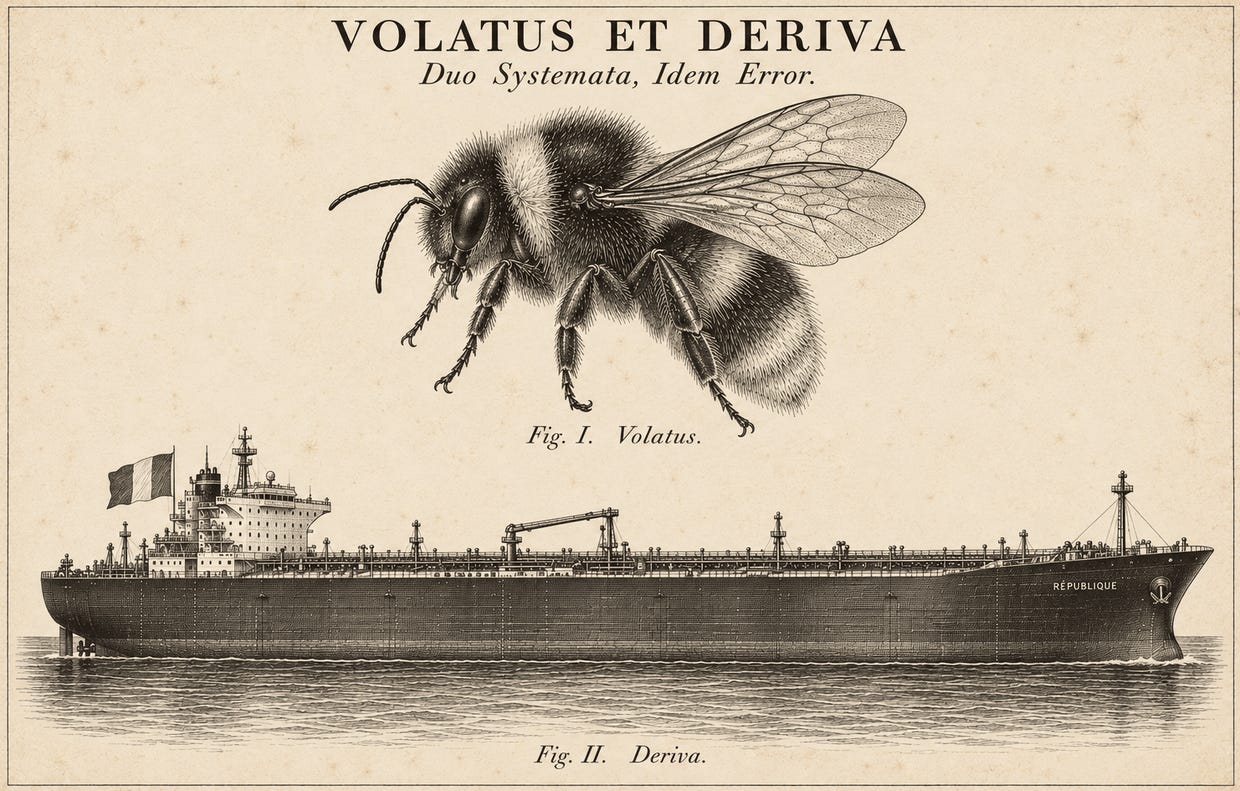
Volatus et Deriva. Two systems, the same error. Fig. I, a thing declared unable to fly. Fig. II, a thing declared about to sink. Neither reads the water it is actually in.
Bonjourhi!
The two essays that follow are about the same mistake, made twice, in opposite directions. In each case the diagram is trusted over the water it claims to chart, and in each case it is wrong.
The first essay is about a thing declared unable to fly. By the textbook the euro should not have survived its first serious shock, and the engineers grounded it on paper before it ever left the ground. It flew anyway. The essay asks how, and what the answer costs.
The second is the same error inverted. Here the diagram does not forbid flight. It predicts a wreck, and points every eye at the wrong kind of failure. France is watched like a condemned building, braced for the fall. But the largest thing in the union will not fail the way the small ones did, and the essay is about the quieter failure the watchers are not looking for.
One piece is about lift. The other is about drift. Both argue for watching the water rather than the chart, and both are, in the end, about the same thinning air.
Read in order. The first asks why the thing flies at all. The second asks what happens when its largest part stops steering.
When the analogies have done their work, the closing note lays the machinery bare, the trade every member made, and the two tools that follow. Read it last, where the pictures become arithmetic.
Pierre Somers
Chief Editor, Bonjourhi Institute
Montreal, Quebec – September 2026
The Bumblebee
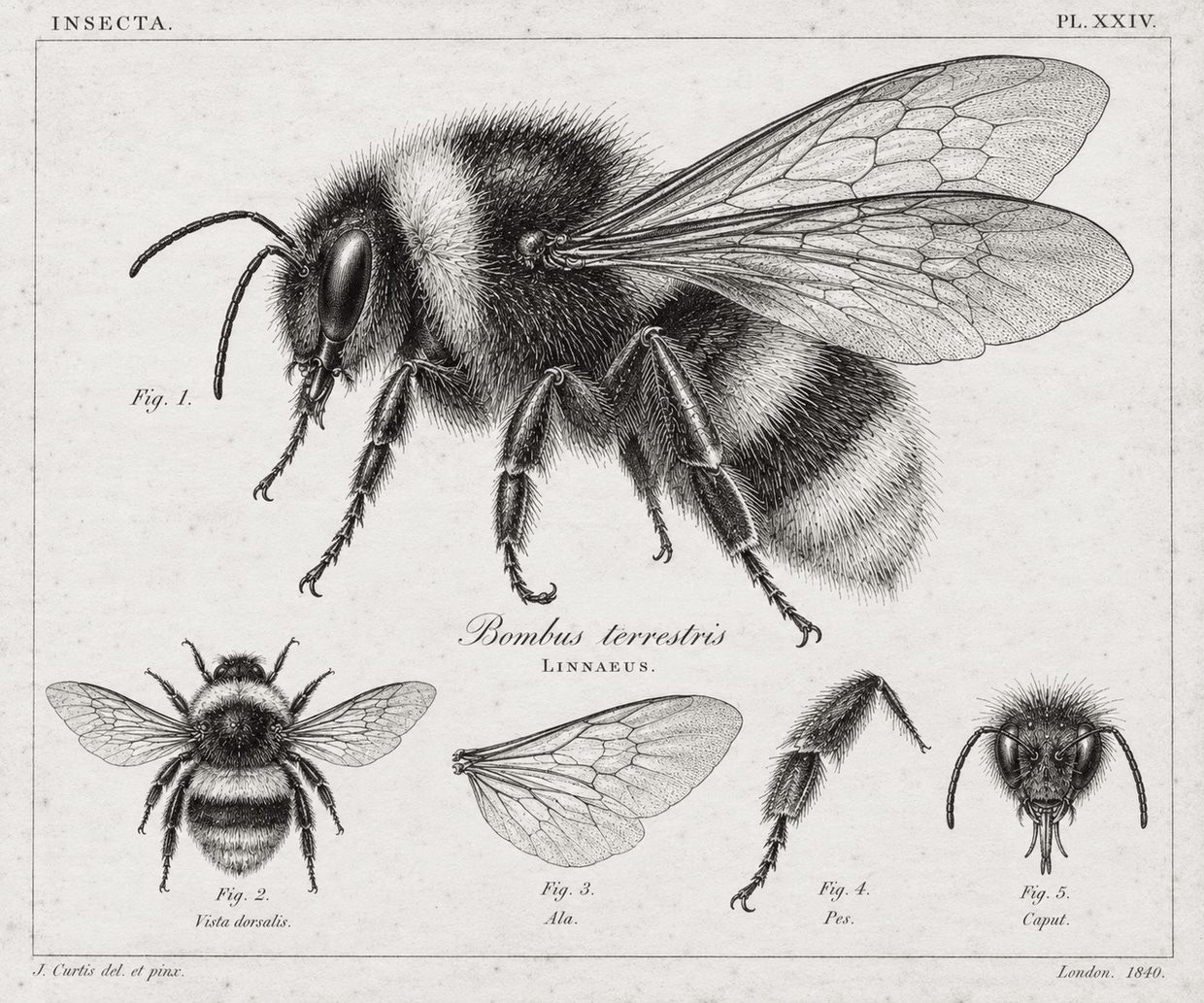
Bombus terrestris, from a London natural history plate, 1840. By the aerodynamics of its day, it should not have been able to fly. It flew anyway. The error was never in the bee. It was in the model.
Everyone agrees the machine cannot fly. Read the diagrams. A single currency stretched across twenty-one fiscal authorities, no shared treasury, no common bond, no way to move a worker from a shuttered town to a booming one without a border of language and pension law in the way. France cannot balance a budget. Italy carries debt no textbook would forgive. The populists are counting votes. By every calculation the aeronautical engineers ran in 1998, this thing is on the ground. And yet it is in the air. The trick is not that it defies physics. The trick is that the observers had the wrong rulebook.
In 1934 a French entomologist named Antoine Magnan did the arithmetic on a bumblebee. He treated the wing as a fixed surface held at a fixed angle, the way you would model the wing of an airplane. The numbers came back clean. The bee could not generate enough lift to leave the ground. The calculation was correct. The bee, meanwhile, went on flying, indifferent to the paper that had grounded it.
The error was never in the bee. It was in the model.
A bumblebee does not fly the way a plane flies. A plane holds its wing still and lets air do the work. The bee does something the fixed-wing equations never accounted for. It beats its wings two hundred times a second. It rotates them at the top and bottom of each stroke. It sheds small vortices off the leading edge and then catches its own wake to push off it again. None of this is visible to the eye. All of it is lift. The bee stays up not through one clean force but through a hundred frantic, invisible ones, generated fast enough that the air never settles long enough to let it fall.
Now hold that image, and look at the old world it flew out of.
There was a model for currencies too, and it was elegant. A currency should sit inside a single state. One treasury behind it. One central bank. One people who could be taxed together and, when the shock came, could send money from the strong region to the weak one without asking permission. Labor moved. Budgets answered to one parliament. That was the theory of the optimum currency area, and by that theory the euro was a fixed wing held at a fatal angle. Milton Friedman said it would not survive its first serious recession. Others gave it a decade at most. On paper, the case was closed.
Then the recession came. And the euro did not fly the way a currency was supposed to fly.
It began to beat its wings. When the sovereign debt of the periphery threatened to break the frame in 2012, the central bank did not follow the textbook. It said it would do whatever was required, and it improvised a mechanism no founding treaty had drawn. It built a banking union in a hurry. It expanded its balance sheet into something the original engineers never sketched. And when a member state faced a run it could not survive, the union reached for the oldest emergency lift there is. Cyprus closed its banks and froze the movement of money in 2013. Greece did the same in 2015. Capital controls, inside a currency built to abolish them. Frantic wingbeats, invisible from the diagram, generating just enough lift to stay off the ground.
This is where the honest part of the argument begins.
The change now is not economic. It is atmospheric. The air the bee flies through is getting thinner. A world order that held for two generations is loosening at the joints. Populist movements are not a fringe anymore, they are a counting bloc, and they campaign on the one promise the euro cannot easily absorb, which is national escape. France runs deficits it has stopped pretending to close. Several members carry debt that only stays aloft because the rates are held down and the buyers are, one way or another, encouraged to keep buying. This is the quiet machinery of financial repression, and it is not a scandal. It is the wingbeat. It is what the diagram leaves out.
So the useful question is not the one the critics keep asking.
They ask whether the euro can fly, and the answer is visible from any window. It flies. It has flown through every storm they said would end it. The question worth asking is about the wingbeat itself. A bee stays up because it can sustain two hundred strokes a second. It stays up only as long as it can. The euro’s lift now comes from repression, from controls held in reserve, from a central bank improvising forces the founders never named, and from the willingness of citizens to keep holding paper that pays them less than the air is worth. Each of these is a stroke. Each one costs something. And the strokes are getting faster while the air they beat against keeps thinning.
The euro was never going to fall the way its critics predicted. That was always the wrong model, and they were always going to be wrong on their own terms.
It will fall, if it falls, the way a bee falls. Not because the physics forbade it from the start. Because at some point the wings can no longer beat fast enough to make up for the air that is no longer there.
Bonjourhi Institute Analytics, Montreal
Too Big to Sink
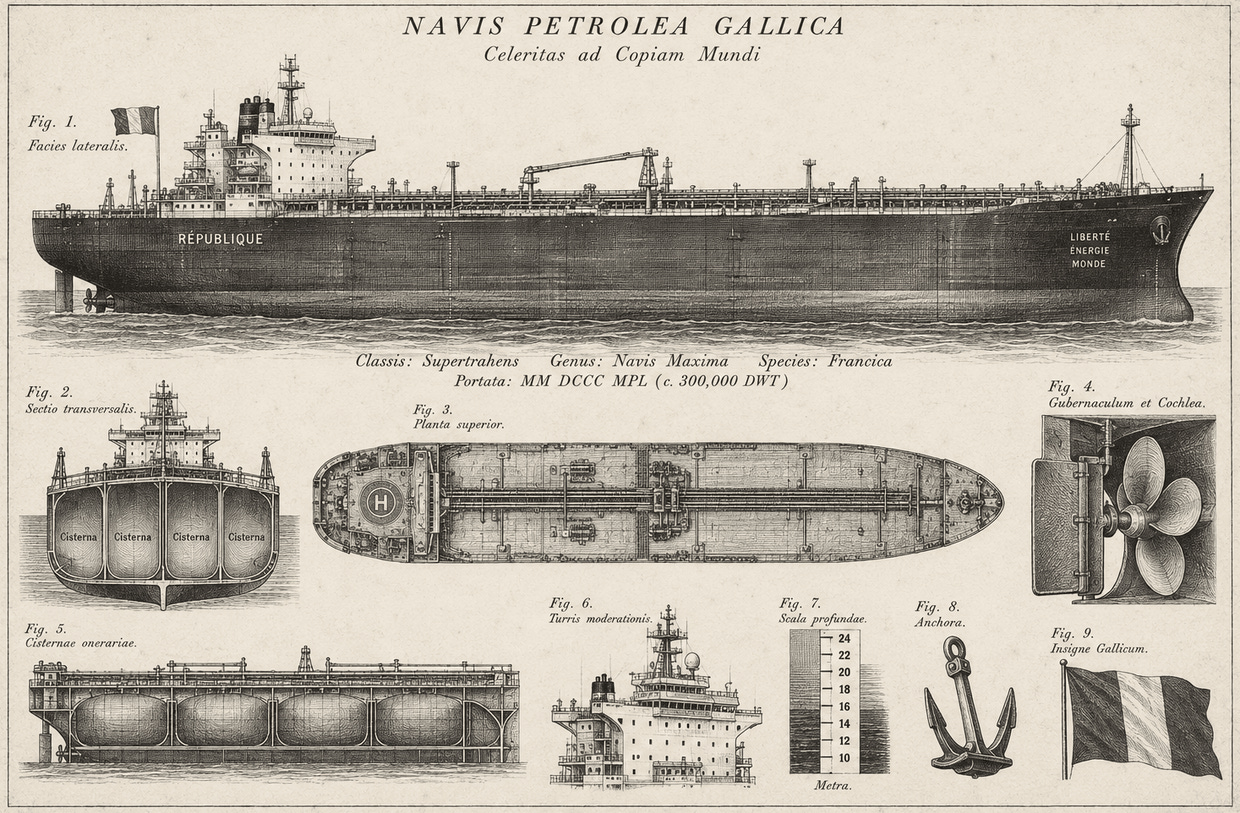
Navis Petrolea Gallica. The largest specimen laid on the table. Its mass is what keeps it steady, and its mass is what will not let it turn.
Everyone is waiting for the crash. They watch France the way you watch a building that has been condemned, expecting the moment it comes down. But that is the wrong thing to watch, and the wrong kind of failure. France is not going to fall the way Greece fell. Greece was small, and its illness was terminal, and it could be seized and turned by outside hands. France is not small, and its illness is not terminal. It will not miss a payment. It is enormous, and it will not sink, and that is exactly the problem. The largest things do not fail by breaking. They fail by drifting. And by the time the drift is wide enough to see, the size that made them stable has taken away the power to correct them.
Consider, then, the supertanker.
A loaded supertanker is among the largest moving objects human beings have ever built. Fully laden it carries a quarter of a million tons, and that mass is the whole point. The size is what makes it stable. A small boat is thrown around by every wave. A tanker of this scale barely registers them. It sits deep and holds its line through weather that would capsize anything smaller. Stability is not something the crew imposes on it. Stability is a property of the mass itself.
But that same mass has a second face, and it shows only when something needs to change.
A supertanker cannot turn quickly. It cannot stop. From the moment the engines are cut, a fully loaded tanker keeps moving forward for several kilometers before it comes to rest. To alter course, the helmsman turns the wheel long before the turn is needed. The ship responds minutes later, slowly, and then keeps turning after the wheel is straightened. Steering a vessel this size is not a matter of reacting to what you see. It is a matter of constant, patient, forward-looking correction. Tiny adjustments, made continuously and far in advance, so small that a passenger on the deck would never feel them.
The crew is always working the helm. The ship always looks, to anyone watching, as though it is doing nothing at all.
The danger is never the wave. The danger is drift. Stop making the small corrections and nothing happens, for a long time. The ship holds its heading through sheer mass while it very slowly ceases to be pointed where you want to go. And by the time the drift is wide enough to see against the horizon, the same mass that gave you stability has taken away your ability to correct it. You cannot yank a supertanker back. You can only have never let it drift.
Now look at France.
France is the mass. It is the second economy of the union, and its debt sits at the core of the European financial system, held by every major bank, every insurer, every pension fund on the continent. That size has always been a source of stability. France was the ballast, the reliable core, too large and too central to be knocked off line by the storms that sank the peripheries. That was never in question. That was the point.
Which is why France cannot be rescued the way Greece was.
Greece was small enough to stop and turn, to be seized and disciplined and hauled back by outside hands. France cannot be moved that way, for the same reason a tanker cannot. The tools that saved the smaller members work by being credibly larger than the target. The central bank’s promise to buy without limit stops a speculator only because the speculator believes the firepower exceeds the problem. France is the first target that approaches the size of the firepower itself. You cannot rescue the ballast by throwing more ballast at it.
The helm is the quiet work of keeping a large economy pointed where it needs to go.
Budgets trimmed. Deficits closed a little each year. Savers held, quietly, in low-yielding national debt so the whole thing stays financed. This is the constant invisible correction, the small continuous adjustment that from the deck looks like nothing happening at all. That is what correct steering looks like on a vessel this size. It is undramatic by design. It was always meant to be.
And here is the whole of it. The ship will not break apart, and it is not sound. The mass is intact and the debt can still be carried, but there is a fault below the waterline that widens a little each year, and France has lost the power to close it. That is the real condition, and it is not steering trouble alone. It is a slow leak the bridge can see and cannot agree to fix. No government can assemble a majority to make the corrections everyone can name. The fault is not disputed. It is simply left, because the bridge cannot decide. And a ship that carries a known leak and a crew that will not act on it does not lurch, does not crash, gives no dramatic signal at all. It rides a little lower each month, and holds its shape, and drifts.
It drifts.This is the part worth saying plainly, because the analogy could let France off the hook if we let it. A tanker drifts because the sea pushes it. France is not being pushed by the sea. The weather is ordinary. The current is nothing a functioning bridge could not correct. France is drifting because the crew has stopped steering, not because the storm is winning. The failure, if it comes, will be written in the ship’s own log, not in the weather report.
So the useful question is not the one everyone is asking.
They ask when France will crash, and they will keep watching the hull for the crack that does not come. The thing to watch is not the hull. It is the heading. You do not watch a supertanker for a collision, because by the time a collision is visible it is already too late to turn. You watch it for drift. And the instruments that show drift are quiet ones. The gap between what France pays to borrow and what Germany pays. Whether any government can pass a budget that actually closes the structural gap rather than promising to. Whether the central bank is quietly holding more French debt than the politics can comfortably admit. None of these is a crash. All of them are heading.
Someone will say the sea does not stay calm. They are right. But a storm belongs to the whole sea, and the fault below France’s waterline is France’s alone. A shared storm is the danger the union is built for: when the weather hits everyone at once, the will to act appears, and the euro has survived every storm it has met. The storm is not what sinks the ship already taking on water. The water is. The storm only decides when.
The crash is not the thing to fear, and it was never going to be the thing that came.
The thing to fear is the long, quiet interval in which nothing appears to happen. The interval in which the ship holds steady through sheer mass, looks from every deck exactly as sound as it has always been, and drifts, degree by degree, off a heading no one on the bridge is any longer willing to hold.
By the time you can see it against the horizon, the mass has already decided the rest.
Bonjourhi Institute Analytics, Montreal
A Note on the Mechanism
The economics beneath the two essays.
The two essays are carried by analogy. This note states plainly what they leave beneath the surface, because the trade underneath both is a single structural fact, and it is worth seeing without the metaphor over it.
When a state joins the monetary union it gives up two things. It gives up its own interest rate, and it gives up its own exchange rate. These are the two shock absorbers a sovereign normally keeps. Outside the union, a country in trouble cuts its rate and lets its currency fall, and the cheaper currency pulls it back toward balance on its own. Inside the union, both levers are gone, surrendered to a central bank that sets one rate for many economies and to a currency that cannot fall for one member alone. That surrender is the whole of the matter. It is why the textbook called the arrangement unworkable, and it is why the largest member cannot simply turn itself the way a country with its own currency turns.
Having given up the two absorbers, the system must find correction somewhere else. It reaches, as such systems always have, for two tools.
The first is financial repression. The return on savings is held below where a free market would set it, so that sovereign debt can be carried cheaply and eroded quietly. Savers are steered into government paper by regulation and by the absence of better options, and inflation does the slow work of shrinking the debt in real terms. No default is declared. No tax is voted. The saver is simply repaid in money worth less than what was lent, at a rate that never quite kept pace. The advanced economies used exactly this to liquidate the debts of the last world war, across the decades after 1945, and the mechanism has not changed.
The second is capital controls. These are the emergency tool, not the standing one, restrictions on money leaving, reached for when a run threatens to break a member before anything else can. They are legally exceptional inside the union, permitted only briefly and only in crisis, which is why it was notable rather than routine when Cyprus imposed them in 2013 and Greece in 2015. A currency built expressly to abolish internal controls reached for them twice inside a decade. They also make the repression enforceable, because a saver who cannot move money out cannot escape the return being held down at home.
So the structure is symmetric. Two absorbers given up, two tools improvised to replace them. That is the machinery the bee’s wingbeat stands for, and the correction the tanker’s helm stands for. The essays dramatize it. The trade is real and it is this.
Here is the analytical turn, and it is the reason the two pieces were set together. As the debt arithmetic worsens and the wider order thins, these two tools stop being measures reached for in an emergency and settle into the standing condition. Repression ceases to be the response to a crisis and becomes the quiet baseline of how the system is financed at all. Controls cease to be the exception held in reserve and become a thing the reader should expect to see used, and used on larger members than before. This is not a forecast of when. It is a reading of direction. The tools that were meant to be temporary are the ones the arithmetic now requires.
One further observation, and the document ends on it. None of this is peculiar to the euro. The reserve currency of the world, the dollar, is not exempt from the same logic. Its position is different in mechanism, the United States surrendered no lever and prints its own money still, but it arrives at the same place by another road. A debt large enough eventually requires that the real return on holding it be held down, because the alternatives are worse, and that is repression by another name whatever the flag on the note. The thing that makes a currency a reserve, that the world must hold it, is precisely what lets its issuer hold savers in low-yielding debt for longer than anyone else could. That is not immunity. It is the widest runway. The reserve currency is not the exception to the logic. It is merely last in line. One should not be surprised to see, in time, the same tools applied to the dollar that are already being applied, quietly, to the euro. The privilege buys the time. It does not remove the need.
Pierre Somers
Chief Editor, Bonjourhi Institute
Montreal, Quebec – September 2026
BONJOURHI! INSTITUTE ANALYTICS · MONTREAL · 2026