
Bonjourhi!
This issue is two pieces, and they belong together.
The first, “Eat Your Vegetables,” is the argument I have wanted to make plainly for a while: a large national debt is almost never repaid honestly. It is escaped, and there are only four exits. Three of them reach into your pocket while you look elsewhere. It runs through the ways governments have taken that money quietly, from postwar America to Japan to the four days in 2022 that ended a British government, and asks why the one honest option is the one nobody chooses.
The second piece is what happens when you write a metaphor and the news makes it real a few days later. “Thirty Million Pounds” takes Canada’s new tariff on canned vegetables, an actual wall against actual cans of peas, and shows it running the same machinery as the debt argument. A cost held away from the truth does not disappear. It changes address, and the new address is your grocery bill.
I put them in one issue because the pairing is the point. The first shows the mechanism at the scale of empires. The second shows it at the scale of a can. Same law, different size.
Sources are footnoted at the end for anyone who wants to check the figures.
Pierre Somers
Chief Editor, Bonjourhi Institute
Montreal, Quebec – September 2026
Eat Your Vegetables
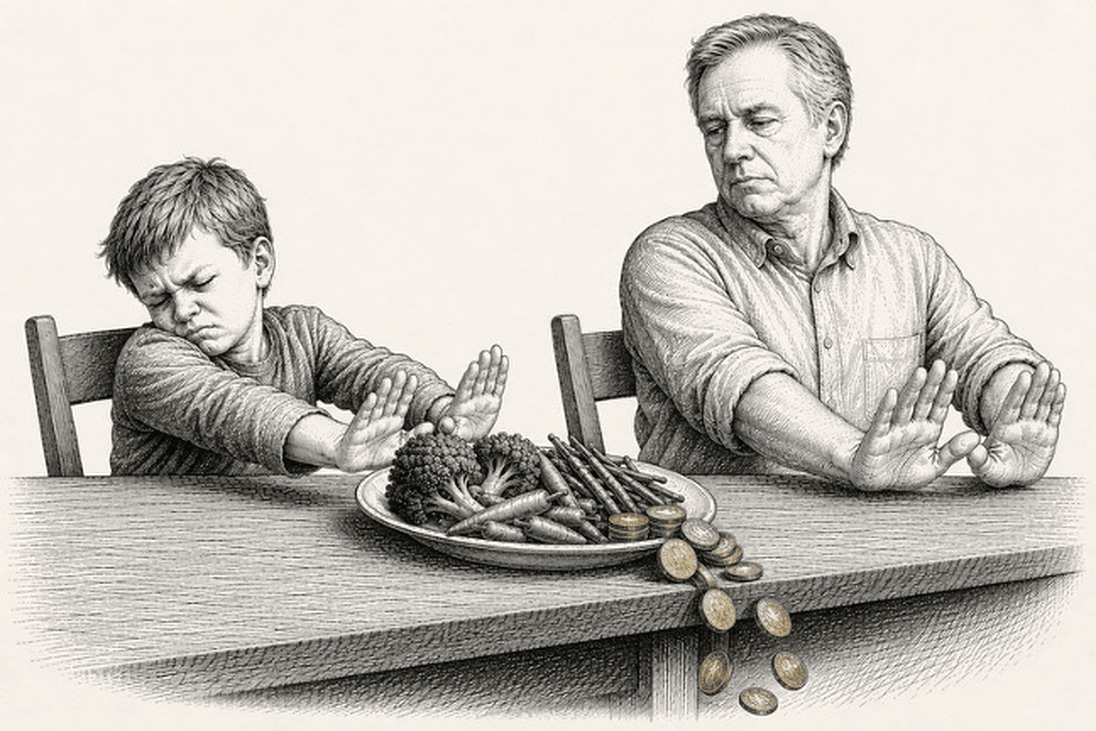
There is a reason nobody acts on the sensible advice about the national debt. Spend a little less, borrow calmly, tax honestly: it is the fiscal equivalent of eat your vegetables, and it sells about as well.
So let us skip the lecture and open the refrigerator instead. Because a country that will not eat its vegetables does not simply go hungry. It eats something else, and the something else is worse.
Here is the fact almost nobody says plainly. A large national debt is almost never repaid the honest way. It is escaped. And there are only four exits.
Three of them fall on you.
The first exit: inflation, the silent default
The easiest escape is to print. Let prices rise, let the currency lose value, and repay the bondholder in full, in money worth half what it was.
Nobody has to vote for it. No law names it. The lender is paid every penny promised, and robbed all the same, because the pennies buy less. It is a default that never has to admit it is one.
The screaming example is Weimar Germany in 1923, when money became so worthless people burned it for heat. But that is the horror movie, and horror movies are easy to dismiss as far away.
The closer truth is quieter. After the Second World War, both the United States and Britain let inflation eat away at the enormous debts the war had piled up. It worked. The debt shrank. Your grandparents’ savings paid for it, and they were never asked.
The second exit: repression, the pocket quietly picked
The second escape is subtler still, and it has a bloodless name: financial repression. The government holds interest rates below the rate of inflation, by rule and by force, so that anyone holding its debt loses a little in real terms every year.
Pensions, insurers, banks, ordinary savers: all of them are made to lend to the state at rates that quietly lose to inflation. The loss is theirs. The gain is the government’s. It is a tax that is never called a tax.
This is not theory. The United States did exactly this from 1945 into the 1970s. Federal debt fell from well over 100 percent of the economy to around a third of it, and roughly half of that decline came not from thrift but from this quiet erosion of what bondholders were owed.
Real returns to American bondholders were negative, on average, for decades. The debt was not paid down so much as gently confiscated. Almost nobody noticed, which was precisely the point.
The third exit: default, the plate smashed on the floor
The third escape is the honest catastrophe: simply stop paying. It is rare for a great power, because the damage is enormous and lasting, but it is not unthinkable.
Argentina has lived there again and again. Russia did it in 1998. And the United States itself has walked to the very edge in its debt-ceiling standoffs, close enough to frighten every market on earth.
Default is the exit that admits what the other two hide. It is also the one no country chooses until the others have run out.
The fourth exit: growth, the only painless door, and the rarest
There is one escape that costs no one anything: grow. Expand the economy so fast that the debt shrinks beside it, the way a large mortgage feels smaller as a salary climbs.
It has happened. It is wonderful when it does. But it cannot be summoned on command, and no government has ever managed to order it up simply because it needed to.
Betting the house on growth that has not arrived yet is exactly the story every doomed borrower told itself on the way down.
But what about Japan?
Here the sharp reader objects, and rightly. Japan has carried debt of well over twice the size of its entire economy, around 240 percent, for years, far past the point where any of this should have broken it. No hyperinflation, no default, no collapse. Doesn’t Japan prove it can be done?
No. Japan did not avoid the exits. It chose the second one and lived inside it for thirty years.
Japan is the world’s master of quiet repression. Much of its debt sits with its own central bank, and interest rates were pinned near zero by force for a generation. Japanese savers earned almost nothing for decades so that the government could carry its mountain of debt cheaply. That is the pocket quietly picked, in a rich and orderly democracy.
And it worked only because Japan had something America does not: a captive, patient, high-saving population willing to fund its own government at a loss, year after year. America’s debt is increasingly held by foreigners, and foreigners can walk. There is no loyal domestic base large enough to be repressed the Japanese way.
Even so, the Japanese trap is now closing. After thirty years, inflation has returned, and the central bank has been forced to let interest rates rise to their highest in three decades. The debt did not shrink; it merely waited. Now the bill for carrying it is climbing, and Japan faces the very squeeze it spent a generation postponing.
Japan is not the exception to the rule. It is the rule, playing out in slow motion, and even there the clock has finally started to move.
What history actually shows
Here is the part that should keep you up at night. Great powers do not usually fall on the battlefield first. They fall at the bond market, and the battlefield only confirms it later.
Habsburg Spain ruled the richest empire on earth, its galleons heavy with American silver, and it still defaulted on its debts more times than any nation in history. The silver came in and went straight back out to its lenders, and the empire faded anyway.
France borrowed through the eighteenth century to fight its wars and fund its court, until the debt, not the mob, forced the crisis that opened into 1789. The revolution had a treasury problem underneath it.
The Ottoman Empire was called the sick man of Europe, but the sickness was largely financial. It went bankrupt to foreign creditors in the 1870s and spent its last decades with its finances run by the very lenders it owed.
Even Britain, which won the wars, lost the empire partly to the cost of winning them. Victory was financed with debt, and the debt outlived the victory.
And lest this feel like a museum of old empires, watch how fast it moves now. In September 2022, a new British government announced tens of billions in tax cuts it could not pay for. It did not take years, or even months. Within four days the bond market drove borrowing costs up so violently that the country’s pension funds began to buckle, the central bank had to rush in to stop the collapse, and within weeks the government itself was gone.
Four days, not four centuries. The bond market no longer waits for the history books.
The pattern is old and it is merciless. The instruments go first. The bond market has buried more empires than any army, and it always sends the bill before the history books notice anything is wrong.
So eat your vegetables
Now the boring advice looks different. Austerity does not sell because it is dull. It does not sell because it is the one exit that leaves your pocket alone.
Inflation robs the saver. Repression robs the pension. Default robs everyone at once. Only the honest path, spend with discipline, borrow with restraint, tax fairly and openly, refuses to reach into your pocket while you look elsewhere.
That is the real choice, and it was never discipline versus comfort. It is discipline now, chosen in daylight, or one of the other three later, taken from you in the dark, with no vote and no say in which meal arrives.
The vegetables were always the mercy. They are the only dish that asks the country to pay its own way.
Bonjourhi Institute Analytics, Montreal
NOTES ON SOURCES
Weimar hyperinflation, 1923. At its peak German prices doubled roughly every few days, and paper currency lost value so fast that banknotes were at times used as fuel and wallpaper. See standard accounts of the 1921 to 1923 German hyperinflation.
Postwar inflation and debt erosion in the United States and United Kingdom. Both countries carried very high public debt after 1945 and reduced it over the following decades with the help of inflation and below-market real interest rates. See C. Reinhart and M. B. Sbrancia, “The Liquidation of Government Debt,” NBER Working Paper No. 16893 (2011).
Financial repression, 1945 to 1970s. Reinhart and Sbrancia find that for advanced economies real interest rates were negative roughly half the time during 1945 to 1980, and that for the United States and the United Kingdom the resulting liquidation of debt averaged about 3 to 4 percent of GDP a year. US federal debt fell from well above 100 percent of GDP after the war to roughly a third of it by the mid-1970s, with repression and inflation an important part of that decline alongside growth. Source as in note 2; see also the Federal Reserve Bank of Richmond, “A Look Back at Financial Repression” (2021).
Sovereign defaults. Argentina has defaulted on sovereign debt repeatedly across the twentieth and twenty-first centuries. Russia defaulted on domestic debt in 1998. The United States has approached the edge of technical default during repeated debt-ceiling standoffs without crossing it.
Japan’s debt. Gross general government debt is among the highest in the world, on the order of 230 to 240 percent of GDP in recent years, held overwhelmingly at home, with a large share on the balance sheet of the Bank of Japan. Interest rates were held near zero for a generation. Inflation has since returned and the Bank of Japan has allowed policy rates to rise to their highest in decades. Debt figures: International Monetary Fund, World Economic Outlook, and Japan’s Ministry of Finance.
Historical precedents. Habsburg Spain defaulted on its debts numerous times across the sixteenth and seventeenth centuries despite large inflows of American silver. French royal finances were in severe distress in the years leading to 1789. The Ottoman Empire defaulted on its external debt in 1875 and its finances were subsequently overseen by the Ottoman Public Debt Administration on behalf of foreign creditors. Britain financed its wars with large debts that persisted well beyond victory.
The 2022 United Kingdom gilt episode. Following the September 2022 fiscal statement announcing large unfunded tax cuts, UK government bond yields rose sharply within days, liability-driven investment strategies at pension funds came under acute stress, and the Bank of England intervened in the gilt market to restore stability. The government’s leadership changed within weeks.
Thirty Million Pounds
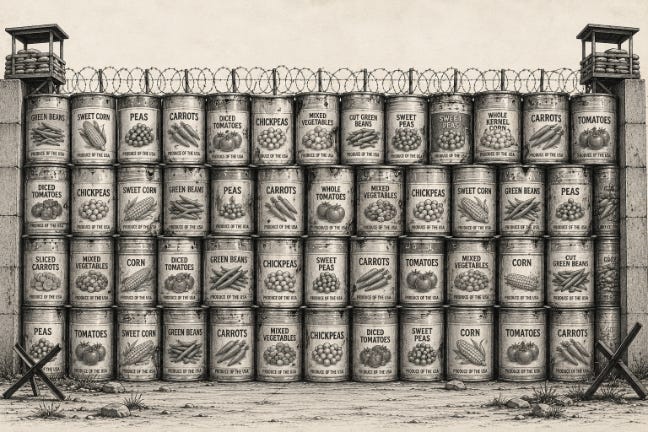
The piece above argued that the vegetables are the only dish that does not cost you your savings to eat. We meant it as a figure of speech. This week Ottawa turned it into a customs schedule.
On September 9, Canada’s trade tribunal ruled that a wave of cheap imported cans was hurting domestic producers. Its remedy is a three-year quota. About thirty million pounds of canned vegetables may enter each year at no charge. Everything past that faces a surtax of forty to fifty percent, and for the first time the wall reaches the United States.
Easy to read this as a story about beans and corn. It is not. It is a story about what happens to a price when you refuse to let it tell the truth.
A price is a claim about what a thing costs to make and move. When an imported can sits on the shelf for less than a domestic one, that gap is information. It says the good is being made more cheaply somewhere else. A tariff does not close the gap. It hides it, then moves it.
The cheaper can is held at the border, so the cost it was quietly absorbing surfaces downstream. It arrives at the grocery shelf, in the price a household now pays for the domestic can it has fewer alternatives to.
Same shape as the four exits, different clothes. A government that refuses the discipline of sound finance does not escape the bill. It reroutes it, through inflation, or through the slow squeeze of financial repression. The refusal feels like relief. The cost only changes address.
Here the new address is the checkout line.
What makes this ruling honest, almost unusually so, is that the tribunal was required to weigh food affordability and food security as it wrote the remedy. The protection and the price it imposes are named in the same document. The mechanism is not buried in a footnote. It is the mandate.
So the question is not whether the growers deserve protection. Many arguments say they do. The question is who pays for it, and the four exits already answered. When a price is held away from what a thing costs, someone at the far end of the system holds the difference.
Keep the cheaper can out, and its cost still finds the table.
Bonjourhi Institute Analytics, Montreal
NOTES ON SOURCES
The tribunal ruling. The Canadian International Trade Tribunal concluded its safeguard inquiry into canned vegetable imports on September 9, 2026, finding that increased imports were a principal cause of serious injury to Canadian producers. Canadian International Trade Tribunal, Vegetable Safeguard Inquiry; and reporting in The Wall Street Journal, September 2026.
The recommended remedy. The tribunal recommended a three-year tariff-rate quota under which about thirty million pounds of canned vegetables, corresponding to Canada’s 2024 import volume, could enter duty-free each year, with imports above that threshold facing a surtax of between 40 and 50 percent. The measure would cover imports from certain countries including the United States, China, and members of the European Union. The Wall Street Journal, September 2026.
Import growth. The tribunal found that total canned vegetable imports rose 28 percent in 2025, with United States shipments accounting for a substantial share of the increase and contributing importantly to the domestic industry’s serious injury. The Wall Street Journal, September 2026.
The provisional measure and its exclusions. On June 19, 2026, Canada imposed a provisional 10 percent surtax on global imports of canned vegetables for up to 200 days, excluding the United States, Mexico, Israel, Chile, and developing countries in line with existing trade obligations. The final tribunal recommendation would, for the first time, bring the United States within scope. Department of Finance Canada news release, June 19, 2026; Certain Canned Vegetable Goods Surtax Order, SOR/2026-135.
The affordability mandate. The tribunal was directed to consider the effect of any proposed remedy on food affordability and food security for Canadian households as part of its inquiry. Department of Finance Canada; Canadian International Trade Tribunal, Notice of Commencement, March 2026.
Finance Minister’s response. Finance Minister Francois-Philippe Champagne said the government was reviewing the tribunal’s report while the existing provisional measure remained in effect. The Wall Street Journal, September 2026.
BONJOURHI! INSTITUTE ANALYTICS · MONTREAL · 2026