Bonjourhi!
This year Canada built a bridge and paid for it. That sentence contains the whole argument, though it takes a moment to see why.
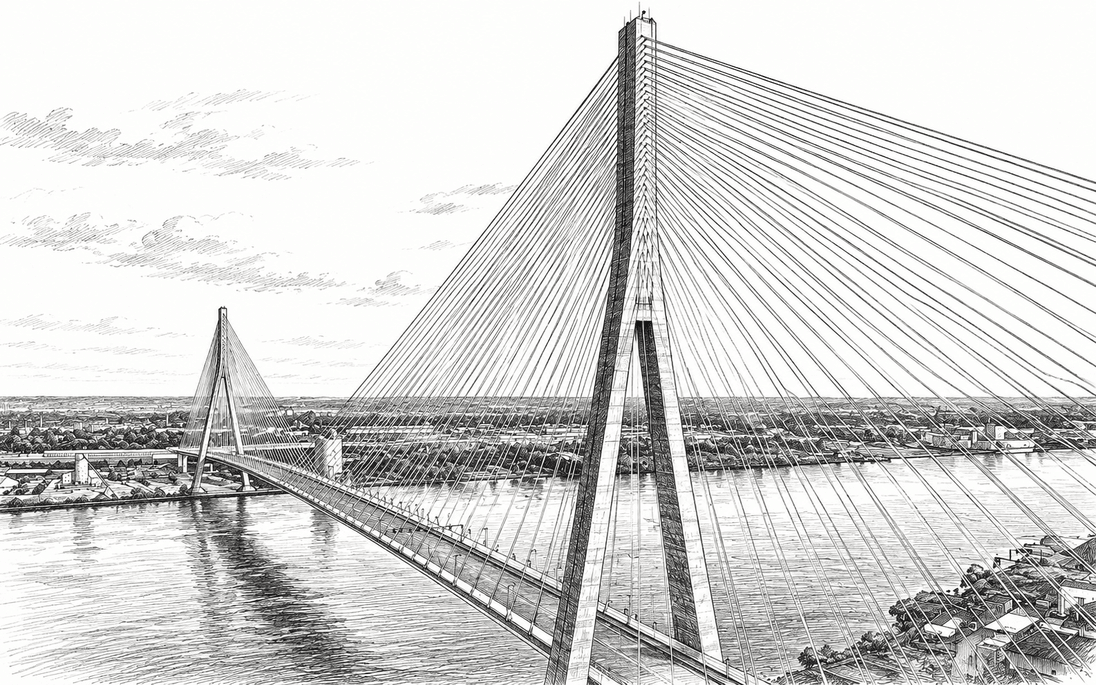
The Gordie Howe opened this year, a mile of cable-stayed steel across the busiest commercial crossing on the continent. Canadian taxpayers funded it, and Canada will recoup the cost through the tolls. It exists for one reason. The old Ambassador Bridge, privately owned and nearly a century old, was a single point of failure on a corridor that carries hundreds of billions in goods each year. A crossing that vital could not rest on one aging span. So they built a second.
Here is the lesson, and the piece needs only this one.
A cable-stayed bridge carries its deck on cables that fan to a common anchor. It shrugs off a thousand small stresses because the load is spread. Cut one cable and the rest take up the slack. But strike the anchor where the cables meet, and spreading the load saves nothing. The span comes down at once. Strength in the cables is not the same as safety at the anchor, which is why the engineers did not just reinforce the old bridge. They built a separate one, so a failure at any single point could not close the corridor.
Now hold that picture and look at the continent, because North America runs on exactly such an anchor and has left it exposed.
An auto part crosses the border seven or eight times before it becomes a car. The integration is the strength. It is also the anchor. Last October, Beijing throttled exports from Nexperia, a company almost no one had heard of, whose chips sit inside airbags and brakes. A Honda plant in Mexico went dark for want of one component. Honda cut Civic production in half, Stellantis stood up a war room, Ford began counting the days until its inventory ran out, and Honda alone booked roughly 300 million dollars in losses. Xi lifted the ban only when Washington agreed to delay a new export control regime. One hand on one anchor, and the whole span shuddered.
Which brings the three men into focus, because you can sort them by what each one builds.
Carney’s Canada built the bridge and covered the toll. Redundancy where it counts.
Trump builds walls. Tariffs on the neighbor, a trade war that deepens by the month, and in August an order renaming Lake Ontario to Lake America, a lake whose waters the United States does not own and whose name it cannot change. He even held the Gordie Howe hostage for a season, delaying its opening into summer over trade until Canada agreed to forgo revenue to get it done.
Xi builds chokepoints. Quiet, precise, and no longer under North American control.
So the reflex of the moment, pull inward, treat the neighbor as the threat, thin out the ties, is exactly backward. You cannot tariff your way out of a chokepoint you do not control. You can only build your way out, and you can only build the redundancy with your neighbors, not against them. That means a deeper Cusma, not a thinner one. Common rules on where critical parts come from. A shared map of the anchor points. A second bridge for every supplier that matters, agreed before the next pull rather than after.
Three men, three projects. One is building bridges. One is building walls. One is building chokepoints. Only one of the three is still building the thing that actually holds the continent up, and it is not the one everybody is watching.
NOTES AND SOURCES
The bridge. The Gordie Howe International Bridge, a cable-stayed crossing between Detroit and Windsor, was funded by Canada and is to be repaid through tolls. After construction was substantially complete, its opening was delayed into the summer amid the trade dispute, and it opened at the end of July 2026 with Canada agreeing to forgo revenue. Reporting: WDIV ClickOnDetroit and BNN Bloomberg, June and July 2026.
The Nexperia episode. In October 2025, following the Dutch government’s intervention at Nexperia, China restricted exports of the company’s Chinese-produced chips, disrupting automotive supply chains. Honda cut production, including at its Alliston, Ontario plant, and other automakers moved to protect inventory. Reporting: CNBC and Nikkei Asia, October and November 2025.
The 300 million dollar figure. The roughly 300 million dollars cited here refers to production-related losses from the incident, as reported by Chad P. Bown, “The Real Risk of a Trade War With Canada,” Foreign Affairs, September 1, 2026. Separately, Honda has estimated a broader semiconductor-shortage impact on fiscal-year operating profit closer to one billion dollars.
Lake Ontario. On August 27, 2026, President Trump signed an executive order directing U.S. agencies to rename Lake Ontario as “Lake America.” The order applies to U.S. federal maps and databases and cannot compel other governments; Canada has said it will retain the original name. Reporting: Associated coverage including CNBC, NBC News, and Time, August 2026.
The framing. The supply-chain argument draws on Chad P. Bown, “The Real Risk of a Trade War With Canada,” Foreign Affairs, September 1, 2026. The bridge, the anchor, and the reading of the three actors are the Institute’s own.
BONJOURHI! INSTITUTE ANALYTICS · MONTREAL · 2026


