
Bonjourhi!
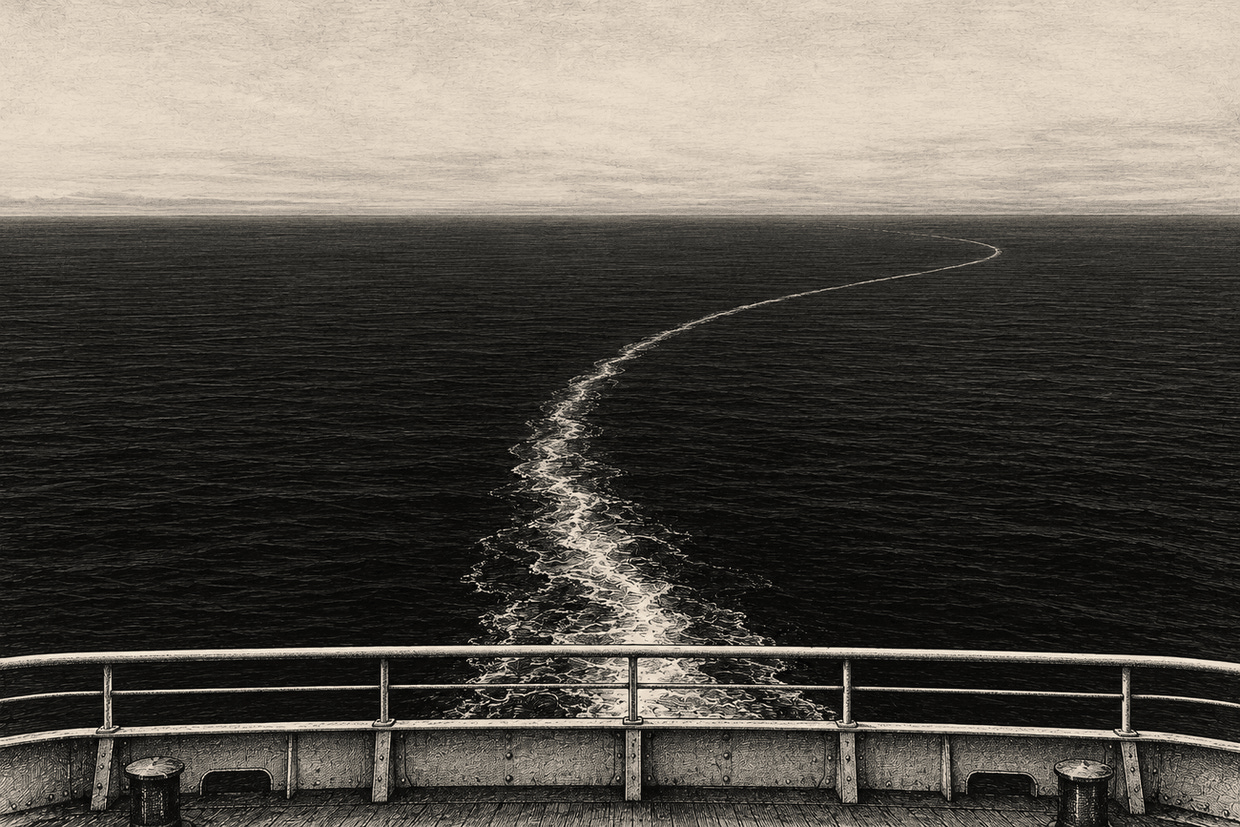
As I was being rocked by small waves on a big boat, I understood why no one believes the water until it is over the rail. The deck barely moved. Yet the vessel was already turning, the way large things turn, onto a heading no one aboard had chosen and no one aboard could feel.
That is America now. The surface is calm, the lights are on, the checks still clear, and the few who read water for a living have slipped to the high side of the deck. This is not a forecast. It is a reading of a turn already made. I looked. Here is what is already written.
Pierre Somers
Chief Editor, Bonjourhi Institute
Montreal, Quebec – October 2026
PART ONE
The Night Shift
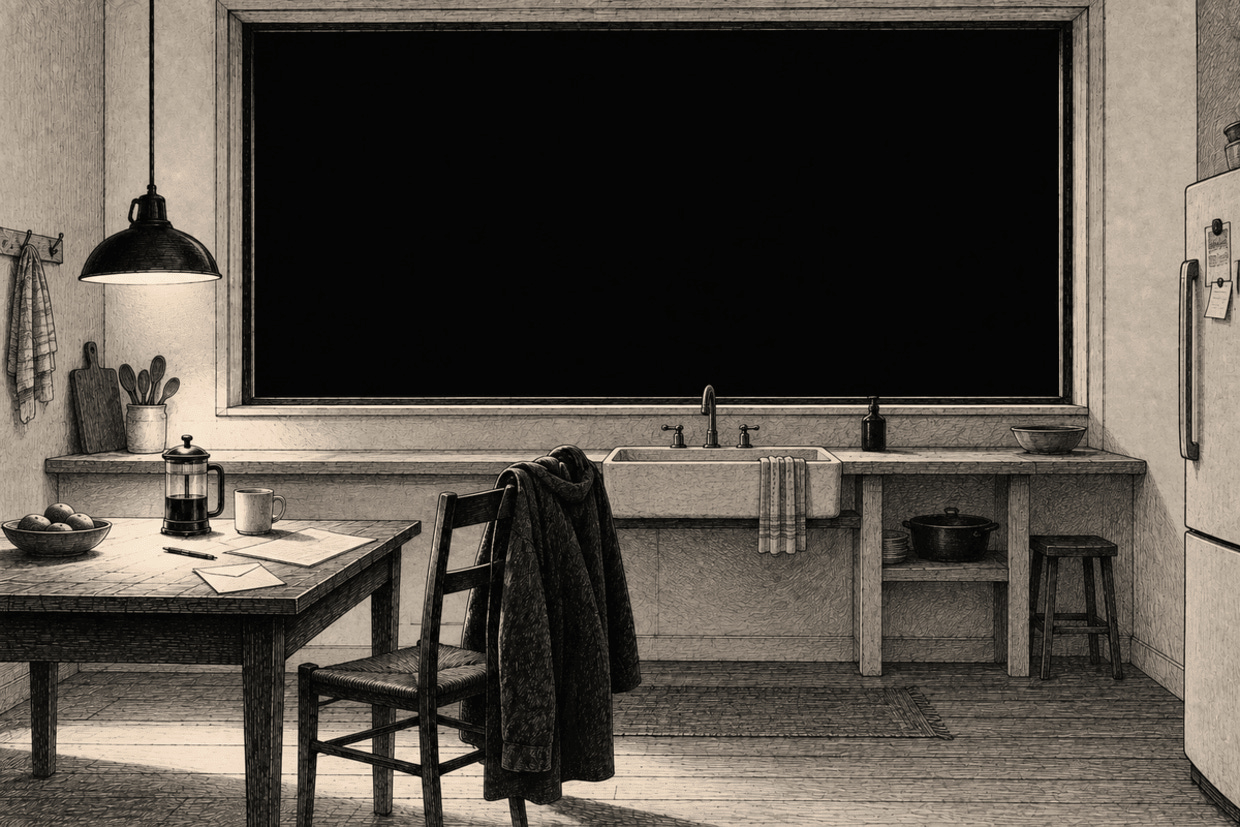
She works the overnight shift at a nursing home in Grand Island, Nebraska. Tonight she is fine. That is the word she would use, standing in the kitchen at 3 a.m. before her ride comes. Fine. The rent cleared. The car turned over on the second try. Her two boys are asleep down the hall, and if she is quiet she can hear them breathing.
Nothing is wrong. That is the strange part. Everything that is going to happen to her has already been decided, and the house is completely still. It is already written.
Watch it come. Not all at once. It never comes all at once.
First the grocery receipt is a little longer, and she tells herself the boys are just growing. They are. They are also eating into a number that is climbing to meet them from the other side, and the two lines are going to touch. Then the letter about her Medicaid hours, which she reads twice and sets on the counter facedown, the way you set down something you have decided not to think about yet. Then the noise the car makes, the one that goes away if she drives a certain way, until the morning it does not go away. Then the second school in a year, the boys quiet in the back seat, not asking why anymore.
None of that has happened yet. All of it is already priced in.
She has not seen it. That is the thing that should raise the hair on your arms. The people who move gold in the dark already know what happens to her, and she is still telling herself the receipt is just the boys growing.
She is not the unlucky one. She is the ordinary one. Turn on the lights in the other houses on the street and the same arithmetic is sitting on the table, waiting to be read.
Two streets over, Ryan and Steph are painting the small bedroom its first color. They are twenty-eight, and it is the first thing either of them has owned. They stretched for it, took the only rate the bank would give them, put every dollar into the door and nothing behind it. Tonight they would rather smell the paint and believe the hard part is behind them. It is not. They are the newest names on the ladder and the first the fall will reach, and the ladder is being drawn up under their feet. Nothing in that bright room has been told the truth yet.
Across town, Marcus and Dana have two incomes and by every rule they were handed they are safe. The house was bought cheap and fixed low. The retirement account looked fine in July. Some nights Marcus lies awake and runs the math and cannot say what he is afraid of, only that the fear has no line item. What he cannot see is that the cheap mortgage has become a cage. They cannot sell, because no one can afford the house at today’s rates, and they cannot pull a dollar out of it. One lost income, and they are trapped in a home they can no longer carry, burning through the savings to hold on. It will not wipe them out. It will strand them. Twenty years of being a little ahead, gone in a morning, and Dana will ask what they should have done differently when the answer is nothing.
And in a quiet condo across from the park, Ed is asleep before the news is over, the way a man sleeps who believes the hard decisions are behind him. He is seventy-one. He took the risk off years ago and moved into the safe things, the pension, the government bonds, the ballast they promise you for the end. He did everything he was told, in the order he was told to do it. He does not know the two are about to fail in the same season, the fixed income thinned as prices climb, the bonds sinking as the world quietly stops trusting the paper. The things stamped safe are the trap. He is the small, human end of the same reckoning the largest players on earth are already backing away from. He has not been shown the page.
They have never met and never will, but they are together in the one room everyone shares. They feel the same bite at the grocery register, where the total creeps past what it was last month and no one behind the counter can say why. At the gas pump, watching the number roll past where it used to stop. In the electric bill that comes heavier each cycle, the insurance that renews for more, the quiet going without that has not yet been given a name. None of them asked for this. Many of them voted for it, and still do not know that they did, because on a ballot the fire never calls itself fire.
And under the arithmetic there is a colder fear, one each of them would struggle to say out loud. That the single lever they were always promised, the vote, the chance to throw them all out and start over, is being unscrewed from the wall while they are busy doing the math at the kitchen table. That by the time they look up it will turn and turn and be connected to nothing. They are afraid they will never really get to vote again, and what frightens them most is that they cannot prove they are wrong.
Four houses on four streets, four futures that look nothing alike, and every one already written, and not one of them read. This was never a story about the unlucky few. It is the arithmetic under most American kitchens tonight, told one at a time because that is the only way anyone ever feels it.
Somewhere far above these kitchens, the decision has been made and the paperwork is moving. The bond market has priced it. The oil market has priced it. And this summer, quietly, with no announcement, the central banks that financed America for eighty years began loading their gold onto trucks and taking it out of New York. They would rather hold a cold bar of metal than a promise with Washington’s signature on it. They are not guessing. They have read the last page, and they are quietly arranging to be out of the room before it is read aloud.
So the question arrives on its own, the way it always does once you have seen it.
Why would an American do this to his own people?
You reach for a traitor. Someone at the center who knew, and chose it, a face you could name and try and remove. You want him badly, because a villain is a switch, and a switch can be thrown back.
Feel around in the dark for him. He is not there.
He does not feel like a man harming anyone. He feels like a man making a correction. The tariffs bring the factories home. The purge drains a government he is certain is his enemy. The war buys respect. He sleeps well.
The bill is dated 2027. The reward, the loyalty and the noise and the winning, is collected now. Every man who has ever held power discounts a year he will not have to stand inside.
And his people were never the whole country. They were a base. A donor list. A balance sheet with his name on it. Serving the few while the whole quietly bleeds is not betrayal if the nation was never the client. It does not even feel like a decision. That is what makes it move so smoothly.
You do not need cruelty to build what is waiting at her table. You need three ordinary things, none of which look like anything from the inside. A short horizon. A crowd that is not the country. An honest belief that the referees had it coming. Not one of them requires him to think about her boys for a single second. He never will. That is the horror of it. It arrives with no one behind it.
There is no one at the center of this. That is not the version that lets you sleep. That is the version that gets up when you do. A man you could remove in November. You cannot vote out a thing that has no face, only a direction, and the direction is already set, and the house is still, and the water is already in the walls.
She is at the table in the fall of 2026, doing the math by the light over the stove, two boys asleep down the hall, waiting for someone in charge to notice.
No one is coming to notice.
No one had to.
PART TWO
The Ledger
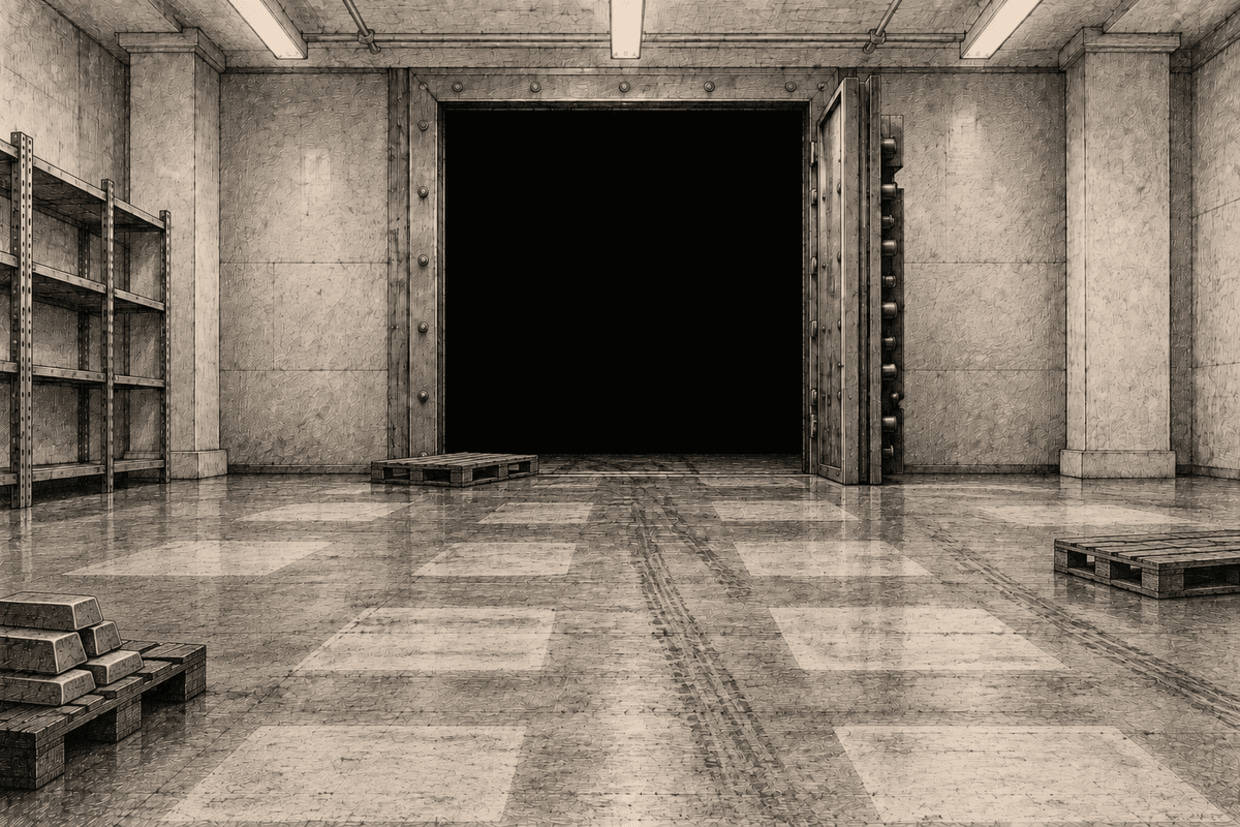
Everyone has seen the gilding of the White House, the gold going up where the cameras are. Almost no one has watched the other gold, the tonnes going quietly out of the vault under New York while the front of the house is being plated. The eye is held by the house of the few. The reckoning is in the vault of the many, and it is emptying.
Fourteen percent. That is all that remains of the world’s central-bank gold in the vault under New York, down from seventeen a year ago. France took its last hundred and twenty-nine tonnes home. The Dutch pulled seventy-eight out of Manhattan across a single spring and summer. Germany still has more than a thousand tonnes down there, and half its parliament has begun to ask what it is still doing on that side of the ocean. And the vault has been thinning for fifty years, from over twelve thousand tonnes at its 1973 peak to about six thousand now. Fifty years to lose the first half. The second half will not take fifty years.1
The room empties a pallet at a time. Pale squares on the floor where the weight used to stand. No announcement. The trucks come at night, and the squares multiply.
Say plainly what the emptying means. For the first time anyone can remember, the metal those governments hold is worth more than America’s word to pay them back. Set the promise on one side and the gold on the other, and they have chosen the gold. That is not a mood. It is a weight, and they are weighing it.2
A country can survive a war. A bad year. A bad policy. Even a bad man at the top. What it cannot survive is all of them at once, while the people who lent it the money walk to the door and the ones whose job was to break the fall have already been sent home. That is the road. What follows is the account of how it was paved, kept in the one language that does not flinch.
Seven months.
Somewhere a ledger is open. Not in anyone’s hand. The price of money keeps it, and it misses nothing, and it never crosses a line out. Every choice made in those seven months sits there with a date beside it, waiting to be read back.
At the end of February, before the first bomb fell on Iran, it cost America almost nothing to borrow. It costs more now than at any time since 2023. The world has simply raised the price of trusting this government, a little more each time it acts, and written down the reason every time.
They went to war beside the narrow strait a fifth of the world’s oil must pass through. It closed. A barrel leapt, eased when a ceasefire was signed in June, and leapt again in July when they tore the ceasefire up. They are tearing it a third time now. Tankers that used to cross freely wait for the American navy to walk them through one at a time. The most powerful military on earth has become a night watchman for oil.3
They built the largest wall of tariffs in a century on emergency powers, and in February the court pulled it down, ruling the President never had the power to raise them. The government must hand back what it collected. But the wall did not stay down a day. Within hours the tariffs were back under a balance-of-payments law from 1974, a ten percent surcharge that law allows for only a hundred and fifty days. When that ran out in July, a third statute was already waiting, and duties of ten to twelve and a half percent on some sixty economies took over the minute the old ones lapsed. Struck down under one law, the tariffs return under the next. They kept the trade war and lost the revenue that was meant to pay for it. Every cost. None of the money.
They cut taxes by trillions and said the tariffs would cover it. The tariffs came back smaller and raise a fraction of the promise, and the hole is not gone. The country borrows at crisis levels in a year with no crisis to blame, and the interest on what it already owes is the fastest growing line in the budget. The cushion that catches a falling economy was spent before the fall began. A man who once ran the economy for a Republican president said it without dressing it: there is no plan left in the drawer, and no one is writing a new one. And into that hole, a gift. Two thousand dollars a person, before the midterms, paid, he says, out of the tariffs, the same tariffs the court just struck down and that already cost the average household nearly as much as the check would return. A rebate of your own money, most of it clawed back by the tax that pays for it, promised to land the month before you vote.4
Then, with the strait already burning, they taxed Canada, the country that sells America most of its oil, its lumber, the power in half its houses. They put a levy on the energy that was never even at risk. Ottawa answered in kind. Every grocery bill now carries a little of that decision, which is why prices will not fall even when the barrel does.
And for a year they hollowed out the one institution built to steady all of this, then handed it a job no one could do. The man running it now has to prove he is nobody’s puppet, so he may raise the cost of borrowing into a slowing economy and an oil shock at once, for reasons that have nothing to do with either. The market has added a surcharge to every mortgage in the country for the simple fact that no one is sure the Fed is still free.
Recession, or the other thing.
A recession is the ordinary weather here. It comes every decade or so, it hurts, the tools come out, and in a year and a half the country stands up again.
The other thing is a depression, and a depression is when the tools no longer answer. This time the tools are in hands that either cannot work them or do not care to.
What the account points to is a long grinding slump with prices that will not sit down. Not the other thing. Not yet. But both of the usual exits have been welded shut from the inside. Rates cannot fall, because prices run too hot. The government cannot spend its way clear, because its lenders will not lend cheap anymore. It is the worst decade of the last century with far more debt stacked underneath it.
And the far door, the one with the real catastrophe behind it, is no longer locked. It takes one auction where no one comes to buy the country’s debt, and the rest follows. A year ago that door was not in the wall. It is what the empty vault is about. The people carrying the gold out are not forecasting the catastrophe. They are making sure they are on the far side of it when it comes.
Now walk it forward.
Six months out. The strait shuts for real, and no navy can escort seventeen million barrels a day through mined water. Fuel climbs, and fuel is what carries food, so the grocery line climbs behind it. Heating oil rises as the first snow falls. Borrowing costs break the level that freezes every house sale in the country. The savings people were told were safe give back a fifth of their worth in a season.
Twelve months out. The layoffs land, on the lag these things always run. The men who move freight, pour concrete, wait tables, build cars out of parts that cross a border six times before they are a car. Millions of them. And the net meant to catch them thins at the exact moment they fall into it, because the states cannot afford it and the federal money that used to help has gone to the people holding the country’s debt. The office you would call is one of the ones they closed.5 Unemployment 6 to 7.
Twenty-four months out. Two full years of this teaches people to expect it, which is the one thing the money men truly fear, because once it is learned it does not unlearn. Borrowing stays dear for good. The interest on the debt passes what the country spends to defend itself. The dollar keeps its throne and quietly loses the discount that came with sitting on it, a little more owed on every dollar, from here forward. And it is an election year, and the cure everyone reaches for costs money the room will no longer lend.
And it does not stop there.
It reaches the ones you have already met, and past them the renter with nothing to set against the climbing cost, the town with one employer or none, and in the end everyone who eats, or warms a house, or keeps a light burning, which is everyone.
None of it is written where people can read it. It is kept in the price of money, a ledger no one signs and no one crosses out, and the only ones reading it closely are the ones whose gold is already on the truck.
Which leaves the question the ledger cannot answer. Not what is coming. Not how the quiet money knew. Whether a country has ever done this to itself on purpose, and walked back out. That is the next part.
PART THREE
The Ones Before
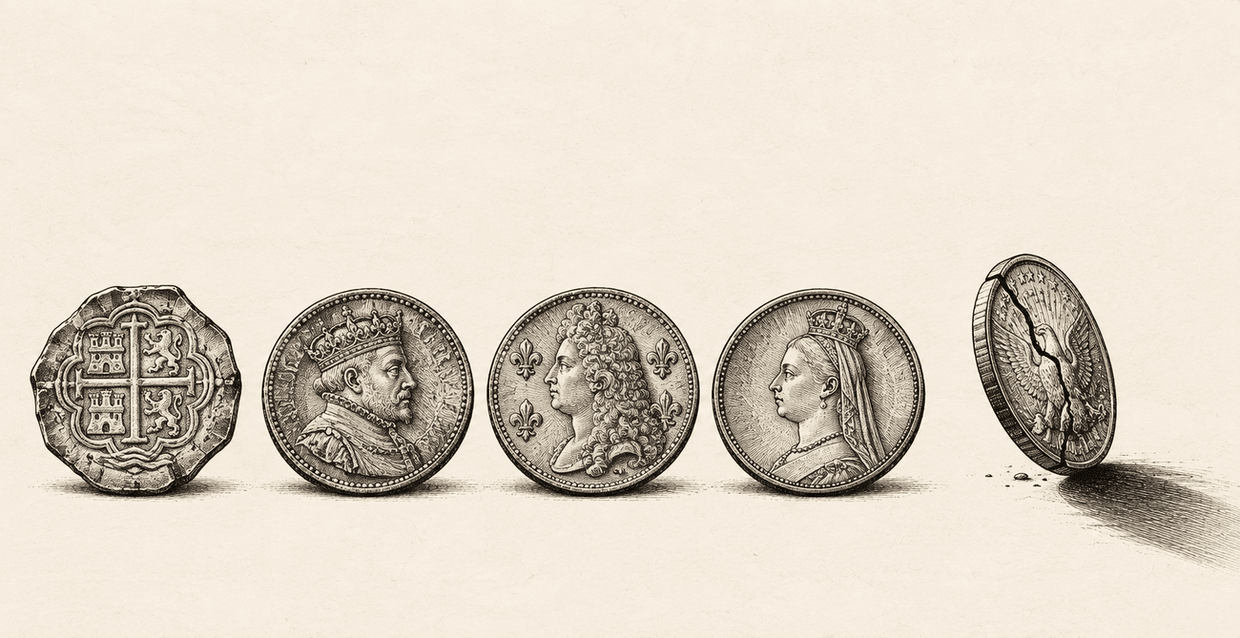
Four are history. The fifth has not landed.
By now a thought has arrived to comfort you, and it is worth naming, because taking it away is the whole purpose of this part.
The thought is this. Every great power has its evening. Rome had one. Spain, Britain. The wheel turns, the mighty come down, and in a century a student reads the fall in a single paragraph. If that is all this is, then it is only weather. Vast, impersonal, no one’s doing, nothing anyone could have stopped. You can close the page and sleep, because the tide goes out for everyone in the end and no one is to blame when it does.
So let us go and look at the ones before, and see whether this is their story or something that has never had a name.
Start with Spain, because Spain had everything. The silver of a new world came up out of the ground and into Seville, more money than any crown had ever held, enough to make an empire last forever. It paid instead for a century of holy wars and royal vanity, four bankruptcies under a single king, and a river of silver that ran through Madrid and out the far side into the hands of foreign bankers who did the real work of getting rich on it. And in the middle of it, over a question of faith and loyalty, Spain drove out the Moriscos, the Muslim converts who farmed its best land, hundreds of thousands of them, and those provinces did not recover for generations. It is the oldest version of sending home the people who keep a country running and wagering no one will pay to bring them back.6
But read Spain closely and the missing thing shows itself. No one in Madrid set out to make the crown’s word worth less. They squandered. They did not sabotage. The silver hollowed the empire by accident, and the men spending it believed they were building. Folly is not design.
England next, under a king who needed money and a marriage annulled at the same time. He broke with Rome and seized the monasteries, theft on a scale that funded a government. The cunning was in what came after. He did not keep the land. He sold it fast and cheap to the gentry, and by doing that he made a whole class of men whose fortunes now depended on the break with Rome never being undone, because undoing it meant giving the estates back. That is how you make a thing outlast you. You do not defend it. You manufacture people who cannot afford to see it reversed. If this rhymes, it should. The quiet fortunes banked this year, the pardons signed, the favors sold, are the same instrument. Owners of the damage, made on purpose, so that whoever comes next inherits their resistance instead of a clean slate.7
France a century and a half later, drowning in debt, much of it run up bankrolling a revolution across the ocean. There was a fix and everyone knew it. Tax the people who actually had it. It could not be done, because those people were the very ones the crown rested on, and no minister who proposed it survived. So nothing was done. The debt rolled forward toward a wall everyone could see, because no one inside the machine could afford to be the one who stopped it. The lesson is quiet and terrible. A country needs no plan to ruin itself. It needs only a problem whose one solution every powerful person has a private reason to refuse.8
Britain, within living memory. In 1956 it moved on Egypt and the canal, and its own banker, Washington, picked up the pound and squeezed, and Britain folded inside a week. The pound did not die that morning. Britain kept its place at the head of the money for years yet. What it lost was quieter and permanent. The deference. The benefit of the doubt the old holder of the world’s money had always been given, gone in an afternoon, and every loan a little dearer forever after for the loss of it. If a line from the last part felt familiar, keep the throne and lose what came with sitting on it, this is where it was written. It has happened once already, to the last people who held the chair.9
One case remains, and it is the one you will reach for hardest, because it wears the shape of rescue. Fifty years ago prices ran like this, an oil shock struck like this, a central bank the markets had stopped trusting like this. And the country came back. Surely it comes back again.
Look closer at why it came back. The tools were still in the building. There was a man to appoint who could break the fever, and a central bank still free enough to let him, and it worked, at the price of a savage recession honestly taken. That is the entire difference and it is not small. Last time the shock absorbers were still bolted in. This time they were pulled out, deliberately, by the same people now asking why the car will not stop shaking. The most reassuring precedent turns out to be the one that shuts the door hardest, because it shows the recovery was never automatic. It was a capacity. And the capacity is exactly what was dismantled.10
So walk back out with the whole shelf behind you and count what truly rhymes. Wealth that hollowed instead of built. Damage made to outlast the men who did it. A fix no one inside could afford to take. A seat that kept its shape and lost its worth. Each one true. Each one a piece. Not one of them the whole.
Because every power that ever lost the seat lost it the same way, and it is not this way. It lost the seat to someone stronger. The money drifted to the better balance sheet the way water finds the lower ground. The Dutch handed the role to the British and lent them the money to take it. The British handed it here. Slow decline to a rising rival is the oldest story there is, and it is survivable, and it is not what is happening.
What is happening has no clean precedent. No power that ever held the privilege of borrowing more cheaply than anyone alive has taken that privilege and spent it against itself, to settle scores at home, while its lenders stepped quietly toward the door. The others were pushed. This one is reaching into its own pocket.
That is why the comfort does not hold. An empire falling is passive, and slow, and blameless, and this is none of those. This is an empire being cashed. And the woman at the kitchen table is not living through the chapter that ends, in the version her grandchildren will read, with the country getting back on its feet. She is living through the first draft of a paragraph no one has ever had to write, because no one before was ever fool enough, or certain enough, to write it.
Bonjourhi Institute Analytics, Montreal
NOTES ON SOURCES
1. On the gold in New York. The Federal Reserve Bank of New York is the largest single custodian of monetary gold on earth, holding bullion for dozens of foreign governments. Its vault peaked in 1973, just after the United States closed the gold window, at over twelve thousand tonnes, and by 2024 held about 6,331 tonnes, roughly 507,000 bars, a slow and steady decline the Fed’s own history records. Germany is the clearest case: of its 3,352-tonne reserve, about 1,236 tonnes, roughly thirty seven percent, still sat in the New York vault as of early 2026, with open calls in the Bundestag to bring it home. The fourteen percent share and the specific 2026 repatriations by France and the Netherlands are the essay’s scenario, extrapolated from that real and quickening trend. Sources: Federal Reserve Bank of New York; Deutsche Bundesbank gold statements; reporting in The Telegraph and Mining.com, 2025 to 2026.
2. On the metal outweighing the promise. The European Central Bank, in The International Role of the Euro (June 2025), reported that gold had overtaken the euro to become the second largest reserve asset of the world’s central banks, about twenty percent of official reserves at the end of 2024 against the euro’s sixteen and the dollar’s forty-six, after three straight years of official purchases above a thousand tonnes. The text’s sharper claim, gold worth more than Washington’s promise to pay, presses that documented shift one step past what the ECB states. Source: European Central Bank, 2025.
3. On the strait. In normal conditions about twenty million barrels of oil a day pass through the Strait of Hormuz, close to a fifth of world consumption and roughly a quarter of all seaborne oil trade, with very little pipeline capacity to route around it. Sources: U.S. Energy Information Administration, Hormuz analysis; International Energy Agency.
4. On the tariffs and the dividend. On 20 February 2026 the Supreme Court held, six to three, that the President may not impose tariffs under the International Emergency Economic Powers Act, voiding the emergency-powers program from the start (Learning Resources v. Trump). Within hours the White House reimposed a ten percent surcharge under Section 122 of the Trade Act of 1974, which caps such duties at fifteen percent for a hundred and fifty days; it ran from 24 February to 24 July 2026, when Section 301 duties of ten to twelve and a half percent on some sixty economies replaced it the same day. Separately, since November 2025 the President has promised a tariff dividend of at least two thousand dollars a person, excluding high earners, to land before the 2026 midterms, though it would require Congress, and by the Yale Budget Lab estimate the 2025 tariffs had already cost the average household about eighteen hundred dollars. Sources: U.S. Supreme Court; Global Trade Alert; U.S. Federal Register; Axios and PolitiFact; Yale Budget Lab.
5. On the central bank as buyer of last resort. After the 23 September 2022 budget sent United Kingdom gilt yields spiking and forced liability driven pension funds toward fire sales, the Bank of England intervened on 28 September 2022 with an emergency, time limited program of long dated gilt purchases, purely to restore market function, and had unwound it by January 2023. Source: Bank of England, Financial Policy Committee and Quarterly Bulletin, 2022 to 2023.
6. On Spain. Mauricio Drelichman and Hans-Joachim Voth, in Lending to the Borrower from Hell (Princeton University Press, 2014), document that Philip II, carrying debts near sixty percent of output, defaulted four times, in 1557, 1560, 1575, and 1596, with much of the American silver passing through Castile to Genoese financiers. On the human cost, Eric Chaney and Richard Hornbeck, in The Economic Journal (2016), put the 1609 to 1614 expulsion of the Moriscos at roughly three hundred thousand people, Valencia alone losing about a third of its population, with local recovery delayed until the late eighteenth century.
7. On England. Between 1536 and 1540 Henry VIII dissolved the monasteries and threw roughly a quarter to a third of England’s farmland onto the market, most of it sold quickly and below value, the bulk gone by 1547. As R.H. Tawney argued and later quantitative work by Heldring, Robinson and Vollmer confirms, the buyers were largely the gentry, whose holdings rose steeply and who then held a direct financial stake in the Reformation never being reversed. Sources: Joyce Youings, The Dissolution of the Monasteries (1971); and Heldring et al. on its long run impact.
8. On France. France spent roughly 1.3 billion livres backing the American Revolution between 1778 and 1783, swelling a royal debt it could not carry. By the 1788 budget about half of all state revenue went to servicing that debt, and on 17 August 1788 the treasury began paying creditors in paper notes, forcing Louis XVI to call the Estates General of 1789. Reform failed because the one real remedy, taxing the privileged orders, was blocked by those same orders. Sources: Thomas Sargent and Francois Velde on French finances; standard accounts of the 1788 to 1789 fiscal crisis.
9. On Britain. Diane B. Kunz, in The Economic Diplomacy of the Suez Crisis (University of North Carolina Press, 1991), shows how in November 1956 the United States, Britain’s principal creditor, let sterling come under pressure and withheld support at the IMF until Britain agreed to pull out of Egypt, which it did within days. Sterling kept its reserve role for years, but not the deference that had come with it. Source: Kunz, 1991.
10. On the last recovery. Paul Volcker, appointed to lead the Federal Reserve in August 1979, drove the federal funds rate toward twenty percent and held it through the severe recession of 1981 to 1982, when unemployment reached 10.8 percent, until inflation broke. The text’s point is that the cure required an appointment and a central bank independent enough to use it, tools that were available then. Source: Federal Reserve History, Recession of 1981 to 82.
BONJOURHI! INSTITUTE ANALYTICS · MONTREAL · 2026